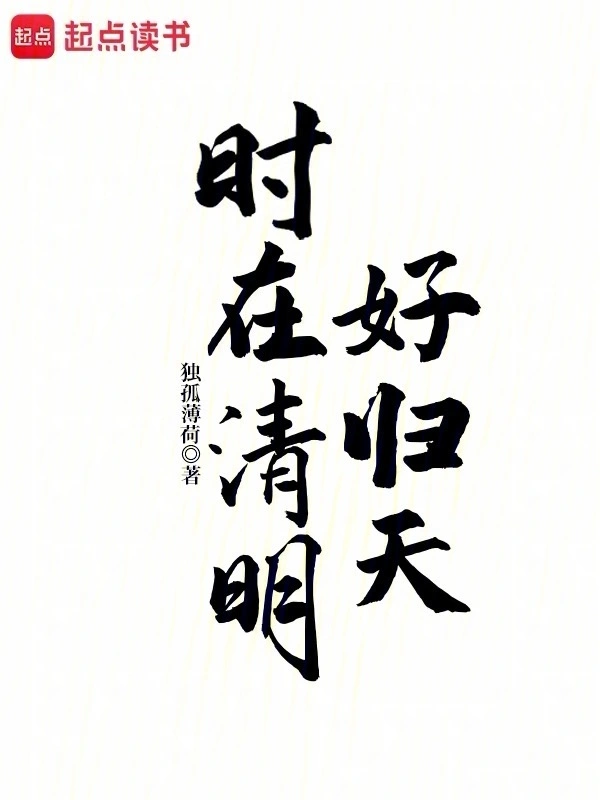
On Qingming, It's a Good Day to Die
时在清明好归天
- Status
- Ongoing
- Length
- 300k Words
- Genre
- Historical
- Audience
- Male
- Subgenre
- Song-Yuan-Ming Dynasties
- Updated
- 3d ago
- Source
- Qidian
Stats
98Chapters
433Votes
4.1kRecs
16.9kFans
Tags
Honours
Synopsis
In booklists 1
Readers also read
 Germany: 1914
 A Literary Master in Ancient Greece
 Seizing the Direct Descendant in the Red Mansion
 Great Ming: His Father Is Useless, So He Must Summon the Founding Emperor
 Please Call Me Your Majesty, the Tsar
 Leader
 Germany, 1903
 Popularity Above All: My Art Style Is Way Too Eccentric!
 I Just Went to College and Was Laid Off. the Counterattack System Is Coming.
 A Dream of the Beiyang Fleet
 Golden Terrace, Han Moon
 Taipingji
Come on
Getting better
He looks like the descendant of an old friend, Shino Saburo, who has a filthy reputation and is inhumane.
Judging from the writing style, it looks like an old friend. I hope I won't suffer from the literary youth disease again this time, and I won't compete with readers this time. I won't be dissatisfied with too many subscriptions.
It is easy to write the history of the Ming Dynasty into some parts of the braided drama of the Qing Dynasty❗
"Slaves": Eunuchs in the Ming Dynasty called themselves "slaves". "Emperor": The Ming Dynasty rarely called the emperor this way, but it was commonly used in the Qing Dynasty. "son": The Ming Dynasty princes did not call themselves this in front of the emperor. "Ai Qing": Commonly used in the Qing Dynasty, but the emperors of the Ming Dynasty rarely called officials this way. "Memorial, Zhezi": This only appeared in the Qing Dynasty. Although it is the same document as the memorial, the difference is huge. "Futai, Fantai, Zhentai": These are the names of the Qing Dynasty. Those with "Tai" are all the names of the Qing Dynasty and were not used in the Ming Dynasty. "Master": In the Ming Dynasty, only top nobles and first- and second-rank officials were allowed. State and county officials were not called "Master". "Sir": In the Ming Dynasty, it was only used for first- and second-rank officials, nobles, and elders of the father's generation. Prefecture and county officials below the third or fourth rank are not called adults. "Prince": In the Ming Dynasty, people rarely addressed princes as "Prince". This was commonly used in the Qing Dynasty. "My King": This was also a commonly used self-proclaimed name in the Qing Dynasty. "Bank Notes": Only available in the mid-Qing Dynasty. At the end of the Ming Dynasty, only money orders circulated among local acquaintances. "Please say hello": The etiquette of bannermen in the Qing Dynasty. This etiquette did not exist in the Ming Dynasty. "Eunuch": In the Ming Dynasty, only senior eunuchs had official positions, and ordinary eunuchs were called chamberlains. Only in the Qing Dynasty did all eunuchs be collectively called eunuchs. "Wejia": Most eunuchs in the Ming Dynasty called themselves "I" to their subordinates. In the late Qing Dynasty, the name "Wejia" began to be used. "Military Gate": the name used in the Qing Dynasty to address generals such as admirals. In the Ming Dynasty, civil officials such as governors and governors were called governors. "Kneeling Ceremony": Ming Dynasty officials temporarily knelt down when presenting to the emperor and stood up immediately after the ceremony. Subordinates do not easily bow down to superior officials. In the Qing Dynasty, emperors often knelt down to listen for a long time, and subordinates also generally knelt down and knelt down when meeting their superiors. There are also many words commonly used by banner people after the Qing Dynasty: Leave here, leave, errand, be on errand, return errand, master, reward some future, dare to love, grace, ... Come, ... Be panic, master , stir up, weigh, send, dilly-dally, get rid of, let's, laoshizi, sweet pastry, alley, see the sky, noon, bashful, scold, wait to see, place, spread, in vain, lose face, cool down, estimate, make fun of , quick, carefree, no way, wilted, accurate, blind, coincidence, ordinary, today, tomorrow, yesterday, the sun, body, follower, scold, rejoice, toss, make do, miss, talk about, see, bump into Nail… {"NickName":"Supervision and Restriction","UserId":406440657}
Ah, here comes the cuckold professional, who is more lenient than a lawyer but strict with a green hat.
I feel like the main line is a bit messy and there are a lot of loopholes.
First: The so-called gangsters are not just gangsters. In the late Ming Dynasty, the productive forces could not support many out-of-work gangsters who could fight. It means that there are dozens of core members of modern underworld gangs, and most of them are peripheral personnel. The big bandits of the Republic of China could have a well-trained core of hundreds of people (who could compete with the regular army). They were all famous and registered, and it was impossible for the bandit leader to be an ordinary soldier. Whether it is a gangster or a bandit, its organizational form will not be like an army with laws and regulations. Several bosses control their own troops, and the big boss controls the most people. The gangs attracted by the big boss's reputation are also led by their own bosses. It is impossible for a gang to have only one core like in the article. The training level cannot be so high. They will form a queue at the sound of a whistle and the marching queue will not be scattered. This is at least the training level of the modern army. The author greatly strengthens the so-called power of fighting. Second: The protagonist lacks initiative and does not develop core armed forces at all. All military actions are based on the author's tricks (for example, letting soldiers stand guard can make Liu feel elite, and he is just an old thief. A water who was originally an ordinary person dares to actively block Liu Zeqing, who is armed with his servants without training or war. If he has the courage, he will be selected as the grain chief?), The protagonist is more like a native than a time traveler. The protagonist's team does not rely on strict organization and a combination of kindness and power to establish the protagonist's leader status, but the vague relationship between the township and the party. But now the protagonist is acting more like a strategist than a leader. The protagonist has not clearly defined his status as the leader of his gang from the beginning to the end. He does not take the initiative to develop his own direct troops and only takes orders from him. To put it bluntly, why doesn't the Township Party choose Jia to be the leader? They are all Township Party members anyway, and Jia is still brave and powerful. Directly leading the army will gain prestige over time, and the protagonist's position in the team is more about contacting the Ming court and other teams to obtain resources. He has the same role as a special correspondent, and can still lead in the early stage. In the later stage, if the author does not resort to castrating the ambitions of the supporting characters, the protagonist will definitely be marginalized.
You know you have a bad reputation, so you change your vest?
The protagonist is too slippery
After reading twenty or thirty chapters, the protagonist seems to be slippery and has no subjective initiative. It's been a month or two and I haven't had anything else to do. I don't know how to train the people under my command. They are so loose that they can't even stand in line. Now that I have an official position, money and food, I don't know how many more people to recruit, or the original dozens of fellow villagers. I keep making all sorts of complaints, relying entirely on the aura of the protagonist to enjoy myself. In these troubled times, I didn't see him showing any sense of urgency. It was like playing a game, as if he would die if he died.
I don't know whether I should continue reading or not.
I've read Chapter 14 so far. The writing is good, but it's very confusing. First, there is no main line, and the positioning of the protagonist is not clear. There is no introduction to the protagonist's modern abilities, and the reader has no sense of identity. After staying in Weizi in Hongze Lake for so long, I didn't realize that modern people have not changed or protected themselves at all. It gave me the feeling that they were just here to be outsiders. He Tengjiao was not allowed to be the county magistrate, just to get a boss? You have to unite at every turn, don't fight with each other, join a group to deal with it, etc. I feel like your political literacy is 0? You don't have a main line yourself, and you still want others to follow you? Do you think you can't live without being a little brother? Second, there is no idea of active development. In the troubled times of the late Ming Dynasty, there were grains from the canal and money and grains found from large households, but the number of people could not change? I really admire it. I can only say that maybe the author's setting is that the protagonist will not be in any danger.
Run quickly
As a time traveler, history, technology, and politics are all useless, and I am more indigenous than indigenous people.
My writing skills are very poor. After reading the first few chapters, there are only dialogues between a few people, no scene descriptions, no character descriptions, and no facial expressions. It's so dry that I can't stand it anymore, it's so boring.
Is the protagonist schizophrenic?
I have been thinking about where to go and cast myself, and I have no loyalty to the Ming Dynasty. As a result, he was sent to Xiangcheng. The enemy troops had not yet arrived, so he thought that if the food for the defenders was insufficient, they would start cannibalizing people to use as military rations. No, when the time comes, the worst you can do is surrender in Kaicheng. As for doing this?
Who is changing the vest? The writing style of the introduction is a bit familiar, but it won't be the same casual and sloppy writing style.
Read the comment section and say you love writing about cuckolds? I'll just say that I am an old pastor who writes cuckold articles.
Just looking at the cover, I have an ominous premonition, like someone who likes to feed readers the finale. Although the writing is okay, he always likes to disgust the brothers. It's hard to describe in one sentence.
It seems that the author does not want the protagonist to fight for world supremacy. Ah, now there are two choices. One is that the author follows history and becomes a slave, and licks his face and becomes a slave. The second is to follow another person to conquer the world. If you choose one, I have nothing to say. If you choose two, who can the protagonist help? Assist those warlords in history? Or he went to the south to support Nanming. Just the protagonist's current humble situation. Then if you write about other forces fighting for hegemony in the future, it is better to focus on those people as the protagonist from the beginning. From the beginning to now, this protagonist has been described to me in one word: Porcelain Hammer
The author continues to be himself, and we readers should also be ourselves. The road is overturned, and each side goes his own way.
Sun Qinhu was granted the title of Marquis, and Shi Ji was granted the title of Uncle.
It is extremely embarrassing. A time-traveler, with foresight and foresight, supported King Fu to ascend the throne, but in the end his achievements and strength were not as good as that of Sun Qinhu, a local ruffian at the same time. His grandmother might as well have been hanged at the gate of Nanjing...
Is the Wen Qinggan who writes in primary school students wearing a vest again disgusting?
Damn it, are you a human being? Then don't subscribe
Just look at the update time and you will know that it is filthy and inhumane. The French book was updated at 6 o'clock and this book at 7 o'clock.
It looks disgusting. Judging from the Red Mansion, the protagonist should be a counselor, the kind who will be killed in the end. Purely just feeding everyone shit
Can the author tell me whether the protagonist can lead a team to conquer the world by himself, or should he be a dog for others?
Are you an old author? Otherwise, this bit of data could be held up by the editor on a small speaker.
Looking at the cover and name, they look like they were written by someone else 🙂
It doesn't matter to me whether the French book is of the same mind as others. The key is that the seated buttocks are always on the labor insurance side. In any era, we must be at the conservatism table
At first glance, the title and cover look so filthy and inhuman
Dream of Red Mansions is not a completely Qing Dynasty setting. At least Baoyu is not a braided person
Inhumans are still reading and writing about France right now.
At present, I feel that the protagonist may be acting as a dog for others. But I can't figure it out. When the author writes about the man named Qian, he always feels that he is special. I guess he might be the emperor in the end.