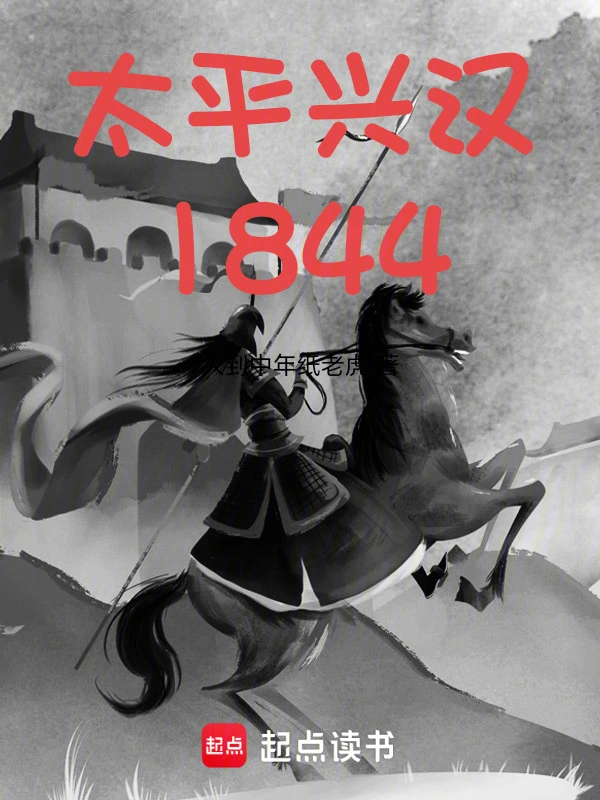
Reviving Han Prosperity, 1844
太平兴汉1844
- Status
- Ongoing
- Length
- 1.5M Words
- Genre
- Historical
- Audience
- Male
- Subgenre
- Qing & Republican Era
- Updated
- 17h ago
- Source
- Qidian
Stats
Tags
Honours
Synopsis
More by this author
In booklists 4
Breaking Out: My Top Booklist
Niche gems with the potential to break into the mainstream. Let's give them a big thumbs-up.

Off-the-Beaten-Path Picks: Hidden Gems Outside the Rankings
I lean toward niche hidden gems. They may not be popular, but every one is top quality. If you like the list, leave a like to support the authors. Thanks!
The Reading Drought Relief Station!
Every book on this list has been carefully selected. Many include experiences drawn from the author's own life. I don't like simplistic stories. I read mainly to broaden my experience and discover different worlds. Urban and historical novels test an author's life experience; without enough of it, it's hard to write a story with real flavor! I've read hundreds of novels, and they've ruined my prospects. Now I want nothing at all! I've also developed some opinions of my own about fiction. Thanks
Books I Like to Read
It may be replaced, it all depends on how the novel is written and updated.
Readers also read
 Seizing the Direct Descendant in the Red Mansion
 A Literary Master in Ancient Greece
 Great Ming: His Father Is Useless, So He Must Summon the Founding Emperor
 Germany: 1914
 Simultaneous Transmigration: Is Everyone Starting Out in Prison?
 A Charcoal Burner in the Qing Dynasty, 1848
 The Winds of 1898: Building a Warlord Empire in the Nanyang
 A Great Industrial Nation, Starting with a Fake Student Abroad
 A Dual Status Panel Descends into the Abyss, and the Assassin's Potion Is Right at the Entrance
 Taiping Heavenly Kingdom 1854
 I Became Emperor in Africa
 Transmigrating to 1570: The Rise of South America
 Tang Ergui Returns to the Vast Sea
 The Han Dynasty Comes from Southeast Asia
 The Wind Rises in Nanyang 1784
Drug test post
I saw that this author was an acquaintance, and I had read a book written by him about Gui Yijun before. That book is very good. The Guiyi Army only needs to use Wushuang Kill to kill. It does not require complicated understanding and thinking, and it is easier to control. The writing style is very good and the story is quite strong. The poisonous point is that he is quite shallow and stubborn in politics, a bit like diode powder. He has a set of solidified things in his mind, which have been religiousized by him. All new knowledge that follows is selectively absorbed and selectively believed. Anything that can strengthen this set of logic is true, and anything that is detrimental to this set of logic is false. This book's understanding of the Manchu and Qing dynasties can basically be summed up in one sentence: It's all the Manchu and Qing dynasty's fault, oh, the Manchu and Qing dynasties are so bad. Today's historical articles do cater to the needs of popular fans, which is understandable, but compared with articles that truly reflect on the society/class/history of the late Qing Dynasty and have insights, it is like a normal article suddenly interspersed with a few passages of reading for young people, which is inconsistent and confusing. If you see someone with private goods, jump away. The reading experience is still guaranteed. If you really can't avoid it, just abandon it if you feel numb.
The author has a problem with the introduction. During the Manchu Qing Dynasty, basic schools such as social studies were destroyed, and a large number of books were destroyed. There were 400 million people, and the literacy rate was probably only a few hundred thousand. Most of them were children of the Eight Banners. Let's put it this way. It took twenty years from the Westernization Movement to 54 to build primary schools. , Why is it said that Li Hongzhang, Zhang Zhidong and others are meritorious, because these Han officials are building schools, Wang Jing has a good saying, you have to use religious forms to guide the illiterate people. In 1860, they were all illiterate. You don't need to be like the Tianping Kingdom. The people under you are illiterate. How can you organize them?
I hope the Taiping Army won't be written too poorly.
They were hacked too much. Although they could not save China, they used their flesh and blood to pave the way for the future Chinese revolution, so the monument has its place, just like grass and grass, as bright as the stars.
A courageous author writes about the late Qing Dynasty and the Republic of China at the starting point.
A hundred chapters have passed and there is still no objection. It is true that the scholar cannot rebel for ten years. Is it okay to say hello in a historical novel? Otherwise, I will really feel stupid after reading it.
It's so good. Others write about the Taiping Heavenly Kingdom. They only talk about the peasant uprising and how individual heroes are. They never talk about ideological issues, only about military affairs. They don't talk about education, just about development. The level is too low.
I think the beginning of this Taiping Heavenly Kingdom novel is quite good.
1. I have also read several novels with the background of the Taiping Rebellion. Most of the conflicts between natives and guests are attributed to land conflicts. This book is different and writes the root cause 2. The analysis of historical figures and descriptions of historical events are obviously more detailed than what I have read before, including some uprisings against the Qing Dynasty and how many national heroes. I like it very much according to the details I hope it can be updated soon, so that the pace of the uprising can be steady and fast.
The Taiping Heavenly Kingdom killed many people all over the southern city. After the Taiping Heavenly Kingdom, the Qing government could not control the south, and it was created by the revolution.
The Taiping Heavenly Kingdom is too unpopular and difficult to write about. I remember that there were many books about the late Qing Dynasty and the Republic of China 10 years ago, such as "The Madman of the Far East", "Warlords of 1911", "Great Power Shareholders", "Rebirth of the Red Star Legend"... Now Qidian has been removed from the shelves
Not only the Taiping Heavenly Kingdom, but also a lot of uprisings
I hope they won't join forces with Hong Xiuquan to create the Taiping Heavenly Kingdom.
In fact, the Taiping Army had some religious attributes in the early stage (I think it was more of a test of obedience), but in the later stage, the pragmatic and powerful Dongwang was always in power. But there is no problem that the whole process is a complete feudal regime (no core aristocratic families have ever joined, and the underlying design is still very backward, and it is also suitable for peasant uprisings such as men's and women's camps). In fact, the Taiping Army was a sitting bandit and a wandering bandit that were stronger than most peasant uprisings.
The Taiping Rebellion was essentially a cult catastrophe, but it did greatly shake the foundation of the Qing Dynasty's rule. The failed Taiping Rebellion is the good outcome. If it succeeds, the roots of the Chinese nation will be uprooted. After all, it is essentially a group of people using cults to wrap up the people to seek power and personal gain. If it succeeds, China will enter a religious theocratic country, where gods will override all rights. It denies the concept of man's victory over heaven and keeping a distance from gods, which is in conflict with Chinese thinking for thousands of years.
The author is quite iconic
I always feel that this protagonist is a very arrogant person. When he becomes a symbol, he even frantically builds a memorial arch. After explaining it for a while, he is very ambitious and bitchy. This is really well written by the author. It is really rare to see such an arrogant protagonist.
Nice
The minimum intelligence of this book is still online, and the supporting characters can be polished. There is also the Han nationality narrative rather than the unity maggot narrative.
You can go to Japan and bring back the Ten Diaries of Yangzhou. Many Han officers in the New Army in the late Qing Dynasty read this book and inspired their national consciousness.
Author, do you have strange sexual fetishes? I have opened three books, and I like second-hand copies of each of them.
After reading this, I have a better understanding of the situation in the late Qing Dynasty. I can only sigh that the Qing Dynasty is so lucky. Originally, Daoguang did have a state of subjugation. Unexpectedly, the Taiping Heavenly Kingdom, Europeans, and southern Han gentry were wrestling with each other. The strengthening of the status of Han officials actually helped them survive.
The author released a new book to support.
I didn't expect that I was the first to post. Excellent author, the first few are all fairy-level works. Considering that no one wrote particularly good novels during the Taiping Rebellion, it is difficult for people not to support them.
Without the modern industrial revolution, the reputation of the Qing Dynasty would not have been so bad. At most, it would be on the same table as the Yuan Dynasty. But it is precisely because of the modern history of humiliation that people can see how much the Qing Dynasty's aristocracy dragged China and how deeply they guarded against the Han people. It is a blessing to have two or three achievements in mobilizing the potential of the whole country. It's not wrong to think that people who are not from my race must have different minds.
In a sense, Mancheng is a good thing for Dasuo.
If you want to conquer a certain city in the future, you only need to fill the city with large ropes. Not only will it make you rich, but it will not accidentally hurt the people, and it can also encourage uprisings, just like the granary of the Sui Dynasty.
The author's strengths and weaknesses are obvious. It is reasonable that the book is not popular enough. The author's strength is that he can indeed write reasonable historical novels that are in line with the times, but his weakness is that the author himself is a bit of a literary youth. In fact, he is similar to the author of the late Song Dynasty. He will deliberately write some extremely mentally retarded "taken for granted" plots in historical novels for the sake of emotional explosion, and thinks that his writing method is also reasonable.
I can't stand it, I can't stand the weakness of the protagonist.
This book feels a bit like the author's masterpiece. It's strange why the results are not good. I almost want to vote for the author
Strangeness
I feel like this is a breakthrough in Tiger's level, and it's like he's enlightened. But the results don't seem to be good.
He's so arrogant. He could finish it in one chapter, but if he drags it on for three more chapters, there will be a bunch of idiots in the comment area, saying that it's for the sake of being reasonable. It's true that it's reasonable, but you can't be so arrogant.
There are more than 400 chapters. There are thousands of monthly tickets in the past few months. There are no restrictions on speeches. Why are there only more than 100 discussions? Bake your votes?
It's just that the pace of progress is a bit slow. After watching it for a whole day and night, there was no uprising, and there was no introduction of Hong Qing to express public opinion. It was frustrating to watch.
When will Tiger publish another overseas novel? It has written about Central Asia and Nanyang. Can you consider Northeast Asia for the next one? I think this subject is very good. It can defeat the Jurchens in Jianzhou and eat Asahi, and finally the Han people can enter the customs. This theme feels very new and interesting and will be popular. I like Hu's books very much and hope that Hu will achieve good results.
I looked at the chapter table of contents and found that the foreshadowing was too long. The Jintian Uprising only started in Chapter 270. It's really not my cup of tea.