


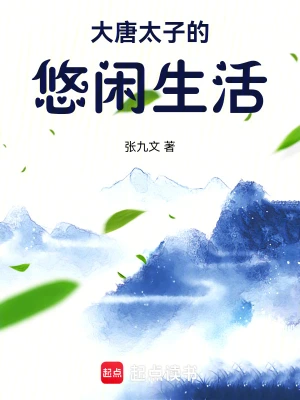
The Tang Crown Prince's Leisurely Life
大唐太子的悠闲生活
- Status
- Completed
- Length
- 2.3M Words
- Genre
- Historical
- Subgenre
- Jin-Sui-Tang Dynasties
- Updated
- 7mo ago
- Source
- Qidian
Stats
Tags
Synopsis
More by this author
In booklists 34
Explore more →
Historical Fiction Reading List, Primarily History
Mostly historical fiction. The scale goes up to ten stars, but even a one-star book is worth a look.

Heavenly Secrets Library
A few books I've read and thought were pretty good

Smart Male Leads
The male leads have brains

Fun, Lighthearted Reads, Quality Guaranteed
Books that are definitely good, with something for every taste.
Smart Protagonists, Essential Reads for a Book Drought
Smart protagonists and engaging plots. Good for a reading slump. Single-heroine stories, slice-of-life, farming, development, and management. Plus a few other good reads.
Historical Archives
The river of history flows ever onward; across a thousand-year scroll, heroes and events meet amid changing fortunes.
The Treehouse Book Nook
I save books that suit my taste and share them with like-minded readers. I’ll add older books now and then, whenever I happen to remember them. =_=b
---Modern Urban Fiction---Worth a Read (In My Opinion)
Books I personally think are worth reading. Everyone's life is different, no one is perfect, and no book is perfect.


Books I've Read Over the Years
A record of my 20 years reading web novels. I read plenty of pirated copies, and some I never finished, while others I reread several times. I was poor back then. I've forgotten the titles of many books I read and can't find them anymore. I'm writing down some personal thoughts as a way to remember, and to thank all the web novel authors I've read. Their work filled my youth and even helped improve my Chinese grades.
My Library
Private library
I'm Seriously Out of Books to Read
An unofficial reading list
Random Musings
Liriliriliriliriliri
Completed Books
Completed books only
I'm Just a Hero for Fun
I only keep track of books I’ve paid to read, enjoyed, and wanted to keep following. The scores don’t really mean anything. I just have a habit of putting a number to things. Whether a book is great or terrible, I give it a 5. Every book I share is one I once thought worth paying to read. Whether it suits your taste is up to you, not me.
A Happy Reading List for Night Owls
Simply put, these are books I like
Novels I Think Are Worth Reading
Novels I've read, across all kinds of genres


Old Favorites Vs. New Buds
This list includes old favorites and promising newcomers. They're all books I've read myself or heard about from friends. If you haven't read them, give them a try. I don't think you'll be disappointed. The list is updated from time to time. I'll add promising new releases and older books that have quietly built up a lot of chapters. If you think the list looks good, click Follow on the right. Thanks! If these books aren't to your taste, just move along quietly. Please don't bash them.
Completed Novels I've Finished
All completed, so you don't have to wait for updates and can read them in one go. Quality guaranteed, since I've read them all, right?

Bold Yet Refined, Refined Yet Bold
Is it possible I made this reading list just so I could send flowers!!!
A Decade on Qidian
Books I personally find enjoyable and can keep reading
A Bookworm's Treasures
That’s all there is to it. Might as well go have some tea.


For My Own Reference
So I can find them again and not forget
A Reading List from a Veteran Bookworm of Over a Decade
Going through the great books I've read over the years


A 16-Year Bookworm's Personal Collection
As long as I’m happy
Readers also read
 Chronicles of the Red Mansion
 In the Ming Dynasty, the Days When the Cows and Horses Turned Over
 The Corpse Plague of 1916
 An Important Town in the Residual Tang Dynasty
 League of Legends: I Just Turned Pro, and You're Saying the League Is Dead?
 The Ming Dynasty's First Brother-in-Law
 The Fierce Minister of the Great Song
 Simultaneous Transmigration: Becoming a Legend Before the Story Begins
 Starting with Saving Manchester United
 In the Hongwu Era, Starting Out as a Rebel
 Let the Tang Dynasty Soar
 1978: I Got Into Harbin Institute of Technology
 The Ming Crown Prince's Entrepreneurial Journey
 The Qin People's Leisurely Life
Reader comments 45
Google Translate
Shuwang's writing is good, but the historical details and technology still need to be worked out.
The first is the problem of papermaking. The problem lies not in papermaking technology but in cheap raw materials. Green paper uses bark as raw material, and labor costs remain high. Later generations used bamboo as raw material, supplemented by solar ultraviolet light for one year to decolorize and improved paper medicine, so that bamboo paper can be as white and flexible as green paper. Remove the drying and bleaching and change the lime into plant ash to make cheap bamboo paper, and change the bamboo into rice straw to make toilet paper. Secondly, in terms of the details of life, many things do not match the times. For example, soy milk, in the Tang Dynasty there were such recipes as (bean paste, bean paste, bean soup, bean juice, bean paste and bean porridge). You may not be unable to understand what soy milk is. After all, tofu was invented in the Han Dynasty. The second is the abundance of material resources. As the largest landowner and the largest violent group, the Tang royal family could not be frugal just by patching up. Washing clothes more times is already very frugal. A serious emperor has a weaving bureau with 1,800 people, and the clothes are thrown away after wearing them once. Apart from anything else, how do you wash fragile products like silk or gold embroidery? Then there is the advantage of modern people. The ancients were not stupid. Of course, this must be made clear. Don't they know that marrying later and having children later has a higher survival rate? I wonder if drinking hot water is comfortable? You can't do it unless you don't want to. What modern people take for granted is a luxury for ancient people who lacked productivity. Not to mention anything else, just to drink hot water, you need to have fuel and utensils. This is a luxury for a poor person who has passed down a broken bowl for three generations and only has one pair of pants for his family. The iron hatchets that can be bought for tens of thousands now were only available to wealthy families at that time, and they were mostly bone, wood, and stone tools. They even eat agarwood (soybean leaves) as a complementary food. To expand productivity, one is shelling (soil hulling) and the other is separation (grain windmill), which can save at least four or five manpower. In fact, the best way is to industrialize, starting from coal fuel to briquettes to coke to blast furnaces to regenerators to reverberatory furnaces. High fuel and material breakthroughs play out with point-to-point coal-steel composites. Next, with the development of industrialization, new energy technologies and advances in material science continue to break traditional production bottlenecks. For example, the promotion of efficient coal-burning technology enabled the widespread use of coal, gave birth to the steam engine, and then drove the mechanized production of textiles, metallurgy and other industries. At the same time, the rise of the steel industry, especially the improvement of steelmaking technology, has not only improved the quality of steel, but also significantly reduced production costs, allowing for large-scale construction of infrastructure such as rails, bridges, and machinery. In addition, scientific and technological progress has gradually penetrated into people's daily life. For example, the ceramic industry has introduced high-temperature kiln technology, making porcelain more exquisite and durable; various new agricultural tools and irrigation equipment have appeared in the agricultural field, greatly improving farming efficiency; and in home life, convenient hot water supply systems have gradually replaced the arduous manual water boiling method, allowing more ordinary families to enjoy the convenience of modern life. More importantly, with the popularization of education and the spread of scientific and technological knowledge, people's life concepts and health awareness are also constantly improving, and they pay more attention to hygiene and quality of life. Modern concepts such as late marriage and late childbearing have also begun to be accepted and practiced by some people. All these changes are due to the leap in productivity and social progress brought about by industrialization. It not only reshaped the social structure, but also profoundly affected every individual's lifestyle and values. Industrialization will also have a profound impact on human lifestyles, especially the concept of time and social management systems. The process of industrialization is not only an innovation in production technology, but also an overall transformation of the operating mechanism of human society. Before industrialization, the rhythm of people's daily lives was often closely linked to the natural environment, and the measurement of time relied on relatively crude methods such as sundials, hourglasses, or burning incense. However, with the demands of industrialized mass production, especially the strict scheduling requirements of railway transportation and factory production, the accuracy of time must be greatly improved. The precision development of the watch manufacturing industry has made it possible to race against the clock. People no longer arrange their activities according to the vague time period of "a cup of tea" or "a stick of incense", but strictly follow the time indicated by the clock. Time has since become an indispensable quantified resource in industrialized society. The specialized division of labor and assembly line operation model of industrial production make large-scale collaboration necessary, which puts forward higher requirements for organizational management systems. The transition from traditional family handicraft workshops to the management model of modern enterprises means the subdivision of workers' roles and the standardization of production processes. The birth and development of a series of modern management concepts and technologies such as Taylor's scientific management theory and Ford's assembly line production model all reflect the inherent need for efficiency pursuit and collaborative cooperation in the process of industrialization. This kind of grasp of time accuracy and professional management methods have not only profoundly changed people's working habits, but also subtly affected all aspects of social life, including education, transportation, communications and other fields, ultimately promoting the entire social management system to become refined, standardized and efficient. With the development of socialized mass production brought about by industrialization, modern society has formed a more complex and orderly social structure and management system, which has greatly promoted the progress of human society.
Qin Fusu (eldest son - committed suicide) Han Dynasty Prince Min Liu Rong (forced to commit suicide) Han Dynasty Prince Liu Ju (suffering from witchcraft - committed suicide) Han Dynasty Prince Gong of the East China Sea Liu Qiang (his biological mother was deposed, he resigned, and died of illness) Emperor Wen of the Eastern Wu (pursuit of honor) Sun He (granted death) Sui Dynasty King Yang of Fangling Yong (false imperial edict and grant death) Tang·Yin Prince Li Jiancheng (Xuanwu Gate Incident) Tang·Min King Li Chengqian (died in exile) Tang·Yan King (posthumous title) Li Zhong (granted death) Tang·Yizong (posthumous title) Li Hong (died violently) Tang·Tang·Zhanghuai Prince Li Xian (forced to commit suicide) Tang· Jie Min Li Chongjun (failed in the palace coup and was killed) Tang Crown Prince (pursuit of honor) Li Ying (imposed to death by corruption) Tang Dynasty Crown Prince Zhuang Ke Li Yong (died violently) Liao Dynasty Prince Zhaohuai Yelu Jun (murdered and murdered) Yuan Prince Zhenjin (died of worry) Ming Dynasty Guangzong (pursuit of honor) Zhu Biao (died of illness) Ming Dynasty Zhu Wenkui (disappeared) Ming Dynasty Xianmin Prince Zhu Cixang (case of true and false prince) Ming Dynasty Zhu Cijiong (the third prince of Zhu was languished or beheaded) Qing Dynasty Yinreng (died of claustrophobia in confinement of two wastes and two establishments) Broadly listed, throughout ancient history, the scrap rate of the princes of the Tang Dynasty was unparalleled. It was not easy to be a leisurely prince in the Tang Dynasty. Taizong's 14th son 1 Li Chengqian (deposed as a commoner, died in exile) 2 Li Kuan (died young) 3 Li Ke (died in prison) 4 Li Tai (conflicted) 5 Li You (given death) 6 Li Min (deposed as a commoner, died in exile Died) 7 Li Yun (conspired to rebel, committed suicide) 8 Li Zhen (failed to rebel against military forces, committed suicide) 9 Li Zhi (died well) 10 Li Shen (killed for rebelling against military forces) 11 Li Xiao (died young) 12 Li Jian (died young) 13 Li Fu ( Good death) 14 Li Ming (forced to commit suicide) Li Zhi's 8 sons 1 Li Zhong (conspired to commit suicide) 2 Li Xiao (died early) 3 Li Shangjin (committed to commit suicide) 4 Li Sujie (falsely accused and hanged) 5 Li Hong (died suddenly during a palace banquet) 6 Li Xian (forced to commit suicide by conspiracy) 7 Li Xian (died violently) 8 Li Dan (died well) By the time of Wu Zetian, Li Tang's family was almost full, including her children and grandchildren, there were 22 relatives and 34 members of the clan. It is indeed a challenge to be a prince (prince) leisurely in Li Tang 😁😁😁😁😁
Open a check-in building
Dear book lovers, come and check in if you have nothing to do 🙏
The fact that the prince went to Lingyan Pavilion doesn't quite hold up logically, and yet he still dwells on it. What other ideas does the author have?
Book review
Book Review This book does not have the so-called golden finger of time travel. Rather, the protagonist's memory, cognition, and strong determination towards himself are his golden finger. It is not a brainless cool novel. What I see is a very talented protagonist, and the feelings accumulated over five thousand years of China. He is an emperor of the Tang Dynasty who is constantly making progress, and an innovator who is constantly exploring new paths. I saw a leader who shouldered national responsibilities. He was cold and ruthless, but he was a leader who was perfectly in line with the development of the times. His vision, which was far ahead of that era, allowed us to see the problems and contradictions of feudal society from another angle. It was the author's own understanding of history and his expectations for the future. Words are powerful, but short words cannot describe a book with tens of thousands of words. Take a look and this book will not disappoint your expectations.
Rare historical masterpiece
It is a bit similar to my father, Emperor Gaozu of the Han Dynasty, but the writing style is not as good. This one has a prose feel, very quiet, emphasizing the moisturizing of things silently, and everything falls into place.
It took a month to tie it up
Just like the title, once again I can't help but admire the excellence of this book. The purpose of the article is clear. The protagonist works as a prince farming leisurely and as an emperor ruling with power. In the early stage, the character description mainly focuses on the growth of the protagonist's family. In the later stage, more brushstrokes are used to depict the group portraits of the new generation characters such as Xu Pei Chu Di. The primary and secondary characters are detailed appropriately, and the small foreshadowing laid in the early stage can be recycled in turn. The plot arrangement is as plain as water, and it can also add interesting fragments that make people smile while solving the topic. In the later plot of the old and new heroes, the author's few strokes can arouse the readers' feelings. It is a pity that this kind of subject matter and arrangement may not be too popular, but I am still very grateful to the author for writing such a farming article that suits my taste. While working in Xi'an, it is a blessing to be able to get a glimpse of the prosperity of civilization and the emergence of talents in this land thousands of years ago from the book!
I was playing in Xi'an and took this photo at the Big Wild Goose Pagoda. I happened to be watching it and it was very suitable for the occasion
When you update, subtle flaws will be magnified, and the greenness of the writing will be criticized. When you update twice, a little patience is born, and the progress of the plot is paid more attention to. When you are on the third watch, the slightest praise begins to sound, and the number of dead harvests begins to decrease. When you read the fifth update, readers' support spontaneously formed, and the voices of praise became louder and louder. When you are at the tenth watch, the Confucian debates are deafening, and the attitude of tolerance is implemented both internally and externally. When you are twenty, you will have a place in the bookworm's memories. Even in a long life, your name will leave a dazzling trace. Updating may not solve all problems, but more than 90% of the problems come from insufficient updates. So how long has it been and you are still trying to catch fish without updating? Are you sorry to everyone?
Although it's dull, it's interesting... The fan value says a lot.