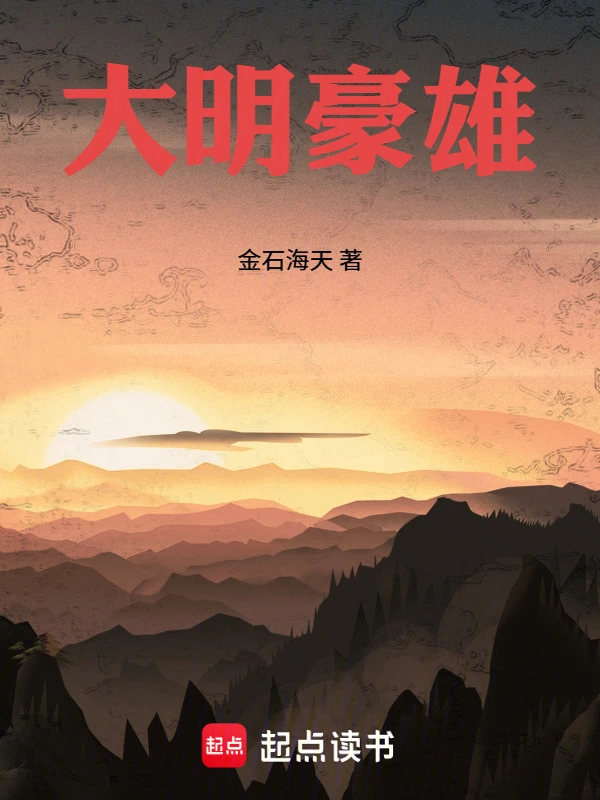
The Heroic Ming Dynasty
大明豪雄
- Status
- Ongoing
- Length
- 1.1M Words
- Genre
- Historical
- Audience
- Male
- Subgenre
- Song-Yuan-Ming Dynasties
- Updated
- 2d ago
- Source
- Qidian
Stats
Tags
Honours
Synopsis
In booklists 7
My Favorite Historical Fiction (Mostly Power Struggles and Lesser-Known Dynasties)
Experience the weight of history. This list includes both new and old books. Recommendations are welcome~ (P.S. I recommend some books in the comments.)
Recommended by a Veteran Reader of Fifteen Years
You can’t go wrong with these recommendations.
A Few Books I'm Following That You'll Love Too
I'm very picky about what I read these days, and rarely add books to my library to follow. Here are a few I'm currently reading.
A Few Books I Really Love
I love sharing things with people: fun places, good food, and great things to read or watch. When someone tries my recommendation and enjoys it, it makes me really happy.
History Novels Especially Loved by Tebie Bai
I haven't written a book in ten years, but the recommendation lists I've posted across various media have been very popular. I'm sharing one here on Qidian as well. No hidden agenda, just fair reviews.


God's Work, God's Work, Is It Enough?
Masterpiece

Books I'm Testing
These are based on my personal tastes. Most are books I dropped after reading the beginning, so don't click if that bothers you. Rated out of five: 1 means I dropped it right away; 2–3 means it has some bright spots or no major flaws, and made me want to see how the plot unfolds; 4 means it's good in every respect and has standout qualities.
Readers also read
 Great Ming: His Father Is Useless, So He Must Summon the Founding Emperor
 Germany: 1914
 Seizing the Direct Descendant in the Red Mansion
 A Literary Master in Ancient Greece
 Simultaneous Transmigration: Is Everyone Starting Out in Prison?
 On Qingming, It's a Good Day to Die
 Taiping Heavenly Kingdom 1854
 A Great Industrial Nation, Starting with a Fake Student Abroad
 A Dual Status Panel Descends into the Abyss, and the Assassin's Potion Is Right at the Entrance
 Taipingji
 A Nobody in the Far East
 An Important Town in the Residual Tang Dynasty
To describe the characteristics of the Ming Dynasty
When you write about the Ming Dynasty, you can't just write about the ancient Ming Dynasty in your imagination, because it was in the budding class of capitalism and had an employment relationship. Then you have to read about the French Enlightenment and watch the struggle between the Montagnard and the Gironde. Only in this way can you know what the closest and most similar feudal dynasty to us is like. For example, the sound of King Chuang's gunfire brought a vigorous workers' movement to the Jiangnan region, which is what the landlord class calls the "Jiangnan Slave Revolution." If these factors are not taken into account, then the Ming Dynasty written about is just a cover-up of the feudal dynasty. History is development and movement, and using fixed thinking to imagine is metaphysical, mechanical rather than dialectical.
Pity
Such a good book is not popular. Alas, it is not easy for the author.
If you think the Ming Dynasty is not good, go and build it; If you think the frontier army is not good, go and kill good people and take credit; If you think the Jing camp is not good, go and eat empty wages; If you think Jiajing is not good, then go and be Yan Song; Don't just abuse, slander, and complain. If you are positive, you will not fish in Wanli; Where you stand is the Ming Dynasty; What you do will be like the Ming Dynasty.
It looks good, please write more.
Then. I have a question. You already have power, why don't you form your own direct lineage? It is very troublesome to have no direct descendants at this time. No need for more, ten people are enough. Can't you think of it? Or deliberately not formed? Add difficulty to the protagonist? It's okay to take in beggars and homeless people. The supply of soldiers is not a problem. Or, you just want to write that the protagonist is a martial artist. The kind of article with no strategic vision. I don't understand why I can win easily. Why do you have to make it difficult if you can't think of it yourself? It is very incomprehensible that you do not form a direct lineage yourself. It is best to be a beggar and a homeless person. You can also choose a few people in Zhuangzi. You have the supplies, so bringing at least five people won't be a problem. Then, you don't have to be careful. Speech also has weight. I don't understand, this is the most important thing to do, why don't you do it? I will organize it on the day the market is established. The protagonist has some problems with his IQ. It's kind of stupid to see that. The key to the problem is strength, but I just don't want to form a direct lineage. The people below are also dissatisfied with this and that. If your protagonist continues to be so stupid, I won't be able to watch it anymore. I think this is a problem that not everyone who has traveled through time can see. The time traveler doesn't understand. So, I suggest you write smarter and not be so stupid.
The masterpiece of local tycoon's opening
The particularly white Ming Wufu is much worse than this one. The literary nature and setting of this book are reasonable, and the character structure is on the same level as the previous "Late Ming" by Ke Shanmeng.
Special Bai is not on the same level as this author.
Who doesn't know how to compare? This writing style is several levels higher than that of Special White
I like the author's style. The ordinary people who traveled back in time to that era had normal development. They first solved the problems of adapting and integrating into society before slowly accumulating experience and strength to make themselves stronger for subsequent development. This seems more logical! The author's writing style is simple and not overly exaggerated and it's also very good👍
The protagonist traveled too early
At the beginning, the protagonist traveled back in time to the 18th year of Wanli. I looked back and saw that Wanli reigned for a total of 48 years 😰. The good family, together with the short-lived Apocalypse in the middle, and the 17th year of Chongzhen, are almost 40 years in total. The age group of people in the prime of life is between 18 and 35 years old. Unless the protagonist wants the Ming Dynasty to die 20 years in advance during the reign of Wanli, what level of rebellion is needed to destroy the Ming Dynasty, which is still capable of launching three major conquests? Li Zicheng and the Qing Dynasty washed the north into hell one after another before the Ming Dynasty was destroyed (there was only the Southern Ming Dynasty left)
Wanli
To be honest, the pressure for rebellion was a bit greater during the Wanli years. Emperor Wanli still had real power under his control, and he had a lot of famous generals and money. It is estimated that there will be a chance after the Battle of Salhu.
It is easy to write the history of the Ming Dynasty into some parts of the braided drama of the Qing Dynasty❗
"Slaves": Eunuchs in the Ming Dynasty called themselves "slaves". "Emperor": The Ming Dynasty rarely called the emperor this way, but it was commonly used in the Qing Dynasty. "son": The Ming Dynasty princes did not call themselves this in front of the emperor. "Aiqing": Before the Qing Dynasty, emperors rarely called officials this way. "Memorial, Zhezi": This only appeared in the Qing Dynasty. Although it is the same document as the memorial, the difference is huge. "Futai, Fantai, Niantai": These are the names of the Qing Dynasty. Those with "Tai" were all commonly used in the Qing Dynasty, and were rarely used in the Ming Dynasty. "Master": In the Ming Dynasty, only top nobles and first- and second-rank officials were allowed. State and county officials were not called "Master". "Sir": In the Ming Dynasty, it was only used for first- and second-rank officials, nobles, and elders of the father's generation. Prefecture and county officials below the third or fourth rank are not called adults. "Prince": In the Ming Dynasty, people rarely addressed princes as "Prince". This was commonly used in the Qing Dynasty. "My King": This was also a self-proclaimed name only in the Qing Dynasty. "Bank Notes": Only available in the mid-Qing Dynasty. At the end of the Ming Dynasty, only money orders circulated among local acquaintances. "Greetings": Etiquette among officials and bannermen in the Qing Dynasty. This etiquette did not exist in the Ming Dynasty. "Eunuch": In the Ming Dynasty, only senior eunuchs had official positions, and ordinary eunuchs were called chamberlains. Only in the Qing Dynasty did all eunuchs be collectively called eunuchs. "Our family": Eunuchs in the Ming Dynasty called themselves "I" to their subordinates, not our family. "Military Gate": the name used in the Qing Dynasty to address generals such as admirals. In the Ming Dynasty, civil officials such as governors and governors were called governors. "Kneeling Ceremony": Ming Dynasty officials temporarily knelt down when presenting to the emperor and stood up immediately after the ceremony. Subordinates do not easily bow down to superior officials. In the Qing Dynasty, emperors often knelt down to listen for a long time, and subordinates also generally knelt down and knelt down when meeting their superiors. There are also many words commonly used by banner people after the Qing Dynasty: Leave here, leave, errand, be an errand, return errand, master, reward some future, dare to love, grace,... Come,... Get panic, ye, persuade, weigh, send, dawdle, get rid of, we, laoshizi, fragrant pastry, alley, see the sky, noon, baba, scold, wait to see, place, arrange, in vain, scorn, chill Zi, estimate, make fun of, deft, guard against shortcomings, no way, wilted, bad, accurate, blind, coincidental, today, tomorrow, yesterday, the sun, body, follower, scold, laugh, toss, make up. Together, thinking about, talking about, seeing, hitting a snag... {"NickName":"Restriction and Supervision","UserId":417773267}
Good book, worth reading for recent historical texts
The beginning of this book didn't quite fit the formula of the three golden chapters of an online novel, so it failed to keep people here, but the subsequent content was very reasonable and made up for this. A good book is a good book. With this score, I'm afraid you might be like TJ.
That sentence Anping Liu Jin is so happy about chaos and misfortune. You should put it in your resume.
The main reason is that the title of the book has persuaded me to quit several times. Who dares to believe that this is a book about how to rebel in peacetime. . Nowadays, most of the rebellion stories in history, where political power comes from the barrel of a gun, started in troubled times. This peace-time novel is refreshing.
This one is better
The Ming Dynasty warriors did not have such a detailed analysis of the forces. They took it for granted when they started to develop their forces. They killed people without any foreshadowing, and then swaggered to take over the forces after killing them. It took only a few chapters to take down this kind of force where you are among me and you are among me. The works of more than ten years ago would not be so advanced.
This book feels good to read, but the dialogue in some places is not very clear, such as "Waiting outside the door". It seems that this situation has happened many times, and it is a bit difficult to understand
It's a bit like the Seventh Generation Pao Ming Te Bai style.
Are you wearing his vest? You have the same style as him at first, but it snowballs later on.
Work hard, Lao Bai
I saw the recommendation on Zhihu and after reading a few chapters, I was basically convinced. It's really impossible to have no traffic these days. There are a group of people on the rankings who are brushing votes and AI. Writing books seriously can only be a struggle. .
I think he wrote it well. I love Yue Qianchou the most. Ci Ai Guan Yue, this one is awesome. I'm very picky. Neither can be a noob. It shouldn't be too suspenseful or convoluted. Lots of dialogue. No system. Much prettier than that white one
A person born in the seventeenth year of Wanli?
Was the dynasty change completed during the Wanli period? By the end of Chongzhen's reign, the pig's feet would have been over 50, right?
It is quite attractive and relatively simple. The Reasonable Party will probably like it more. I give it to you with a monthly ticket. I hope the author will work hard. In Wanli, the transition from prosperity to decline, let's see how to make a big difference with a little.
Very white, the vest can't hide you
Especially recommended by Bai Zaihu on Zhihu
Is it a small number (●__●)
Better than what Ming Wufu wrote!
Good book
At first glance, it seems a little distorted, as if the main perspective is not at the pig's feet. A book friend in the comment area summed it up very well. It's pretty much the same feeling of alienation. But after reading dozens of chapters now, the more I read, the better it gets.
The great Ming warrior, right?🤓
The same writing style as Ming Wufu
Saying that no uprising can occur in the middle and late Wanli period and Lao Nu's influence in the Northeast
You will understand if you look at the Chaotian Lu of the Li Dynasty. Several tributes were sent to Yanjing, and there were refugees all over the place, and officials along the way were personified. However, the court did not go to court for 20 years and broke up with the ministers to replace the prince. The failure to approve the promotion of officials resulted in a shortage of 30% of the chief officials in the six departments of the court and the prefectures and counties. The loss of tax power management of prefectures and counties also prevented officials from being promoted and trained normally, which greatly reduced their subsequent bureaucratic abilities. The treasury was empty by arbitrarily launching the three major levies of the border army. He sent eunuchs to various places to collect various taxes but only 10% went into the private treasury. His reputation and authority had long been ruined, and he was just moving forward with inertia. Lao Nu returned to the tribe in the 11th year of Wanli and unified the Jurchens in the 16th year of Wanli. By then, he was already a powerful force and the Ming frontier army was no longer able to handle it. By the time of the Battle of Saarhu, he had annexed all the Mongolian and Kan tribes in the Sea in the 30th year of the Northeast War. He was already an elite soldier in hundreds of battles, and the Ming frontier army was no longer an opponent.
One chapter per day is not enough. The author needs to work hard to become more popular.
Map of Henan Prefecture during the Wanli Period
Anping is Xin'an in Tuli, with Mianchi and Shaanzhou to the west, Luoyang and Mengjin to the east, and Yiyang to the south.
Some conjectures after defeating the attack of the eunuch minions
After wiping out all the eunuchs' minions, I guess there are several scenarios. First, they will not rush into Luoyang and kill the eunuchs. Second, the local gentry mobilized public opinion, and the eunuchs' tax collection triggered a civil uprising, forcing Wanli to recall the eunuchs from western Henan. Third, the eunuch was kept in Luoyang as a sick cat without claws as a cover, and the Luoyang gentry was asked to pay some money every once in a while to prevent Wanli from sending tax inspectors again. Fourth, the Shaolin Temple's armed forces were weakened. They combined eunuchs, officials and local forces to use the black information in Master Xingkong's hands to get rid of the current management of the Shaolin Temple and carve up Songzihao Trading Company.
I feel comfortable reading this chapter today 🤭