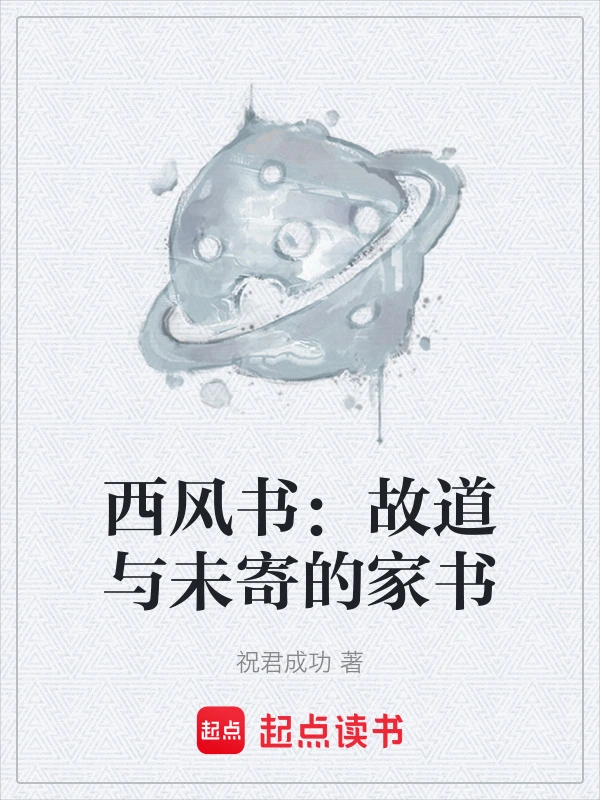
Letters from the West Wind: Old Ways and Unsent Letters from Home
西风书:故道与未寄的家书
- Status
- Ongoing
- Length
- 235k Words
- Genre
- Sci-Fi
- Audience
- Male
- Subgenre
- Time Travel
- Updated
- 10mo ago
- Source
- Qidian
Stats
0Monthly votes
3Recommends
0Fans
84Chapters
Synopsis
Reader comments
Readers also read
 My Low-Dimensional Universe Model
 Doomsday Convoy: I Can Extract Unlimited Entries
 Psychic Worlds: the Paladin Forges His Body into a Numerical Monster
 Oh Yeah! I've Seen Fake People
 Corpse Hunter
 Night Without Borders
 How Can You Become an Immortal If You Don't Have Money?
 Alien Hotel
 99 Days Before the College Entrance Examination
 Green Hills
 Xuanjian Immortal Clan
 Become a God from Water Monkey
 Zhou Jun's Collection of Emotional Quotes and Poems
 Appreciation of Mr. Xingyun's Original Collection of Poems
 The Habitat of the Soul: Xingyun's Poetry
 Interstellar 1: Paradox of Space and Time
 Interstellar 2: Cradle of Decreasing Entropy
"Xifeng Shu: Old Ways and Unsent Family Letters"
"Book of the West Wind: Old Ways and Unsent Letters Home" is a masterpiece that skillfully combines historical research, science fiction imagination and deep emotions. Through the core image of "unsent letters home", it weaves an emotional network that spans time and space, and conducts a grand speculation on the survival of civilization and the value of individual emotions. Archaeology in the Folds of History: When Letters Become the Code of Civilization The most unique charm of "The Book of the West Wind" is that it constructs a narrative system called "Dream Archeology" and "Emotional Quantum Entanglement". The protagonist Lin Feng does not crawl through traditional documents, but uses science fiction settings such as quantum microscopy and consciousness frequency tuning to directly "dive" into the subconscious sea of historical figures and interpret the true emotions and historical trauma that have been buried in the dust of time in those never-sent letters home. The "archaeological" object described by the author is the "unsent letter home" with great symbolic significance. From the word "peace" encrypted with blood, tears and star maps by the canal workers in the Tang Dynasty, to the intelligence instructions disguised by female teachers in the Republic of China with cheongsam buttons and homely chatter, to the last words written by General Zuo Quan in the flames of war, full of concern and determination, to And Commander-in-Chief Zhu De's earnest teachings to his daughter during the strategizing period... These family letters were not delivered due to war, separation or death, and they themselves became a huge emotional suspension system, accumulating huge emotional energy. The novel cleverly reveals that the huge entropy increase of these personal emotions has even attracted the attention of high-dimensional dark matter civilization, which regards it as energy that can be harvested, thus pushing the story to the trial scene of the "Cosmic Moral Court", making personal and historical emotions suddenly become the key to the survival of the entire civilization. Narrative Experimental Field: The Humanistic Core Under the Cloak of Science Fiction In terms of narrative techniques, "Book of the West Wind" conducted a bold cross-border experiment. • Cross-border fusion of concepts: The novel deeply grafts scientific and technological concepts with humanistic thinking. For example, "emotional entropy" is used to quantify the collective weight of historical tragedy, and "quantum entanglement" is used to explain the emotional resonance between Lin Feng and historical figures in different time and space that transcends cause and effect. The most interesting thing is that it even introduces "quantum humor" as a weapon against cold logic. When the dark matter civilization attempts to harvest human sorrow, the protagonist uses an adaptation of "Yellow River Cantata" and puns to overload the system. This setting of using laughter to deconstruct a grand conspiracy is both absurd and rich in wisdom, and becomes a bright color of the novel. • The interweaving of serious history and romantic imagination: the work is not divorced from the historical soil. The family letters of Zuo Quan and Zhu De that it quotes are all based on solid historical facts, giving the story a heavy sense of reality. On this basis, the author indulges his romantic imagination, allowing the love between Lin Feng and Republic of China teacher Su Qing to become quantumly entangled across time and space, allowing the fate of individuals and the fate of civilization to be connected through the topological structure of a scar. This combination of fiction and reality makes the story extremely broad. Emotion and civilization: a grand dialogue between the individual and the collective The deep theme of the novel is a profound dialogue about the emotional value of individuals and the destiny of civilization development. • The weight of emotion: The core question of the story is: What is the value of personal regret, sadness and unfinished love in the face of the cold laws of the universe and the grand narrative of civilization? Dark matter civilization represents an absolute rationality that can quantify sorrow into energy. The existence of human civilization just proves that the creative energy contained in emotions—especially those that are incomplete and full of regrets—is the "source of negative entropy" that resists the heat death of the universe. • The aesthetics of "unfinished": The novel highly celebrates the "unfinished" state. Unsent letters from home mean undelivered concerns and unfulfilled promises, but precisely because of this, they preserve the purest original emotional intentions and infinite possibilities. This is in line with Li Shangyin's eternal hope of "cutting the candles from the west window together" and Zhang Kejiu's melancholy of traveling while "asking me when I will return", capturing and amplifying the implicit and delayed sadness and power in Eastern aesthetics. Examination of literary value: a stunning "adventure" Of course, such a narrative experiment is undoubtedly an "adventure". The setting density of science fiction is extremely high, and the concepts come one after another, which is a test for readers' acceptance ability. Some settings may alienate readers who seek hard-core science fiction logic or the charm of traditional historical novels. However, the achievements of "Xifeng Shu" are remarkable. It successfully integrates the weight of history, the weirdness of science fiction, and the delicacy of emotion, creating a world that is both familiar and unfamiliar. It is not only a story about traveling through time and space, but also a philosophical discussion about how to face history, how to place personal emotions, and where civilization will go. Conclusion "Xifeng Shu: Old Ways and Unsent Letters Home" is a work full of ambition and creativity. It tells us that those unsent letters home, which are deep in the folds of history and carry the joys and sorrows of life, may not only be witnesses of personal destiny, but may also be the most precious emotional code on which a civilization depends for its survival. For readers looking for depth of thought, novel narrative and emotional resonance, this is undoubtedly a worthwhile reading journey. I hope this book review can provide you with some valuable reference. If you are interested in exploring a specific character or plot in the novel in more depth, we can continue the conversation.