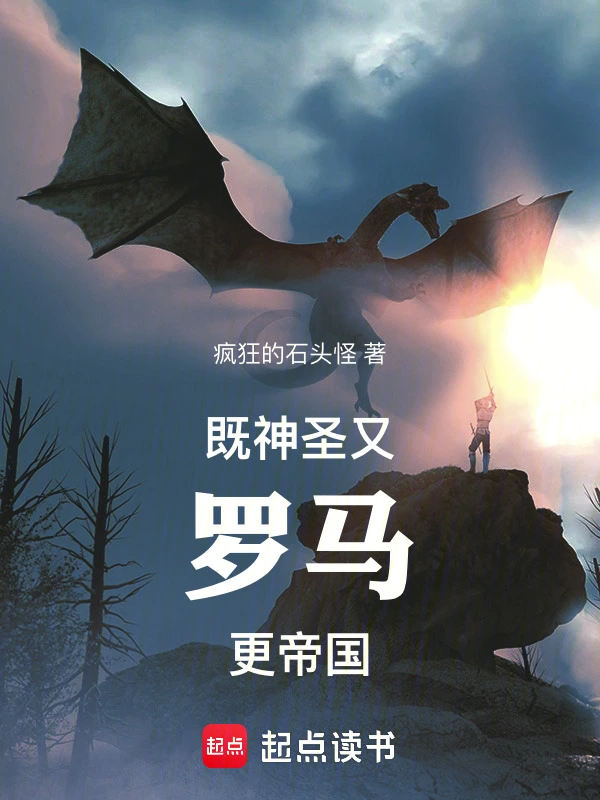
Holy, Roman, and Even More Imperial
既神圣,又罗马,更帝国
- Status
- Ongoing
- Length
- 1.4M Words
- Genre
- Western Fantasy
- Audience
- Male
- Subgenre
- Sword & Sorcery
- Updated
- 19h ago
- Source
- Qidian
Stats
361Chapters
557Votes
24.8kRecs
71kFans
Tags
Honours
Synopsis
More by this author
In booklists 2
🔥Book Relief Station🔥only Collects Ambitious Novels🔥
I read all kinds of subject matter, and I take in everything. Basically, I only accept novels that are large in volume and full in scope.
80Books769Follows1moUpdated
Moonlight over the Sea
Personally I think this is a very good novel and I hope to share it with everyone!
52Books114Follows9moUpdated
Readers also read
 Why Is This Knight's Holy Light Red?
 With Full Charm, He Was Won by the Countess That Night
 The Juggernaut Starts with the Condensation Feat
 Adventurer: Heavy Reliance on Dragons
 Simultaneous Transmigration: Is Everyone Starting Out in Prison?
 Trench Guns and Magic
 Fire Emblem: Dragonrider Lord
 A Great Industrial Nation, Starting with a Fake Student Abroad
 A Dual Status Panel Descends into the Abyss, and the Assassin's Potion Is Right at the Entrance
 1422: The Revival of the Eastern Roman Empire
 The Tang Dynasty in Warhammer: The Tianbao Dream Shattered, and the Fanzhen Rebelled
 Master of the British Isles
 In the Middle Ages, I Draw Cards to Rise in Rank
 League of Legends Starts with Minions
 King of Glory Live Streaming System
Nowadays, the rules of the book review area are corrupt and traitors are everywhere. This is due to insufficient updates. If the author diligently updates 10,000 words every day, then the traitors will be afraid and retreat, and the moral gentlemen will rejoice. This is a feat worthy of praise by Yao and Shun. I heard that calves born in sheep pens will not behave like sheep when they grow up. You are at the starting point and your computer keyboard is often used, but you have lost interest in updating it. Is this reasonable? The reason why Qidian is strong is that we have inherited the etiquette and skills of our ancestors. Stop breaking the news, the pressure has nowhere to release, and you become tired. Isn't this the same as abandoning the roots of the tree and pursuing the treetops? If it goes on like this, great disaster will definitely happen! The reason why Bai Jin can have tens of thousands of royalties and not be hurt by villains is because they are willing to listen to what upright gentlemen have to say! But Pujie can't get royalties and is even looked down upon by his girlfriend. This is because they are close to evil villains. I hope you can think carefully about the difference. There is one thing for which the author can cry bitterly, and six things for which the author can sigh. Since ancient times, when performing actions, the words are often very passionate. If they are not passionate, they will not be able to move the actor's heart. Harsh words are akin to slander. Author, you should think carefully about whether such a thing is right or wrong. Those authors who updated less, delayed, or missed updates had no time to feel sad about themselves, so they were drowned in the torrent of works, leaving only later authors to feel sad about them; later authors felt sad and did not learn from it, and future authors felt sad about it!
The protagonist obviously has the goal of restoring the country, but as of now, he has not made any plans or actions for this purpose. Author, you can write at a slow pace, but you didn't give readers enough pleasure, and you didn't let the protagonist slowly work towards this goal to bring positive feedback. You just followed the trend. The protagonist is a herbalist and has a good heart. Normally, he will develop reputation and interpersonal relationships, but he ends up becoming a lone ranger. The followers that are currently being developed are also delivered to your door. Doesn't the protagonist have a plan to fight back by destiny? In addition, the author, instead of worrying about the protagonist's strength increasing too fast, you should worry about whether the readers can persist until it is released. The combat strength is completely unsystematic.
The main character in the book is generally Japanese, and has always lived in isolation, which means he has no friends, no subordinates, and no leader. The knight invites and refuses to go back and establishes himself as an herbalist who is equivalent to the representative of the devil in the eyes of everyone. His main job is a wolf sect demon hunter and his second job is potions. It follows the traditional game route, which means that at least in the early stage, he will be followed by the same people in the game who hate dogs and are single-target invincible. He has no legion, no territory, and no prestige, neither Cao Cao nor Liu Bei. The title of the book is a bit redundant. It is neither Roman, nor holy, nor imperial.
Does the author have context?
The fantasy in the Western fantasy skin can also be changed in the middle to practice and purify the bloodline. As soon as I think about it, the dragon will become a real dragon in the future, the real dragon will become a dragon, and the real dragon knight will be raised and upgraded from birth. It can be seen that there is no outline, and it smells like the stitching of the Divine Seal Throne.
The protagonist has always emphasized being obscene, but after becoming a knight, he has to fight the envoy for someone who has nothing to do with him, and the left and right brains are fighting each other? He made himself a wanderer again. And I don't see the protagonist having any social interactions at all. He just relies on his herbalist to gain reputation. In this magical world where personal combat power is so high, what are you doing to win over ordinary people? Do you have the ability to turn them into extraordinary beings? No, do you think these ordinary people are enough to be killed by an immortal upper-class vampire?
It's strange why the protagonist doesn't canonize himself as a knight. Although Dongluo has perished, the protagonist's status as a prince is still there. As the prince of Eastern Rome, the protagonist must have the title of Caesar or Augustus. He can directly form a government-in-exile by himself, and then the government-in-exile declares and grants him the title, although this government-in-exile only needs one person. Even if the knight title requirement is Western European, it doesn't matter. The protagonist is a prince. You can play a trick, such as making your cat the lord of a certain place (virtually claiming a piece of land in Eastern Rome), and then let your cat handle the knight's formalities. It's strange, why I am so entangled in a knight title, and the protagonist is not a commoner.
Selling dog meat for a sheep's head, don't arrange any Roman princes for the protagonist A Dou
🤣What kind of herbal medicines are there, and then you grind and grind, can't you write about the force value, can you, can't you write about the fighting, the word count of the whole article is low, just look at the title, you don't need to read the content, to be honest
It was like The Witcher before, but it became Kingdom Come after it was released. Now it's like Game of Thrones, but it's well written. If it had traffic, it would at least be worthy of being rated as a high-quality product. It's a pity that there are too few updates.
Please stop writing about these two people in Kingdom of Heaven and Rescue. I don't want to see these two people at all since I got the dragon. Then I'll rewrite these two supporting characters and abandon the book.
Well, I finally gave up on the book.
Although I also play Kingdom Deliverance and really like Henry, the strategic nature of the dragons in this book is too important. I don't think they deserve two dragons. In a sense, they are added together and can indeed be regarded as one person. They are already the most noble people except the British, French, Haburg and Ottomans. There is a strong sense of separation. According to history, they should not be worthy of even one dragon. My previous thought was that two people would tame a dragon together, which would have some drawbacks, but today's chapter gave me the feeling that the author favored them too much, far more than the heroine, and taming the dragon was too simple. It suddenly knocked the preciousness of the dragon into the sewer. It also seemed that all the major kingdoms at this time were fw, especially Habsburg and France. I like European history very much, and what keeps me reading is this sense of fantasy and history. There are no dragons in Habsburg in this book, and there seems to be no dragons in France. As a result, characters who are not so important in the original history are given such a big hook, and the historical flavor disappears completely in an instant. Another point is that the two female protagonists do not have dragons. I felt that there was no problem before. After all, dragons are precious. Now this chapter gives me a feeling that the female protagonists are not as important as Henry Capone. The author is willing to cheat them, but is not willing to cheat them. Is it necessary to write that the flying dragon does not need to be a real dragon after it evolves? This also seems stupid. The heroine may have a real dragon in the back, but the number of dragons is too many after all. I can only say that I hope the author will continue writing, so that we can have a good time together.
The number of dragons is too poisonous
There is only one native chicken, and there are no Polly and Habao. These two are just one person each, and the entire combat power system has collapsed.
Let's talk about the significance of dragons to low-magic medieval battlefields
I feel like there are always people who don't understand the significance of dragons on medieval battlefields. Let's analyze it a little. Let's talk about the overall look and feel first: similar to Dragons from A Song of Ice and Fire, but a little stronger. Less restricted. Premise: In the Middle Ages, cold weapons were the absolute main force. Infantry lines need to be densely packed. Threat to dragons: Ordinary shooters cannot break armor against dragons. Ordinary javelins don't seem to work either. Special alchemical javelins or high-quality steel javelins can break the dragon's armor when wielded by a strongman or knight. But it is difficult to hit (if the dragon does not enter the army pile). The ballista does not seem to be specially designed to shoot high, but if it is specialized for dragons, it should be possible, if the dragon is stationary. A moving dragon is like a javelin, basically unable to hit (set by the author). So for a dragon, if it swoops down and spits fire and then escapes, it basically has no natural enemies. The only limit is the number of fire breaths (it seems to be physical strength?). Of course, after landing, he will be slaughtered by the assembled knight team. The bigger dragon seems to be less of a threat to the knights. A core inference brought by the above analysis is that the dragon itself is difficult to kill. In a battle of, say, 5 hours, the dragon may not directly kill more than 2,000 people (the dragon will not land, and the army will form a dense formation). But the Dragon's ability to maneuver and pour firepower in key places at key times is unparalleled. Considering the actual scenario, one side has dragons and the other side does not have dragons. Unless the side without dragons sticks to the castle and specializes in anti-aircraft and is filled with dragon-hunting crossbows as pure targets, otherwise as long as the side with dragons can maintain a stalemate in a short period of time, for example, if it reaches one-third of the strength of the side without dragons, the side with dragons will win steadily. This force is more important than dragons in smaller-scale battles. One third of the ratio is based on my imagination: 5,000 vs 15,000 combatants, and the battlefield width is about 1-2km. Suppose the dragon can spray 15 times in a three-hour battle. It can be sprayed 3 times quickly at first. This means that 500 of the elite armored soldiers on the dragon-free side may be reimbursed before they can directly engage in battle. The next 20 minutes after the engagement may have to endure at least 200 casualties. Note that this does not take into account the situation where the giant beast uses its points and faces to step on its feet in melee combat. Specific enough to distinguish between the left wing, the center army, and the right wing. As long as there is a stalemate in one place and the enemy has no reserves, the dragon can stably and quickly collapse a local battlefield, thus snowballing. What level is this force? Take the Battle of Joan of Arc decades ago in the article as an example. There were 4,000 British troops and 7,000 French troops. For this level, having a dragon means crushing. Considering the logistical supply in the Middle Ages, this was actually the norm. And if there is a famous battle in history, such as the Battle of Vienna 150 years later that has not happened yet, the strength comparison is 80,000 vs 17,000, the actual combatants are about 8,000 vs 10,000, and the actual battlefield casualties are 5,000 vs 15,000. Considering that dragons can cause thousands of casualties, they are still a very important source of damage, not to mention the key breakthrough capabilities in key locations. But if the battle between the two sides is not evenly matched, it will be difficult for the dragon to turn the tide in this situation. To sum up, in the protagonist's era, as long as it is not a national battle between Shinra + Eastern European countries and local chickens, basically if there is a dragon, it will be pure crushing. A grand duchy can mobilize 10,000+ people to fight to the death. In this principality-level battlefield, there are dragons on one side and no dragons on the other. It is not an exaggeration to find a terrain of 10,000+ dragons to push and win 30,000 (typical of Brandenburg + Teutonic incomplete mobilization to beat the glass) So, those who are still questioning that it is not an exaggeration to say that the kingdom of heaven saves the two protagonists by sending two dragons from the sky, do you understand? As soon as these two dragons are revealed, as Bomi's own Earl, if they want to connect in series, Bomi's throne will change hands in an instant. The king simply doesn't have the strength to fight! After a little internal integration, we can wait until Frederick dies and competes for the emperor of the HRE. The dragon is natural legitimacy. In this case, the author's original intention was probably that these two would become the main character's grasp for Silesia/Pomi? Become a younger brother? I don't know whether it's the younger brother who is more likely or King Pommy who is more likely to face two dragons in a few months? Why should someone treat you as your little brother instead of being a popular drinker? Yaron is slightly better, at least he is unlikely to be pushed directly to the king's position by dissatisfied nobles
The Dharma King's dragon is Jeanne d'Arc. It's really too hellish. Can't you design a new one? This process of controlling the dragon is also unbelievable, and it is no different from finding a reason to do it directly.
There's nothing interesting about it, so I'm going to give it up. The two minor supporting characters each have a dragon. It's as if the dragons follow the crowd. It's normal for the protagonist to have a dragon. Otherwise, it's not interesting. It's normal for Osman to be free. In the medieval empire, both minor supporting characters are available. I can't watch it anymore. I wish you can write better. It's too casual. It doesn't matter if you write that these two supporting characters are the protagonists.
The biggest problem with this book
The role of the dragon is too great, too powerful! There is no way to restrain dragons yet, and extraordinary beings seem to be generally weak. With such strong mobility and powerful abilities, the dragon can launch lightning decapitation operations and attack and retreat quickly, so no one will die. There is a dragon engaged in guerrilla warfare. Which country can withstand such a fierce war?
Shennong's post, contains slight spoilers
It is an imaginary Western fantasy novel of the Renaissance period, but the textual research is good. As a historical imaginary Western fantasy novel as a whole, I can give it a solid +. The progress is actually not as slow as the chapter review section says. It's just that the chapters before they were put on the shelves were a bit slow, but after they were put on the shelves, they were almost successful. The plot of the knight's competition is also very interesting. The latest chapter has reached the point where the leading 10,000 soldiers and the Ottoman regular army confront each other. The only bad point in the whole story so far is that the exchange of identities with the princess of Komnenos is a bit abrupt. Considering that the protagonist urgently needs a deputy author who can be trusted, this arrangement is understandable, but everything else is a masterpiece.
Let me just talk about this background and this writing style that seems familiar. It turns out that the author is writing about drawing cards. He doesn't want to play a good hand of cards like the previous one and write fantasy history into a light novel.
I was just browsing site B and saw someone mentioning the book you wrote about League of Legends minions before, and I suddenly thought of you. The last memory I have is Nong Li Bai's book. Those two books were both good books for me at the time. I came here specifically to search and reminisce, and found out that a new book has been published, cheers. I want to take a look at those two books again.
Too few updates will make readers look more carefully for the shortcomings of the book, and it happens that the book does have many shortcomings. The biggest problem is that the dragon setting is too buggy. Apart from dragons, this book is a world with low martial arts. I can't see the possibility of any non-dragon units killing dragons and dragon knights. Especially since the system not only adds bonuses to the protagonist's dragons, but also gives bonuses to the protagonist himself. In addition, the dragon itself has strong mobility. It is difficult to imagine how a country without dragon knights can still exist in the book. Moreover, the insertion of the dragon, a bug-level combat power, and a system for the protagonist to enhance himself, led to the label of this book being mainstream. In fact, the battle is mainly about the protagonist leading the dragon to defeat everything and win. However, the protagonist obviously has the strength to not eat beef, but he still recruits soldiers and develops the territory as if there is no dragon. It is awkward no matter how you look at it.
Character dialogue must fit the story background and character settings. You can't write "Adou who can't be helped" in the Qin Dynasty You can't write traditional martial arts novels, and suddenly someone drives a tank out to participate in a martial arts competition to recruit a bride. Correspondingly, in the setting of the Western fantasy world, characters opening and closing their mouths is an idiom. Author, don't you think this is strange?
. . .
There is always a sense of separation between a Western fantasy novel that combines personal power and an imaginary world based on real history, and the stitched monsters. On the one hand, it is based on the realistic logic of real history and the development of the material world, and on the other hand, it is a fictional fiction created out of fantasy. They are naturally incompatible, and there will always be plots that do not conform to logical development, which is the so-called combat power. Based on the comparison of the villain's combat power in the book, the protagonist's combat power is erratic. When he is weak, he can kill the second-largest vizier of the Ottoman Empire in a formation of ten thousand troops; when he is strong, he can have a back-and-forth with Achilles, the fallen vassal of the Shinra Empire. The real prime minister of the Ottoman Empire was not as good as the ruined vassals of the Holy Ra Empire. Presumably the real power of the Holy Ra Empire could have unified Rome, destroyed the Ottoman Empire that blocked the trade between the East and the West, and marched all the way east to the border of Dameng. In 1460, maybe the students from Wala who had just launched the rebellion to seize the gate could be allowed to study in Shinra.
No, don't tell me that Leo can control the evil dragon, can't you just snatch the dragon over? It's not a super big IP to write about a duo that will be rescued by the Kingdom of Heaven. Not even the protagonist of Kingdom of Heaven himself.
The pace is too slow. With the heir to the empire claiming to be a soldier, why not go to the West to seek investment? Any investment would be better than now.
Find an operations officer. Sometimes you should control reviews. Some comments in book circles are really abstract...
If it weren't for the fact that the results were really bad, I would have doubted whether there was an author who was smearing or being slanderous 😅 I think that although this book is not very well written, my personal evaluation is -. In the current situation where there are only three or two kittens about lords in the Middle Ages, it can be read, but it will not be too much. Too bad, in my opinion at least the research is passable (for example, the merger of the Margrave of Brandenburg and the Principality of Prussia and the wedding at the Italian Palace and other designs at least show that the author understands some common sense about the Western European medieval period. The fault of Saint Joan of Arc probably comes from the author's two-dimensional hobby). There are very few online articles about Western Fantasy Medieval Times (# feudal fiefdom system in the middle ages) that I could read. A group of people have such a low level of tolerance. They started to criticize after just a few chapters. This circle is really getting cold. There aren't many great people and LV5 stalwarts to attract traffic to the medieval and feudal lord circles. If this continues, no one will write about medieval lords.
One million words. Background board. Joan of Arc or background board?
I guess I started out with an idea of a person in a dream, but then I realized it wasn't easy to write and decided to cut it.
The title of the book should be changed to: zz Xiaobai, a junior high school student, accidentally enters the Game of Thrones and starts fighting for hegemony by relying on the halo of wisdom.
I don't know if it's intentional, but I've been writing exclusively about dragons for more than half a year.
Since the last book, the author has been very fond of cheating the protagonist. He is still trying to cheat the protagonist even though he is already invincible. As a result, in the later stage, the real world cannot be written at all and he can only keep entering the dungeon. The army has also become a pendant and can only be crushed by personal strength. This book itself does not put so much emphasis on leading troops to fight, but after the dragon came out, it was completely written about dragons. The same resentment caused by giving dragons to one's own supporting characters before, and now the same is true for giving dragons to opponents. That's not to say that you can't write it this way, but can you write the ups and downs of the plot in this way?
No, where did the Wallachians offend the protagonist, a great nobleman from Rome?
The protagonist is really like Cheng Xin from The Three-Body Problem. He talks about benevolence and morality when he opens his mouth and shuts up about morality and justice, but in reality he is a traitor to mankind and a despicable villain who harms others and himself. The Wallachians risk everything to defend their homeland and are not slaves to the country. Eight of the protagonists are dissatisfied and seven are not angry. If you have the ability, you can do it. Do you have to stand on the moral high ground and drag your feet to become a Donglin Party?
To be honest, the writing is actually very good. Some of the things mentioned in the comment section cannot even be considered shortcomings. As the plot slowly unfolds, it gets better and better. There is nothing to say about the writing.
Why didn't you even meet Catherine? Why did you make the promise in the first place if you didn't want to accept it? It makes me sick, you know?