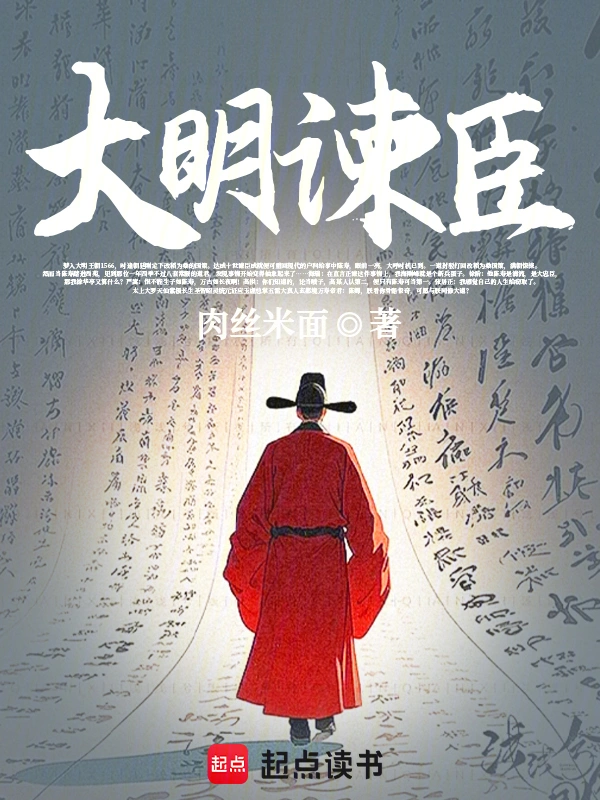
Ming Dynasty Admonition Minister
大明谏臣
- Status
- Completed
- Length
- 604k Words
- Genre
- Historical
- Audience
- Male
- Subgenre
- Song-Yuan-Ming Dynasties
- Updated
- 5mo ago
- Source
- Qidian
Stats
0Monthly votes
7.4kRecommends
19.9kFans
180Chapters
Tags
Synopsis
Reader comments
Readers also read
 Talker in the Song Dynasty
 Please Call Me Your Majesty the Tsar
 1914 Begins with the Rejection of the Schlieffen Plan
 In the Red Mansion: Escort Daiyu to Beijing at the Beginning
 Zhenguan Warrior: Starting from Teaching the Prince to Counterattack
 Daming: I, a Lackey of the Strict Party, Became an Anti-Corruption Pioneer
 Ming Dynasty: in the Beginning, He Complained That Zhu Di Was Not the Right One to Succeed to the Throne.
 Daming: I, Yan Maoqing, Really Smoked
 The Tang Dynasty Began with the Heian Shi Rebellion
 Datang: They Force Me to Be Emperor, Right?
 Daming: the First Assistant of a Poor Family!
 Northern Song Dynasty: Starting from the Interception of Hu Zhaoji's Throne
 Ming Dynasty 1566: Regent of the World
 My Father Jiajing
 The Legitimate Son of the Ming Dynasty
What is the picture of Jiajing in Cambodia? If you really don't want to live anymore, why don't you just imitate Zhou Yunyi and get married? Still giving advice and giving advice on changing rice to mulberry, just looking for trouble.
The stall is a bit big
The current layout of the two lines (Southeast Examination Law/Pinging Japanese/Foreign Trade/Agricultural Reform vs. Liaodong Defense Dilemma) is slightly scattered. If Liaodong continues to deteriorate, Shanhaiguan can be defended for the time being. If the southeast policy focuses on government affairs, maritime borders, commerce, people's livelihood, and the suppression of Japanese slaves, its potential to stimulate overall change is far greater than that of Liaodong. Since the protagonist has always been in the center, instead of pulling the two lines and causing the narrative to lose focus, it is better to make a breakthrough with the southeast as the fulcrum. When the reform in this area becomes a demonstration, the accumulated potential energy will naturally radiate to the entire Liaodong area. This will not only strengthen the self-consistency of logic, but also highlight the in-depth wisdom of central operations.
Damn it, why the hell did I find this book at chapter 26. I gather. Not enough, damn it.
Be broad and broad, except at the beginning
But it gets better later on, and it's not just a mindless rant against everyone. Good job of pulling off the tiger's skin, but there are some similar ones that I really don't understand. Everyone squirts. The emperor was also a brainless person, and he even got promoted. This is good, but the emperor was dragged out to endorse it. The emperor was arrogant and blamed all the faults on the "treacherous ministers". The emperor was just deceived, but the premise is that the emperor is not that kind of idiot. If he were to be like Yang Guang, the protagonist would be numb 😁
The protagonist can completely ridicule Yan Shifan in secret. He is not even a fraction of Xu Jie's reputation for corruption. It's not that Yan Song and his son don't know that Qingliu is a beast, but under the dark light, they didn't expect that they are the real biggest moth and cancer. They want to Knowing that Xu Jie and his representatives could be so greedy, and knowing that Gao Gong and the Shanxi merchants behind him could betray the country so completely since Hongwu, yet they themselves were greedy for a small change like a clown and got a huge amount of dirty water thrown at them, how could they and their son not break their guard? They asked the father and son to secretly investigate these things themselves, and the results of the investigation made Jiajing go crazy. This was completely a conspiracy. Jiajing knew that the gentry was not a thing, and he probably didn't know how they could be such beasts. He could tolerate them being greedy for the fourth level, but it was impossible to tolerate the greed of the rich gentry in the world for the ninth level. He himself had no level one, so there was no need to go into battle naked all the time.
If possible, save the people first, then save the country, and finally save the monarch who "saves himself". If he doesn't save the country, just ignore him and look at him coldly!
Yes, it's much better looking than those sent to death. 😁
The writing is quite good, both in terms of writing style and characterization. The main character appears in a suitable role and does not talk nonsense like a petty official or a common man. Historical figures are all complicated. It can be said that very few people have read the official history of the Ming Dynasty. You may have just read 1566. Moreover, you must know that it is writing about figures in feudal society. You cannot ask the author to write about feudal society from the historical perspective of a modern republic. That would be too dramatic.
Shennong, I have tasted it, it looks good, come quickly
It's a rare good book. Although the author started with the TV series of the Ming Dynasty and borrowed some lines from famous scenes. But in the chess games and debates between the ministers, they have their own thoughts, which is a rare good idea! It's a pity that I came too early and couldn't see enough! If the follow-up plot is still of this quality, monthly tickets will be enough.
It's too difficult, forget about saving the Ming Dynasty, forget about saving the people, it's better to make yourself happy for the rest of your life.
What mistakes are easy to make in historical novels❓
Before the Ming Dynasty, the emperor was not called "Emperor". In the Song Dynasty, he was mostly called "Guanjia", and in other dynasties, he was often called "Your Majesty". In the Ming Dynasty, the emperor was occasionally called "Emperor", and in most cases he was called "Your Majesty". After Kangxi of the Qing Dynasty, people began to be generally called "Emperor". Princes and princes call themselves: Princes in the pre-Qin and Han Dynasties can be called "Gu", and a few can be called "Ignores". After the Wei, Jin, Southern and Northern Dynasties, the title of "Ignores" gradually became exclusive to the emperor, and princes, princes and princes can only be called "Gu" or "I". Song, Yuan and Ming called themselves "I" or "I". Before the Qing Dynasty, princes and princes rarely called themselves "this king". Starting from the Kangxi year of the Qing Dynasty, princes generally called themselves "this king". In ancient times, women called themselves: "nujia" was a modest name for women after the Song Dynasty. Women in the Han and Tang Dynasties more often called themselves "concubine", and noble women could call themselves "I" and "I". Before the mid-Ming Dynasty, most dynasties used copper coins for daily transactions, with very little gold and silver. It was only in the mid-to-late Ming Dynasty that silver became the mainstream currency. -In the late Ming Dynasty, "meeting votes/deposit checks" appeared among the people. There were no unified rules. Most of them were deposits and withdrawals/exchange receipts from acquaintances or local circulation, and were not legal currency. In the early years of Daoguang in the Qing Dynasty (1823): Rishengchang Bank was established, and private banks began to issue standardized banknotes, focusing on cross-regional exchange. They were only circulated in Shanxi merchant trade circles and major commercial ports, and were not yet popular. In the third year of Xianfeng in the Qing Dynasty (1853): the official issued the Ministry of Revenue official banknotes (official banknotes), which were forced to circulate nationwide. At the same time, the network of private banknotes expanded to the whole country, and official and private banknotes ran parallel. The use of banknotes entered an explosive period and became the "starting point of popularization." High-leg tables and chairs only completely replaced the low tables for sitting on the floor in the Song Dynasty. During the Han and Tang dynasties, people knelt and sat on the tables to eat and discuss matters. The furniture was mainly low tables and couches. The memorial system was only established during the Kangxi period of the Qing Dynasty. Officials in the Tang and Song Dynasties used "memorials", "tables" and "statements" when submitting memorials, while in the Ming Dynasty they used "memorials" and "memorials". There is no such thing as "memo" or "zhezi". In ancient formal occasions, the hand-over gesture was performed with the left hand outside and the right hand inside. The right hand outside was a special "unlucky gift" for funerals. "Better greetings" is a unique etiquette of the Qing Dynasty. It was mostly used by subordinates to superiors and juniors to elders. During the Tang and Song dynasties, people often performed cross-hand salutes and bows to greet greetings when they met, and there was no such thing as "sending greetings". Before the Yuan Dynasty, subordinate officials rarely called superior officials "adult". In some dynasties, subordinates called eunuchs "adult", and in some dynasties, they called their parents and elders "adult". Beginning in the Yuan Dynasty, lower-level officials would occasionally call officials of second-rank and above "sir". From the middle and late Ming Dynasty, only officials of third-rank and above would be called "sir" by their subordinates. Officials with lower ranks could not be called "sir". However, in the late Ming Dynasty, there began to appear a few cases where officials above the fourth rank were called "adult". Before the mid-Qing Dynasty, following the rules of the Ming Dynasty, only officials of third rank or above would be called "adult". Starting from the mid-Qing Dynasty, calling officials "adult" gradually became common for lower-level officials. Attention! ! ! What is mentioned above is that lower-level officials refer to higher-level officials. No matter which dynasty, it is absolutely impossible for higher-level officials to call lower-level officials "sir". Some novels even write about emperors or nobles calling other officials "sir". This is simply contrary to Tiangang! ! ! Finally, let's talk about the problem of civilians calling officials Before the middle and late Qing Dynasty, civilians in various dynasties and generations called officials differently, and most of them called them "officials" and "masters". From the middle to late Qing Dynasty, civilians also called officials "adult". {"NickName":"Supervision and Restriction","UserId":406440657}
It's just that the eunuch has lost his character. I'd better take some time to sketch out the ending. I understand that it won't make any money, but it doesn't respect the readers. Moreover, having such a record will actually affect the new book.
Well, this book is well written. It's much better than the one in which Qingtian was played, but the tone of that one was too high. Now I feel constipated every day. Too lazy to look.
Xiaoge always looks like a comedian. It's really fun. I hope it will be offline later.
After reading Chapter 24, I feel pretty good. It's a pity that it doesn't suit my taste. Oh, looking at the protagonist's current behavior, he looks like a paper framer
How come we tied it so quickly😖
Important content
All adoptive fathers of Qidian should know the importance of reading new Qidian books. I beg you foster parents to read the latest chapters every day. If you have a monthly ticket and think this book is good, please give it a vote. Now the rankings have changed a lot, and these data will be applied to the rankings. Thank you all foster parents!
The monthly pass expires in 4 days, it depends on the renewal.
Is one chapter, one vote feasible?
Write "Is it you" on the tomato? If not, you will be copied.
Is it useful for you to submit a letter during the Jiajing period? The emperor only wants money to build temples and build palaces, and he doesn't care about the rest. How else can Bian Hairui submit a letter to improve public security? Isn't it because you understand that the final reason is Jiajing's reason?
You don't think that the good policy you have in mind will be implemented later, do you? Slogans cannot be realized by shouting them. Look at Du Huazhou and Wang Yuan
It's a pity. I think it was mainly because you made a scene about the tenth generation admonishing people and returning to the modern era at the beginning that drove people away. Afterwards, no one read it if it was good.
Author
Why do (Ming) type novels not choose Zhu Yuanzhang's time (Ming) novels?
The biggest problem with this kind of book is that the problem cannot be solved. Many problems that existed in ancient times were insufficient productivity. The more troubles were made, the more unstable the country became, and the Golden Finger setting became speechless.
Come on
Free fighting looks good🤓
How come all the books I like to read are written by the same author?
Is this book not doing well? I think it's okay, why don't you make more updates? I'm almost behind the other one too.
In reality, there is no such thing as changing rice into mulberry
I think it is better to write refreshing articles. Historical issues that are too complex cannot be solved and readers are tired of reading them. Why did the book The Prodigal Son of the Ming Dynasty become a god in one book? Learn more