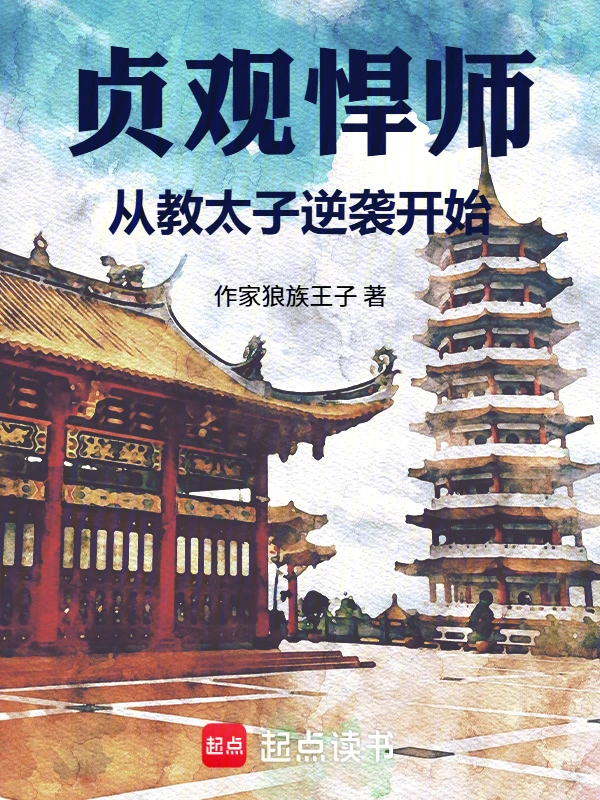
Zhenguan Warrior: Starting from Teaching the Prince to Counterattack
贞观悍师:从教太子逆袭开始
- Status
- Ongoing
- Length
- 2.8M Words
- Genre
- Historical
- Audience
- Male
- Subgenre
- Jin-Sui-Tang Dynasties
- Updated
- 2d ago
- Source
- Qidian
Stats
Tags
Synopsis
Reader comments
In booklists 4

Say Hello to 2026: in the New Year, They Will Update 10,000 Words Every Day
Your New Year's Day is taken over by stories. A list of 20 10,000-word updated books specifically designed to combat the holiday book shortage has been launched online. It is updated rapidly and has a large volume to keep you reading throughout the holiday!


2024 Personal Book List
The books in the book list are all subscribed, and they look okay.
Cai, Step on Me
Color

I've Seen It over the Years
I have been recording my online articles for 20 years. Although many of them are pirated, some have not been read, and some have been copied, there is nothing I can do. I was poor back then, and now many of the articles I have read cannot be found because I cannot remember their names. I write down some personal opinions as a way of reminiscing. I also want to thank all the authors of the online articles I have read, which enriched my green years and improved my Chinese language scores to a cert
Readers also read
 I, Feng Yong: I Knocked Out My Dad at the Beginning and Quit Fengtian!
 Red Mansion: Starting from Joining Jinyiwei
 Gou Served as Sima Under Dong Zhuo
 Red Mansion: Start Escaping and Farming from the Equipment Bar
 The Grandson of Zhenguan of the Tang Dynasty: Please Call Your Majesty the Crown Prince!
 Ming Dynasty Veterinary Medicine, Who Saved Zhu Biao's Life at the Beginning
 Ming Dynasty: in the Beginning, He Complained That Zhu Di Was Not the Right One to Succeed to the Throne.
 Daming: I, Yan Maoqing, Really Smoked
 Datang: They Force Me to Be Emperor, Right?
 Datang: How to Become the Chief Planner of Xuanwu Sect
 Datang: a Guide to Avoid Pitfalls for Li Er at the Beginning
 The First Uncle of the Ming Dynasty
 Da Qin: Mistakenly Recognized the First Emperor as the Father-In-Law at the Beginning
After watching it for so long, I always feel like something is wrong.
It is written that now the protagonist is still working as the grandson of the emperor, and his reputation has been given to Li Er. From time to time, he has to be questioned and doubted by Li Er, and he also writes a lot of journals to "change customs". Who the hell wants to see modern things as ancient times? I bought two books to see if I can't see it. Up to now, the little boss Li Tai is still alive and kicking, and he is also a god.
I read the war strategy article last time (Start today to compete in the world). In the end the author failed. I hope the author of this book will not be a loser. I will subscribe as much as you write. Please don't give up because of public opinion. Very well written, keep it up!
If I were Li Chengqian, the first person I would kill as emperor would be the protagonist.
The writing of Prince Li is simply ridiculous. He must do everything as the ministers say. Although he is stupid, he is not too stupid. The author is still like a literati. The Holy Emperor rules from the top of the arch, and the public is full of justice. Disgusting, bah, you might as well write that the prince was taken away from his body. A little person jumps like this. Is it really difficult to think of an emperor who doesn't lift a sword and transfers people with an imperial edict? He can't find someone to replace them all and kill them all. You regard an emperor like Li Shimin as a good person, and you mock him like a monkey. People take advice because they are ministers, not to ridicule him or fight against him.
😌In fact, this book can also be placed on a female channel. As long as the protagonist changes her personality, this book will directly make the female channel a god
There are three accompanying students and two are gone. Who else can teach, and who is still the mastermind behind Tiantian?
How should I put it, the last few chapters have been bloody. The most important thing is that the author doesn't understand the emperor's bottom line at all? What is the bottom line for officials? The emperor's bottom line is only one, that is, rebellion is not allowed. There is only one bottom line for officials and aristocratic families, that is, they are not allowed to influence their fortunes. Aristocratic families were killing people, setting fires, eating human flesh, and exploiting the people. Even if they massacred the city, the emperor would probably tolerate it. Similarly, even if Wei Zheng spits at Li Shimin and Li Shimin smiles, he can endure it. But there is one thing that cannot be tolerated, and that involves rebellion. Once rebellion is involved, it will be destroyed without mercy. As for purging a certain aristocratic family, it will cause local turmoil and bring the court to a standstill. I'm sorry, but it's really unimportant. Compared to dealing with the rebellion, other things are small matters. Similar political struggles will basically not push the other party to a desperate situation. The family may send a killer to assassinate the prince, this is possible. The family may have poisoned Li Shimin to death. This is also possible. It is even possible to go to the extreme and incite local rebellion. But you can do everything, but you will not openly hold a group in the court to force the emperor to depose the prince. Because it is easy for people to think that Cao Cao forced Emperor Xian of Han to kill Queen Fu. This has basically pushed an emperor into a desperate situation. You have violated the emperor's bottom line, and it is an act of rebellion. The emperor can no longer mix mud and boil frogs in warm water. Even if the emperor wants to take a step back, it is impossible. Because if we take another step back, the imperial power will be shaken and the foundation of the Tang Dynasty will be unstable. Political cleansing by thunderous means, or even political massacre, is necessary.
Full subscription, more than two million words, let's talk about your thoughts after reading it.
It took more than two months to read the latest chapters one after another. What makes this book more outstanding is that it uses many advanced systems and theories of later generations combined with the words of saints to teach the prince, influence the country, and change the understanding of the ancients. The smell behind the scenes. As the protagonist emerges, everyone knows that the protagonist is helping the prince behind the scenes, and the protagonist is the master, but. A group of court ministers and Li Shimin also tried various methods to test their wits. Moreover, the writing format tends to be more and more routine. The most classic one is that the protagonist proposed an advanced method and system to the prince Li Chengqian. After seeing it, he praised his talent and then told Li Shimin. After seeing it, Li Shimin was amazed, silent, jealous, and worried about the prince's power and balance. Then he asked his eldest grandson Fang Xuanling to discuss it. They read it one after another and expressed various opinions and discussions. After returning home late at night, they began to meditate behind closed doors again, and then worried about the relationship between father and son. The king of Wei and Du Chuke discussed various strategies and plotted. The more I read, the more tired I became, and the more I read, the less interesting it became. In the end, I didn't even need to read it. I already knew what was going to be written next. The only things I was interested in were the theories, systems, and ways of thinking. Finally, I would like to say to the author that no one's money comes from the strong wind, and the audience is not stupid either. If you skimp on your word count today, and tomorrow and the day after tomorrow, your word count will only get lower and lower. This book has come to an end.
The introduction smells like a female channel. Brother, are you on the wrong channel?
Take out some evidence and hammer it down
It is obvious that AI is used. I have been reading novels for so long and I have never seen any author be so rhetorical. Only AI has the problem of excessive rhetoric. There is also a historical text in this book. The narrator likes to use extremely modern vocabulary, such as judgments, buttons, etc., And the long string of classical Chinese text at the end is even more outrageous. Which author nowadays can casually talk about a long paragraph of classical Chinese? If I use AI, why should I pay? How good is your AI?
I want to know how this book got on the list?
What I most admire about Li Chengqian in the book is that he always questions the method proposed by the protagonist, even though the protagonist has proven time and time again that as long as the method he proposes must be able to be completed, Li Chengqian still questions and denies... Really, is it so difficult to listen to the protagonist's words?
You want to create a rebel in the Eastern Hemisphere, the governor of Asia, the emperor of the ages, the Khan of Heaven, the general of Tiance, the founder of the Tang Dynasty, the founder of the Xuanwu Sect, Emperor Taizong of the Tang Dynasty Li Shimin. The identity of the time traveler? Omniscient? IQ 180? Or the disabled prince Li Chengqian?
Look at the introduction... Versus Li Shimin? I don't know who is crazy
Negotiate the decentralization of power for the current prince
It's quite humorous. If you become the emperor, you will be punished. Either the protagonist becomes the emperor and takes the initiative to decentralize power, or you centralize power until death. The protagonist's identity is doomed to death.
I have been criticizing those who complained in the comment section of this book for the past two days. I am not criticizing them just because they think the book is not good. The reason for criticizing them is that they posted some bad remarks on a new book by a new author. First of all, the author did not make any bad remarks about the content of the book. The author himself did not engage in inappropriate behavior, nor did he defraud anyone of their money because of this book. When a new author sees so many bad comments in the early stages of creation, it is a huge blow to the creator. New creators are ordinary people like everyone else, and it is impossible for them to achieve perfection from the beginning. I think it is speechless for everyone to criticize the author with the requirement of perfect work. Put yourself in Qian Xuesen's shoes and judge you based on Qian Xuesen's achievements. If you can't achieve Qian Lao's achievements, I will say that you have accomplished nothing, and it may even escalate to your personality problem. Can you accept it? So give creators some patience and tolerance. With a good creative environment, more creators will produce more works. I am a person who likes to read novels. My usual hobby is reading novels. When I see a work I like, I support it. When I see a work I don't like, I just change it. I think this is enough for the creator.
So hard to guess
1. It has been more than thirty chapters, and the emperor has not found out who the master behind the prince is. It's so hard to guess! Is it difficult to replace everyone? This is the protagonist forcibly giving wisdom to the emperor. There are too many wisdom drops so I won't watch it. 2. Why not directly travel to Li Chengqian? Because the author is a good teacher. In the form of dialogue, every action and every point of view should be broken down and taught to the readers. The trouble with people lies in being a teacher. Is this teacher, the author, absolutely necessary? 3. In short, for the sake of being a teacher and for behind-the-scenes hobbies, I forcibly impart wisdom to the imperial power machine. This is the characteristic of this book. It's okay to read Shuangwen, and reducing intelligence is the standard feature of Shuangwen 😴😴😴
You go and interfere with the emperor's family affairs. The ministers of the Ming Dynasty thought the same way at first, but later they were buried in the snow by Zhu Laosi.
What mistakes are easy to make in historical novels❓
Before the Ming Dynasty, the emperor was not called "Emperor". In the Song Dynasty, he was mostly called "Guanjia", and in other dynasties, he was often called "Your Majesty". In the Ming Dynasty, the emperor was occasionally called "Emperor", and in most cases he was called "Your Majesty". After Kangxi of the Qing Dynasty, people began to be generally called "Emperor". Princes and princes call themselves: Princes in the pre-Qin and Han Dynasties can be called "Gu", and a few can be called "Ignores". After the Wei, Jin, Southern and Northern Dynasties, the title of "Ignores" gradually became exclusive to the emperor, and princes, princes and princes can only be called "Gu" or "I". Song, Yuan and Ming called themselves "I" or "I". Before the Qing Dynasty, princes and princes rarely called themselves "this king". Starting from the Kangxi year of the Qing Dynasty, princes generally called themselves "this king". In ancient times, women called themselves: "nujia" was a modest name for women after the Song Dynasty. Women in the Han and Tang Dynasties more often called themselves "concubine", and noble women could call themselves "I" and "I". Before the mid-Ming Dynasty, most dynasties used copper coins for daily transactions, with very little gold and silver. It was only in the mid-to-late Ming Dynasty that silver became the mainstream currency. -In the late Ming Dynasty, "meeting votes/deposit checks" appeared among the people. There were no unified rules. Most of them were deposits and withdrawals/exchange receipts from acquaintances or local circulation, and were not legal currency. In the early years of Daoguang in the Qing Dynasty (1823): Rishengchang Bank was established, and private banks began to issue standardized banknotes, focusing on cross-regional exchange. They were only circulated in Shanxi merchant trade circles and major commercial ports, and were not yet popular. In the third year of Xianfeng in the Qing Dynasty (1853): the official issued the Ministry of Revenue official banknotes (official banknotes), which were forced to circulate nationwide. At the same time, the network of private banknotes expanded to the whole country, and official and private banknotes ran parallel. The use of banknotes entered an explosive period and became the "starting point of popularization." High-leg tables and chairs only completely replaced the low tables for sitting on the floor in the Song Dynasty. During the Han and Tang dynasties, people knelt and sat on the tables to eat and discuss matters. The furniture was mainly low tables and couches. The memorial system was only established during the Kangxi period of the Qing Dynasty. Officials in the Tang and Song Dynasties used "memorials", "tables" and "statements" when submitting memorials, while in the Ming Dynasty they used "memorials" and "memorials". There is no such thing as "memo" or "zhezi". In ancient formal occasions, the hand-over gesture was performed with the left hand outside and the right hand inside. The right hand outside was a special "unlucky gift" for funerals. "Better greetings" is a unique etiquette of the Qing Dynasty. It was mostly used by subordinates to superiors and juniors to elders. During the Tang and Song dynasties, people often performed cross-hand salutes and bows to greet greetings when they met, and there was no such thing as "sending greetings". {"NickName":"Supervision and Restriction","UserId":406440657} Before the Yuan Dynasty, subordinate officials rarely called superior officials "adult". In some dynasties, subordinates called eunuchs "adult", and in some dynasties, they called their parents and elders "adult". Beginning in the Yuan Dynasty, lower-level officials would occasionally call officials of second-rank and above "sir". From the middle and late Ming Dynasty, only officials of third-rank and above would be called "sir" by their subordinates. Officials with lower ranks could not be called "sir". However, in the late Ming Dynasty, there began to appear a few cases where officials above the fourth rank were called "adult". Before the mid-Qing Dynasty, following the rules of the Ming Dynasty, only officials of third rank or above would be called "adult". Starting from the mid-Qing Dynasty, calling officials "adult" gradually became common for lower-level officials. Attention! ! ! What is mentioned above is that lower-level officials refer to higher-level officials. No matter which dynasty, it is absolutely impossible for higher-level officials to call lower-level officials "sir". Some novels even write about emperors or nobles calling other officials "sir". This is simply contrary to Tiangang! ! ! Finally, let's talk about the problem of civilians calling officials Before the middle and late Qing Dynasty, civilians in various dynasties and generations called officials differently, and most of them called them "officials" and "masters". From the middle to late Qing Dynasty, civilians also called officials "adult".
Why do you always imagine that ancient times need evidence? It's a bit funny to just replace all the people and it's all over. Just replace three with two and keep one protagonist.
You can read it before it is put on the shelf. The writing is very good. You don't need to read it later. It's just a money scam. Che Zhuluan said back and forth that he doesn't want any Bilian.
I've read almost 200 chapters, and it's well written, but it's too monotonous. The Tang Dynasty was not only about machinations but also about the love between children. Even a few fewer chapters would be better than none. Men's world needs women to embellish it.
Standard intellectual essay
Just read the free chapters of this novel. If you really pay to read the later chapters, then I really think you have bought shit. Smart people like Sun Wuji and Fang Xuanling always sneered and scolded the prince in his heart for being stupid. You said it would be okay if it was just once. Are you sitting still? Isn't that stupid? You were reasonable once, but later people will definitely wonder why the prince did this behind his back, and what is their deep meaning? In the end, the prince did this, it was too reckless, the prince was too stupid, and then he sneered in his heart. The description of Li Shimin is the same. Alas, I can only say that if you spend money to buy the paid chapters later, I can only say congratulations on winning the big prize.
It's better to teach Li Chengqian, invite other princes to drink, poison them all and kill them. Li Shimin did it, why should the prince do it? Can't do it
I'm really out of inspiration, so I'll just end it. It's already very popular.
It's been 4 days, when will it be updated?
Such a good book, I'll kill myself
Updates are getting slower and slower. I subscribe to a lot.
Have you noticed that each chapter now has to repeat one or two paragraphs, paste and copy?
I've been waiting for you for half an hour. Why the hell are you still waiting for me?