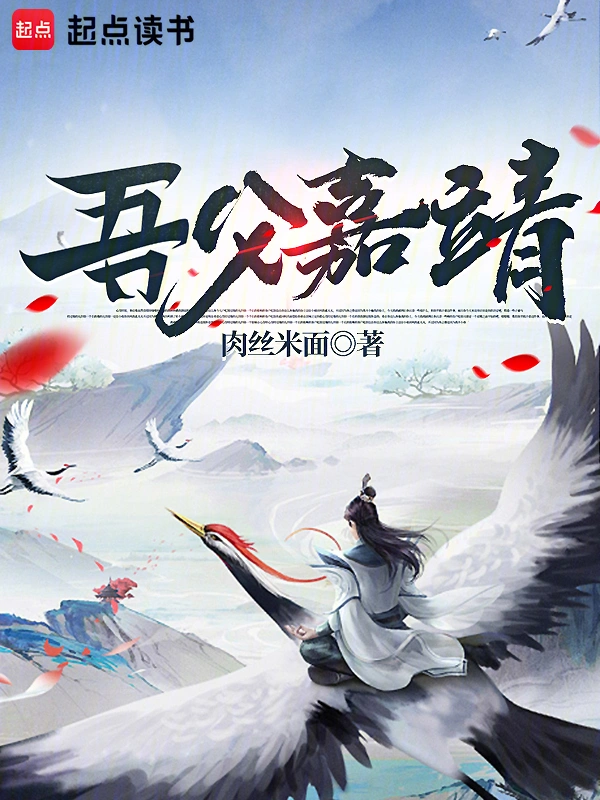
My Father Jiajing
吾父嘉靖
- Status
- Completed
- Length
- 897k Words
- Genre
- Historical
- Audience
- Male
- Subgenre
- Song-Yuan-Ming Dynasties
- Updated
- 8mo ago
- Source
- Qidian
Stats
0Monthly votes
15.6kRecommends
39.5kFans
247Chapters
Tags
Synopsis
Reader comments
In booklists 1
Readers also read
 1914 Begins with the Rejection of the Schlieffen Plan
 In the Red Mansion: Escort Daiyu to Beijing at the Beginning
 Talker in the Song Dynasty
 Please Call Me Your Majesty the Tsar
 Never Walk Alone!
 Emperor of the Song Dynasty 1066
 Northern Qi: My Father, Emperor Wenxuan
 Daming: Have I Become Wanli's Portable Grandfather?
 I Am Drawing a Hot-Blooded Episode in the Zhiyu Episode!
 Datang: They Force Me to Be Emperor, Right?
 Emperor Ning Has the Guts
 Jingtai: Make Ming Dynasty Great Again
 Ming Dynasty 1566: Regent of the World
 Ming Dynasty Admonition Minister
 The Legitimate Son of the Ming Dynasty
Have you ever been a prince? Some things are written randomly, taking it for granted
Bore explosion problem
Bore blasting was a global problem at the time, especially in Europe, where the metallurgical industry was immature. The gun blasting rate was actually very high, and it also caused serious accidents. In 1574, the Governor of the Spanish Netherlands ordered 300 cast iron cannons from the Liege Cannon Foundry. However, due to the lack of casting iron technical support, although these iron cannons were delivered on time, after testing, all of them exploded and no one was spared. Wathier Godefrin, the director of the cannon foundry and the cannon caster, was also arrested and imprisoned because of the failure of the cannon casting. Source Colin J. M. Martin—"Full fathom five wrecks of the Spanish Armada" The cast iron cannon artifacts from three periods, including the Inmarill Rose that sank in 1545; Gustav's leather cannon, and the Batavia that sank in the Netherlands in 1629, all have obvious traces of splicing. Most of the extant European wrought iron cannons from the late Ming Dynasty have barrels that are level with the barrel, and traces of gaps in the iron bars are clearly visible. This is irrefutable evidence that can be found online. European wrought iron cannons even mentioned in their own documents that they could not be loaded with high-pressure granular gunpowder, and they often exploded and the real King of Scotland was killed on the spot. The ratio of saltpetre to carbon to sulfur was 7.5:1.5:1 In the nineteenth century and 5:1:1 in the sixteenth century. Additionally, powder made in France and Italy at least up to the end of the sixteenth century was not grained.'' Morin "Morphology" Powdered gunpowder burns slowly and produces a lower chamber pressure. The energy of granular gunpowder is 1.5 Times that of powdered gunpowder, and the burning rate is 3 times that of powdered gunpowder. , As a result, Western European wrought iron cannons only used low chamber pressure powder gunpowder, and the chambers repeatedly exploded. It was still possible to replace them with granular gunpowder. During the British expedition to Cadiz in Spain in November 1625, due to the greed and embezzlement of military contractors, and the lack of management experience of state officials, who knew nothing about military logistics support, the British expedition not only lacked food and clothing, but also used shabby weapons. There were even many matchlocks that did not even have fire holes, so they could not be fired at all. The country invested a lot of money, but there were too many moths, which ultimately led to the failure of the war. During the Battle of Oudenaarde on July 31, 1667, 600 French heavy matchlock guns exploded on the battlefield in one day (Source: "Un probl ème opé rationnel du "the prac tife of a rtillerie" In 1621, Spain cast 150 new bronze cannons within two years. Due to the poor skill of the gunsmiths, these cannons were not cast well. Among them, 20 of 36 cannons were damaged when they were tested for the first shot. Although the British cast iron cannons in the 17th century had a temporary monopoly in Europe, unfortunately it was only in the early 17th century that there were records of the British adding limestone to blast furnace smelting, and it was not until the fall of the Ming Dynasty that they began to use coke for smelting. Fortunately, the British's high-quality low-sulfur and low-phosphorus iron ore helped them a lot. Otherwise, with their metallurgical technology, the iron cannons they cast would not be much better than those of Spain. Also, the Hongyi artillery introduced in the early days of Chongzhen exploded in front of all civil and military officials during the first test firing in the capital, and the remaining unexploded parts were sent to the Liaodong battlefield for use. European science and technology has also developed step by step. Some people think that Europe has been advanced for three to five hundred years or even longer because of its advanced science and technology in modern times. How is it possible that real life is not an instant improvement across eras by clicking "Upgrade" in a video game?
Sea ban and Japanese pirates
The purpose of the so-called "sea ban" in ancient times was to restrict and eliminate rebel forces, combat piracy and smuggling, and ensure social stability. The "Sea Ban" was only promulgated when there were Japanese pirates. Rather than "sea ban" first, there will be Japanese pirates. Don't reverse the causal relationship. Sea ban and seclusion are two different things. The direct cause of the Japanese rebellion was the civil strife in Japan. In order to make a living and seek wealth, the feudal lords, samurai and ronin who failed in the war organized into armed gangs and went to China's coastal areas with pirate merchants to carry out armed smuggling and robbery and other criminal acts Ming Dynasty literature is actually quite strict about nouns. Pirates, sea pirates, Japanese pirates and Japanese slaves all refer to completely different groups. Japanese pirates are divided into slave thieves and sub-thieves. The Ming Dynasty called these people differently. If they were pirate merchants, they were called pirates. If they are Japanese, they are called Japanese pirates. There is a clear distinction. For example, the Ming Dynasty court and the local chronicles of Zhejiang Province distinguished between Japanese pirates and pirate merchants who colluded with Japanese pirates. Wang Zhi was the largest pirate merchant on the southeast coast at that time. He raised a large number of Japanese pirates to cause trouble, but the record about him clearly stated that he was a pirate merchant, while the Japanese he raised were recorded as Japanese pirates. They have never been mixed together The Japanese can be divided into two types. One is the pirate group headed by Wang Zhi who has inextricable interests with the Japanese pirates. The other is the pirate group whose wives and children were held hostage by the Japanese pirates and forced to attack the town The Japanese pirates are the Japanese pirates as described in Jixiao's new book Military Training Records. The Japanese pirates are Japanese pirates. Forced Japanese pirates were classified as rescued people, while pirate groups were classified as rebels. They were not confused with each other The main force, logistics, bases, and channels for selling stolen goods were all provided by Japan. And the disappearance of coastal Japanese pirates had a great relationship with the changes in Japan. Since the establishment of the Tokugawa shogunate in 1603, the Warring States Period in Japan ended, and vassal states from all over the country collected troops and put them into the treasury. Ma Fang Nanshan Soon after, the Tokugawa shogunate issued a lock-down order. Japanese citizens were not allowed to run around. They stayed at home, men farmed and women weaved, and the economy was restored. Then look at historical data. Starting from 1603, the Japanese rebellion in the late Ming Dynasty began to slowly decrease. The last Japanese pirates seen in history books invaded the coast of Fujian in July of the fourth year of the Apocalypse (1624). From 1633 to 1639, the Tokugawa shogunate issued five consecutive lock-down orders. The Japanese pirates are completely extinct The direct cause of the Japanese pirate rebellion is the civil strife in Japan. At the end of the Yuan Dynasty, Japan split into the Northern and Southern Dynasties, and wars between the two sides continued. In order to make a living and seek wealth, the feudal lords, samurai and ronin who failed in the war organized into armed gangs and went to the coastal areas of China with pirate merchants to carry out armed smuggling and robbery and other criminal acts. Because the main force came from Japan, they were called Japanese pirates at the time Japanese pirates Ancient name) Japanese pirates (bandits or foreign invaders of national borders) Japanese pirates refer to the Japanese. Chinese people want to be Japanese pirates unless they have Japanese household registration. The Japanese pirates are composed of Japanese samurai ronin, Japanese pirates, and Japanese merchants Sea bans have been in place since the Song Dynasty😲😲 The "Book of Taizong" in "History of the Song Dynasty" records that Zhao Guangyi "banned sea merchants" in September of the second year of Yongxi (985). According to the "History of the Song Dynasty·Shihuo Zhi", Zhao Guangyi stipulated private trade with overseas countries in the early years of Taiping and Xingguo (976) Anyone who trades for more than 100 coins will be sentenced, and those who trade for more than 15 coins will have their faces tattooed and be exiled to the island. In other words, Zhao Guangyi not only completely banned overseas trade, but also completely banned land trade with foreign countries. He did not do it on a whim, but implemented it as a long-term national policy. In the fifth year of Chunhua (994), the ban was specifically reiterated, and the punishment laws were also very harsh. It was a crime to have more than 100 guan, and if the amount exceeded 15 guan, one would be tattooed on the face and sent to an island. Later, it was stipulated that those with more than 4 guan would be sentenced to one year in prison, and 20 guan would be sentenced to local service with tattoos on the face. The "History of Song Dynasty: The Benji of Emperor Gaozong" records that in the seventh month of the fourth year of Jianyan (1130), he "banned shipping merchants from Fujian, Guangzhou, Huaihe and Zhejiang to Shandong, and was considered to be the guide of Jinren Township". Not only that, he also issued an edict in August of the second year of Shaoxing (1132) to confiscate the ships of the coastal people and replace them every year to guard the dangerous sea lanes. In essence, it was not much different from the sea ban. According to the "History of the Song Dynasty·Shi Huo Zhi", Emperor Gaozong of the Song Dynasty established a market in the twelfth year of Shaoxing (1142), so he took wax tea as the basis of the market. All the crotch, cut, piece and collar, regardless of how high or low they were, were scrutinized by the officials, and smuggling into the sea was strictly prohibited." That is to say, the overseas trade of wax tea was prohibited.
The affairs of the world are planned and calculated, but the word "people" is nothing more than the people. No matter how civil servants, military officers, or heroes, they can't stop the people's concerted efforts. Modern children understand this, but few ancient emperors could fully understand it.
If the male protagonist reuses Zhang Juzheng, he should not always let him do this kind of charging into battle. It is better to treat it as a certificate of submission for the male protagonist or an opportunity to enter the eyes of the emperor and important ministers. If it is done too much, it will be too hateful and offending, and it may become Zhu Wan's second best. If he is to be trained as the future first assistant, he still needs to find someone else to rush into the battle and be the mouthpiece of the prince, so that Zhang Juzheng can offend less people. After all, the male protagonist may not be able to protect his own people now. Zhang Juzheng's words are suitable for the time being to hide in the rear and make plans, to observe politics step by step, to understand the world's current problems, to integrate the direction and measures of reform, and to prepare for the future. After all, he is not yet the Yuan Fu who will have insight into world affairs in the future. The male protagonist needs to find a knife to rush forward and hide himself and his future important ministers in the back. Gao Gong does this well and his character is also suitable.
Thoughts after viewing
I have read more than 30 chapters and it is a good book. I personally feel that the protagonist pays too much attention to political dogfights. Various calculations are described in each court meeting with the expressions of all parties. Although this is normal, after all, political battles are inherently more verbal confrontations. However, in this way, the plot is a bit delayed. I want to see the protagonist become the emperor, which may take one to two million words. I think It would take at least 4 to 5 million words to see battleships with big cannons and queuing to kill. Although it is reasonable to write like this, I may have read too many cool articles in recent years, and now I feel uncomfortable reading this kind of (ps: In addition, I think that if you want to revive the Ming Dynasty, you must first do it with the belief of re-conquering the world. It is not a good choice to reveal political opinions from the beginning)
Strengthen authority, rule and clan arrangements
Only reducing the benefits of clans has limited effect. If there are more clans in the future, they can arrange to form the "Zhu Family Army" (the lower-level clans in the fifth server have the least risk, and let the clans pay blood tax to reduce some of the population burden). Zhu Yuanzhang had a similar idea. As a result, because of Zhu Di and Zhu Yunwen, the Ming clan cannot be used later. It is a pity that these are all human resources! (Big In Volume 17 of the Ming Huidian, officials and gentry paid taxes as one, and even the vassal kings had to pay taxes. It was illegal to donate and annex land. Once someone reported that the whole family was exiled, the land was distributed to the surrounding people. However, later supervision and restrictions were relaxed, and it was useless to reduce the treatment of the clan in history. The Ming Dynasty finally died of poverty.) The clan could take the imperial examination, which was restored in the Wanli Dynasty. Even if you don't go to war, you can recruit workers in factories🏭, set up the Internal Revenue Service, and let the lower-level clans serve as violent tax collection teams. You can also set up a royal academy for the clans to study astronomy, geography, mathematics, medicine, physics, chemistry, machinery, art... To contribute to human civilization. To make contributions, don't forget to ennoble vassal kings overseas😏 When the clan has more members, you can also find these distant relatives to perform corvee service. The most important thing is that you don't have to pay 💰💰💰 Let the clan make money and respect the emperor😎 It's rare to be an emperor in time travel. If you can't make the capitalists jealous, the emperor will be in vain. The so-called "civilian group" is essentially a group of representatives of interests from different regions competing for power in the court. They are not monolithic. In the middle and later stages, party strife will only occur when the emperor's authority and control declines. If these groups of scholar-bureaucrats are divided, they can use the share dividends of some factories and chambers of commerce to win over them. "We must make many friends and few enemies." It can be improved. The status of the three ancestor gods Xuanyuan Huangdi, Fuxi, and Nuwa enhances the legitimacy of the protagonist's authority (the three ancestors are the protagonist's predecessors😏) and increases the cohesion and assimilation ability, which provides justice and legitimacy for the complete incorporation and assimilation of surrounding ethnic minorities. On the high ground of faith, we not only need local Taoism and other philosophical sects, but also have ancestral beliefs as firewalls😎, and they will not go astray as easily as religions🔥 In China, ancestral beliefs are very important. It is related to the legitimacy of the court, the authority of elders and parents, and the consensus of the people😊 Even if the feudal dynasty, Confucianism, and religion are gone in the future, the people of China can be reunited.
Long live Grandpa Mao
Gee, Zhang Juzheng is still young at this time. In 10 years or even 5 years later, his performance will not be like this. Now he is not the one who has no inner support, no trace of external desires, and is obsessed with the camera. The passion in his heart is still there. I hope that Zhang Juzheng will be written well and his characteristics will be written out, instead of being a flat character. After all, he is the prime minister who saved the time. I hope he can get along with the male protagonist as a monarch and his ministers.
I hope the author will not have a personality cult tendency. For example, with Zhang Juzheng, you need to treat each courtier according to the plot development in the novel. You can use both good and bad people, but you must know in your heart what interest groups they each represent.
Don't ignore this factor in Xu Jieshi and Zhang Juzheng's work. Gao Gong is stubborn and has various problems, but he is good at one thing. He has no descendants who can be pure ministers.
Jiajing had 8 sons. By the time Jiajing died, only one of the eight had died, King Yu. King Yu also passed away a few years after he succeeded to the throne. I remember that none of them lived past the age of 40. The sons given to Jiajing were even more at risk than the emperors of the Ming Dynasty.
Wanshou Emperor
Train to look like a crane
Jiajing's plate is really difficult to accept. Qingliu is in charge, the inner court and the outer court are colluding, the empress dowager is still alive, and there is no one in the five-city army and horse department. We rely on others to fight the war, and we can't collect the money. It's extremely difficult.
There are two types of tribute: regular tribute and partial tribute. The partial tribute is the main one and has a huge bilateral transaction volume. The amount of positive tribute is generally very small, and tribute trade is a very high-end and cheap alliance system. The Ming Dynasty tribute was not a loss-making transaction. For details, please refer to the Ming Dynasty Huidian. You are wrong to think of losing money, because in the Ming Dynasty Huidian, the price of the Ming Dynasty's own cloth was a hundred times that of others' tribute, so there is a saying that the Ming Dynasty returned dozens of times the tribute, because the pricing power rested with the Ming Dynasty. During the Hongwu period, North Korea was allowed to pay tribute, and a large number of war horses were sucked up by the tribute. North Korea was the horse-raising area designated by the Yuan Dynasty. In the early Hongwu period, North Korea had a large number of troops and war horses. Japan's trade with the Ming Dynasty was a steady loss. Japan's tribute was swords and armor, and the Ming Dynasty paid tribute in the form of cloth, bowls, and pots. Japan has detailed tribute trade records. The copper ore sent by the Japanese contained high silver content. The Ming Dynasty bought it at a slightly higher price than ordinary copper ore, so that a lot of silver could be extracted. Then the copper ore was minted, and then the copper coins were used to settle Japan (even treasure banknotes were used to settle Japanese goods🤣🤣). The Yongle Tongbao copper coins of the Ming Dynasty were originally needed, such as trade sanctions, etc., The Ming Dynasty also played it According to the calculations of modern Japanese scholars, Japan imported 200 million taels of silver to the Ming Dynasty through trade for more than two hundred years Even the pricing power is still in the hands of the Ming court, making crazy money 😉 As a result, there are still people Talk about making money at a loss There is also the Indochina Peninsula, which has provided gold and silver lessons to the Ming Dynasty for nearly two hundred years. It is not enough if you don't pay. The Tusi copper, gold and silver mines in the southwest often breed the Ming army. The Ming army levied high mineral taxes to supplement the finances of Yunnan, Guizhou and Sichuan, and at the same time, it made three announcements and six peace treaties in the southwest of Yunnan, Guizhou and Sichuan over the past two hundred years. Countless Rebellions In the tribute trade (prospecting trade) between the Ming Dynasty and Japan, the Ming Dynasty did realize the hidden plunder of Japanese silver through the combination strategy of "high silver-containing copper mines + minting rights + treasure banknote settlement", causing Japan to lose a large amount of silver in the long-term trade. This point has received more and more attention in economic history research in recent years. In particular, calculations by Japanese scholars show that Japan exported as much as 200 million taels of silver to the Ming Dynasty in the 16th and 17th centuries (accounting for about 1/3 of Japan's silver production). The Ming Dynasty achieved low-cost seizure of Japanese resources through sophisticated currency and trade methods.
The Ming Dynasty's health schools and other systems should be improved and restored, as well as talent training. Don't make them as bad as they were during the Chongzhen period. Weixue (Weixue School) in the Ming Dynasty was the school set up by the guards. It was a public school opened by Zhu Yuanzhang for the children of military households. It was found in every guard. Moreover, the proportion of military households passing the Jinshi examination is second only to civilian households. In the 13th year of Yongle's reign, the proportion of children from military households in the imperial examination reached 15.4%. After Jingtai, it remained around 30% for a long time, and even reached more than 40%. The establishment of martial arts has been since the Hongwu period when Daning and other Wei Confucian schools were established to teach the children of military attachés. In the orthodox tradition, Zhu Yong, the Duke of Cheng, selected fifty-one brave military commanders and other officers, and one hundred junior officers skilled in riding and shooting, and ordered the two capitals to establish martial arts schools to train them. Those whose children are over ten years old and who should be attacked by the Ming Dusi or Wei Suo, will be sent to martial arts by the academic officials. Those who have no martial arts will be sent to Wei Xue or nearby Confucianism. In Chenghua, the imperial department took the year-end examination to enroll martial arts students. Those who have been unable to study for more than ten years will be sent to the camp for training. During the Hongzhi period, Ma Wen, the minister of the Ministry of War, was promoted to Yan, and the "Seven Books of Martial Arts" were published to disperse the martial arts and Yingshe people in the two capitals. During the Jiajing period, the martial arts school in the east of the capital was moved to the abandoned temple in the west corner of the imperial city, so that the children of military attachés and newcomers to the lord could study there and be taught by important civil and military ministers. Health education is not limited to military attachés, military households in the health institute can also attend school. First of all, a military household is usually a large family, because the Ming Dynasty law prohibits military households from dividing their families. As long as one male in a military household can serve as a soldier, the rest of the males can make a living on their own, and it is not a problem to go to school. "A Study of Military Households in the Ming Dynasty" by Zhang Jinkui clearly states that the political status of military households in the Ming Dynasty was higher than that of civilian households, and that after the mid-Ming Dynasty, military households could change their registration, sell their own land, and gain free time by paying taxes and grain. At the end of the book, the essential difference between military households in the Ming Dynasty and those in the Wei and Jin Dynasties was particularly emphasized. Military households in the Ming Dynasty had no personal dependence The politics of the Ming Dynasty established by Zhu Yuanzhang needed to be cultivated. Therefore, at the same time that Zhu Yuanzhang established official government schools across the country, Zhu Yuanzhang said to the officials of the Zhongshu Province: "The teachings in the schools were extremely harmful in the Yuan Dynasty. Up and down, ups and downs were prevalent, and although the schools were established, they existed in name only. Since the mutiny, people have learned war, but only If you know how to fight, you can't know what you are doing. I only govern the country with education as the first priority, and education as the foundation." ("History of the Ming Dynasty, Election Records 1") Students who have not entered the government-run Confucian school, whether they are children or older people, are called "tongsheng". It means children who study. Once these young children enter a government-run Confucian school, whether it is a government school, a state school, or a county school, they all become Confucian students, and they begin to have an identity that is different from ordinary people. They are what we often call talented people. The prefecture, state, and county Confucian schools established by Zhu Yuanzhang are actually like our municipal middle schools, state middle schools, and county middle schools today, but there is only one in each prefecture, state, and county. The school level is the same, but the instructor level is different. School instructors at the prefecture level are called "professors", at the state level they are called "Xue Zheng", and at the county level they are called "Jiao Yu". There are also teachers below them called "disciples". Among the instructors at these levels, only the professor of Fu Xue is a ninth-grade official, which is the lowest grade among graded officials. The other instructors do not even have a grade, so they are not considered to be in the mainstream. Although these instructors are of very low grade or have no grade at all, even if they are ordinary instructors, they still have crowns, that is, official uniforms and hats, which are different from ordinary scholars; and local officials are not allowed to send instructors to show the importance of the court. Zhu Yuanzhang attached great importance to education, so there should be as many schools as there are prefectures, states, and counties in the country. At that time, there were only twelve provinces, prefectures, prefectures, and counties, plus the schools established by the military and garrison stations, with a total of more than 4,200 teachers. To us today, we think it's so little. But at that time, it was considered quite a lot. The school with the most students is Yingtianfu School. Yingtianfu is the seat of the capital, so there are more students, with a total of 60 students. In other places, there are only a quota of 40 students in a school in a prefecture, and only 30 students in prefectures and counties. With just such a small number of students, it can be regarded as a key and important school, right? These students are called students and scholars. I did some calculations and estimated that when there were many students in the country at that time, there were 30,000 to 50,000 students, accounting for a little more than one thousandth of the country's population. Even though these scholars are just middle school students, they are the treasures of the country. They were all students at public expense. Each person was given six buckets of rice per month, which was later increased to one stone. They were also given fish and meat. They were not only responsible for food, but also for clothing. However, the clothes also have prescribed styles, which are uniform school uniforms: wear a square scarf, a student uniform, and a robe, one inch above the ground, with sleeves longer than the hands, and the turned-back cuffs cannot exceed three inches above the elbow. Later, because this suit of clothes was somewhat similar to the clothes of officials, the style was improved. The improved clothes had a proper name, called shirt, which was made of jade-colored cloth and silk, with wide sleeves. Later, they were also required to wear a sun hat. Historical books say: "Taizu personally inspected, and all three changes were finalized." Unified school uniforms such as "History of the Ming Dynasty·Yu Fu Zhi San" were all approved by Zhu Yuanzhang himself
It's not easy to be the son of a Taoist master! It's easy to die! The mortality rate is obviously abnormal! Can't say yet! If you say it, you will be called a conspiracy theory!
That's it. The protagonist proposes an outline to determine the direction. The detailed operations below will naturally fill in the details of those who came out of the imperial examination. It is indeed right to rectify the government first after the examination is completed. Only when there are people first can the policy be implemented. We still have to rectify the Beijing camp. Without the support of the army to dare to propose reforms, the protagonist will have to dissolve in water. I feel that the protagonist will be assassinated, burned, and flooded many times later on, leveraging the interests of the gentry, and the road to reform will be long.
If not, just say something
First it was double-opening, then it was interrupted and the eunuch was asked to make an announcement...
This plot is worth seeing
Even in the early Ming Dynasty, I have to say that I am not a shoehorn, I am really xxxxxxx. By the end of the Ming Dynasty, the tension was too strong, it was all about war. The Jiajing period has not yet reached its peak, and there are many parties and groups fighting each other. The protagonist is dressed as a prince, and the father and son are of the same mind. It is very relaxing and enjoyable to read~
Read the introduction
The last sentence of the novel's introduction is too low
Free for all orders 😭
About ballistics
The mathematical basis of external ballistics is Newton's three laws and the law of universal gravitation, first published in 1687. Otherwise, there is no way to calculate ammunition at all. In other words, before Newton's three laws, only empirical formulas could be used for gunfire. The "New Science" published by Tartaglia in 1537 was actually Tartaglia's public advertisement for job hunting. However, his work was kicked out of the textbook in 1590 because it was not accurate enough. ("New Science" laid the foundation of modern ballistics, but the book "New Science" believed that the cannonballs would fall vertically at the highest point. It made me laugh to death😃😃😃hahaha) Tartalia claimed that he had never fired a cannon. The book "New Science" had nothing to do with artillery at the beginning, but it was later practiced by Spanish people in large numbers In fact, it was written by Western ballistics has always been relatively slow to respond to mathematics and physics research. Artillery production and use systems are often inconsistent (for example, the British artillery during the Peninsular War once pulled out a bunch of Spanish Harborg-era cannons for supplementary purposes). The projectiles of muzzle-loading guns often use shrinking bullets, and the people who teach mathematics may not know how to shoot artillery. European artillery-related mathematics education can only cultivate intuition to a large extent (this was even the case in the 20th century. The preface to the US military-related textbooks in the 20th century also emphasized that practitioners who introduced the use of artillery were more capable of training and practicing artillery officers than mathematics professors. Benefits), many of those equipment are simply money-making gadgets - Galileo started to engage in ballistics back then just to promote his own equipment, but if you really plan to use these things that may even be based on Aristotelian mechanics to defeat the enemy, then you can only say good luck. The accurate hit range of traditional general artillery and Western artillery in the Ming Dynasty was actually the same "two hundred steps", and the Ming army had better conditions to spend money on target training. At the same time, those European mercenaries even skipped musket shooting because the economy and wages could not support it: (frontier fortress in the Jiajing period) and could see beyond the trenches. The terrain is vast. If you encounter a large enemy approaching the border and the officers and soldiers unexpectedly fire their weapons and crossbows from far and near, you should consider placing them outside the wall of the enemy's tower. This method is suitable and a mound of six to seven feet should be erected about two hundred paces above the suspected thief. If the thieves come to this pile, use the extremely distant divine cannon to attack. Invincible gunslinger. Use the cannon tip to point out the machine and other weapons to attack it. It's about a hundred and fifty steps up. Another mound of soil five or six feet tall was erected. Like thieves here. Then use weapons such as the Sub-far Divine Spear, the Erlang Machine Seven-Eyed Gun, etc. To attack them. About a hundred steps further. Then set up a mound four to five feet tall. Like thieves here. Then use the long-range arm, crossbow, arrow, rocket, three-eyed gun, Fran machine and other weapons to attack them at the same time. Then every shot will hit the target. No one is safe from harm. You will see thieves running and hiding. Don't dare to spy on my frontier. The 1849 "Supplementary Readings and Records" believes that the range of the open artillery and the foreign artillery in the Opium War are the same, two hundred paces: there is also a test target, the close one can only be one hundred lunges, counting fifty feet; the far one is two hundred lunges, counting one hundred feet; further away, it is vague and subtle, and the inspection is unreal. This is consistent with what Chen said, exactly. The most effective way to use early artillery is to put it close and aim directly. 😊 European science and technology also developed step by step. Some people think that Europe has been advanced for three to five hundred years or even more because of its advanced technology in modern times. How is that possible?
Although it's not the best, it's well written. Why are there no fine products? I feel that this exquisite book must be of this quality.
The votes have been given, please update more.
000000
It's very comfortable to read. I finished one article and it's clean, not cluttered, and non-toxic.
Author
Can you answer the previous question?
Keep updating! It's very good. It needs to be tested and verified, and it needs to be climaxed and climaxed.
Solve the problem of taking pills first and then solve the problem of heirs
The three generations of Jiajing were deceived. Jiajing loved to take pills and also gave pills. Yan Song and Jiajing were the most resistant to erysipelas in history. Lead and mercury also loved to eat pickles. This completely aggravated the toxicity of lead and mercury and still lived a long life. None of his sons lived a long life. The only Wanli emperor was also the only one to be exhumed from the Ming Xiaoling Mausoleum. After archaeology, it was proved that Wanli had a leg disease, which was contracted from his mother's womb. This left a point for the monarchy to be attacked.
It's going to be a bad rhythm again 🙂