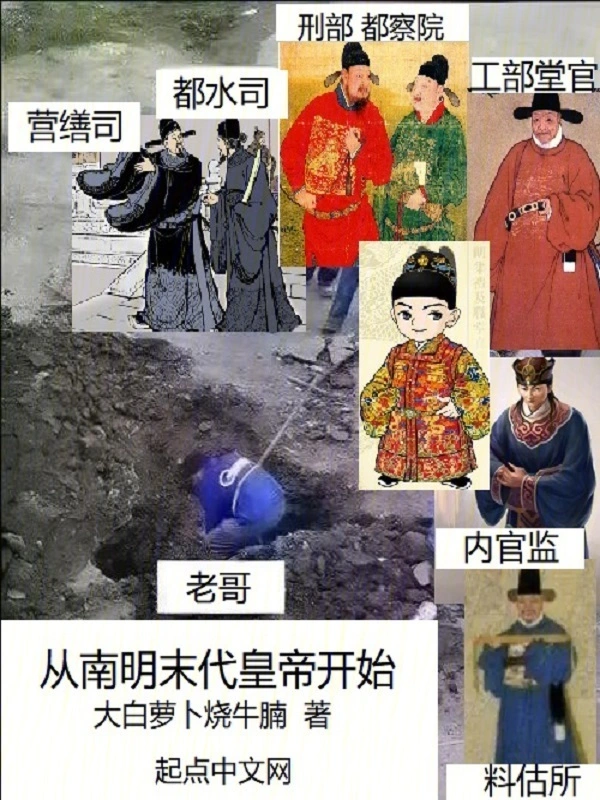
Starting from the Last Emperor of the Southern Ming Dynasty
从南明末代皇帝开始
- Status
- Completed
- Length
- 1.1M Words
- Genre
- Historical
- Audience
- Male
- Subgenre
- Song-Yuan-Ming Dynasties
- Updated
- 2y ago
- Source
- Qidian
Stats
0Monthly votes
2.8kRecommends
7.2kFans
501Chapters
Tags
Synopsis
Reader comments
Readers also read
 Talker in the Song Dynasty
 Please Call Me Your Majesty the Tsar
 In the Red Mansion: Escort Daiyu to Beijing at the Beginning
 1914 Begins with the Rejection of the Schlieffen Plan
 Never Walk Alone!
 Taichang Daming
 Sun and Moon: Yongli 1656
 Daming: Have I Become Wanli's Portable Grandfather?
 I Am Drawing a Hot-Blooded Episode in the Zhiyu Episode!
 Anti-Qing: Start with a Piece of Stone!
 You Promised to Fight Against the Qing Dynasty and Restore the Ming Dynasty, but You Are Going to Camp in Jintian?
 Taiping Heavenly Kingdom 1854
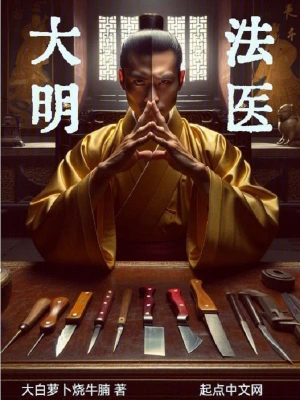 Ming Dynasty Forensic Medicine
The poem at the beginning caught me off guard while driving 😌
The title of the book is not eye-catching enough, how about "The Emperor of Ashes"? Maybe it can also trick fans of Li Longji or Zhu Wen into it.
I still prefer rebellion, but the officialdom environment at the end of the Ming Dynasty was impossible to rectify.
There are two Ming Dynasties in historical materials, one is the Ming Dynasty written by the Ming Dynasty, and the other is the Ming Dynasty written by the Qing Dynasty. A person's understanding of the Ming Dynasty depends on whether you understand the Ming Dynasty through the Ming people or the Qing people. If you understand the Ming Dynasty through the people of the Qing Dynasty, the Ming Dynasty must be a mess, but if you understand the Ming Dynasty through the people of the Ming Dynasty, the Ming Dynasty is also a mess. This involves another characteristic of the Ming Dynasty, which is the contention of a hundred schools of thought. In the writings of the Donglin Party, everyone in the Zhongguan Party is a real villain. In the writings of the Zhongguan Party, everyone in the Donglin Party is a hypocrite. Gentleman, as for the true and false, you can only judge carefully. There are also the Neo-Confucian School, the Heart School, the Qi School, the Practical School, and the Western School... Each of them has his own opinion about what is true and what is false. The same thing is not agreed upon by all parties. It really tests the IQ of history readers, so that many can only understand the Ming Dynasty from the "summaries" of the Qing people.
It's a good work in all aspects. Some people like the rebellion in the late Ming Dynasty, but I prefer the revival of the Ming Dynasty. The problem of the late Ming Dynasty actually existed in all dynasties. This is the cyclical law. The reason why I like the revival of the Ming Dynasty is because the Manchu Qing Dynasty was unbearable. Apart from other things (the feudal dynasties are similar), it is enough that the Manchu Qing Dynasty brutally destroyed the remaining books of the Chinese civilization and imprisoned the people's ideology, causing the civilization to not advance but retreat, thus making the entire nation swallow the bitter pill of ignorance.
Personally, I feel that even if it is obscene, it must at least be consistent with realistic logic. In the environment of Nanming, even Emperors of Qin, Han, Wu, Tang and Song Ancestors had no choice but to accept their fate. A modern ordinary person is incompetent in writing and martial arts, and still wants to overturn the situation. There is absolutely no logic at all.
The monthly vote has been cast, can the author hear my opinion?
First of all, it is about the Loyalty Battalion and the Daxi Army. The Peasant Army has a cooperative relationship with the Ming Dynasty. It was forced by the Qing Dynasty's military pressure and had no choice but to show allegiance to the Ming Dynasty. This situation is actually quite similar to the modern history of our country. Therefore, can the author not show that Li Guo or Li Dingguo were very loyal to the Ming Dynasty in the book? It would be embarrassing to watch. The peasant army could at most help the Ming Dynasty fight some wars that would not damage the foundation (and take the opportunity to seize territory). Once they encounter dangerous combat missions, they will definitely refuse. (Not mentioning modern history, you can also look at Zhu Wen of the late Tang Dynasty. He was also a general of Huang Chao, and then defected to the Tang Dynasty, and finally instigated the throne of the Tang Dynasty. Therefore, if you are familiar with history, it is normal for the Ming Dynasty civil servants to be hostile to Li Guo and others, and Li Guo himself understood it. His relationship with the Ming Dynasty was eased due to the military pressure of the Qing Dynasty. Once the Qing Dynasty weakened, the relationship between Li Guo and the Ming Dynasty would immediately break down) Secondly, regarding titles, there is an old Chinese saying: Only weapons and names cannot be faked. Even in the Southern Ming Dynasty, the enfeoffment of titles was still meaningful, and it was not a false name. As long as you had a title, it was equivalent to entering the Ming Dynasty system. You could legitimately mobilize and suppress Ming Dynasty officials with lower titles than yourself, which was very beneficial to the Loyalty Battalion or the Daxi Army to occupy the Ming Dynasty territory and obtain taxes and other materials. It would also psychologically reduce the psychological pressure of some local Ming Dynasty officials to join the Loyalty Camp and the Daxi Army, and help the peasant army recruit talents. And because they joined the Ming Dynasty system, when they forcibly expropriated the wealth of local large households, some of their resentment would be attributed to the Ming Dynasty, which would also cause certain obstacles to the Ming Dynasty's rule of the place. (Don't think that big local families can tell clearly what is the official army of the Ming Dynasty and what is the Zhongzhen Camp. Once the army moves quickly, the local people will only recognize the flag.) And regarding the title of nobility, there is another hidden danger, which is that some scholars who have a bloody feud with the Zhongzhen Camp and the Daxi Army will have a hatred of the Ming Dynasty. The Ming Dynasty was extremely disappointed. The Loyalty Battalion and the Daxi Army had been rebelling for so many years and had killed countless officials and scholars of the Ming Dynasty. Moreover, due to the long history, it was impossible to expect the peasants in the late Ming Dynasty to have the qualities of modern revolutionaries. They would have massacred cities in the early days and arrested ordinary people for siege like the Qing army. Everyone who is familiar with the history of the late Ming Dynasty knows this. Of course, as the war continued, a large number of generals of the Chuang Army and the Western Army who liked to do evil died, or surrendered to the like-minded Qing Dynasty. The remaining Zhongzhen Battalion was still of high quality, but ordinary people could not tell what the Chuang Army and the Loyalty Battalion were, and hatred would be recorded on their heads. Therefore, the Ming Dynasty's acceptance of the Zhongzhen Battalion and the Daxi Army would disappoint these people, or even surrender to the Qing Dynasty. (Of course, this is not to say that the Zhongzhen Camp defected to the Ming Dynasty. It was strange to be awarded a title in the Ming Dynasty. If you read the history books, you will know that even the ancients could see the situation clearly and cooperated with the Zhongzhen Camp and the Daxi Army without hesitation. Modern people's doubts are more ridiculous, but that was when the situation in the Ming Dynasty was extremely dangerous. Nanming The disease is coming to the hospital indiscriminately, and we must seize every opportunity to save ourselves. To this end, we not only unite with the Loyalty Battalion and the Daxi Army, but also join Christianity and ask for help from Japan, Vietnam, Thailand, etc. In times of crisis, the Ming Dynasty will bow their heads, but once the protagonist comes, the situation seems less dangerous. This must be the attitude towards the Loyalty Battalion and the Daxi Army. It will inevitably change. Of course, this change is actually right for the Ming Dynasty, because officials have read history, and there are countless similar situations in history. Anyone who does not watch out for defectors like Zhongzhenying will definitely be usurped in the future. The series of embarrassing operations in Nanming also come from an understanding of history, and we Modern readers cannot understand it because they only read the history of the late Ming Dynasty and did not look at it from all historical perspectives) Then there is the issue of Eurocentrism. The author repeatedly emphasizes the Portuguese instructor's stick, which seems to have greatly increased the Ming army's combat power. But if you think about it carefully, isn't this Eurocentrism? The foreign sticks made the natives obedient and they had fighting power. Then the foreign heavenly soldiers could beat the shit out of the Qing army. Does the author really believe that 20,000 Spanish soldiers can conquer the Ming Dynasty (a very famous historical joke)? Can the Morris Square and the Portuguese instructor's stick defeat the Qing Dynasty? The Europeans themselves cannot achieve this record with their own armies. (I know that the author also added new concrete technology, but in terms of main senses, I still feel that the author pays more attention to the sticks of the Portuguese instructors) (In addition, I feel that the author also has a bit of a Manchu-oriented meaning, and he always seems to be a Manchu superman or something like that. It seems that the Han people are vulnerable, but hundreds of years later, the composition of that army will not be Han people?) Finally, there is the issue of the emperor's personal conquests. I know the author wants to imitate the Shao Song Dynasty, but the personal conquests of the emperor are really not that powerful. When people are about to die, Unexpectedly, to be loyal to the emperor, countless top leaders (not necessarily emperors) of the Five Dynasties, Ten Kingdoms, Wei, Jin, Southern and Northern Dynasties personally marched on the battlefield, and the effect was not necessarily good. For example, in the late Sui Dynasty, Dou Jiande also marched on the battlefield in person, but it did not have a particularly big effect, let alone the protagonist is Emperor Yongli. He is an unorthodox emperor. Perhaps Emperor Chongzhen's personal expedition would have this effect, but it is difficult for the protagonist to have such an effect. Of course, for the Guangzhou soldiers who won the battle to defend Guangzhou, the protagonist's prestige will be higher, but how can the protagonist have such high prestige among the old armies of Huguang and Jiangxi? Are there many Nanming emperors who have been sold by them? Finally, I know that these problems will make it more difficult for the author to write a book. I have to write it according to reality. Now it is 400 chapters and we have just arrived at the Guangzhou Defense War. Therefore, I do not ask the author to modify or write related plots. It is just that I feel a little embarrassed and I am not happy about it. If I have offended, please forgive me! Generally speaking, this book is of a higher standard than other late Ming Dynasty novels. I am very happy to read it and have ordered it all. I hope the author will write better and better and become a great writer soon!
You reuse Li Dingguo just because you think you will die too slowly. How did Liu Wenxiu say that when a tiger enters a wolf, the king of Jin will harm the country?
Now the author seems to need some quiet time to think about the purpose of his writing. If you are happy, then be happy. If it is quite rigorous to use the engineering thinking and mathematical logic of a civil engineer to achieve the great cause of resisting the Qing Dynasty. So let's keep the drama steady.
I really can't understand why the protagonist can stand in troubled times without a golden finger.
Too much of the science and technology tree will overwhelm the seedlings, and too much of a step will destroy the eggs. The emphasis is on cultivating the spirit of innovation and exploration, providing a soil for the growth of talents, and opening the country to foreign exchanges and learning. Shao Ze, Fusheng in the late Tang Dynasty, wrote very well
Yongli is basically hopeless. He has no land, no people, and no famous generals. He can only rely on the Daxi Army.
Burning cement. In ancient times, there was no awareness of protection. It is estimated that pneumoconiosis will develop in a few years It is something that cannot be avoided in modern times. What's more, in ancient times, it is recommended to use prisoners of war or to kill the Nine Tribes to burn cement. After the war, they will use outsourced slaves to burn cement.
Come on, less systems and stuff like that
It's quite good. The kind of person who transforms into a political animal and an officialdom veteran as soon as he travels through time is too fake. He is always shocked by this and that. The ancients were not fools. Not to mention the one who brought his own history book. He remembered the year, month and day so clearly that it was so fake. The protagonist is based on his own knowledge system, and it is only logical to accumulate it slowly.
This book was both painful and joyful to read. I was happy because the author's writing logic was pretty good, but painful because there were too many dusting details in the text, which reminded me of the days of dusting at the construction site!
Highly recommended!
The writing is really good, I am an old bookworm. The author's writing style is smooth, logical, relaxed, lively and well written. Vote 2 monthly votes to encourage us! I hope that the author will continue to work hard, update, maintain the standard, and don't be a eunuch or a mess! PS: If the author is of this caliber, he might as well recommend his previous books, I would like to read them!
Wu Sangui died too quickly, right?
I'm curious about how to solve the problem of powering the crusher? Steam power or electric motor? You don't know how to hit people!
What a great book. I'm surprised it's not popular.
The title of the book doesn't work. I used to catch up on the latest chapter, but after a few months I couldn't find it. This time I had to search through the history categories to find it.
Okay, okay, it's too hardcore. It's a pity that the book is not popular.
Why not develop fisheries in Guangzhou?
In the late Ming Dynasty, there could not be civil servants without any role.
There is a strange question. When Sony went to negotiate, even if he did not get the emperor back, he would first get back the captured Eight Banners of Manchuria. These are also his direct troops. Was it possible that when Sony went to negotiate, he only thought about the emperor and not about the other prisoners?
This novel is so well written. Come on, Bailuobo, you will definitely become a great author. Friends who are waiting for the update can also read "Rolling Ming" first, it is not bad.
It's boring. The main character is an emperor with only two women, and a Westerner. There are no reforms and the eunuchs are abolished.
Zhu Youlang is here. If there is no system, there is no way he can be saved.
The pace is too slow
The protagonist has traveled through time for more than two years. He started from Guangzhou and has not left the southeast region for more than two years. Guangzhou is still struggling to fight. The provinces of Jiangxi and Hunan have not yet been fully controlled and only occupy a few key points. Guangxi in Guangxi and Guangxi has disappeared. If this situation continues, it will probably be fifty or sixty years old to unify the country and drive out the Manchus. How can we develop the country? Expand territory? Could it be that people at that time were determined to die for the Manchus? I remember it was only fourteen years when Zhu Yuanzhang and Jianming drove Yuan Meng away. There were still warlords fighting everywhere. Isn't it more difficult than the protagonist? According to the progress of the protagonist, it is estimated that it will take more than twenty-four years to drive out the Manchus. I hope to refer to the development of the same type of period in history to speed up the progress appropriately! Don't turn around in one place