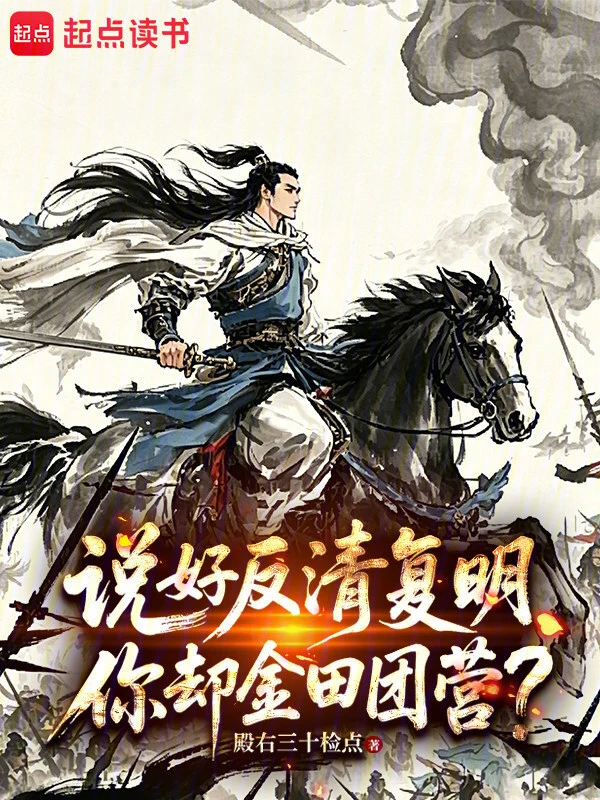
You Promised to Fight Against the Qing Dynasty and Restore the Ming Dynasty, but You Are Going to Camp in Jintian?
说好反清复明,你却金田团营?
- Status
- Ongoing
- Length
- 331k Words
- Genre
- Historical
- Audience
- Male
- Subgenre
- Qing & Republican Era
- Updated
- 2d ago
- Source
- Qidian
Stats
205Monthly votes
1.5kRecommends
183Fans
149Chapters
Tags
Synopsis
Reader comments
Readers also read
 Northern Qi, Sage Khan
 Red Mansion: Start Escaping and Farming from the Equipment Bar
 Fu Ming 1627
 After Lying in Bed for Three Years, He Was Forced to Help the Han Dynasty
 On My First Day at the Police Station, I Ate Imported Candy from a Police Beauty.
 Late Ming Dynasty: Lion of East Asia
 Three Kingdoms: Crossing the River by Touching the Sima Family
 My Girlfriend Cheated on Her and Got Pregnant, and I Ran Away Nine Months Later
 During the Republic of China, I Baoguowei Huangpu Phase I
 The New Tang Dynasty Began with the Anshi Rebellion
 Anti-Qing: Start with a Piece of Stone!
 Sun and Moon: Yongli 1656
Little Karami would not build a mountain by himself and mix with others. At that time, we were still modern people, educating hundreds of people, brainwashing them every day, and starting pyramid schemes. When the Taiping Heavenly Kingdom attracted the attention of the Qing Dynasty, how many troops could a few hundred people pull up, and the rules and regulations were improved at the same time. Being someone else's younger brother, you don't know that reputation and skills are the key to being the elder brother. Once you become someone else's younger brother, you will be the younger brother for the rest of your life. Do you know how to rebel?
It is better to fight against the Qing Dynasty and restore the Han Dynasty than to fight against the Qing Dynasty and restore the Ming Dynasty. What can be done to restore the Ming Dynasty?
I still expect more from this book
Just a quick rant and some personal reflections. Some people in the comment circle asked why they wanted to cast a magic stick, but it still failed. I think it's normal. The protagonist was originally a Hakka from Tiandihui. It is itself a force outside the system. They were not tolerated by the mainstream society at that time. In some respects, they might as well have worshiped God. Although Shi Dakai, Wei Changhui, Hu Yihuang and others are struggling, at least their economic status is good and they can maintain their legal status. Who can survive and rebel? At that time, the only way to start a business and start a project was to invest in Hong Xiuquan. Otherwise, would they follow Hong Bing? Or to suppress the Taiping Army? If it is to be independent and establish a base similar to CPC, then does it need at least a travel group like Lingao Qiming? Can one person do it? If you participate in the Jintian Uprising, you can at least take advantage of the trend. If it doesn't work in the later stage, you can still find a way to stand on your own, or simply go overseas. At least many people in the historical field agree that the Qing Dynasty was really coming to an end in the last years of Daoguang. It was not the Taiping Rebellion and various civil commotions and wars that caused huge population losses and forced Malthus. Then the external forces of the British Empire intervened to forcibly replenish blood, and the Qing Dynasty might really be finished in 1870. People at that time may have had similar considerations, otherwise there would be no Tongguang ZTE. ZTE can actually be interpreted as Zhongxing, which is not a good word. Historical time travel is not about making up for difficulties and making up for shortcomings. In the early days of the Taiping Army, at least in Guangxi and Hunan, the mobilization and combat effectiveness of military discipline organizations were also very strong. There is also the Northern Expeditionary Army behind. Everything that exists is rational. So shouldn't we assume that we are people in the world and think about the key points? You can't just beat him to death because of a magic stick. Travel historical novels are still limited in their fiction and add settings. It still cannot be separated from the background of the times. People's choices are constrained by the limited environment of the times. If the traveler comes to the southeast. What he faced was the Taiping Army, which had been transformed, reduced in revolution, and degraded. I'm afraid he will have to suppress the Taiping Army and then take the Westernization route to seize power bit by bit. The best thing about the author is that he can round up many things in the early stage. Relatively self-consistent. The Father came to use the means of witches and gods. He reminded Feng Yunshan to keep a low profile, but there was nothing he could do. The exaggerated ceremony itself is part of the theocratic narrative. Similar is Xiao Chaogui. Personally, I am more looking forward to the if line, how to manage Jiangxi, exaggerate the strength, handle it properly and care about foreigners. A certain book idealizes some foreigners and turns them into deus ex machina, willing to sell all kinds of good things. On the other hand, some people were beaten to death with sticks. In order to simply cater to the trend of thought on the Internet and please readers, many places have been changed to be detailed in one stroke, which saves trouble. The comment area is still deep in water now. The motivations for some of the violent comments are indeed questionable. Please think about it and decide for yourself.
As long as it's anti-Qing, I support it.
I haven't read this novel yet, but the title is so exciting that I immediately invested all my monthly tickets. 🙂
One problem is that all the characters speak in a formal manner. Whether they are scholars or illiterate farm workers, they have no character recognition at all. Just reading one sentence, I have no idea which character said it.
This book is too poisonous. I can't figure out why I would take refuge in a failed regime.
The collection is too small. Can the author continue writing? The writing and textual research are relatively smooth, but the technique is particularly poor, with a pure running account and no characterization.
The author has absolutely no idea about the historical background of the Taiping Rebellion
The Taiping Rebellion was a joint-stock entrepreneurial project of unemployed workers after the cotton spinning industry chain in Guangzhou was eliminated by the British. In the name of worshiping God, it was just an affiliation. Because after a crow, there was freedom of preaching, and in the name of preaching, troops from all walks of life could be gathered across the state capital
It is better for the protagonist to learn from another book that also wears the Kingdom of Heaven. The human body is picked up by the Taiping Army, and then he starts as an engineer, and the start is not as good as the protagonist The author originally wanted the Kingdom of Heaven to go to Nanjing by the original route and go to Guangzhou to farm, but after being persuaded, he changed it and let the Kingdom of Heaven go to Xi'an The ancients said that God will be blamed for not taking advantage of him. If Yang Xiuqing knew that he could conquer Nanjing, he would not carry Hong Xiuquan's flag.
An Essay on the Beginning and End of Chiang's Fifth Suppression of Southern Jiangxi
Gu Zuyu said about Ganzhou: "The government is connected to the area of Ou, Fujian and Baiyue, and is blocked by valleys and mountains. It is the key to the mountains and seas and the hub of the rivers and lakes. If something happens on the right side of the river, it must be fought over." The Red Army's capital Ruijin, with Zhanggong as its vein, Dayu as the south gate, Tingzhou as the east, Chengui as the west, and divergent in all directions, are the living expression of Gu's "key to the mountains and seas". Chiang wanted to pull it out, but he knew that it took more than one province's troops to do it, so he overthrew the country and locked up four mouths, and then suppressed them five times and then temporarily succeeded. The changes in strategy, the reasons for victory or defeat, and the huge cost can be obtained and detailed. 1. Strategies of the First Four Suppression Campaigns and Reasons for Failure Between Gengwu and Guiyou (1930-1933), Chiang Kai-shek attacked Jiangxi on four occasions. One of his strategies was to use troops from Jiangxi Province to engage in head-on collision. At the beginning, Chiang ordered Lu Diping to gather 100,000 people, with the name "Drive straight in, advance separately and attack together"; then ordered He Yingqin to supervise 200,000 people, with Yi's name "Fight steadily, make camp step by step"; thirdly, Chiang appointed himself as commander-in-chief, accompanied by British, Japanese and German advisers, gathered 300,000 people, and advanced in three directions; fourthly, he ordered Chen Cheng and Gu Zhu to lead more than 300,000 to suppress the enemy in a pincer manner. Although their names have changed many times, in fact they all want to find the main force of the Red Army and annihilate it, without leaving him alone. The reason why there are three losers in a row: One is that the shaft belt is not locked. Chiang only knew how to fight for the gateways of Jiujiang and Nanchang, but did not know the secrets of Ganzhou. To the south of Meiguan, Chen Jitang supported his troops and was happy to leave a buffer zone; to the east of Tingzhou, the Fujian army was empty; to the west of Chengui, the Hunan army stood on the sidelines and watched. With Ruijin as its navel, the Red Army retreated into the mountains of Xingguo and Ningdu when the enemy came, making it difficult for Chiang Kai-shek's heavy artillery to attack; when the enemy retreated, it returned to Tingzhou and Xinfeng, with three branches always connected. As Gu warned, "If you don't know the secrets of fighting for the family, you can take advantage of my queen." Second, the tactics of war are mutually exclusive. The Red Army used the strategy of "luring the enemy deep and annihilating them with movement". In the Battle of Longgang, Zhang Huizhan went deep alone and the entire army was annihilated; in the second encirclement and suppression, he swept across 700 miles on the 15th; in the third encirclement and suppression, in the third battle of March, 30,000 enemies were annihilated; in the fourth encirclement and suppression, in the battle of Huangpi, he performed an ambush and performed meritorious service. Chiang Kai-shek's "long drive" was trapped in the ravines, while his "steady attack" was exposed in the cracks, and the main force of the Red Army was still out of reach. On the third day, the people's support is against them. The Soviet area was divided into acres of land, all the people were soldiers, and every village was equipped with sentries. When Chiang Kai-shek entered the mountain, he was like a blind man, while when the Red Army came out of the mountain, he was like an arm with fingers. Gu Shiyun said, "The dangers and dangers depend on the people." Chiang had hundreds of thousands of troops but did not have the right location and people, so he suffered repeated setbacks. 2. The Strategy of the Fifth Suppression and Reasons for Success In Guiyouqiu (1933.9), In view of previous losses, Chiang Kai-shek set up a camp in Nanchang to take charge of the military affairs of the five provinces of Jiangxi, Guangdong, Fujian, Hunan, and Hubei. The three-pronged strategy was to attack Gu's "Key to Ridge and Sea": One day, four provinces encircled. The North Route Army's Gu Zhutong and Chen Cheng led the 33rd Division and three brigades to build forts from northern Jiangxi and move south; the South Route Army's Chen Jitang led the 11th Division and one brigade to lock Dayu and Meiguan, blocking the road to northern Guangdong; the East Route Army's Jiang Dingwen led the Sixth Division and one brigade to guard Changting and cut off the aid from western Fujian; the West Route Army He Jian led the Ninth Division and three brigades to block the entrance to Chengui. The four fronts advanced in parallel, each locked on one side, so that the Red Army could not cross the border to breathe. Four of Gu's "key points" were welded to death. The second is fortress doctrine. Chiang Kai-shek changed his "long drive" to "cannibalization" and built bunkers every time he pushed forward. On the border between Jiangxi and Fujian, there were more than 15,000 fortifications and thousands of miles of highways, supplemented by 200 aircraft bombing day and night. The mountainous area that used to "lure the enemy deep into" has now become a prison cage lined with blockhouses. The Red Army had no way to retreat and was unable to fight, so the "communication" function of the axis was abolished. Three: economic suffocation and three-point politics. The four provinces have joined forces to strictly prohibit salt, medicine, cloth, steel, and telecommunications from entering the mountains. Prices in the Soviet area were soaring, there was no steel in the arsenals, no iodine in the hospitals, and the soldiers and civilians were in poor health. He also carried out "three-thirds of military affairs and seven-cents of politics", strictly enforced the rule of "protecting the army", surrendering himself to clean up the party, and digging out the roots of people's war. However, Chiang Kai-shek's success was not the result of a single military plan, but actually the Red Army's own destruction of its axis. At that time, Bo Gu and Li De were in charge of the government and abandoned the old laws. First, we advocated "defending the enemy outside the country's gates", storming Lichuan and Nishi, and rejecting the strategy of "lubing the enemy deep into the country"; continued the strategy of "fortress to fortress, short assault", defended the battle of Guangchang for eighteen days, suffered 5,500 casualties, and opened the north gate; resumed the strategy of "dividing troops into six routes and defending along the entire line", with 80,000 people scattered across hundreds of miles of defense lines, and everywhere was weak. What is especially hateful is that after the Fujian Incident, the 19th Route Army rebelled against Chiang Kai-shek. Mao Zedong and Zhou Enlai took the opportunity to attack and contact Cai Tingkai to break the siege. Bogu denounced it as "deception by the third force" and sat back and watched Chiang suppress the Fujian Revolution, blocking his way to the east. By the autumn of Jiaxu (October 1934), there were only eight counties left in the Soviet area, and all their food and ammunition were exhausted. The 86,000 Red Army troops were forced to leave Duhe, and their axis was broken. 3. The depletion of troops and the huge cost Chiang's Fifth Suppression, the troop strength increased, and the cost was appalling. In the first four campaigns, about a million troops were gathered, and about 80,000 generals were lost. The fifth campaign was an overwhelming effort: one million troops were mobilized across the country, and 200 aircraft were deployed, of which 500,000 (the Sixty-fourth Division and Seven Brigades) went straight to southern Jiangxi. It lasted a year, and Jiang's army suffered tens of thousands of casualties, but it was not defeated. The consumption of wealth is more than the loss of soldiers. We borrowed foreign debt to purchase weapons, built 5,000 forts, built thousands of miles of roads, and established an officer corps of 7,500 people in Lushan. The cost of "suppressing the Communists" accounted for half of Nanjing's annual expenditure. The exorbitant levies and miscellaneous taxes increased to 1,756 types ("Ta Kung Pao" Gui You recorded), draining the people's power. As for national destiny, the price is particularly high. In 1933, the Great Wall War of Resistance had just ended, the Tanggu Agreement had been signed, and North China was in danger. Chiang ignored the danger of the nation and trapped millions of elites in a corner of southern Jiangxi, leaving the three eastern provinces, Rehe, and North China defenseless. The Japanese pirates beat the enemy at Shanhaiguan, while Jiang was busy welding the mouth of southern Jiangxi to death. This is not only a cost of material resources, but also a drain on the Republic of China. On the subject Chiang's four previous defeats were due to the fact that the troops of one province in Jiangxi collided with the axis of the four provinces in Ganzhou. The secret of Gu's "key to the mountains and seas" has not yet been solved. Fifty percent, Cheng Zai borrowed the wisdom of the barbarians to understand the method of "locking the four mouths and welding the axis belt", but the Red Army turned left and committed suicide. However, although Chiang Kai-shek drove the Red Army out of Duhe, he spent one million troops, five provinces' treasure, and seven hundred thousand taxes in exchange for one "Red Army leaving Jiangxi" every year. Both troops and money were exhausted. The Marco Polo Bridge Incident happened the next year, and the Republic of China no longer had the strength to fight. This is the ninth corpse after the eight corpses listed in Gu Zuyu's house. The most important thing about Ganzhou is being able to get out but not being able to hide. Chiang Kai-shek's four mouths were formed. It was formed when the Red Army broke its own axis, which is not the place of true knowledge. If you really know that "you know Ganzhou can be used as an axis and then you can do something for the world", you should know that if you use a million soldiers to destroy an axis, even if you win, you will lose the battle. The Qing people paid more attention to Xunyang and despised Qiannan, but Chiang Kai-shek paid more attention to Qiannan, but they exchanged the life of a country for the empty city. Gu Zuyu's sentence in his blank line, "The risk and impermanence lies in the human being" is now fully visible. Alas! The land is still the land, and the people are still the people. If the axis remains, it will prosper, and if the axis is broken, it will perish. Is this the case in Ganzhou alone?
Where is Chen Kai at this time? This guy knows water division 🤓
It's okay to call me Chen Shiqing. Yang Fuqing didn't change it either.
I haven't developed anything after reading more than ten chapters. I'm just kowtowing to this and that. What's the point of joining the Taiping Heavenly Kingdom?
The Strategy of the Red Army in Southern Jiangxi (After Gu Zuyu's "Minutes of Reading History Fang Yu"
In the past, when Gu Zuyu discussed Jiangxi, he took Jiujiang as the gateway, Nanchang as the heart of the palace, and Ganzhou as the center. He said: "The government is connected to the area of Ou, Fujian and Baiyue, and is blocked by the valleys and mountains. It is the key to the mountains and seas and the hub of the rivers and lakes. If something happens on the right side of the river, it must be fought for." He also said: "Knowing that Ganzhou can be ignored, it can be used later. Nanchang; knowing that Nanchang cannot be defended, we can then use Jiangxi; it is better to fight outside Jiangxi than to fight outside Jiangxi." This statement was read by the Qing Dynasty as a footnote to defense, emphasizing Xunyang and despising Qiannan. By the 20th century, when the Red Army started in southern Jiangxi, they knew that it was not a retreat, but a foothold in the world. 1. Reasons for choosing the location At the end of the Qing Dynasty, the people were in ruins and the Republic of China was in chaos. The Red Army started in Jinggang and turned southward. It did not go to the battlements of Jiangzhou or conquer the city of Hongdu, but chose the upper reaches of the Gong River between Ruijin, Yudu, Xingguo and Ningdu as its base. Why? In the land of Ganzhou, Zhangshui comes from the west, Gongshui comes from the east, and merges into Qiancheng. It flows into Pengli in the north and Dayu in the south; when it crosses Meiguan, it goes down to Nanxiong and follows the Beijiang River to Guangzhou; when it leaves Tingzhou in the east, it enters the Minhai; and when it goes west to Chengui, it leads to southern Hunan. Converging in all directions, it is not the defense of one corner, but the changing mouth of the world. Ruijin Jugong River is located on the upper reaches of the Mianjiang River, at the western foot of Wuyi, surrounded by mountains and mountains, without the convenience of a railway or the burden of a fortified city; forty miles to the east is Changting, which leads to the west of Fujian and goes down to the Tingjiang River; to the south it passes through Huichang, Xunwu and Xinfeng, strangling the throat of Jiangxi and Guangdong; to the west it looks to Ganzhou without touching its walls, and to the north it is connected to Xingning to force Ji'an. Where Hakka people gather, land rights are tight and the people want to change. With the call for land reform, all the workers will be soldiers. Therefore, the Red Army abandoned Jiujiang in silence and abandoned Nanchang in the heart of the hall. It stood alone as the source of Zhanggong, with Ruijin as the navel, Yudu and Xingguo as the left and right, Dayu as the south gate, and Tingzhou as the east door. This is not to avoid disaster, but to demonstrate that Gu's "great authority can be relied upon". 2. Signs of growth In the winter of Jisi (1929), the Fourth Red Army moved south from Jinggang, achieved a victory in Dabaidi, and another victory in Changling Village, conquering Changting, and decided to "use more than 20 counties in southern Jiangxi and western Fujian as separate regimes". From Gengwu to Xinwei (1930-1931), he defeated Chiang Kai-shek's army three times: Longgang captured Zhang Huizan, Donggu annihilated Gong Bingfan, Huangpi and Liantang won three battles, and twenty-one counties in southern Jiangxi and western Fujian were connected into one area, covering an area of 50,000 miles and a population of 2.5 Million. In October 1931 (November 7, 1931), the First National Congress of the Chinese Soviets was held in Yeping, Ruijin. The provisional central government was established under Chairman Mao Zedong. In December of that year, there was an uprising in Ningdu. Dong Zhentang and Zhao Bosheng led 17,000 people to join the army, and the fifth Red Army was formed. Renshen (1932) conquered Zhangzhou, and Shuikou rejected the Guangdong army; Guiyouchun (1933) broke the Fourth Suppression, and the Soviet area became extremely prosperous: it governed 60 counties in the four provinces of Jiangxi, Fujian, Fujian and Jiangxi, and Guangdong and Jiangxi, covering 84,000 square kilometers and 4.5 Million people. The main force of the Red Army and local armed forces combined were more than 80,000. The Shanghai Provisional Central Committee also moved to Ruijin, and the hearts of the red flags in the world gathered in a corner of Mianjiang River. There are three reasons why it is strong: the first is to divide the land, and the poor Hakka farmers get the land, and the farming and fighting are integrated; the second is the red traffic, from Hudu to Hong Kong, and then transfer to Shantou, Dabu, Yongding, and Changting to reach Ruijin. The Secret Artery of Three Thousand Miles is the modern incarnation of Gu's "key to the mountains and seas"; the third is the three-layered army, the main Red Army, the local Red Army, and the Red Guard Young Pioneers. The reason why the three and four encirclement and suppression campaigns were defeated Chiang's four campaigns (1930.12-1933.3) Were all defeated, not because of the height of the mountain, but because of the victory of axis, people and law. The first is to lure the enemy deep and drag him into the hall. The enemy came from Jiujiang, Nanchang, and Ji'an, and the Red Army retreated from Xingguo, Ningdu, Huangpi, and Longgang. It was in the inner layer of what Gu called "the barrier of thousands of mountains in Ganzhou's Jiexi Valley." Zhang Huizan entered Longgang alone, and Gong Bingfan entered Donggu alone, but they were all annihilated in the mountains. Second, move forward and retreat in large steps. The sixteen-character formula - "When the enemy advances, we retreat; when the enemy is stationed, we harass; when the enemy is tired, we attack; when the enemy retreats, we pursue" - coupled with "concentrate our forces to attack the weak". The second encirclement and suppression campaign lasted for 700 miles in 15 days, the three campaigns had three victories in 80 days, and the Huangpi ambushes killed two divisions four times. The mountains rendered heavy artillery ineffective, and the Red Army was reduced to pieces, and pieces to pieces. Thirdly, the people are the wall. The villages are all outposts, the roads are all eyes, the food is provided by oneself, and the guides are provided by oneself. Mao Zedong said, "Arouse millions of workers and peasants to work together." When Chiang Kai-shek's troops entered the mountains, they were deaf and mute, while when the Red Army entered the mountains, they were deaf and dumb. Fourth, if the city is not nailed down, the axis will live on its own. The Red Army surrounded the capital city of Ganzhou and could not leave immediately. They did not attack Nanchang or defend Jiujiang. They used Ruijin as a stepping stone. The Shunggong water could go down to the mouth of the lake. After crossing Meiguan, they could go to Lingnan, leaving Tingzhou in the east and entering Chengui in the west. Gu's horoscope "knowing that Ganzhou can be ignored and then using Nanchang" has become a method of forming an army. In the autumn of Jiaxu (1934), the left-leaning force was used, abandoning the old strategy of luring the enemy, and going "fortress to fortress", defending city by city, fighting trench by trench, and filling the trenches with powerful troops. The axis of Ganzhou was broken, and Guangchang and Huichang fell one after another. We know that Gu Zuyu's admonishment of "fighting for the sect and not knowing the secrets of taking advantage of my queen" and "fighting in Jiujiang will lead to the waterfront" are not empty words. 4. Traces of Breakout In the ninth month of Jiaxu (1934.10), The Red Army gathered people in the capital, crossed the river at starry night, crossed Xinfeng, knocked at Meiguan, borrowed the road to Nanxiong, followed the old road of Dayuling, went south to northern Guangdong, turned to Renhua, Lechang, and turned into southern Hunan. The roads traveled include Xu Daofu's road to Xunyang in the north, Chen Baxian's road from Nankang to Ganshi, and Lu Guangchou's road across the mountains to Shaozhou. Chen Yi and Xiang Ying stayed in the towns of Youshan and Meiling for three years of guerrilla warfare. They composed poems such as "Today's events are based on righteousness and benevolence, and flowers of freedom are planted all over the world." On: Gu Zuyu prefaced Jiangxi, seemed to focus on Jiujiang, then Nanchang, and finally Ganzhou. However, if the cause and effect is reversed, if the source of Zhang Gong is not alive, then the silence of Hukou will be a dead throat; if the key of Dayu is not opened, then the key of Linghai will be a useless button. The Qing people adhered to the word "gateway", focusing on Xunyang and despising Qiannan. Only when they came to the port of trade did they realize that Ganzhou was a golden vein, but the system was inert. The Red Army did not defend the battlements of Jiujiang and the city of Nanchang. They stood in Ruijin and pushed forward in all directions - following the Ganjiang River in the north they could compete for the Jianghu River, crossing Meiguan in the south they could connect to Guangdong Province, going east to Tingzhou and west to Chengui. In the past, Chen Baxian established his hegemony from Nankang, Lu Guangchou used his piety and bravery to defend the Huainan Ridge, and Wang Shouren hid his troops to stab Chenhao in the back. In the 20th century, the Red Army all followed the same principle: taking Ganzhou as the axis and connecting the four directions, there was no way to retreat, which was Wang Ye's foot. The eight corpses recorded in the Gu family's house were fully alive; the Qing court's neglect of Ganzhou fully demonstrated its ignorance. Sigh! The earth is impermanent and dangerous, but people use it. There is a Wei in Ruijin and a river in Mianjiang. From the completion of Gu Zuyu's book to the uprising of the Red Army, in the 180 years, the true meaning of the word "tangao" was finally obtained.
Hong's Heavenly Father and Brother Tian wanted to prove that he was the Son of Heaven and was inferior to the kings in terms of hard power, so he could only serve as the Heavenly King.
There is a hero in the profile. This man who could become a warlord of the fifth generation and create a modern country is incompatible with the hero.