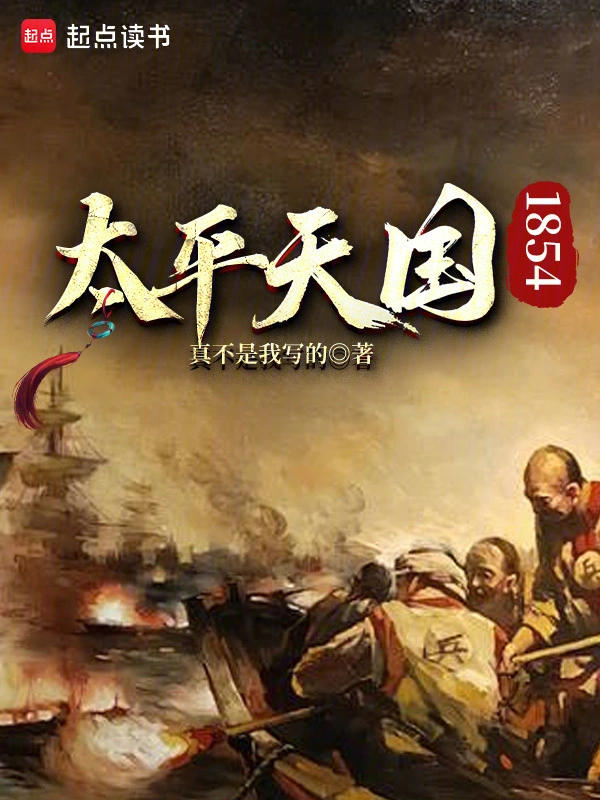
Taiping Heavenly Kingdom 1854
太平天国1854
- Status
- Ongoing
- Length
- 1.8M Words
- Genre
- Historical
- Audience
- Male
- Subgenre
- Qing & Republican Era
- Updated
- 3d ago
- Source
- Qidian
Stats
589Monthly votes
28.7kRecommends
75.7kFans
561Chapters
Tags
Honours
Synopsis
Reader comments
In booklists 2

Shennong Is Actually Myself
I hope that every book on this list is worth downloading and reading for a long time. It will not be lost in the sea of books because of the passage of time.
40Books4kFollows3dUpdated


Grass Jelly Book List
This book list collects good-looking books in various categories, such as fantasy, fairy tales, fantasy, urban, science fiction, light novels, Infinite World, etc., As long as they are good-looking.
99Books668Follows1dUpdated
Readers also read
 Fu Ming 1627
 I Am a Tyrant in Nanming
 At the Beginning, Please Ask Chongzhen to Abdicate!
 Red Mansion Xiaoke
 Daming: Attack, Emperor Yongle!
 Sun and Moon: Yongli 1656
 Nanming, This Emperor Is a Bit Stable
 I Get a New Character Every Week
 Transform into Tang Monk and Become Stronger Starting from Covering the Sky to Obtain Scriptures
 Anti-Qing: Start with a Piece of Stone!
 Beiyang Dream
 Ming Black Sail
 The Capture of the Legitimate Son in Kowloon Started with the Night Capture of Nian Gengyao
As a bookworm of twenty years, my mouth is getting more and more chewy. Many books I have read halfway and abandoned. It is rare that I can read a book like this to the end and still look forward to updating it. It is rare that I can give you two monthly tickets to encourage me.
What can we do if we follow these rotten people like the Taiping Heavenly Kingdom? They have been rotten since they invaded Nanjing.
The people who died in the Jintian Uprising were heroes of the people
: There are many people in the comment area who say that the Taiping Heavenly Kingdom is more evil than the Manchu Qing Dynasty. I won't go into what kind of people are like this. It is undeniable that the leadership collective of the Taiping Heavenly Kingdom had many limitations of the peasant uprising. There was also corruption and internal strife after the uprising, and not all of them were great and upright. However, we must always remember the spirit represented by the Jintian Uprising of the Taiping Rebellion and the huge sacrifices made to resist the reactionary forces at home and abroad. The Monument to the People's Heroes of the Republic has eight reliefs from the eradication of opium in Humen to the victory in crossing the river and liberating the whole of China. It represents what Chairman Mao said: "This dates back to 1840. Since then, in order to oppose internal and external enemies and strive for national independence and people's freedom and happiness, the people's heroes who have sacrificed their lives in various struggles will be immortal!" The people's spirit represented by the eight reliefs is the foundation of our country.
Or be an emperor?
If you dare not let go and mobilize the masses, your dream is to be an emperor and then wait to be overthrown? It's a bit ridiculous, right?
The fundamental reason for the failure of the Taiping Heavenly Kingdom was that it failed to maintain a good relationship with the foreign powers and forced them to side with the Qing court. It also failed to join forces with the Northern Nien Army in time to form a mobile operation.
The Taiping Heavenly Kingdom will never be able to succeed. The leaders of the team are all uneducated and are religious. They will definitely not have a chance on Earth. If you want to succeed, you have to go to Mars. To write about the Taiping Heavenly Kingdom, you have to write about absorbing the few talented people in it and then establishing your own business.
Don't write about recruiting landlords like Jiang Zhongyuan to surrender like the one next door. The rule of the Taiping Heavenly Kingdom was naturally opposed to the landlord class.
Author, I think the Taiping Heavenly Kingdom is very difficult to succeed, not even for time travellers. The high-level officials are corrupting too fast and cannot attract scholars to govern the place due to religion. It will also cause religious and interest conflicts with the great powers. The protagonist is unable to support the high-level people alone and may even be eliminated. Is it possible to attack the coastal areas, and then buy the island of Kalimantan from the Netherlands and the United Kingdom, leaving an escape route? Kalimantan should not be completely occupied at this time. I think it is feasible. Logically, if you retreat overseas, you need to defect to the United Kingdom, but you can really retain an overseas force. It was really a miracle after World War II, because not only did we have to face the great powers, but we also had to face the covetousness of Japan and Germany. Without the protection of the United Kingdom, we would be a piece of fat. How to obtain British protection while maintaining a certain degree of independence is very difficult. Moreover, the resources on the island should not be developed too early, otherwise the price will be greater.
What are the best basic novels about the Taiping Rebellion? Please share. I've become quite interested in it recently.
I haven't read the book yet, but I'd like to ask those who have read it how Mancheng was dealt with and how the bannermen dealt with it. If it's the same old thing about letting go of hatred, then this book means nothing to me. I just want to see blood flowing like a river and dogs cutting it into pieces.
There are currently very few Taiping Heavenly Kingdom novels written. This book should be used as food and fodder. The author must be steady, steady, steady, and don't be anxious! The details, history, and characters must be grasped more rigorously, and there must be less contact with high-voltage wires. Writing in the late Qing Dynasty is not easy, so read it and cherish it!
Under the Taiping Heavenly Kingdom, men and women were not allowed to interact. Hong Xiuquan had many women by himself. It would be strange if he did not kill anyone else. He was not killed by one of his own people.
A Sima said that he was entrusted with a dream by Brother Tian. How many heads do you have to kill?
The protagonist of a historical novel must have a main plot
The protagonist doesn't even know what he wants to do. He has no main plot. He is always led by the situation and is moved by himself. Historical writing cannot be like this.
It is said that the Taiping Heavenly Kingdom made the Hunan Army rich in a wave, and then returned home to improve education. There are many talents in modern times.
One good thing about this book is that it dares to deduce it. Unlike some books, you can write it again and again, but you can't write it at all except relying on the original history.
Very poisonous
In the first few chapters of the game, you just pretend to be a magician, and you will be defeated if you ask Jesus to have a dream. A low-level villain dares to compete with the higher-ups for the right to interpret religion. It is really asking for death. However, the author thinks that the logic is perfect. What a smart guy
Regret
The author lacks courage. At best, there is an extra Li Xiucheng, which is not enough to reverse the Tianjing Incident, nor is it enough to overthrow the Manchu and Western Hu.
The Taiping Heavenly Kingdom, a tragic and premature "rehearsal". Here, where will she go?
This kind of preachy writing is really annoying, you know what
Let's talk about the idea of catching Xianfeng. If Xianfeng is really caught, the protagonist will never have a chance to let him go. Because the crime of letting the Qing Emperor go was too big, in order to appease the public anger, whoever let him go would have to take the blame, and in the end he could only make wedding clothes for others.
I hope there will be more complexity and cruelty in history
Seeing that we have now entered the Hubei battlefield, the overall rhythm is still very good, but there are a few very specific points. The more I read, the more I feel a little "out of touch". I want to have a good chat with you and all the book friends, purely out of the selfish hope that this book can be improved to a higher level: 1. The "absolute unity" of King Chu's subordinates It's a bit inconsistent with human nature and the reality of the army I especially understand that Da Da wants to create an ideal army with combat effectiveness and faith, but even if it is a team led by the King of Chu himself, it cannot be completely free of internal contradictions, right? Between troops from different sources: For example, the old brothers who first followed the army, the Tiandi Congregation who defected halfway, and the later Qing troops who were recruited and surrendered. There will definitely be estrangements, suspicions and even conflicts of interest between them. Between civil and military forces: the generals who lead the troops and the civilian officials who are in charge of logistics, in resource allocation, war There are inevitably differences in the choice of techniques Between superiors and subordinates: there are generals with high achievements, veterans with insufficient ability but seniority, and young officers who are eager to make merit These small frictions and games will not shake the overall unity of King Chu's army, but will make this team more real and flesh-and-blood. Now everyone seems to be carved out of the same mold. They are absolutely obedient to the King of Chu and have no selfish intentions. On the contrary, they are less of a human being. 2. The local resistance was seriously underestimated, and both the Wubao War and the Agrarian Revolution were written too easily. Except for future bosses such as Zeng Guofan and Hu Linyi, in fact, the most troublesome thing for the Taiping Army at that time was the local regiments and powerful Wubao all over the countryside. Those big landowners who have been entrenched in the local area for decades often have money, food and people, and the forts they build are easy to defend and difficult to attack. They are familiar with the terrain and have strong walls and clear fields. Many farmers are frightened by the landlords and the government and do not dare to ask for their land; some landlords will secretly organize resistance, spread rumors to confuse the public, and even assassinate grassroots cadres of the Taiping Army. If these difficulties can be written about, and how the protagonist team can break down these hard bones step by step, it will be much more convincing than the current plot of "it depends on the rumor". 3. The difficulty of raising an army has been greatly simplified, and logistical supplies have almost become "air" The King of Chu's army has grown too fast, with tens of thousands of troops, so many horses, and ever-increasing artillery and ordnance, but the supply problem has never really seemed to be a crisis. Where does food come from? You won't be able to survive for long just by attacking local tyrants to share their wealth. The daily food consumption of tens of thousands of troops is astronomical. How to raise military horses? Not only do you need a lot of fodder, but you also need veterinarians and grooms. How to replenish the horses if they are sick, injured, or killed in battle How to produce weapons and ammunition? Fortunately, swords, guns, swords and halberds, the casting of artillery and the preparation of gunpowder are all very complex technical activities As well as the placement of wounded soldiers and the pensions for the families of fallen soldiers, these are huge expenses Writing about the logistical pressure and how the protagonist racked his brains to solve these problems can truly reflect the King of Chu's ability to govern the country and the army, and make every victory seem more hard-won. 4. The "friend-enemy relationship" between other Taiping troops in Hubei is too vague I am particularly touched by this! Historically, factional struggles within the Taiping Army have never stopped, let alone on the battlefield in Hubei, far away from Tianjing. The relationship between the troops of other kings and the army of King Chu is definitely not a simple "friendly army" relationship. They may cooperate with each other when fighting against the Qing army, but they may also undermine each other in order to grab territory, supplies, and credit, and even stab each other in the back Some generals may have two sides and act according to the prevailing situation. Today they are still allies, but tomorrow they may be allies because of Tianjing's power. They fought hard and became enemies There are also some self-contained local armed forces that nominally submitted to the Taiping Heavenly Kingdom, but actually obeyed the instructions but did not listen to the propaganda If this complex and variable relationship could be written out, the plot would immediately become ups and downs and full of suspense. Now that everyone is working together to defeat the Qing army, there is less drama and conflict.
A few days ago, I saw that the Taiping Heavenly Kingdom had been labeled a cult by some historians. But why was the Yellow Turban Uprising a peasant uprising? The Taiping Heavenly Kingdom was not included.
History has proven that Yang Xiuqing's divine power was not stable.
Critics underestimated the "collective disbelief" of the Taiping leadership. The reason why Wei Changhui, Shi Dakai and others tolerated Yang Xiuqing was because they needed his divine power to unite the bottom class, not true faith. As a time traveler, the protagonist can give Wei Changhui and others the "theoretical weapon" to overthrow Yang Xiuqing as long as he shows rational logic and exposes the flaws in the performance. What the Tianjing Incident lacked in history was this "legitimacy excuse", and the protagonist was given this knife at the beginning.
"High risk" is precisely the optimal survival strategy for time travellers.
Feeling "stupid" is based on the inertia of Internet writing based on "obscene development". But in the Taiping Heavenly Kingdom, if the protagonist from a lower-class background goes to farm or train soldiers, he will immediately be annexed as resources by Yang Xiuqing, Wei Changhui and other factions. Fighting for the right to interpret is the only way to skip the long cycle of "accumulating military merit" and directly enter the core power level. This is not to commit suicide, but to replace extremely high political legitimacy with extremely high political risks. Once he stands firmly, the protagonist will have a "divine bargaining chip" that is on par with Yang Xiuqing, which is more effective than bringing 10,000 troops.
The only historical document that has been tracked down in recent years
It's really well written and expresses what's in my heart. It's just that it's too easy, and the progress is too fast. It feels like the Qing court will be destroyed soon. Now I feel a few doubts 1. According to the current progress, the Qing Dynasty feels that it will live in a few years. How to promote the subsequent plot. Will foreigners intervene? 2. What will be the governance philosophy after becoming bigger? Be an emperor? Still be president. I feel like I haven't said anything at all at the moment. In other words, it is still the concept of the peasant army. There should be a small amount of progressive thinking at this time 3. Henan has attracted a lot of energy, will it cause a chain reaction, the Qing government has no time to take care of it, and the border will lose a lot of land.
In more than two hundred chapters, I haven't seen how to climb the technology tree, and the intelligence agencies and propaganda agencies have not done much. A powerful propaganda force is worth thousands of troops.
Is there any technology crushing it?
Is there any technology crushing it? I mean, build heavy machine guns, airships and other heavy weapons, and then crush your opponents? If not, don't watch it. Traveling back in time to compete with the ancients in strategies, cold weapons, and horseback slashing is just like a master's degree graduate who has to go to the countryside to compete with farmers in picking up manure. It is not only stupid, but also meaningless.
Atlas
Northern Expedition Army, Northern Expedition Reinforcements, Qing Army Route Map Early Nian Army Activity Map Taiping Army Early Western Expedition Route Map
The book with one million words has been completed, so feel free to read it.
There are already one million words in this work, and I don't know how to be a eunuch. Please feel free to read it. New and old readers are welcome to support it.