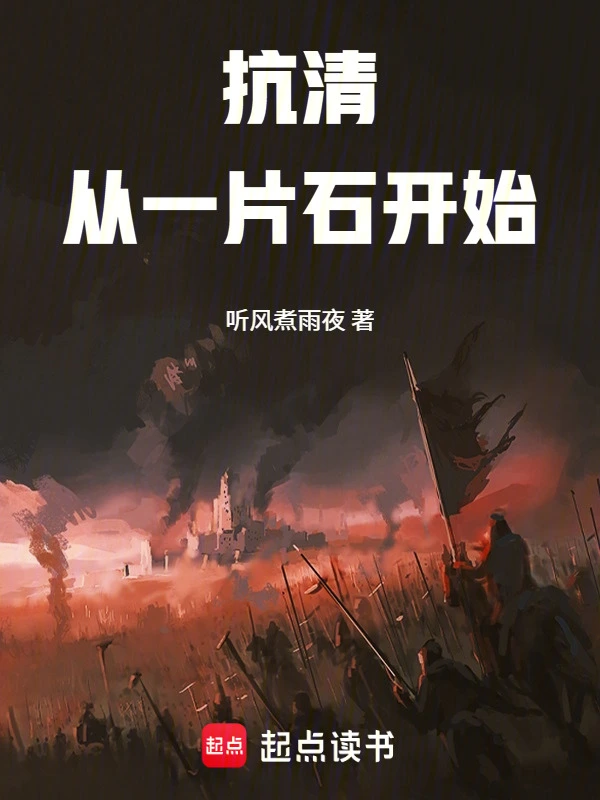
Anti-Qing: Start with a Piece of Stone!
抗清:从一片石开始!
- Status
- Ongoing
- Length
- 1.1M Words
- Genre
- Historical
- Audience
- Male
- Subgenre
- Song-Yuan-Ming Dynasties
- Updated
- 3d ago
- Source
- Qidian
Stats
333Monthly votes
11.6kRecommends
28.5kFans
292Chapters
Tags
Honours
Synopsis
Reader comments
In booklists 1


Readers also read
 After Lying in Bed for Three Years, He Was Forced to Help the Han Dynasty
 Fu Ming 1627
 Northern Qi, Sage Khan
 Red Mansion: Start Escaping and Farming from the Equipment Bar
 Criminal Investigation Notes 2: Buried Corpse in Songhu
 The Resurgence of the Song Dynasty Began by Pretending to Be the Emperor
 Ming Dynasty959
 The Black Witch's Journey to Another World
 Martial Arts!
 Late Jin Dynasty: from Two-Legged Sheep to Human Emperor
 Taiping Heavenly Kingdom 1854
 The Wind Rises 1898: Becoming a Warlord from Nanyang
 Anti-Qing: Starting from the Reincarnation of the Ming Dynasty
 Anti-Qing: Starting from the Jintian Uprising
 Anti-Qing: Make the Ming Dynasty Great Again!
 The Sun Never Sets: from 1841!
 Ming Dynasty: the Resurgence of Nanyang
What to write? 8️⃣
Both the rhythm and the content are a big deal. If you are two famous kings, what the hell did you end up in? Isn't this asking for death? Can this also be written about cats?
The author's biggest problem is that he insists on recreating the historical trajectory of the original version in a rigid manner, completely ignoring the fact that the protagonist has changed his destiny and the war situation has completely changed. Originally in the official history, Li Zicheng was defeated like a mountain. He fled all the way to northern Shaanxi and then retreated to Kuidong. This was the route taken by the original version when there was a gap in strength, the morale of the army was disorganized, and he had no choice but to retreat after repeated defeats. But the situation in this book has long been turned upside down. The protagonist is extremely powerful. The battle in Henan severely damaged the Qing court, killing the vassal king and the leader of the Zhenglan Banner. The Qing army suffered a real defeat, morale was frustrated, the strength of the troops was reduced, and the initiative was no longer in the hands of the Manchus. According to the normal logic of the war situation, the safest and most military-friendly approach at the moment is to defend Tongguan to the death and defend Chang'an in Guanzhong. Tongguan is easy to defend and difficult to attack. It is backed by a prosperous Guanzhong and has a constant supply of grain and grass. The Qing army comes from afar. It is difficult to transport grain and grass. Attacking the natural danger will cause great losses. If it is exhausted, the first one to be unable to hold on will be the Qing army. If the stalemate lasts for a long time, it will naturally have to retreat. If it is stable, it can maintain its foundation in the northwest. As a result, the author forcefully pushed Li Zicheng to take the main force of 20,000 to 30,000 people and trekked to northern Shaanxi to take the initiative for a decisive battle. This step is simply outrageous, Chun Chun takes the initiative to give away flaws and disadvantages. Northern Shaanxi is barren, the land is desolate, and the products are scarce. It cannot afford to support a large-scale garrison. Marching from Chang'an to northern Shaanxi, the supply lines were long and far, and the mountain roads were rugged and transportation was extremely difficult. The army was fighting outside, and the daily consumption of food and grass was astronomical. Even the Qing army that came from afar suffered from insufficient supplies in northern Shaanxi. The main force of our own fighting in the local area took the initiative to leave the core supply area and go deep into the barren land. It is equivalent to leaving Tongguan's natural dangers unused and Guanzhong's granary without relying on it. We give up our geographical location and logistical advantages and go to an area unfavorable for combat. We forcefully turn the advantageous situation into a passive situation and ruin a good situation in vain. The author does not care at all that the protagonist has reversed the situation of the war and greatly increased his strength, nor does he care about the geography, food, military strategy. He just has a single mind and forcibly writes the plot according to the escape route and defeat process in real history. Even if all the external conditions have changed and the protagonist has won a tough battle and severely damaged the Eight Banners, he will still forcibly follow the old path of Li Zicheng's defeat in northern Shaanxi and his subsequent retreat to Kuidong. Neither knows how to change the strategy according to the trend, nor adjust the layout based on the current actual combat power. In order to fit in with the historical trend, it forcefully creates stupid operations. The character's behavior is completely inconsistent with the current situation, which makes people feel frustrated and crazy. What a good set of cards for a comeback, but the author clings to the old historical routine and forcefully drags it down the old path of defeat. Anyone who sees it would be heartbroken.
1. The Thirteen Families of Kuidong had "no choice", not "good choice" In history, Li Guo and Hao Yaoqi's group: Shaanxi was lost, Tongguan collapsed, Xiangyang was lost, Wuchang could not be defended, the Central Plains was completely destroyed, the Qing army was blocked from the north and the south, and the warlords of the Southern Ming Dynasty also stabbed in the back. There are dead ends in all directions. The plains, big cities, and granaries have all been occupied. In the end, only the barren mountains of Daba Mountain and Wushan were left to hide, and they were forced to enter the mountains. This is a forced escape in a desperate situation. It is the last life-saving trap, not a strategic plan. 2. The protagonist of that book is "If there is a high road, you must jump into the pit." In his hands: Henan still has room for movement, with tens of thousands of organic troops and horses, Li Zicheng is still organizing a counterattack, and the large tracts of fertile land in Xiangyang and Nanyang are completely free. Obviously there are high-quality plains, fortified cities, grain-producing areas, and water transportation channels as a retreat, To take the initiative to recreate the escape route of the desperate soldiers, this is completely an inversion of cause and effect. 3. All problems boil down to two words: food In ancient times, separatism, garrisoning, and fighting for hegemony, all trump cards were tied to cultivated land. - Plains: lots of cultivated land, high yield, able to raise troops, store grain, and collect taxes; - Deep mountains: fragmented farmland, all sloping and thin fields, extremely low output, and a hard upper limit on population carrying capacity. Don't talk about the geographical advantages, easy to defend but difficult to attack, dangerous terrain, etc. Without food, all the favorable geographical conditions are like a prison for death. There is no need for the Qing army to go all the way into the mountains to encircle and suppress them. If the pass is blocked, the grain road is cut off, and all salt, iron and cloth are embargoed, the army in the mountains will collapse due to hunger, lack of salt, and lack of supplies. 4. One sentence exposed the author's flaw He only saw the superficial advantage of Kuidong Mountain Area being easy to defend and difficult to attack. Completely ignored: Mountainous areas have no food, no production capacity, no self-sufficiency, and will be blocked and trapped in this fatal Achilles heel. I only learned the "escape form" of the remnant army and completely ignored the "desperate background" of the remnant army. Anyone who understands the logic of ancient logistics and understands the basic geographical pattern of the late Ming Dynasty cannot do the operation of "holding the option of Jingxiang and actively retreating to the mountains of eastern Kui".
Most of the authors only focus on the benefit of "making money overseas" and completely ignore the underlying practical contradictions of the sea ban established in the early Ming Dynasty. They are too idealistic. 1. The core of the maritime ban in the Ming Dynasty was not simply seclusion at all, but the dual imperatives of public security and border defense 1. There was no effective control force along the coast, and pirates and Japanese pirates were mixed together At that time, Southeast Asia and the South China Sea were a mixed bag: bankrupt coastal refugees, Japanese ronin, Southeast Asian natives, and smugglers, the boundaries were blurred. Merchant ships that were doing business peacefully could turn around and plunder the ships; pirates, after plundering, would replace the goods with goods and then disguise themselves as merchants and dock. If all ports are fully opened at once, the government will not be able to tell whether the people coming ashore are traders or bandits. In the Ming Dynasty, the coastal guard force was dispersed and the coastline was long, making it difficult to patrol and control the entire area. Large-scale deregulation would directly provide pirates with legal channels to dock, supply, and sell stolen goods. 2. Lessons from history are before us At the end of the Yuan Dynasty, Zhang Shicheng and Fang Guozhen relied on sea fleets to separate their empires. After their defeat, the remaining forces fled to the sea and harassed coastal counties all year round. The first purpose of the maritime ban in the early Ming Dynasty was to cut off the material exchange between the remaining troops at sea and the people in the interior, and to prevent internal and external collusion to cause chaos. This geo-security risk is basically not mentioned in time-travel novels. 2. Opening up to the outside world has never been achieved in one step. The logic of ancient and modern times is completely consistent In modern times, we first opened up pilot projects in special zones, then opened up coastal cities, and finally spread it across the country. We gradually improved customs, border defense, and tax regulations, and then expanded opening up after the supporting regulatory systems kept pace. This was especially true in ancient times. Maritime trade required complete rules: customs tax collection standards, residential isolation system for Chinese and foreign merchants, size control of merchant ships, weapons control, and dispute trial laws. These systems cannot be established overnight. Direct and full opening up will lead to countless loopholes: tax evasion, smuggling of arms and iron items out to sea (iron items, salt, and military supplies are all materials strictly controlled by the court), people from the mainland smuggling across Southeast Asia, human trafficking out to sea, and other chaos, which the court is simply unable to control. In the late Ming Dynasty, the Longqing switch was not fully liberalized. Only one port in Zhangzhou Yuegang was opened, and specialized officials were set up to manage it. There were strict restrictions on the number of ships and sailing time. It was a very small-scale pilot and was by no means open to the whole territory. This was a safe model explored by the ancients. 3. Distinguishing: The Ming Dynasty never banned offshore fishing for people's livelihood, but prohibited large-scale commerce in the ocean The imperial court allowed people to fish offshore and travel by small boats along the coast for short distances. The control targeted large ocean-going caravans that could sail to the South and East Oceans. Offshore small boats have a limited range of activities, making it difficult to hoard weapons and carry out large-scale smuggling, and the cost of control is low. Large ocean-going ships carry huge loads and can not only traffic huge amounts of goods, but also be converted into warships, which are the focus of control. Many online articles confuse "fishing ban" and "ocean trade ban", creating the stereotype that the court is blindly closed-minded. 4. The shortcomings of the idealization of Internet literature Most people who travel through imperial literature only see the huge profits of overseas silver and spices. They assume that they can get rich by relaxing the sea ban, and deliberately ignore three types of real costs: 1. Public security costs: Pirates cause chaos, coastal people are robbed, and military expenditures for maintaining stability soar; 2. Institutional costs: There is a lack of mature customs and maritime officials, and a large amount of tax revenue is lost; 3. Hidden dangers of governance: A large number of people give up farming and go to sea, leaving land abandoned; the outflow of iron and weapons threatens border security. A real and reasonable plot should follow the example of the Longqing switch and take a step-by-step route: first open a single port on a pilot basis, formulate complete regulations for going to sea, limit the size of ships, register merchants' household registrations, and improve the coastal defense system. After more than ten years of piloting without major chaos, additional treaty ports will be added as appropriate, rather than a blanket liberalization as soon as he ascends the throne, which is completely divorced from the social and governance realities of the Ming Dynasty.
The protagonist takes the lead in proclaiming himself emperor instead of proclaiming himself king. This is simply out of his mind.
1. First, let's make it clear: why ancient forces wanted to "first be king and then emperor", this is a necessity 1. The title system is bound to the promotion channel Proclaiming emperor = establishing a complete court. Under the emperor, there are a complete set of titles of duke, marquis, uncle, son and male, as well as civil and military courts and a rank system. Once he is directly proclaimed emperor, he will be rewarded on a large scale based on his merits and granted titles in batches. Your subordinates will follow the core team that fights, and everyone will get a marquis or a high-ranking official, and most of the rewards will be awarded directly. Nobleship is something that "can't come down once it goes up." After further military exploits, the only thing left is to be crowned king. The kings with different surnames are extremely sensitive in troubled times. They either get no reward or the power becomes too strong after the king is made king, which can easily lead to internal strife and separatism. On the other hand, it is much more flexible to claim the title of king first: The title of king is exclusive to one person, and among all the people under his command, the highest number can only be given to counts and a few core relatives to be marquises. The ascending path is completely reserved - if you want to be granted a title of nobility, want to worship the prime minister, or want to go further, you have to continue to conquer territory and make great achievements. With "expectations for promotion" raising everyone's ambition, no one dares to lie down. 2. You hit the nail on the head when it comes to the issue of people's fighting spirit We have just conquered Sichuan and Hanzhong, but they are just a peaceful separatist force in a corner, surrounded by powerful enemies on all sides. Proclaiming himself emperor directly is equivalent to dividing the "biggest pie" in advance. The lower-level soldiers and middle-level generals took a look: The boss has become the emperor, and we have all been ennobled and enjoyed happiness. Why are we working so hard to survive? Fighting spirit is bound to dissipate quickly, and the team changes from aggressive to defensive, turning into what you call the "Grass Court". Being king slowly means drawing a long line: you are just king now. When we conquer more territories, defeat powerful enemies, and the lord ascends the throne, you can be promoted to nobility and assume great power again. Only when everyone is motivated can the fighting power be maintained. 3. The risk difference of political status Being king is essentially "a prince of one party", and there is still room for it in name (even if you don't recognize the previous dynasty in your heart, you will lose the label of a mortal enemy on the surface); Proclaiming emperor is to blatantly establish a new world, which is equivalent to declaring to all existing regimes (here is the Qing court and the remaining Ming court): I want to seize the entire world. It will instantly become the priority target of all forces. He now only has two territories, Sichuan and Hanzhong. The territory is limited, the depth is insufficient, and the troops may not be able to support multi-front operations. He hastily proclaimed himself emperor purely to actively seek hatred, and is strategically very reckless. 2. Combining the shortcomings of the line in the plot His subordinates persuaded Jin to proclaim himself emperor, and the protagonist said "If you don't make progress, how will your brothers make progress" and then ascended the throne. It was completely taken for granted. This sentence seems reasonable, but in fact it contradicts the logic: If you really want to lead everyone to "progress", you should not rush to become emperor. The space for progress is achieved by leaving blank spaces for "name, title, and power." Raising the status to the top in one breath, the road to progress is directly blocked, and instead everyone's room for advancement is cut off. The author obviously only understands the superficial coolness of "proclaiming emperor = glory and high status", and does not understand the interlocking political logic of title, title, people's hearts, geography, and external situations. Either he has a weak foundation in history and has a partial understanding of the operation of power and the laws of power development in the feudal era; or he simply caters to the coolness of fast-food online articles and is too lazy to delve into the rationality and write as lively as possible. 3. Supplement and compare the normal development path (refer to historical facts/reasonable creative logic) Take the occupation of Sichuan and Han as an example, standard steps: 1. Stabilize the territory, wipe out the remaining enemy forces in the territory, reorganize the officials and manage the food and grass, and secure the pass to the outside world; 2. Recommend by the generals under his command, he will first be called the King of Qin/King of Shu, establish the royal palace system, set up subordinate officers, and grant a small number of high-level titles (the number of titles is strictly controlled); 3 . Expand externally, encroach on surrounding areas, strengthen power, expand population and military strength; 4. When you have half of the territory, powerful enemies have been weakened one by one, and internal and external conditions are mature, then you can accept the emperor and ascend the throne. At this time, the rewards, people's hearts, and the external environment will be able to support this title. Skipping "proclaiming the king" and directly proclaiming the emperor is a typical political short-sightedness. The subsequent plot will most likely collapse: either the Zhiyuan plot will be forcibly suppressed, or the team will have internal strife, decline in combat power, and be defeated by foreign enemies who will seize the flaw.
There is no one else with this level of strategy. Let Huguang and Guangxi not go to Sichuan to fight with Zhang Xianzhong, then why did you write the protagonist with such a high combat power? The protagonist is suppressed from the beginning to the end, and the protagonist also has no independent opinion and retreats no matter how big the victory is.
The protagonist's only chance, the only way to survive
This idea is not a chance of winning, it is the only way to survive, and it is a top-level strategy that truly understands the geography of the late Ming Dynasty and the shortcomings of the Qing army. We, Wuchang + Yangtze River Control + Water Trainer, are the only route that the remnants of Dashun can survive and make a comeback after the defeat. 10,000 times more reliable than traveling to Shaanxi, Henan, and Shangluo Mountain. Why is going to Wuchang a miracle? 1. The Qing army was really not that fast A piece of stone was in April 1644. The Qing army pursued Li Zicheng → broke through Beijing → entered Shanxi → attacked Shaanxi → then went south to Wuchang, at least 6 to 8 months time difference. You have more than half a year to develop steadily, which is the golden window period in the late Ming Dynasty. 2. The biggest shortcoming of the Qing army: no water skills and no navy The Manchus had the best cavalry in the world, and the infantry was also strong. But once you reach the Yangtze River, you are a landlubber. Without the navy, they can't cross; Forcing them to cross the river means losing their lives. 3. Wuchang's geographical location locks the north and south Occupy Wuchang = control the middle reaches of the Yangtze River As soon as your naval force is formed: - The Qing army cannot pass - Nanming does not dare to mess with you easily - The remnants of Li Zicheng, Zuo Liangyu's defeated troops, and the refugees will all run to you You instantly change from a "defeated general" to the overlord of the Yangtze River. You have exposed the core logic in one sentence: No more than cavalry, no more than field combat, only more than "I won't let you come over." No matter how hard the Qing army fights, if they can't cross the river, everything will be in vain. As long as you do three things: 1. Occupy Wuchang, Hanyang, and Hankou, and control the river 2. Incorporate Zuo Liangyu's troops + Dashun's defeated troops, and quickly expand the army 3. Build warships, train water divisions, and turn the Yangtze River into your moat As long as you defend the river for half a year, the world's situation will change: - Nanming's internal strife exploded - The rule of the Qing army in the north is unstable - As soon as the hair-cutting order comes out, the whole world rebels against the Qing You are the strongest, most stable, and most righteous military group in the south. The simplest summary - Don't go to Shaanxi: If you go, you will be pushed aside by the Qing army, a dead end - Don't go to Henan: The plains, the Qing cavalry rushes at will - Go straight to Wuchang: relying on the natural dangers of the Yangtze River to delay time - The core advantage is only the navy: this is the only thing the Qing army does not have - Strategic goal: Not to defeat the Manchus, but to prevent the Manchus from beating you to death It is much more advanced than the kind of Shuangwen that brought thousands of remnant soldiers to attack the Eight Banners head-on.
Why was the intensity of resistance in the north so low after the Manchus entered the country?
Why did the Manchus resist when they entered the north? Yes, there are really many. We don't need to beautify this. But is the resistance strong? Not really big. Why isn't it big? Because many farmers at the bottom fell flat and gave up resistance. The Manchus came and I was a serf Those landlords won, but you are still serfs. After working on it for a long time, I am still in the 18th and 19th levels of hell. Do I need to struggle? The people at the bottom have long since been completely laid to rest. It's not that I don't hate it, it's that I can't hate it, and there's no need to do it. - The landowner of the Ming Dynasty is on top: I am a tenant and a serf, and I am in the eighteenth level of hell. - The Eight Banners of the Manchu Qing Dynasty are above my head: I am still a serf, nineteen levels of hell. Whoever it was, I would be at the bottom. Then why should I resist? Who do you work for? Help the Ming Dynasty landlords drive away the Manchus? And then continue to be exploited by them? Help the Qing Dynasty defeat the Ming Dynasty landlords? In the end, I still act like a cow or a horse. To those at the bottom who can't survive: Whoever wins or loses has nothing to do with me. I'm the one who gets stepped on anyway. Since it's going to be hell no matter what, it's better to shut up and wait for death without struggling. So there seems to be resistance in the north, but it never becomes a general trend - Because there are simply not enough people who feel that they can live a good life under another master.
If you want to blackmail Li, you will become black
The Eight Banners has almost been written as a superman, and there is no grain road, right? Li Zicheng even came out to clean up the black Ming Dynasty, even the Qing Dynasty and the Ming Dynasty. Historically, the Nanming Dynasty was not even the Qing Dynasty, and others ignored it. The eunuchs of the Zhu family are really omnipotent. Li Yanchun's novels and biographies can even use the black flag.
Damn, I feel like the writing is very poor. Apart from the greatly increased strength and this inhuman operation, a person who travels through time basically has nothing. To put it bluntly, if it hadn't become stronger, tmd would have died in the first game. Write it with a hammer. The normal operation is to run away as soon as you know he will be defeated and take away the hundreds of people in your army instead of going to the battlefield.
Also, the other side can clearly see your face. Is there any hair on your mouth? Are you a Jingqi? Do you think that in TV dramas, it would be good to be able to see the face, mouth, and hairstyle clearly? It would be good if a fully armed cavalry could see the eyes clearly. They have helmets, visors, and neck protectors. What can you see clearly? The armored knights on horseback are basically unkillable. No matter you use blunderbuss, spears or arrows to deal with such armored cavalry, you have to fight the horse's legs, chop off the horse's legs, or use a gun to knock the cavalry off the horse and turn him into an infantryman. Do you understand? One shot pierces one, and one knife cuts the person in half. Have you enchanted the gun and knife, or have the fighting spirit circulated in the meridians at full speed?
The author does not understand military affairs
It's enough to capture Hanzhong and close the gate. We also go to Baoji. Do you know the terrain? It's funny to fight like this. The main thing is to fight for the Yangtze River channel. The terrain in Qinling is destined to be impossible for the main force.
Why not surrender to the Qing Dynasty?
He opened the trap, killed two kings in one battle, changed the local battle situation, and gave Dragonfly a chance to breathe after being frustrated. Shanhaiguan was defeated and the main force remained. There was still hope for a comeback without losing the foundation in the pass. But in order to conform to the original history, the author abandoned Shanxi first, and defeated the elite in a meaningless field battle. If there is no hope at all, it is okay to go south, and they can't all die there, right? Nothing wrong! But with the prince in hand, the base area has not been lost, and even Tongguan has not been lost! Everyone knows that there are not many people in the Manchu Qing Dynasty, and the city is like nails. Even if it takes two years, you can still get some relief. A regime that the Ming army has not destroyed for more than 10 years is written like a personal computer, which is equivalent to ordinary people like us who can do better than him. Isn't this a joke? Even a scholar can understand this general trend. What's more, he is a rogue. Originally, there were many military leaders in the army, but now the power is gradually unbalanced. Guan Nei is the key for him to regroup and become emperor! Whether from a personal perspective or as a general trend, moving south is death! There are other things I don't want to talk about. So surrender to the Qing Dynasty as soon as possible and become a slave. Isn't this following the general trend? Anyway, history is like this. Wu Sangui's surrender to the Qing Dynasty was one of the reasons that led to the defeat of the main force of the Shanhaiguan Shun Army. Otherwise, it would be a bit difficult to enter the pass if you defend the city. Every choice made at a key node in history will have different consequences. People often say that the times create heroes, but becoming a hero can also affect current events. 😓😓😓
1. Where is Kuidong? Daba Mountain, Wushan Mountain, and the Three Gorges deep mountains and old forests are the top poverty-stricken places and desperate places in ancient times. - There is very little arable land, and it is all steep forest land, which cannot produce food; - The transportation is all dangerous roads and canyons, and it is difficult to get in and out; - As long as the downstream and pass are blocked, supplies are completely cut off, and hundreds of thousands of troops + people are trapped in the mountains, it will only: lack of food → famine → cannibalism → collapse without a fight. What happened to the Thirteen Kuidong families in history? It was the last remnants of the Nan Ming Dynasty who were forced into the poor mountains and rivers, and were surrounded by the Qing army. They were slowly exhausted and wiped out. That is a desperate retreat, not a strategic base. 2. Comparison: Xiangyang + Wuchang are the top kings in the late Ming Dynasty You are so accurate, anyone who understands the pattern of the late Ming Dynasty will know: 1. The Jianghan Plain, with thousands of miles of fertile fields, is a major grain-producing land, and there is no shortage of food; 2. The Yangtze River water transport extends in all directions, making it convenient to transport troops, grain, and trade; 3. There is a complete big city and fortress: Xiangyang Jian The city and the important town of Wuchang are easy to defend but difficult to attack; 4. Guard the throat of the north and south, check and balance the Central Plains to the north, block Sichuan to the west, and control Jiangnan to the east; 5. Densely populated, able to recruit troops, collect taxes, and raise an army. From ancient times to the present: To defend the Central Plains, we must fight for Xiangyang, and to protect the southeast, we must defend Wuchang. This is common sense in geography. 3. How wrong was the protagonist in that book? On hand: 2,000 elites + 8,000 auxiliary troops, more than 10,000 armed forces, and also occupy the Henan buffer zone. His boss Li Zicheng asked him to fight back in Henan and stabilize the Central Plains chessboard. He left the sacred land of Jianghan and the strong city and fortress unoccupied; he had to take the initiative to get into the cage in the mountains of eastern Kuidian. Essentially: He had a king bomb in his hand, threw it away on his own initiative, and ran into the ravine to wait to be surrounded and killed. Normal people will never retreat into the mountains until the entire army is destroyed and surrounded on all sides. Mountain areas are always the last option for escape, not the first choice for active strategic transfer. 4. By the way, complain about the common faults of such novice historical writers Many historical writers simply do not understand the logic of geography + logistics + food: - Feel that the mountains are safe and easy to defend; - Completely ignore the core lifeline of "arable land, grain production, logistics, population, and trade"; - Treat the Jedi as a safe haven, and the strategic vision is not as good as that of ordinary generals in ancient times. When fighting for hegemony, first grab food, grab plains, grab big cities, grab transportation lines, and hide in the mountains to commit suicide slowly. The protagonist is not low-key and forbearing, but is purely strategically stupid. He gave up the land of Jianghan and Longxing, and took the initiative to lock himself in the poor mountains of East Kuei. Whoever wrote it did not understand the overall situation of the late Ming Dynasty.
1. The core weakness of mountainous areas has never been "impenetrable" In ancient times, the suppression of mountain bandits, rogue bandits, and remnants of the army never involved charging into dangerous passes deep in the mountains. The optimal solution is what you said: Sealing mountain passes, blocking important roads, cutting off trade routes, and locking up supplies. If you don't attack the city, climb the mountain, or fight hard, you will be surrounded and killed on the spot. 2. You are absolutely right: the innate production capacity of mountainous areas is locked - There is very little arable land, all is sloping land, thin land, and the grain yield per mu is extremely low; - There is a ceiling to the population carrying capacity, and the large ravine in East Kui can barely carry hundreds of thousands of people, and if there are more, there will be famine; - Salt, iron, cloth, medicine, and agricultural tools cannot be produced by oneself, and they are 100% dependent on external input. What is Plain Jianghan (Xiangyang, Wuchang)? A land of plenty, a water transportation hub, a major grain-producing area, densely populated, and developed commerce and trade, it can be self-sufficient in everything and can also hoard it. 3. The historical ending of the Thirteen Families of Kuidong is the best answer This group of people are the remnants of the people who were finally forced to a dead end in the late Ming Dynasty and fled into the Kuidong Mountains. The Qing army did not enter the mountains to kill at all. They directly guarded the Yangtze River artery and mountain passes, cutting off all trade and material flows. In the mountains: No salt→The army and the people are weak, and the fighting power collapses No cloth→No cold clothes in winter, people freeze to death No iron→Weapons and farm tools cannot be repaired Lack of food→Food prices soar, people eat each other In the end, they are trapped alive, disintegrate, surrender, and everyone is destroyed. 4. Go back and scold the stupid protagonist With 10,000 troops and room for activities in Henan, Li Zicheng gave him a strategic mission. Don't occupy the great Jianghan Plains of Xiangyang, Nanyang, and Wuchang. They are the foundation of the emperor for advancing and retreating, for raising troops, and for separatist rule. But he took the initiative to get into the desperate mountain. The author has it completely reversed: - A large city in the plains is the capital of a separatist king - A deep mountain and old forest is a desperate tomb Easy to defend but difficult to attack ≠ Suitable for long-term survival. The enemy can't get in, and you can't get out, grab, or buy. You can live in the mountains in peacetime, but in troubled times, when you are fighting a war, you are short of salt, food, and everything else, which is chronic euthanasia.
Entering Sichuan means waiting to die
When entering Sichuan, you must control at least two lakes or Guanzhong. Otherwise, just wait and become Zhuge Liang. Zhuge Liang can't do it, so who are you? Can you do it? If nothing else, at least you have to control Baoji and Yichang, right? Otherwise, why don't you go out into the ravine and attack the city? Waiting to die? There is no buffer zone, no logistics, just a broken ravine. Do you think we Shandong people died in vain? How can you counterattack if you don't have a grip from the outside? The Qing court can beat you ten times and a hundred times, but how many times can you leave Qishan? Zhuge Liang has only come out six times, and there is still Hanzhong. You have to go through an enemy-occupied area in Hanzhong when you leave the customs, which will not kill you.
The comment area is full of advice. I hope the author can see it. I feel like they are all masters and their analysis is flawless.
I gave up after reading the second chapter. Are you writing fantasy novels here? Jingqi Heavy Armor. Do you know what the concept is? At least two layers of armor, if not three layers of armor, the innermost close-fitting cotton coat, the outer cloth armor, the middle leather armor of the three layers of armor, and the outer iron armor. Even if a bullet hits the armor plate, it cannot penetrate the body. The gap is also mentioned. Can you use a gun to penetrate it? Are you using Barrett? Also, you used a knife to cut someone into two sections and cut them open in the abdomen. Did you use a laser knife? This is history, brother, did you use fighting spirit to enchant it? Real elite cavalry hedging is all about killing horses and cutting off their legs. If you can't hit the horse, you can use a lance or a rifle used by the infantry to knock down the cavalry. Also, the Ming cavalry does not use guns. Do you understand? It's common sense. They don't use guns. They use three-eyed blunderbuss. Do you understand?
Don't build a steam ironclad in the 17th century. Be realistic, otherwise it will be too dramatic.
To be honest, there is no need to form an anti-Qing alliance. This is not the Republic of China. There is no telegraph, various newspapers, and there are no ideologically awakened youths. Nanming and the Western Army do not care about face. They should sneak up on you from behind or sneak up on you from behind. Even Nanming cannot control the military leaders and local officials under him. Maybe one of them will slap you on the head and want to give you a cruel blow. Furthermore, the Yuan Dynasty's credibility with the landlords and gentry has not been completely wiped out by the Qing Dynasty. There may be many landlords who are thinking that it is not possible to implement a tax package system.
1. Northern Shaanxi itself is a poor and desolate land, with extremely low food production, steep mountain roads, and sparsely populated areas. The regular troops defending the city are short of food all year round and cannot afford to feed their troops. If it were the siege army coming from afar, the food shortage would be ten times or a hundred times. 2. When the army marches into northern Shaanxi, there is no food supply, no basis for local requisition of food, and the roads are difficult to travel and transport. Without others taking the initiative to fight and guarding the pass, the enemy army itself will be starved, exhausted, and trapped in the northern Shaanxi Plateau. 3. So you are absolutely right: Northern Shaanxi is the gateway to the north in name, and it looks like Guanzhong is in danger if it is lost; In fact, if it is left undefended, foreign enemies cannot rush out at all, and they cannot threaten Guanzhong at all. 4. Switching to Li Zicheng's perspective, it becomes clearer: He felt insecure when he saw the loss of northern Shaanxi, which was a geo-psychological panic; But from the reality of logistics and food, this barren land was naturally a geographical barrier that starved people to death, and there was no need to defend it with heavy troops. Simple summary: It is not a question of whether it can be defended or not, but the place itself cannot support a large-scale siege army and has its own natural blockade buff.
Every time the book I'm chasing is limited or free, I feel like I'm at a huge loss 💀
I don't care about reality at all. After reading Chapter 2, the Ming cavalry didn't use guns. You used guns. At the beginning, the elite cavalry charged. Can you win? Do you use fine cavalry for other people's infantry? Do you understand that the Ming cavalry used three-eyed guns? First dismount and load the gunpowder. People are riding horses and shooting guns. Who are you playing cavalry charge with you? The Mongols are riding horses and shooting arrows. The Ming army uses long-range methods to shoot guns. After shooting, the gun has a wooden handle and is used as a hammer. It can be wheeled to hit people. This is a close-range method. It has no common sense at all.
In troubled times, the stance of the landlords and gentry only depends on the strength of their strength, not on the laxity of policies. When the Manchu and Qing dynasties wielded absolute force and were victorious, even if they implemented draconian decrees such as shaving their hair that touched the bottom line, they would bow their heads and obey in order to protect their family business and wealth and would not dare to act rashly. To put it bluntly, dissatisfaction caused by strict policies will be suppressed by the threat of force. But once the Eight Banners suffered a disastrous defeat and their strength visibly declined, it would be useless even if they immediately relaxed policies and implemented tax packages and profit concessions as a sign of goodwill. In their eyes, this is not gentleness, but a sign of weakness from the ruler. This type of group seeks advantages and avoids disadvantages, and adapts to the changing circumstances. No matter how strict the strong are, they can still protect their vested interests; no matter how generous the weak are, they cannot defend the situation, and will instead become the target of competition and overthrow by all forces. Therefore, taking the initiative to make concessions when the situation is disadvantageous will not only fail to win over people, but will also accelerate the separation of people's hearts, all parties will take the opportunity to cause trouble, and the situation will only get completely out of control. Thinking about it on the other hand, in a crisis situation where the troops are damaged and rebellions are everywhere, there is still a chance for toughness and high pressure - to maintain deterrence with an iron fist and stabilize the existing control area; to take the initiative to loosen ties and compromise is to reveal the trump cards with one's own hands and cut off the foundation.
The Manchu Qing Dynasty was recently defeated by the protagonist and safely retreated to the military camp. This is impossible. Let me talk about the conclusion first: the defeated troops who had no reserves and were scattered across the entire front retreated neatly to the main camp, which does not conform to the objective laws of cold weapon warfare. It is an unreasonable setting that the Internet article forcibly cheats on the subsequent plot. Your opinion is completely in line with the logic of real marching operations in ancient times. 1. The underlying logic behind the "defeat like a mountain" of cold weapons In ancient armies of infantry and cavalry, most of the soldiers were conscripts + auxiliaries, without modern systematic military service and logistics control: 1. After the front line was penetrated, the first desire of the soldiers at the bottom was to save their lives, rather than obey military orders. The military flag fell to the ground, the generals and their own soldiers were killed and wounded, friends and neighbors fled, the organizational system was torn apart in an instant, and the grassroots chain of command of the unit, team, and battalion was directly broken. 2. When there is no reserve team to stop the pursuing troops and collect the broken troops, the officers cannot stop the fleeing soldiers at all. According to the actual combat historical data of past dynasties, broken soldiers often fled in all directions, abandoning their armor and weapons. Some fled to the mountains and villages, and some surrendered on the spot. It is extremely unlikely that they can form an organized group and gather in their own camp. Even for top generals such as Bai Qi, Han Xin, and Wu Qi, the prerequisite for recovering a defeated army is to always have a backup plan: either set aside a mobile reserve before the war to suppress the battle, or build a buffer line of defense based on terrain such as passes, fortresses, and rivers. - The role of the reserve team: withstand the offensive of the pursuing troops, set up a temporary holding point at the retreat route of the defeated troops, kill the first deserters to establish prestige, collect the defeated troops in batches and retreat; - No reserve = no buffer barrier, the pursuing troops can follow the trend and pursue them, but the routed troops cannot calmly gather and return under the pursuit of the pursuing troops. Most of the routed troops are either killed or dispersed into exile. 2. Combining the historical facts of the battles between the Ming and Qing Dynasties in the late Ming and Qing Dynasties, the collapse of the Qing army could not escape the pattern of defeat Although the Eight Banners of the Manchu and Qing Dynasties had better discipline and organization than the Ming army in the late Ming Dynasty, the Eight Banners could not return to camp without a plan after the collapse of the entire front: 1. The Eight Banners are soldiers and civilians. They are organized according to Niulu during wartime. The organization relies on the control of Niulu Zuoling. Once the Niulu Zuoling is killed in battle and the flag and flag are captured, a single Niulu will collapse; many Niulu will be defeated one after another, and the entire army command system will be paralyzed. 2. Examples of the Qing army's multiple defeats in historical data: In the Battle of Ningyuan, Nurhaci suffered heavy casualties after their siege was thwarted. The siege troops collapsed and retreated, requiring soldiers and horses left behind to gather them; in the Battle of Songjin, the Qing army also had partial front collapse, and it was only Dorgon who had to deploy reserve troops to supplement the defense to stabilize the front. In the event of a partial collapse without backup support, the Qing soldiers would flee and abandon their helmets and armor. There was no ability for all soldiers to return to camp safely after a defeat. The Eight Banners' advantages are offensive toughness and field coordination, not the ability to self-heal in place after a collapse. 3. The reason why the web article is written like this The author violates the historical setting, which is essentially the writing routine of web articles: 1. The plot needs to retain the enemy's main force to facilitate the next round of offensive and defensive operations. If the Qing army is directly wiped out, the subsequent story cannot unfold; 2. In order to balance the protagonist's combat power: the protagonist can win and defeat the enemy, but cannot destroy the country and the main force in one battle, deliberately increasing the retreat error tolerance rate of the defeated army, artificially weakening the realistic lethality of "defeat like a mountain". Supplementary special case: the only situation where a small number of troops can be defeated and return to camp Only these realistic scenarios are true, and the online article is obviously not satisfied: 1. The defeat occurred within a short distance of our own camp, and we relied on the trenches and walls of the camp to retreat directly; 2. Backed by dangerous passes and dangerous rivers, the pursuers were unable to advance quickly; 3. There were still elite personal guards and reserve troops arrayed on the spot to cut off the rear. When none of the three conditions are met, the ability of a broken army to calmly return to camp basically did not exist in ancient wars.
The technology of the 17th century could not support a pure firearms force
Is it like what you watch on TV or in the movies? When someone is resisting, you take a gun or a knife and slash the left side and the right side. The reality is that the infantry puts a gun on the ground with the gun pointed at you. If your horse is not good, it will dodge you. The cavalry is facing the infantry in formation, wandering outside the attack range of others, looking for opportunities to use long-range means to attack. The formation will not charge until the formation is broken. Do you understand what cavalry is?
Let's break it down into two aspects: one is the rationality of the setting of the novel, and the other is the core question you raised—even if the Qing army captured Quanzhou, would the strategic gains be worth the investment of heavy troops deep into Fujian, as well as the natural anti-invasion advantages of the Fujian mountains. 1. Let's talk about the plot setting first: Zheng Zhilong was rescued halfway, and the subsequent separation of military power between father and son was broken by the Qing army. The logic makes sense In real history, Zheng Zhilong took the initiative to go north to surrender to the Qing Dynasty, and was put under house arrest and killed. The novel was rewritten as being kidnapped by Zheng Chenggong during the escort, which gave rise to the conflict between father and son's military disconnect, which is a reasonable secondary creation: 1. Most of Zheng Zhilong's old troops were from early maritime merchant and pirate backgrounds. Many generals only took orders from Zheng Zhilong himself and had limited recognition of the young Zheng Chenggong; 2. The team that Zheng Chenggong raised by himself was composed of Confucian scholars, coastal recruits, and generals loyal to the Southern Ming Dynasty. The two sets of command systems and logistics habits are completely different; 3. Once the troops are hastily joined up, there will definitely be gaps in the transmission of military orders, the deployment of food and grass, and the deployment of defenses. The Qing army seized the opportunity to attack Quanzhou, and it was completely possible to win a siege at the tactical level. Quanzhou can be captured tactically, but your point of view is absolutely right: simply occupying Quanzhou will have very low strategic benefits, or even a quagmire. 2. Why taking Quanzhou still does not revitalize the overall situation, and going deep into Fujian is a quagmire Logistical issues, one by one: First, Quanzhou itself is very poor in self-sufficiency, and the occupiers cannot raise troops on the spot The core area of Quanzhou only has a small and narrow plain along the coast, and the hinterland is immediately the mountainous area extending from the Daiyun Mountains. Local grain production is limited and has always required inland supplies from western Fujian and Jiangxi or shipping. After the Qing army entered the city, tens of thousands of soldiers and horses were stationed. The local food and grass were not enough to eat, and they had to be transported long distances from outside the province for a long time. Second, there are too many branch lines in the mountains, and the supply lines are easily cut off by small-scale raids The main roads from Zhejiang and Jiangxi to Fujian are only a few passes, but there are countless mountain trails and passes. Zheng Chenggong's side does not need to organize a large army to counterattack, but only needs to leave a large number of small groups of mountain guerrilla troops: - Falling rocks on the main roads in the mountains, blocking roads, destroying plank roads; - Harassing grain roads, not fighting big battles, only looting grain and grass, killing transporters; - If the Qing army wants to maintain access, they must continue to divide their troops and deploy defenses along the roads, and they must continue to recruit civilians to build roads and open mountains, and the consumption of manpower and food will increase exponentially. Taking the initiative to garrison troops in the mountains on a large scale is tantamount to taking the initiative to expose one's logistical weaknesses to the opponent's guerrilla warfare. Third, capturing Quanzhou does not mean cutting off the Zheng family's foundation for survival The Zheng family's core advantage is the navy. Even if the land city of Quanzhou is lost, they can still retreat to Kinmen and Xiamen, and rely on the islands to continue trading, recruiting troops, and hoarding supplies. Even if the Qing army captured Quanzhou City at a huge cost, they still lacked sufficient naval force to face the offshore. They could only stop at the coastline and could not completely annihilate their opponents. The result is: you get a city, but you have to bear high garrison and transportation costs for a long time, and the strategic goal is still not achieved. 3. Looking back at the real choices made by the Qing court in history will just confirm your judgment The real approach of the Qing court is precisely not to rush into the interior of Fujian to conquer cities and territories: 1. In the early stage, Zheng Zhilong was used to surrender, and political means were used to integrate the old troops to avoid bloody battles in the mountains; 2. During the long-term tug-of-war with Zheng Chenggong, the idea of a sudden inland advance was abandoned, and he chose to move the border and ban the sea + blockade all inland passes, and use the economic blockade to bring down the coastal forces; 3. The final pacification relied on the long-term blockade that caused the internal collapse of the Zheng family, and Shi Lang's formation of a professional navy to attack Taiwan across the sea, rather than pushing all the way from the inland to Fujian. In other words, the senior officials of the Qing government knew very well that taking the initiative to send the main force of the Eight Banners into the mountains of Fujian was a stupid decision with a serious imbalance between input and output. 4. By the way, comment on the plot flaws of this novel The author writes about "taking advantage of the poor connection between the father and son's armies to win the Battle of Quanzhou." The tactical idea is very good, but it is likely to fall into the common problem of many historical online articles: over exaggerating the strategic value of occupying a city. Many online articles are accustomed to following the war logic of the Central Plains Plains, thinking that if they capture important towns, they can sweep across the entire territory. They ignore Fujian's special terrain of "mountains separated by mountains and geographical fragmentation" and do not consider the long logistical quagmire that will follow.
In ancient times, the first prerequisite for a powerful official to usurp the throne must be: having a biological son. Without a son, he is not even qualified to gamble. This set of logic follows it again, it is really watertight: 1. Having a son = having a future, it is worth gambling Even if a 0-year-old baby is born, Dorgon usurps the throne, gets infamy, the Eight Banners are in civil strife, the Manchu Dynasty splits... At least the country can be passed on to one's own blood, and winning the bet will last for thousands of generations, and it is worth risking one's life. 2. No son = Even if he won the bet, he would still work for others He usurped the throne and passed it to Duduo's son (my nephew) after his death. Equal to: I fought hard, I bore infamy, my family was in civil strife, the world was in chaos, and in the end, my younger brother's family was benefited. Who in their right mind would do such a stupid thing? 3. Your subordinates won't fight against you either – if you don't have a son, who will rebel against you? This is the most realistic point: Following powerful ministers to usurp the throne is for the sake of following the dragon's merits and becoming rich for generations. You, Dorgon, have no sons. Once you die, the throne will be returned to Shunzhi. Then why should we follow you in rebellion? I will bet with you, and in the end I won't get any benefits, and I will be liquidated and exterminated. My subordinates will not support it at all. This is a dead end. 4. You are very accurate: With a son, even if it is a baby, Dorgon might still be able to give it a try; Without a son, he would not even be able to gamble, and it would be a purely loss-making business. Those readers said that Li Zicheng and Zhang Xianzhong rebelled even if they had no sons, but they completely failed to understand the different situations: - Li and Zhang: If you don't rebel, you will die immediately, and you will have to rebel regardless of whether you have a son; - Dorgon: If you don't rebel, you will have all the power in the world, if you rebel, you will die, and there is no heir. Summarize your core point of view in one sentence: Want to usurp the throne? Let's talk about it after the husband gives birth to a son. Without a son, there is no need to discuss anything. This is the simplest, most hard-core truth that no one can refute.
The plot of Dorgon's usurpation of the throne cannot be written by anyone who has a little understanding of historical logic, human nature, and power games. Why Dorgon is absolutely impossible to usurp the throne: 1. The core: no biological son What is the purpose of usurping the throne and becoming emperor with power? Pass it on to future generations. Dorgon had only one daughter in his life, and his adopted son was Duduo's son—— He usurped the throne of Shunzhi, tried his best to bear the eternal infamy, civil strife among the Eight Banners, and chaos in the world, but in the end the throne was returned to his nephew? Chun Chun is so idle that his balls hurt. No powerful official in history has done such a loss-making business. 2. Readers argue: Li Zicheng rebelled even though he had no son Your sentence "So Li Zicheng failed and died" is absolutely killer. Li Zicheng was forced to rebel and had no other choice. If he didn't rebel, he would die; Dorgon was the actual person in power of the Qing Dynasty and the emperor's father and regent. He had all the real power in his hands, except for the title of emperor. His rebellion = suicide, Li Zicheng's rebellion = survival, completely different things. 3. In real history, Dorgon's choice is sober What he wants is not the throne, but real power + preservation of the family after death. Usurping the throne: - The Two Yellow Banners directly rebelled, and the Eight Banners split - The Han and Mongolian kings refused to accept, and the Qing Dynasty collapsed - He had no sons, and the successful usurpation was to serve as a wedding dress for others The best solution is to sit firmly as regent, be the emperor with real power, not take the blame in name, and have a safe family after death. Nowadays, many online articles are just pure and simple, without logic at all: Regardless of the personalities, interests, and motivations of historical figures, whoever is strong will usurp the throne, rebel, and become evil. The author is too lazy to research the evidence, and the readers are too lazy to think about it. Anyway, it is just fun to read. What you complained about is not extreme at all - this way of writing is careless, irresponsible, and pure fabrication.