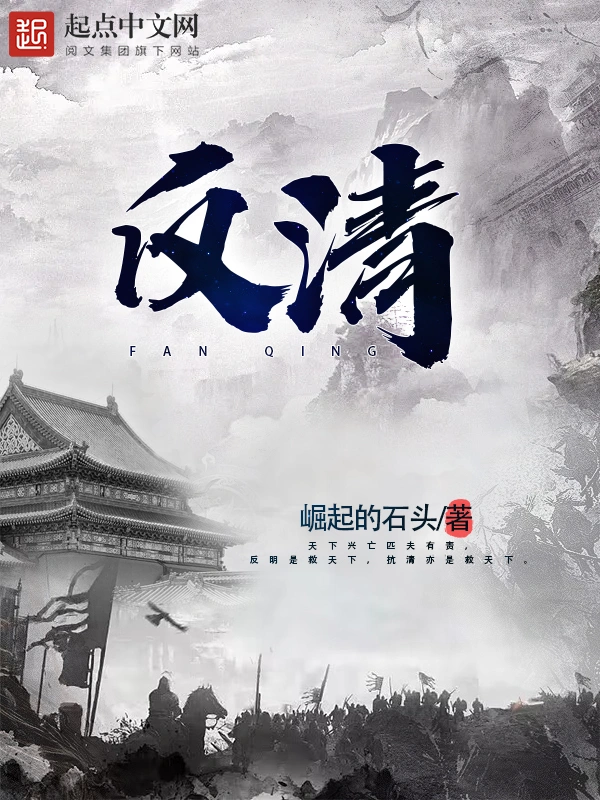
Anti-Qing
反清
- Status
- Completed
- Length
- 301k Words
- Genre
- Historical
- Audience
- Male
- Subgenre
- Song-Yuan-Ming Dynasties
- Updated
- 2y ago
- Source
- Qidian
Stats
0Monthly votes
5.1kRecommends
14.2kFans
140Chapters
Tags
Synopsis
Reader comments
Readers also read
 Please Call Me Your Majesty the Tsar
 In the Red Mansion: Escort Daiyu to Beijing at the Beginning
 Talker in the Song Dynasty
 1914 Begins with the Rejection of the Schlieffen Plan
 Never Walk Alone!
 Taichang Daming
 Sun and Moon: Yongli 1656
 Daming: Have I Become Wanli's Portable Grandfather?
 I Am Drawing a Hot-Blooded Episode in the Zhiyu Episode!
 Anti-Qing: Start with a Piece of Stone!
 Da Liu Bandits
 Taiping Heavenly Kingdom 1854
 Ming 1629
 The Strongest Chongzhen in History
 Ming Dynasty: Counterattack Starting from Slaves
 Zhu Di Was Reborn in Tumu Fort
 I'm Really Not the Carpenter Emperor
 Concubine Becomes Emperor
 Sweep the Light
I feel like if the word count is enough, I can read it all night long. I haven't felt like this in a long time.
The time of the first siege, the Ming army commanders and the process results that Li Zicheng experienced are as follows: The first siege (1631.4), Hong Chengchou The superior Zhang Cumeng killed his brothers and rebelled and surrendered to the army. Li Zicheng persisted and refused to surrender. The team suffered heavy casualties. Only 700 people escaped from the mountain road and entered Shanxi. The second encirclement and suppression (1632.8), No results As the peasant army approached Huaiqing and threatened the safety of King Zheng of the Ming Dynasty, Chongzhen mobilized the border troops in Xuanda and Changping to go south. Li Zicheng first defeated the Yanghe border army and then annihilated the troops of general Wang Shiying. As Zuo Liangyu, Meng Ruhu, Hu Dawei and other troops gathered together, Li Zicheng took the initiative to withdraw. Later, he fought fiercely with General You Shilu's troops in Liaozhou. He wounded You Shilu, You Renlong and his son and successfully broke through. In this battle, more than 1,300 people from his troops were killed. The third encirclement and suppression (1633.1), No (Chongzhen's Sao operation, no commander with unified powers was dispatched) The Ming Dynasty mobilized seven troops including Lu Xiangsheng, Ding Qirui, Cao Wenzhao, Deng Qi, Zhang Yingchang, Meng Ruhu, and Zuo Liangyu to encircle and suppress the peasant army, and later sent Wang Pu's troops in Beijing. Li Zicheng first annihilated Qian Zong Bai Xianlai's tribe, then faced the main force of Zuo Liangyu's tribe, annihilated the general Rui Qi, and defended the troops of Wang Jitong and Liu Jingyao. However, the second battle failed and general Zhang Cheng died in battle. After joining Zhang Tianlin, Li Zicheng annihilated more than 7,000 Zuo army soldiers and surrounded Zuo Liangyu in Wu'an. When Ming army reinforcements arrived, Li Zicheng retreated into the Taihang Mountains, surrounded and annihilated Ming army guerrilla Tao Xiqian's troops, and joined Wang Ziyong, Gao Yingxiang, Zhang Xianzhong and others. After three battles and three victories, they annihilated the Sichuan Army Yang Yuchun's Department and Mao Hulu Bing Ding Shouxian's Department, and surrounded the Sichuan Army Deng Qi's Department in Tangyin. Due to the arrival of Ming army reinforcements, Li Zicheng withdrew from the siege. The Ming army pursued, but Li Zicheng was defeated by Cao Wenzhao and lost hundreds of soldiers. Gao Yingxiang and Li Zicheng fought six fierce battles with the Ming army. Both sides suffered heavy casualties. The peasant army retreated into the Taihang Mountains. Gao Yingxiang and Li Zicheng tried to break out of the encirclement and won the first battle. However, they were defeated in an ambush and fought hard before breaking through. The main force of the Ming army was encircled. The peasant army took advantage of the contradiction between the Beijing camp and Zuo Liangyu, Deng Qi, Cao Wenzhao and others to break through the Yellow River and escape from the encirclement by pretending to surrender. The Fourth Encirclement and Suppression (1634.1), Chen Qiyu Li Zicheng continued to move and fight in Shaanxi, threatening Xi'an, but the Ming army was never able to capture his main force. Li Zicheng sent Gao Jie to attack Longzhou with thirty cavalry and succeeded. Chen Qiyu sent He Renlong to rescue him. Gao Jie took the initiative to give up Longzhou. After He Renlong entered the city, he was surrounded by Li Zicheng. Li Zicheng used the siege and reinforcement tactics to annihilate the general Wang Shiming's troops sent by Chen Qiyu to rescue. It wasn't until Hong Chengchou put down the Xining mutiny and sent Zuo Guangxian to rescue that Li Zicheng left the siege. Li Zicheng was attacked by Zuo Guangxian and lost 440 troops. The Fifth Encirclement and Suppression (1635.5), Hong Chengchou Chen Qiyu was imprisoned by Chongzhen and replaced by Hong Chengchou. Li Zicheng rained over Tianxing Zhang Tianlin, and Mantianxing fought together and won successively, annihilating the Ming army Wang Jixun, Liu Honglie, and Ai Wannian ( Deputy Commander-in-Chief Ai Wannian and Liu Guozhen were killed in the battle, with more than 2,000 casualties. Hong Chengchou sent Cao Wenzhao to encircle and suppress them, but they were also annihilated by Li Zicheng (Cao Wenzhao had nearly 3,000 Guan Ning troops, and only Cao Bingjiao escaped successfully with more than 1,000 people). This was the first Ming army general to be killed since the outbreak of the Peasant War in the late Ming Dynasty, and the whole Shaanxi Province was shocked. Hong Chengchou hurriedly mobilized all Shaanxi troops and horses to help prevent Li Zicheng from attacking Xi'an, but he was defeated again at the head of Jinghewang Bridge. The Ming army Zuo Guangxian, Wang Shiqin, Cao Bianjiao and other troops fought with the Chuang army in Sanyuan. The Chuang army was defeated and more than 450 people died in the battle. Afterwards, Li Zicheng annihilated Wang Jiamo's tribe of the Ming army. Li Zicheng tried to cross the Yellow River eastward into Shanxi, but was blocked by the Ming army and could not succeed. So he turned to Henan and was joined by a large number of local peasant troops. Li Zicheng fought back to Shaanxi. The Sixth Encirclement and Suppression (1636.3), Hong Chengchou Li Zicheng captured thousands of Ming army horses in Tianshui to reorganize the cavalry, and defeated the Dingbian deputy general Zhang Tianli. Zuo Guangxian led his troops to pursue him, but the intruder army was at a disadvantage in the battle. They lost more than a hundred troops and retreated. Yu Chongxiao, the commander-in-chief of Yansui, came to pursue Li Zicheng, and all 5,000 soldiers and horses in the ambush were wiped out. However, during the battle to attack Yulin, Li Zicheng was defeated by He Yilong and his team collapsed, leaving only a few hundred men. Gao Yigong led more than 10,000 troops to surrender, and fellow Mizhi people also rushed to defect, and Li Zicheng quickly regrouped. After this, Li Zicheng and his ally Zhang Tianlin were unsuccessful in the battle with Hong Chengchou and retreated into Qianlong Mountain. The Seventh Encirclement and Suppression (1637.1) Hong Chengchou After spending the winter in the mountains, Li Zicheng came out again and threatened Xi'an again. Hong Chengchou mobilized elite soldiers such as Zu Dabi, Cao Bianjiao, Bai Guangen, Zuo Guangxian, and Sun Xianzu to fight with Li Zicheng in Huating. The two sides fought for seven days, with neither victory nor defeat, and each retreated because they ran out of food. After that, Li Zicheng fought with Cao Bianjiao, Zuo Guangxian, Sun Xianzu and others in the mountains around Chenghui. Both sides lost hundreds of people, and they stopped fighting again because they ran out of food. Zu Dabi led the Guan Ning army to pursue Li Zicheng to Tiesuo Pass, but Li Zicheng set up an ambush and annihilated most of them. Guerrilla Zu Jie, general Fei Yizai, and guard Wang Zehong were beheaded and Zu Dazhu was injured and almost killed. He Renlong was also defeated by Li Zicheng, and his general Ding Mingtai was killed. Li Zicheng led more than ten peasant troops to attack Xi'an in a large-scale attack. Sun Chuanting led his troops to resist. The two sides fell into a fierce battle. Li Zicheng retreated. The Ming army pursued and ambushed, and general Ge Yong was beheaded. The peasant army coalition attacked Hanzhong, but failed due to Cao Bianjiao's blockage, so they decided to march into Sichuan. The Eighth Encirclement and Suppression (1637.12), Hong Chengchou Li Zicheng developed rapidly in Sichuan. He first killed the commander-in-chief Hou Liangzhu, then Zhang Qiming and Zhang Hu, and then killed the commander-in-chief Wu Mingfeng. He defeated the commander-in-chief Zhu Tingyi. Within one month, he conquered thirty-eight cities and besieged Chengdu. Hong Chengchou was horrified and hurriedly led an army of 70,000 into Sichuan to pursue Li Zicheng. The battle was unsuccessful and Hong Chengchou blocked their way back to Shaanxi. Li Zicheng made a unique move and led his troops into the Songpan area of western Sichuan, crossed the grassland, climbed over the snowy mountains in Minzhou and Taozhou, and fought back to Shaanxi. The Ninth Encirclement and Suppression (1638.2), Hong Chengchou, Yang Sichang Under the pursuit of Cao Bianjiao, Zuo Guangxian, Zhang Tianlu and other troops, Li Zicheng entered the Qiang region of Qinghai. The Qiang people, peasant army, and official army fought in melee for 27 days, and Li Zicheng broke through and entered Hezhou. The Ming army was surrounded by heavy troops. Under Yang Sichang's strategic encirclement, Li Zicheng's friendly troops betrayed one after another due to lack of food and clothing. Even the Eight Kings were appeased by Cao Cao one after another, and the pressure on the Ming army was greatly reduced. Finally, in the Battle of Taohe, Li Zicheng was ambushed by Cao Bianjiao, Zuo Guangxian, Ma Ke and other troops. The army collapsed, leaving only more than 300 people. Although the remaining troops were subsequently gathered to more than 3,000 people, under the continuous pursuit of the Ming army, the entire army eventually collapsed, leaving only more than 300 people who took refuge in Shangluo Mountain. The Tenth Encirclement and Suppression (1639.11), Yang Sichang Li Zicheng gathered the remnant troops and had more than 2,000 people, and fought jointly with Zhang Xianzhong and Luo Rucai. Yang Sichang mobilized a large army to encircle and suppress the army. Luo Rucai and Li Zicheng annihilated the general Luo Anbang and deputy general Yang Shizhong. Because Luo Rucai negotiated peace with Yang Sichang, Li Zicheng led his troops to leave. Yang Sichang besieged Li Zicheng in Yubeli Mountain. Li Zicheng burned his baggage and escaped over the mountain. The Eleventh Encirclement and Suppression (1640.9), Yang Sichang Li Zicheng failed several more times, but after joining forces with Ma Chao and Yuan Zhong, the peasant army in southern Shaanxi, he regained his momentum. Yang Sichang mobilized Zuoliangyu's troops in Huguang and Li Guoqi's troops in Shaanxi to suppress them. Li Zicheng led 500 elite cavalry to break through Zuo Liangyu's defense line, rushed into Henan, and entered the Xiong'er Mountain. Tens of thousands of deserters from the hungry people in Henan came to surrender. Li Zicheng attacked Luoyang, and it became a prairie fire from then on. The Twelfth Encirclement and Suppression (1641.5), Fu Zonglong Chongzhen released Fu Zonglong from prison as the governor of the three sides, specializing in During the encirclement and suppression of the invading army, Li Zicheng and Luo Rucai discussed pretending to attack Chengtian. Fu Zonglong was afraid that the bandits would dig up the emperor's ancestral tomb and would not be able to explain it, so he pursued them all the way. Li Zicheng and Luo Rucai then turned to Henan and attacked for thousands of miles, leaving the Ming soldiers exhausted. When they arrived in Xiangcheng County, the Ming army ran out of food and dispersed to various villages to grab food. Li Zicheng and Luo Rucai took the opportunity to rush out, defeat the official army and kill Fu Zonglong. The Thirteenth Encirclement and Suppression (1642.1), Wang Qionian Wang Qionian, who succeeded Fu Zonglong, led 30,000 troops out of the border to rescue Zuo Liangyu who was besieged by Li Zicheng and Luo Rucai. Unexpectedly, Zuo Liangyu saw the strength of the peasant army and ran away while Li Zicheng and Luo Rucai faced off against Wang Qiaonian. The Ming army lost the first battle and Wang Qiaonian's generals fled first. Wang Qiaonian became the bare commander and was easily killed by Li Zicheng. The Fourteenth Encirclement and Suppression (1642.5), Ding Qirui Li Zicheng besieged Kaifeng. Chongzhen strictly ordered Supervisor Ding Qirui and Baoding Governor Yang Wenyue to assemble an army of 180,000 troops to rescue. Zuo Liangyu plus Hu Dawei, Yang Dezheng, Fang Guoan, and Jiang Mingwu claimed 400,000 troops in the battle of Zhuxian Town. Li Zicheng and Luo Rucai surrounded the Ming army in Zhuxian Town and dug a long trench to trap them. When ambushing the forward of the Ming army, Zuo Liangyu saw the overwhelming strength of the enemy and wanted to escape overnight. As a result, he ran into a large ditch dug by the intruders, causing huge chaos. Other Ming troops thought that the rogues had attacked at night and scrambled to escape, causing the entire army to collapse. Li Zicheng and Luo Rucai won a complete victory. They killed the general Jiang Mingwu and surrendered tens of thousands of Ming troops. The artillery, mules and horses were useless . The Fifteenth Encirclement and Suppression (1642.10), Sun Chuanting Sun Chuanting ordered Niu Chenghu's troops to fake defeat and lure Li Zicheng into an ambush. Li Zicheng was defeated, but the invading army retreated in an orderly manner while abandoning supplies. Luo Rucai took the opportunity to fight out, and Li Zicheng also returned to fight again. The Ming army was defeated and thousands of soldiers were lost. Lieutenant General Sun Zhixiu was killed in battle. More than 70 senior and middle-level generals including Hei Shangren, Zhang Mukui, Li Qifeng, Ren Guangyu, and Dai Youren were killed in the battle. Later, Li Zicheng killed Yang Wenyue in Runing, expelled Zuo Liangyu, occupied southern Henan and northern Hubei, and began to establish political power in Xiangyang, provide disaster relief, farmland, and open schools to recruit scholars. The Sixteenth Encirclement and Suppression (1643.7), Sun Chuanting Sun Chuanting led the Qin army's main force of 100,000 people to launch the final decisive battle against Li Zicheng. As Sun Chuanting entered the area occupied by the Chuang Army step by step, he and Jiaxian defeated the main force of Li Zicheng's front camp. General Xie Junyou of the Chuang Army died in the battle. However, Li Zicheng's strategy of strengthening the wall and clearing the country to lure the enemy deeper began to work. The Ming army was unable to obtain food supplies in Henan, and the battle line became longer and longer. They fought with Li Zicheng's main force in Xiangcheng. In the end, Liu Zongmin seized the opportunity and sent 10,000 light cavalry to cut off the grain road to Baisha in Ruzhou. Sun Chuanting tried to withdraw to Shaanxi for food supply, but Li Zicheng took the opportunity to launch a counterattack and defeated the Ming army in Nanyang. When Sun Chuanting fled back to Tongguan, he found that the Ming army suffered 40,000 casualties, and all the ordnance and artillery were captured by the Chuang army. The Chuang army then entered Shaanxi and pursued them to Tongguan. Sun Chuanting ordered the soldiers to fight. However, the families of the officers and soldiers were all in Tongguan City, without food or pay, and one hundred thousand elites had been wiped out. No one was willing to risk their own lives to be loyal to Emperor Chongzhen, so they all protected their families and escaped. Sun Chuanting died in the rebellion. After that, Li Zicheng pacified all of Shaanxi in just two months and surrendered almost all Shaanxi officers and troops.
I feel that we must at least stabilize the Dashun Army's basic base of Hubei and Guanzhong to have a chance to win over the Qing Dynasty. If the protagonist still loses Guanzhong after traveling through time, the feeling will be the same as in history. Therefore, we must complete the basic base so that we can attack the Ming Dynasty and supplement it by going south, and we can directly conquer the Qing Dynasty by going north and east.
As long as someone is against the trend of ugly hairstyles, I will support them. In this era of life without a complete hairline, let's destroy it.
Lord, we brothers all know that you work hard every day, and we only regret that we can't share your worries and solve problems with you. However, the brothers eventually want to create a great cause with the Lord, so the Lord asks the Lord to lead the brothers to rush forward again on the weekend. Now there are approximately one hundred and eighty brothers who have been following the Lord. If the Lord strives to move forward on the weekend, there will be more brothers to help. We all ask your lord for more updates.
Hao Yaoqi can be regarded as Li Zijing's first direct descendant, and Wu Zhaosheng is Li Zijing's second direct descendant through his own efforts and Li Zicheng's layout and arrangements. These two people are the team members who helped Li Zijing get started. I don't know how many direct descendants Li Zijing can gain on his way to Huguang and after he takes root in Huguang.
Because of this book title, I made this post! I wish the author a good story.
A rogue bandit is a rogue bandit. Once he tastes robbery, he will no longer be a rebel. I hope Li Zicheng will not be written like a white lotus.
The main reason for Li Zicheng's failure was his failure to effectively deal with the sudden collapse of the Ming Dynasty's state machinery. As a result, Dashun's ruling area quickly expanded from eight prefectures in two provinces (the four prefectures of Xiangyang, Jingzhou, Chengtian, and De'an in Hubei and Nanyang and Runing in Henan, in addition to the central Henan region centered on Yuzhou) to the entire North China; the army quickly expanded from more than 100,000 to more than 300,000. Furthermore, the Dashun Army had no state machinery or base when it left Henan in the 13th year of Chongzhen. It began to establish a government in the autumn of the 15th year of Chongzhen, and then invaded Beijing in the summer of the 17th year of Chongzhen. It only took four years for the Dashun Army to transform from an armed force of more than a thousand people to the master of the entire North China. The result must be a serious shortage of cadre reserves and a rather incomplete state machinery. In other words, most of the Dashun Army, from civilian and military generals to grassroots soldiers and officials, came to the Dashun Army for speculation in an environment of successive victories, and lacked organic connections with each other. It can be said that such a regime cannot withstand any failure and will "collapse" again at the slightest sign of trouble. This has essentially nothing to do with the political strategy adopted by the Dashun Army - except for a very small number of high-ranking officials and gentry above the third rank, the vast majority of the landlord class is not likely to be more disgusted with the Dashun Army's policy of recovering stolen goods [1] than they are with the Qing Dynasty's policy of enclosing land, let alone issues such as shaving one's hair to make it easier to serve. This is the basic starting point for our discussion of this issue. For a detailed discussion, see the old answer I posted in the link above. It can be seen that if Li Zicheng wants to improve his situation, he can start from two directions: 1. Avoid over-expansion in the short term. The easiest way is to stay in the northwest, capture Shanxi at most, and avoid capturing Beijing and the North China Plain. However, the disadvantages of doing so are also great. The Qing army could seize the above-mentioned areas as if they were ripe, and even advance southward to control the rich Jianghuai River in Nandu. Since the state machinery of the Qing Dynasty was far more mature than that of Dashun, and the talent echelon construction was far more advanced than that of Dashun, these areas that Dashun could not effectively utilize fell into the hands of the Qing Dynasty, and they could provide funds and troops for the Qing Dynasty. In turn, they could attack the Dashun army living in the northwest that had been destroyed by natural disasters and man-made disasters and had barren land and poor people. Therefore, although the Dashun Army can avoid chaos behind a stone, there is still a high possibility of failure in a long-term confrontation. Of course, if you don't capture Hebei, capture Shandong. Using Hebei as a bait and attacking from both sides is another matter. 2. Avoid major military defeats. Obviously, a more positive approach is to avoid military defeat. As long as the Dashun Army continues to win, internal collapse will not occur, and Dashun will naturally only improve its organizational construction in the process, becoming stronger as it fights. Considering that the Qing government had decided to mobilize the whole country to break through the Pass before Dashun captured Beijing, it was naturally difficult for the Dashun army to avoid a battle with the Qing army after entering Beijing. In this way, we must win this battle. As for how to win, we can naturally consider aspects such as gathering stronger troops, winning over Wu Sangui, and avoiding field battles. We will not go into details here. After the defeat of Yipishi, officials, gentry and generals in Xuanda, Jizhen, Zhili and Hebei launched large-scale rebellions. The Dashun army suffered heavy losses in the process. Nearly half of the 150,000 basic troops in the Eastern Expedition to North China were lost, and the total strength of the Dashun Army dropped to more than 200,000; while the upper limit of the Qing Army's strength increased from less than 150,000 to about 250,000. However, if the Dashun Army plans carefully at this time, it is still possible to win. The specific methods are: 3. Fight the Shanxi Campaign well. Historically, the Dashun Army deployed tens of thousands of troops in Shanxi. Even after Tang Tong, Nan Yikui and others rebelled one after another, they still had a basic strength of at least 50,000 people (20,000 people participated in the Huaiqing Battle, 10,000 Taiyuan defenders, thousands of Pingyang Prefecture defenders, etc.). However, Zehou Tian Jianxiu, who was in charge of the Shanxi campaign in Pingyang Prefecture, first sat back and watched the Dashun army fight in separate groups with thousands of people. As a result, they were defeated by the Qing army led by Ye Chen. Later, he launched the Huaiqing campaign, possibly with the intention of cutting off Ye Chen. (However, Ye Chen had already joined forces with Jiang Xiang and others who had gone south from Datong to Taiyuan, so this intention could not be realized at this time). As a result, Duduo's army was attracted, which seriously interfered with the plan for the northern Shaanxi battle. 4. Avoid antagonism with Zhang Xianzhong. Zhang Xianzhong became the Qin king of Dashun at the beginning of the first year of Yongchang. In the early days of his entry into Sichuan, he regarded Dashun as Zhengshuo. However, Li Zicheng did not temporarily entrust Zhang Xianzhong with full power in Sichuan. Instead, he assigned a large number of civil servants led by Jiedushi Li Yutian, and ordered Ma Ke to lead his troops to escort him into Sichuan. This action was understandable in Beijing, but after the failure of Yi Yi Shi, these civilian and military generals should have been recalled immediately to appease Zhang Xianzhong and stabilize the security of the rear. However, Li Zicheng had no idea, and he probably didn't expect that Zhang Xianzhong would take crazy actions that would make his relatives happy and his enemies happy. As a result, Zhang Xianzhong went north to attack Ma Ke after taking Chengdu in August of the first year of Yongchang. After the initial dispatch of Ai Nengqi was defeated, Zhang Xianzhong personally led Li Dingguo and other main forces to defeat Ma Ke in September. In October of the first year of Yongchang, Zhang Xianzhong, who had long been a superstitious believer in destiny, was proud of his victory and proclaimed himself emperor in Chengdu, officially establishing the Daxi regime. In November, Zhang Xianzhong began preparations to march to Hanzhong. In the first month of the second year of Yongchang, when the Dashun armies of Li Zicheng and Li Guo were fighting against the main forces of the Qing army, Duduo and Azige, in Tongguan and Yan'an, Zhang Xianzhong sent Li Dingguo to occupy Hanzhong, and Bao Xiedao threatened Chang'an, the capital of Dashun. After preparing a banquet and three tables of guests, Li Zicheng was already at a disadvantage in Tongguan and Yan'an. He was unable to deal with the threat of a third party and was forced to abandon his vast northwest base. In fact, looking back in hindsight, although Zhang Xianzhong's offensive was fierce, it was actually vulnerable. The Li Dingguo army that entered Baoxe Road was suddenly defeated by the Dashun Army He Zhen's troops who rushed from Baoji to help Hanzhong. After that, Zhang Xianzhong was no longer able to invade the north, and started a vicious cycle in which the entire Shu was rebelled, besieged on all sides, massacred the city and threatened the people, until he was ruined. However, the internal strife between Dashun and Daxi is really unnecessary and can be resolved through diplomacy. And without this fatal internal strife, Dashun might have had a chance to turn defeat into victory in Tongguan, and Daxi would not have become a target for the Sichuan warlords to gain experience from then on, and finally fell into a state of national madness when only Chengdu Prefecture was left. 5. First north and then east. In December of the first year of Yongchang, Li Zicheng had more than 100,000 Dashun troops on hand (minimum 110,000, maximum 150,000). His original plan was to march north and fight to the death with Azig's 80,000 North Qing army with an army of 100,000. However, Azige moved slowly in northern Shaanxi and was delayed in crossing the river. After crossing the river, he was delayed in going south. On the contrary, Duduo's 90,000 East Route Qing army moved quickly and was approaching Tongguan. Worried that Duduo would quickly break through Tongguan and advance into Guanzhong, Li Zicheng decided to attack Duduo eastward with his main force. However, the terrain along Hangu Pass and Tongguan is easy to defend and difficult to attack. After Li Zicheng's army arrived at Tongguan, it turned into the attacker, which meant that he chose unfavorable terrain. Duduo wisely chose the tactic of holding a stronghold, fighting in vain, and waiting for work, which frustrated the Dashun Army's attempt to attack in a roundabout way, and then turned to the offensive after consuming a large amount of Dashun Army's strength and obtaining red cannons. If Li Zicheng trusted Ma Shiyao's ability to defend Tongguan and went north to eliminate Azig first, then even if Guanzhong fell temporarily, the situation would still be better than reality. Of course, the risk of this move is quite high, and it is understandable that Li Zicheng does not want to do this. Compared with the surrendered generals in North China, the surrendered generals in Guanzhong and Li Zicheng had a relatively deep relationship of love and murder. Therefore, whether they are old enemies from the regular army of the Ming Dynasty such as Chen Yongfu, Zuo Guangxian, Niu Chenghu, etc., Or old friends such as Gao Ruli, Wu Dading, Wang Yongqiang, etc. Who were originally from the civilian army and then surrendered to the Ming army after the Battle of Ruzhou, they are all more loyal to Dashun than the generals in North China. Even after Dashun withdrew from the northwest, He Zhen called himself General Fengtian Advocating Righteousness (the honorary title used by Li Zicheng before he became emperor). He joined forces with Gao Ruli, Wu Dading, and Ming generals Sun Shoufa, Zhao Ronggui and others to besiege Xi'an. After failure, he joined forces with Dashun Guangshanbo Liu Tichun. Later, when Jiang Xiang raised his troops, Wang Yongqiang also raised his troops in northern Shaanxi, and appointed Dashun Prime Minister Hui Shiyang as the leader of northern Shaanxi's resistance to the Qing Dynasty. It can be said that Dashun had a ruling foundation in the northwest region. However, due to the above mistakes, Dashun was eventually forced to abandon the northwest. After abandoning the northwest, Dashun moved into the old base area of Hubei and Henan. At this time, Dashun's territory and military strength had declined back to the situation before defeating Sun Chuanting, that is, the territory was no more than five or six prefectures, and the military strength was no more than a hundred thousand people (and it was divided into two parts. The 40,000 to 50,000 people in the West Route Army led by Li Guo were fighting in Ningxia, Longxi, Hanzhong, Northern Sichuan, and the Three Gorges area, and the East Route Army led by Li Zicheng personally had no more than 100,000 combat troops). Since Tian Jianxiu did not burn Xi'an's savings (this itself also shows that Dashun does not have too many problems in governance, and the fiscal revenue is enough to meet expenses), the two armies of the Qing army were able to separate and pursue Dashun's army. In this very unfavorable situation, if Li Zicheng thinks calmly, it is still possible to reverse the situation. 6. Defend Jingxiang in the north and take Hunan and Guangdong and Guangxi in the south as a long-term plan. Historically, Li Zicheng believed that he could no longer maintain the Jingxiang base area, so he decided to go east to the south of the Yangtze River, seize Nanjing, and make another big move. Considering that Zuo Liangyu's forces of the Ming Dynasty often attacked Li Zicheng's base in Xiangyang, Hubei at that time, and the hostile attitude of the Southern Ming Dynasty towards itself, this idea is understandable. However, I have analyzed before that this move is very unwise. Dodo's actions will not be slower than his. Even if Li Zicheng could seize Nanjing before Duduo, he would still face the same situation as Beijing: there are officials and gentry inside who are ready to make a move, and there are hundreds of thousands of Qing troops outside who are watching covetously. The Dashun Army, which had suffered repeated defeats, could not perform better in Nanjing than in Beijing. However, given the lessons learned from Taiyuan, can Xiangyang City really be defended? Historically, Zhang Nai and other troops from the rear of the Dashun Army also defended the city in Yangwu Prefecture (today's Zhongxiang, Hubei Province), but they could not hold on for long. However, in fact, as long as the correct city defense tactics are adopted (although it is not clear whether the Dashun Army, which has long relied on field battles to annihilate enemies, is proficient in it), it is entirely possible to hold on for a long time in a larger city like Xiangyang. For details, you can refer to the battle of Jin Shenghuan and Wang Deren (also from the Dashun Army) to defend Nanchang a few years later. At this time, the Duoduo Division of the Qing Army had turned from Henan to the canal axis to attack the Nanming Hongguang regime in Nandu. Only a part of the Azige army (which was much smaller than the 80,000 troops in northern Shaanxi due to reasons such as leaving troops stationed along the way), Of course, he successively surrendered the Yunyang Army of the Ming Dynasty and the traitor Han Wen of the Dashun Army and continued to pursue the Dashun Army. As long as the Dashun Army has a determined general and an army of 30,000 to 40,000 people behind it, it can prevent Azig from continuing to move south. Moreover, after entering summer, Azig will inevitably have to return to the court. Of course, if you stick to Xiangyang, you will be breached one day. The main force of the Dashun Army should still try to join the West Route Army and march south to Hunan and even Guangdong and Guangxi. At that time, the Ming armies in Guangdong, Guangxi, and Hunan were in chaos, and it was not difficult to wipe them out in one go. The climate in these areas is relatively humid and hot, and Manchurian soldiers have avoided long-term stationing for many years thereafter (during the Ming and Qing Dynasties, Manchurian soldiers have always avoided long-term stationing in areas further south than Nanjing and Jingzhou). If Dashun's army can control the two lakes and pacify Guangdong and Guangxi, there is still a considerable chance of revival. Li Zicheng failed to plan this and blindly followed Chongzhen's old routine of mobile warfare fifteen years ago, forgetting that he was no longer the leader of the rebel army. As a result, he was defeated at Fuchikou and Jiujiangdong. Not only did he lose his territory, but the entire army also lost its organization. In the end, Li Zicheng himself was killed by a militia group at Jiugong Mountain in Tongshan County. Despite this, the remnants of Dashun are still there, and they have considerable cohesion. A few months later, all the ministries gathered in Jingzhou, accepted the unified leadership of Li Guo, and formed the Loyalty Camp. At this time, whether Li Guo was independent or united with the Ming Dynasty to resist the Qing Dynasty, the Dashun Army still had a chance to revive. Although it may not be within the scope of the question, I will mention it here by the way. 7. Winning the Battle of Jingzhou Don't overly believe in the combat effectiveness and reliability of He Tengjiao, Ma Jinzhong and other troops. Adjust the focus to reinforcements, defeat the troops that rushed thousands of miles away from Luck Deh, and then capture Jingzhou and eliminate Zheng Siwei. The prestige of Li Chixin (i. E. Li Guo, Li Jin) can rise just like Sun Kewang killed Zeng Ying in Chongqing, and the cohesion of the Dashun Army can continue to be maintained without falling into a state of disintegration. After the Dashun army was defeated in Jingzhou, the leaders went their separate ways. Liu Tichun and Yuan Zongdi went north to Xing'an to join He Zhen, and moved to Kuidong earlier. They mechanically imitated Li Zicheng's strategy of retreating into the mountains from the 11th to 13th years of Chongzhen's reign, but they accidentally opened up an anti-Qing base for the thirteen families that followed. Hao Yongzhong, Wang Jincai, Niu Wancai, Zhang Guangcui and other figures who were originally relatively alienated from the direct line of Dashun (probably from Cao Ying and Gezuo Fifth Battalion) were incorporated into Zhongwu Camp by Nan Ming, and followed He Tengjiao into the internal party disputes and warlord melee in Nan Ming. The main force of the Zhongzhen Battalion was controlled by Du Yinxi, and continued to be squeezed out by the Nanming government; after retreating to Guangxi and Du Yinxi's death, Gao Bizheng and Dang Shousu tried to turn the Zhongzhen Battalion into the Central Army of Emperor Yongli, in order to reorganize the authority of the Ming court and solve their own food and salary problems. As a result, this plan offended all the warlords, and the Zhongzhen Battalion was attacked by a group. When the Yongli court played the situation between Guangdong and Guangxi to death and was forced to accept the leadership of Sun Kewang, the leader of the Western Qin Kingdom, the remnants of the Zhongzhen Battalion only had 20,000 or 30,000 soldiers and horses. They were in an embarrassing situation because of their previous refusal to entrust Qin's civil service and had to return north to Kuidong. After that, the remnants of the Dashun Army achieved a long-lost rendezvous in Kuidong, with more than 50,000 troops, but they were no longer an independent force politically and fell under the control of Wen Anzhi and others. At this point, the Dashun Army's final outcome can only be sacrificed to prove that they are worthy of being outstanding descendants of the Chinese people of all ethnic groups.
Multi-science popularization uses Ming Dynasty black technology
Novels that don't use the Invincible Flintlock Gun are actually more exciting. Novels about the Invincible Flintlock Gun are often better than Europe. Europe only began to slowly replace the heavy matchlock gun (a heavy matchlock gun that combines matchlock and broken hair) in 1725. There is a sentence that is easy to say, but if you can't write it, you still like to write it. The writing is bloated and wraps your feet [you are both good and like to play with the sense of déjà vu]
I really can't stand it anymore, it's too poisonous. Have readers read history? Li Zicheng was the overlord who overthrew the Ming Dynasty. He sounds like a retarded person. Also, you can't highlight the protagonist, just let the supporting characters act like weaklings and kill Li Zicheng's only brother, while the protagonist defies the sky and the earth and defies the air. Also, the protagonist led hundreds of people to dig a twenty-mile tunnel in half a day, something that even an excavator cannot do now.
I have always wanted to find a book describing the Dashun regime. It is a pity that Dashun, as a promising emerging force, was destroyed by the Qing army. I hope the author can persevere. I really want to read a different late Ming Dynasty novel!
The three golden chapters are well written, but unfortunately when the protagonist is the boss, he takes it for granted and kills the old soldiers to scare the monkeys. There is no reason to punish them without teaching them. He also makes the old soldiers of the long-term gangsters as easy to fool as new recruits. The protagonist can shock all the gangsters with casual words, and even Li Zicheng can only appease them. How can the protagonist, a second-generation emperor, have the confidence to restrain the long-term gangsters by killing the chickens to scare the monkeys? If you really do this, you will be tricked sooner or later.
Li Zicheng does not have to die, the protagonist imitates Song Taizong, and Li Zicheng immediately seizes the throne after his death.
China only has a bug-level figure like Zhu Yuanzhang. His ability to learn and progress is too strong, but he still has the limitations of a low-level figure. Li Zicheng is an ordinary person who worked hard to reach a high position but failed in the end. It will take at least two or three generations to work hard to improve. After all, he is not qualified. Sun Kewang's qualifications are okay, but his birth and experience have limited his character. Li Dingguo has the qualifications to be a handsome man, but he cannot be the king. It seems that only Zhu Yuanzhang and Liu Bang were the only ones who succeeded from scratch in a generation of history.
I don't understand why Niu Jinxing targets Li Zijing. As Li Zicheng's only relative, isn't it normal to be promoted after being capable? Besides, Niu Jinxing is a civil servant and Li Zijing is a military attache. Can they still threaten him? Niu Jinxing's power comes from Li Zicheng. Doesn't it mean that the stronger Li Zicheng is, the greater his power will be? As those with vested interests bound together, don't you wish Li Zicheng well? I understand that the author wants to increase the difficulty for the protagonist, but this is completely illogical. Niu Jinxing's diploma in the exam shows that he received a systematic elite education from the Ming Dynasty. Please don't forcibly reduce his intelligence, okay?
I have read the author's The Carpenter Emperor. The previous book was okay. The protagonist had a strong sense of presence. It was a cool novel. It felt very immersive. I forgot about it after reading it.
Ranked among the top 100 new books for boys in all categories, and ranked third on the list of signed new books in the historical category, not bad.
The title can be said to be concise and concise, and it speaks directly to the heart and highly condenses the content of this book.
If the protagonist wins this time and space, what kind of dynasty will be established? My personal judgment is that the grassroots level should follow the Ming Dynasty's rural covenant + fort system, relying on veterans to go down to the grassroots to cooperate with the gentrified landowners to achieve a certain degree of direct control - ultimately it should be similar to the Russian commune farmers' private land + royal public land model. As we all know, for the Ming Dynasty, the vassal king accounted for a large amount of expenditure, so for the Shun Dynasty, this part of the expenditure would generally support the military part of the military gentry regime. There will be semi-off-the-job peasants and soldiers as reserves and a corresponding military control system similar to the Han Dynasty in the local areas, and the central government will control a powerful standing army. Li Zicheng admired the Tang Dynasty very much, and he must imitate the system on the surface, but in fact he followed the Ming system. It's just that the justly named "Tianyoudian Pingzhang" is more conducive to the overall structure of the government than the unjustified secretaries and "majors". Local governments may reappear the separation of military, administrative, and judicial powers of the early Ming Dynasty, with the governor who controls food, wages and personnel as the first, the chief envoy who controls administration as the second, the inspector who controls justice and supervision as the third, and the generals who lead the army share the military power. In terms of the legal system, it can be speculated that we will go back to the legal system of the Tang Dynasty with separate legal and order formats - it will not be like the Tatars who were unable to produce a real Qing legal system for two hundred years. Taking into account the disaster of eunuchs in the Ming Dynasty, it can be expected that a situation will be established with the royal family as the axis, Wu Xun as the two wings, and internal court-style civil servants and royal manor farmers as male servants to replace eunuchs. Generally speaking, the overall situation is to transform into a military-gentry regime. It is a rule that civilian officials will serve as soldiers, governors, governors, and even the first-level prime ministers of Pingzhangshi will become Jiedu envoys and governors. It can be expected that as the union between the military and the gentry deepens, will Li Zicheng retain Zhu Yuanzhang's "small government" system like the Qing Dynasty and only make superficial repairs, or will he identify the shortcomings of this system and make drastic reforms like Zhu Yuanzhang himself? In the system of the first year of Yongchang, the central government had "Pingzhangshi" and the local governments had "Jiedushi and governors". It was obvious that the system deliberately imitated the Tang system and targeted the Ming Dynasty's shortcomings such as the abolition of prime ministers, emphasis on culture over military affairs, and excessive weakening of local governments. If Li Zicheng follows this path and carries out reforms for another thirty years, it is difficult to say what the result will be. Perhaps a centralized fiscal system could be established. In addition, how much impact will the process of pacifying/collecting the Wu Sangui, Nanming, Qing, Daxi, and Zheng families have on the Shun Dynasty system, especially the military system? If there were guardsmen and five battalions of field troops based on farmers, the combat effectiveness would not necessarily be lower than in the early Ming and Qing dynasties. All this is unknown. Li Zicheng's character was very forbearing and adventurous. Based on the situation in the first year of Yongchang, it is unreasonable to infer that Dashun [will not] perform major surgery on the Ming Dynasty system. In fact, I think that if Li Zicheng lives long, the Shun Dynasty will definitely reform. And if the Shun Dynasty is indeed determined to reform, the Qing Dynasty's problem of "excessive imitation of the previous generation" is likely to be overcome, and the views of a series of late Ming thinkers such as Li Zhi, Wang Fuzhi, and Gu Yanwu will be taken seriously. The protagonist can also make certain reforms to Li Zicheng's Dashun.
It is said that Wu Sangui is a traitor, whose country did Wu Sangui sell out? Daming or Dashun? Wu Sangui led the Qing army into the city after the fall of the Ming Dynasty in Chongzhen. As for Dashun, haha, it's strange that a group of rebels who have brought disaster to the country and the people can establish the country.
Not bad, it looks good, but updates are slow.
The protagonist mainly wants to develop Guanzhong as the core, expand the Hetao area to the north, and expand the Western Region to the west. At this time, Yeerwu is already in civil strife and it is the time to destroy it.
The History of the Ming Dynasty and the History of the Qing Dynasty are two of the most unreliable history books in the history of the world. One is heavily criticized and the other is heavily fanned. Internet novels are even more reliable than these two pieces of garbage.
You are writing a novel, but you are unwilling to look up the information, and it is full of loopholes. You will see the Han army flag and the green camp, and you have no understanding of the status of King Sanshun in the Qing army. The description of the war scenes is like a child playing house. I hope you can write the book carefully. If you don't, the manuscript fee will be low! I hope you will continue your efforts.
The war scenes are detailed and vivid, great book!
If Li Zicheng defeated Ajige in northern Shaanxi, he should focus on recovering Shanxi. Shanxi's geographical defense line is too important to Shaanxi. If Shanxi cannot be recovered, then the Qing Dynasty's power projection capability can always threaten the foundation of Shaanxi. Therefore, Shunqing will decide a battle in Shanxi, and Duoze will not watch in vain in Henan after a period of rest. He will inevitably send another partial force from Henan to threaten Guanzhong. After the protagonist has been operating in Xiangyang for a period of time, he must be prepared to go north for assistance. Cases such as Li Jiyu from Tuzhai in Henan must also be collected one by one. Everything is to serve the overall situation of resisting the Qing Dynasty.
Shunzhi becoming a monk was the biggest scam in history. It was obvious that he would die after contracting smallpox. If the true situation was revealed, it would surely encourage the anti-Qing resistance and shake the Qing Dynasty's stable rule. Because the Manchus entered the country and killed countless people and committed too many crimes. In the feudal era, this was "heaven's punishment", so they made up such a story to deceive fools. The most important reason why Kang Mazi was able to rise to power was that he contracted smallpox and survived.
Historically, the three brothers Wang Guangen defended Xunyang, but the Shun army attacked several times without success. This nail must be removed. Although the Eight Prefectures of Xiangyang are the old base of Dashun, there are still native villages established by the gentry within the territory. These unstable factors must be eliminated, and they must be disrupted and incorporated into the local guard.
From the summer of the Jiashen year to the spring of the Yiyou year, the Huguang garrison was restrained by enemies from three directions. Five thousand Gao Doushu from Yunyang restrained Xiangyang Prefecture, and no less than several thousand Hunan Ming troops from Yuezhou and Changde fought with Jingzhou. There was a confrontation across the river with Zuo Liangyu's army in the direction of De'an Prefecture. Although Zuo Liangyu's army could not win, the Zuo Army relied on its large number of troops and invaded many times. At the beginning of Yiyou, he once again sent large troops to besiege Jingzhou Prefecture.