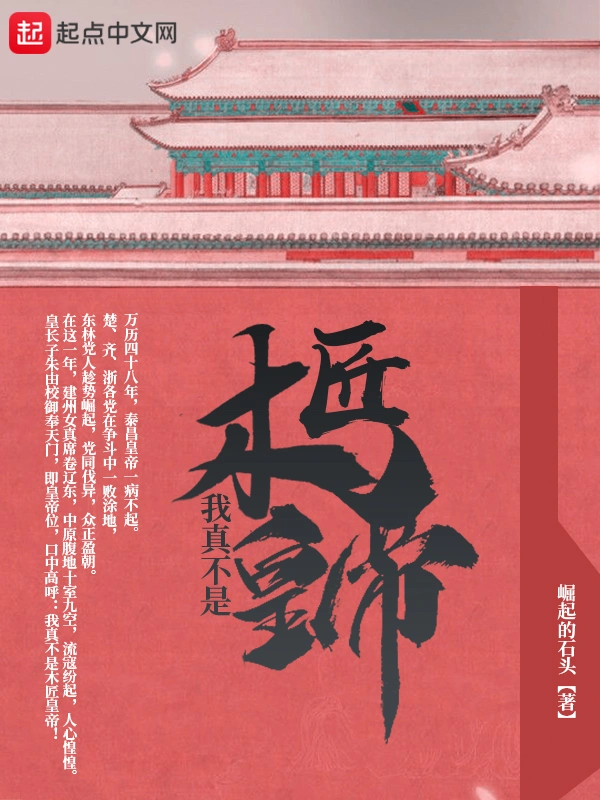
I'm Really Not the Carpenter Emperor
我真不是木匠皇帝
- Status
- Completed
- Length
- 2.2M Words
- Genre
- Historical
- Audience
- Male
- Subgenre
- Song-Yuan-Ming Dynasties
- Updated
- 4y ago
- Source
- Qidian
Stats
Tags
Synopsis
Reader comments
In booklists 12
Take Good Care of Seedlings, Like Grass Jelly, and Stay Away from Poisons
As a bookworm for ten years, I only read high-quality products, of course, high-quality products that have the same taste as me.
Traveling Through History, Exquisite Products Dominate China and Foreign Countries
Travel to ancient times and achieve hegemony
Collect Fresh Seedlings \^O^/ (There Are Also Other Themed Books That Can Be Changed at Any Time
You can pay attention! There are various types, I recommend them after seeing them myself. If no one likes it and it's too old, it will be deleted from time to time. Removed: Pushing the Heavens from the Wind and Cloud to Meet the Leader League of Legends: Age of Kings The daily life of a supervisor Happy Dream Road League of Legends Champion Arrow Konoha's Heroic Ninjaden spy shadows Absolutely My wife is the reborn boss I am a fellow countryman of the ruthless emperor New Divine Court of Sup
Proclaimed Emperor🌸emperor🌸founded a Nation Overseas🌸han Chinese
I, the descendants of Yan and Huang, are invincible in the world and have made pride for the Han people. Only the Han people will live forever! Recently, I don't like to see people who travel through time and become emperors, and then give all kinds of cheats and all kinds of illogicality. Originally, the biggest advantage of time travellers is not that they are familiar with history, but that we all have received modern higher education and know simple physics and mathematics. Even if you are j
Excellent Books
There are too many books on my bookshelf. I won't write all the comments one by one. Only the readability index is written here, the highest is 5 stars. But I only recommend books with more than 3 stars, and they are all books that I can put on the bookshelf after reading them myself.

An Ordinary Book List
Recommend books I like.



Chen Peiguang's Book List
I like it

Boutique Book List
Although I can't guarantee that everyone will like to read every book here, I can guarantee that everyone will find a book that they like to read here. Please pay attention! Please give me flowers! Please collect! Please comment!


City, History, Game Quality
Books I've read and loved
Fattening Book List
Fattened for slaughter


Personal Library
I personally think it's good
Good History Book
Good history book
Readers also read
 In the Red Mansion: Escort Daiyu to Beijing at the Beginning
 Talker in the Song Dynasty
 Please Call Me Your Majesty the Tsar
 1914 Begins with the Rejection of the Schlieffen Plan
 The Reborn Fashion King
 The Sun and the Moon Are Always There
 Travel Through the Ming Dynasty and Become a Tyrant
 Fusion of Wolf Spider Genes, Killing Like Crazy on the Russian-Ukrainian Battlefield
 Live Forever as a Cat
 Strategies for Revitalizing the Northern Song Dynasty
 My Eldest Brother's Name Is Zhu Chongba
 Ming Dynasty Started with Caution
 Ming 1629
 The Strongest Chongzhen in History
 Ming Dynasty: Counterattack Starting from Slaves
 Zhu Di Was Reborn in Tumu Fort
 Anti-Qing
 Concubine Becomes Emperor
 Sweep the Light
Qidian Reading, per capita history experts, there is no basis for writing history and saying that history is not trustworthy and writing unofficial history. You can tell the pros and cons. No matter how many people kill, Zhu Yuanzhang will always be the most popular. Zhu Yuanzhang will always be the favorite when he favors eunuchs. The Ming Dynasty produced great eunuchs, corrupt officials, saints, talented people, and national heroes. The Ming Dynasty was a magical dynasty. The emperor could be captured, eunuchs could take power, and civil servants could force the emperor to deny his biological parents. So don't take the Ming Dynasty too seriously.
Sometimes..., The nuclear province is too strong, I will try it like this
I feel that the difference between Shi Shi and other authors is that his works are more comprehensive. Just like in some authors' stories, time and space change only when the protagonist appears. The villain is strong at the beginning and is strong when he is solved. This kind of book is also what everyone often calls "Shuangwen" (mainly in the fantasy area. I can't make a conclusion since I haven't watched the female channel) There are many problems in the Ming Dynasty, very deep, as long as twenty or thirty years. Only by reform can the situation be avoided by force, and the internal and external relations of the court are so complex that every small change affects the interests of many people. Maybe he is just a postman, maybe he is a prince, maybe an unemployed official, maybe a so-called "clean stream". Whenever a monarch who intends to change appears, the winners will rebound again and again, until the monarch gives up, is forced to drown, or is hospitalized. (Corresponding to Wanli, Apocalypse, Zhengde) The rise of early countries relied on strong monarchs (ability and prestige) In the original world line, Zhengde was infinitely close to revitalizing the imperial power. He had an army, supported by some officials, and developed to the level of a spy at the peak of the Ming Dynasty (three factories and one guard). However, when he initially established his prestige, a counterattack came, and an "accident" caused the king to be taken away. Some people may say that this is clearly a conspiracy theory, Yes, this is a conspiracy theory. Even if there are threats from external forces and the danger of being invaded by foreign nations, reforms are still subject to crazy counterattacks (refer to Alexander II and the Hundred Days Reform) So don't talk about what you would do if you were yourself. Brother, if you are not hundreds of years ahead of their thinking, your IQ is not even as good as theirs. Don't think of the ancients as fools. Anyone who can reach a high position is not too stupid. Those who are famous all over the world are only accomplished by novices. What's more, without the accumulation of ancient people, how would today's technology come from? Humanity's current achievements are not created out of thin air. They are the accumulation of thousands of years of human civilization.
I just started reading this new book and wanted to give Shi Shi some advice. There is absolutely no problem in Shitou writing the historical main line, but judging from Shang Chongzhen's point of view, the rush to finish it in the later stage was too hasty. I feel that there are too many layouts and no time to deal with. I suggest using emotional drama as a buffer. If the main line is written in a hurry, write the emotion and take a rest to slowly conceive. The emotional writing in Chongzhen's book is not satisfactory. Writing about emotions in historical texts does not deviate from the theme. It is good to use emotions to transition, assist in establishing characters, and provide benefits to readers. After all, it takes a lot of time and energy to look up information, so lubricating it with emotions when you are tired can do wonders. Just like the marching method written in stone, take ten steps and stop. Looking forward to the next level of this book (。・ω・。)ノ
After reading the comments, I realized that this is a time-travel novel. The protagonist has the characteristics of a time-traveler. He only remembers his identity as emperor and has military power. How can he deal with the Donglin Party? Things like the Donglin Party don't mean that as long as the Donglin Party members are still there, the influence of the Donglin Party will only increase. It's not like writing official history. Why explain so many causes and consequences? This is a novel, and every plot shouldn't be to create characters. Looking at it now, I can't even imagine the image of Zhu Youxiao in my mind. It can be seen that all the character portrayals have failed. You can write about other people, but you can't write about everyone else.
It makes sense that no one reads the book
After reading more than a hundred chapters, the author repeatedly emphasized that it is not a cool article. It is indeed not a cool article. I don't like reading cool articles, but whether you like to read cool articles or not doesn't mean you like to read cool articles, right? Do we read novels to feel uncomfortable? Moreover, the war scenes in this book are sparse. The most terrible thing is that every time a war is written, it is sensational. Every battle must be incited. It is simply poisonous. Not recommended for reading.
The more I write, the more chaotic it gets. I don't know what I'm writing about. I'm making changes here and there. Something has a beginning but no results, and it's unfinished!
Good-looking or good-looking, you deserve to have the skills here
😭😭😭 Two updates a day, forget about the past after reading, forget it, gain weight and then read again 😭😭 See you next year
You are the best at starting to write about the Carpenter Emperor.
Please update it quickly. It's gone. It's too short.
There are so few words written in several novels
The teacher in class asked everyone: "What is an angel? What is a devil?" Everyone was silent. A usually silent person in the class stood up and said: "Angels will betray you for the world, and devils will betray the whole world for you"
Zhu Youjian is a typical person with great ambition and talent! A fool who was deceived by the Donglin Party! When it comes to imperial power, Tianqi has never experienced systematic royal education, but the historical Emperor Tianqi was still able to grasp the balance of government affairs! Good guy, historically Wei Zhongxian, the trump card that Tianqi left to Chongzhen, was killed when he came to power. It was okay to kill him, but after killing this fool, he didn't support a replacement for Wei Zhongxian. It's outrageous! He even disbanded Dongchang and Jinyiwei, and cutting off his own ears and eyes was also awesome! During the Apocalypse Dynasty in history, there was no shortage of military expenditures for the Nine Borders and no shortage of food relief funds. Although Liaodong was in chaos, the Tatars could not invade! Where is Chongzhen? Kill Xiong Tingbi, kill Mao Wenlong, drive out Sun Chengzong, believe in Yuan Chonghuan? ? Take Mao Wenlong as an example. Regardless of whether he was a military leader in history or whether he listened to propaganda but not instructions, at least his Dongjiang Army contained the Tatars, just like a thorn, stuck there! Once Mao Wenlong died, the Tatars had no worries... As far as money is concerned, Tianqi has never been short of money, and Wei Zhongxian will help him get it! Chongzhen, tsk tsk, if you want to raise taxes, you can, just put it on farmers, businessmen? That won't work. The emperor can't compete with the people for profit, well, that's what the Donglin Party said! A dignified emperor is reduced to asking his ministers to borrow money. The key is that he hasn't borrowed much yet. It's ridiculous.
If I traveled through the Ming Dynasty and was a commoner. In ancient times, he was called Pao Ding. What about you? Ask yourself. Benima told me about making glass soap and so on. You know what you are like
At the beginning, many primary school students thought that with the army, they could govern the world and kill anyone who disobeyed. The army is the foundation for you to have a stable position. Governing the world still requires tactics. The army is also led by generals of all sizes. People are not tools and puppets. People who do whatever you say are selfish. If governing the world was as simple as you say, you would be invincible with military power and there would be no dynasty change. Don't tell me how Lao Zhu kills people. When he kills people, look at what his sons are doing. The Nine Great Sai Kings commanded most of the army. This was his confidence. Otherwise, he would dare to kill those generals and civilian officials at will? Having said all this, don't believe that the army is invincible. No one's loyalty remains unchanged. When the Manchus entered the customs, they knew that those who wanted to win over civilians and military generals were not only good at killing people. They also attracted the generals headed by Wu Sangui and the civilian landlords and gentry who had the privilege of not paying taxes. It was not until Yongzheng was firmly established that he attacked the civilized landlords. If you try to implement an integrated tax system as soon as it enters the customs, the country will not be able to sit still. Just because you have an army does not mean that it can be airborne every second. The army is also composed of individuals. I have seen many people saying that if you have an army, you will kill without any scheming or interest.
LWhoever dares to reply to me, I will curse him to be immortal, live a long life, be molested by the goddess every night, and still get a system. I solemnly say it again, don't reply randomly! ! ! Who dares to reply me, I will curse his golden gun not fall, long life 100 years old, every night by the goddess of indecent, can also get a system. I solemnly say again, do not disorderly reply!!
I don't have clear ideas when reading this novel. The protagonist shouldn't be like this.
When I saw Chapter 208, I had some unclear ideas. It has been a year or two since the protagonist traveled back in time. Except for one personal expedition, I feel that the entire Ming Dynasty has not changed and is still lifeless. Technology has not improved, and the army is just that, exempted from some gifts, and promoted sweet potatoes. I don't know what the effect will be. I am either hunting or exhausted all day long. A young man of 17 or 18 years old is very depressed, always hiding behind, always trying to keep himself clean. The protagonist always hides behind and engages in some conspiracy, with a despicable mentality of "I'm going to trip you up, you don't know, I'm just having fun seeing you unlucky, but you're a big fool". The emperor should be grand and majestic, and should use yin and scheming. The protagonist is exactly like Emperor Jiajing, scheming, manipulative, fickle and suspicious. From the perspective of a minister, he is mean and ungrateful. A mean and ungrateful leader expects his subordinates to be loyal to him? No mean-spirited and ungrateful emperor in history has ever had a good reputation. The protagonist treats loyal and traitorous ministers little differently when he travels back in time. He is not interested in changing the tragic ending of the Ming Dynasty, nor does he seek the welfare of the people. He is focused on maintaining his supreme status. The problem is that he has made little contribution in that position, and the advanced nature of the time traveler cannot be seen at all. I don't know if the author also has such a character, but this is not a character that most people like. There are certainly people like the protagonist in life, but no one likes such a protagonist, and there is no way to put themselves into such a role.
If you don't clean up the Donglin Party, you'll be dead. If you clean up the Donglin Party, you'll have a narrow escape. You may die faster. How do you choose? Choose to take a chance or wait for death? The chance of death is greater the further you go, the Jiajing period in Jiangnan obviously lost control. A lot of things happened in the Wanli year, which basically went against the emperor. Wanli lost face and reputation in Jiangnan. Even so, Wanli still fought three major conquests. After the treasury was conquered, he still had a foundation, and the internal treasury also had money. Now everyone who understands can see clearly how big the interests of Jiangnan are? Historically, Tianqi also knew very well that since the Donglin Party was established, all of them were extremely rich, and all the money that should have gone to the imperial court had gone into their pockets, so if they were allowed to bite them, Chongzhen would have nothing to say. How stupid does one have to be to regard his biggest opponent as a benefactor?
Deleted, protagonist, please hurry up. My Ming Dynasty has become the Qing Dynasty. If they disagree, they will kill each other. In the end, this country will be similar to the Qing Dynasty. There will also be the Opium War and the Gengzi Treaty, but there will be no pigtails.
One thing to say, this is the best among the late Ming Dynasty novels. It is much better than the late Ming Dynasty tyrants and so on. However, some plots are a bit confusing. Maybe it is because the late Ming Dynasty novels are difficult to write. It is too difficult to break the situation. There are only a handful of people who can write it well.
The author should now think about reforming Confucianism. The superiority and inferiority of monarch, minister, father and son in Confucianism can be retained, and other things that are too castrating to human nature should be removed. It is also possible to implement part of Wang Yangming's philosophy of mind, or the Confucianism of the Han Dynasty. Think about it carefully. Only by laying a solid foundation on the ideological and spiritual levels can you better control practical subjects.
I suggest that the author hang up those comments that he doesn't understand but still act like he understands them well, and let everyone criticize them.
I feel that the protagonist, the emperor, is not as decisive as Chongzhen. At least the ministers can change and kill, unlike the protagonist, who is always bickering and then incompetently getting angry, saying that he has failed to live up to my expectations. And this protagonist really traveled through time? If you don't reform, what will you do? It's only now that I've seen the Spanish Academy that I thought of it. If you don't develop science and engineering, are you a time traveler? Everyone is competing with the ministers in a battle of wits and courage, and those who don't know think the world is peaceful.
I hope the author can insert the perspective of some minor characters
Looking at it now, I feel that several of the author's books are quite depressing. I don't know if it's my reason or something else. The oppression and victory on the battlefield are shown without any fluctuations. I only feel involved when I see the protagonist being discussed by other characters and giving orders. I feel that adding some psychological changes of the soldiers on the battlefield and the protagonist's influence on them, as well as the changes in the lives of the farmers, etc., Make the book less depressing 🙂 (personal opinion, don't comment if you don't like it)
It's all on the shelves. I hope the author won't be so sloppy and ink-stained. My impression of this book since I read it is that the emperor has no temper at all, no sense of urgency at all, and keeps grinding. Donglin is a waste snack and can talk a lot, but the emperor still tolerates it due to face issues. I never thought that I only had more than ten years to live, that tens of millions of people would soon be massacred, that the position of the world's Big Brother was unstable, and that a 300-year dark age would soon envelope this country. Then this country and the nation are faced with a living space squeezed by white-skinned and black-skinned people, and they have to limit their own population. Others encourage childbirth, but only this country is restricting it. But I am the emperor, and I have the possibility of flipping the table to change these things, but I have been fighting wits and courage with a bunch of losers in my den, and I am afraid of being called a coward and tyrant. It feels incredible!
Let me briefly talk about my views on feudal officials. Those who have a general understanding of history from the Western Zhou Dynasty to the Ming and Qing Dynasties should have the feeling that from the beginning of the feudal system, officials' ability to perform government affairs has been declining. The first decline occurred after the unification of Qin Shihuang, who truly practiced "the whole world is not the king's land, and the shores of the land are not the king's ministers". Shi changed from a free man who could change jobs in pursuit of ideals and ambitions to a family bound to the dynasty. This was achieved after the deposed Baijia. The enthusiasm of working for oneself and working for others are completely different. So before the Wei and Jin Dynasties, even if the Central Plains dynasty was weak, it could still beat the crap out of foreigners, because the Central Plains was the home of aristocratic families, and the sons of good families had a real sense of ownership. However, those who have had freedom before will try their best to regain freedom. The Wei and Jin Dynasties were an attempt by aristocratic families to return to the feudal system of the Great Zhou Dynasty. However, when the Sima family took the throne, they immediately switched from the position of the aristocratic family to the position of the royal family. The Central Plains was involuntarily involved, and foreigners seized the critical opportunity to invade. It was simply a mess. The second decline was the emergence of the imperial examination system in the Sui and Tang Dynasties. With the tacit approval of the emperor in order to centralize power and dominate the imperial power, the talents provided by the imperial examination formed an arena for academic elites to compete with aristocratic families, and administrative power was used excessively in three dynasties. The Sui Dynasty proposed the imperial examination, and the aristocratic families of the Tang Dynasty had the upper hand. The Song Dynasty looked at the fate of the generals and knew that the academic clan had achieved a great victory. The most famous ones were the Su clan of Su Dongpo and the Cheng clan of Cheng Zhu Neo-Confucianism. Although they were named after their surnames, they were actually academic clans. Who are the Xuevalians? Of course, the Song Dynasty was not stupid. It knew that empty talk among academic factions was not conducive to governing the country, and the academic factions in the Song Dynasty were dominated by aristocratic families, not regional parties behind them. However, the hidden disadvantages of the imperial examination system have also been revealed: the lower class people will first make money to improve their lives after being elected, secondly they will annex land to develop their families, and finally, their desire for power will lead to party unity and opposition. In the final analysis, there are some shortcomings: ① Lack of sense of ownership and ideal sentiments about family and country, ② Short-sightedness and failure to plan far-sightedly, ③ Abandonment of the Six Arts of the Gentleman. One is the lack of family background and the inability to learn the Six Arts, and the other is the lack of money to support the study of the Six Arts. After all, modern people have to consider carefully when learning a piano. The third decline was caused by the Eight-Party Recruitment and the struggle between the North and the South. Hao Shou was poor in scriptures and did not practice business. All his wisdom was spent on imperial examinations and party struggles. All practical matters could only be handled by his staff. The staff deceived the superiors and concealed the superiors and subordinates, and they were also corrupt. They formed an interest group with thousands of families and surnames. With geographical relations as the link and the cultural schools as the core, they were like-minded people. However, capable officials who were paid to do things became the scapegoats for corruption. After all, you can gain both fame and fortune with just your words. You don't have to get your hands dirty when it comes to corruption. All you need to do is keep abreast of the court's trends, "reasonably" avoid commercial taxes, and prohibit the court from competing for profits with the people. Why bother working so hard for the "untouchables"? The Ming Dynasty ended in the hands of this group of Donglin saints who had no foresight and only knew how to involuntarily involuntarily. Another difference between a scholarly clan and an aristocratic family lies in the "roots". In an era when national consciousness has not yet awakened, a scholarly clan can surrender, while aristocratic families are naturally under suspicion, because aristocratic families can become royal families, but academic clans cannot. Aristocratic families have a sense of being a protagonist, but academic clans do not. The Qing Dynasty was different from the Ming Dynasty. The official corruption in the Qing Dynasty was corruption, but it was a piggy bank for the Manchu people. When He Shen was overturned, Jiajing was full, and by the way he gained the reputation of a holy king. The Qing Dynasty had two selection systems. One was the cruel succession struggle in the grassland within the Manchu Eight Banners. Take a look at the Kowloon to seize the throne. The emperors and ministers who came up were very good at their methods; the other was the Hanchen imperial examination system. Those who were looking for agents, professional managers, and capable domestic slaves. As long as they were obedient and able to flatter, they would discuss it after everything was done. If it was not done, they would be beheaded. Even so, there is no better Hanchen. That's about it. A person will inevitably have some loopholes after thinking about it for a while, but the logic is generally smooth. If you have different opinions, just look at me for typing so many words and don't criticize me. Also, the imperial examination system only talks about trivial side effects, but the imperial examination system is definitely a very good cross-class tool for people like me at the bottom. There is no black imperial examination system. Everything has advantages and disadvantages.
In order to be more intuitive, I simply drew a strategic map. The thick yellow line is the Ming army led by Zhu Xieyuan, the green line is the Fuyuwei tribes headed by Wu Qiyete, the blue line is the Duoyan tribes, the thick gray line is the gathered coalition of Horqin's five tribes, and the thin gray line is the marching route after the troops were divided.
I would like to ask, if the protagonist doesn't have some confidants to protect him day and night, won't he be afraid of "falling into the water"? According to me, let's not worry about the Donglin Party fighting for Jiangnan and Liaodong. Anyway, the Ming Dynasty will not be destroyed for a while. Arrange the imperial guards to control the palace, and protect your own life first before talking about anything else. Otherwise, if you announce a tax today and fall into the water or get violently ill the next day, wouldn't it be over?
Who are the enemies and who are the friends? Whose soldiers are they? Where does the food come from? Where does the money come from? What is the basis of your governance? Why did the old nose tax collected during Zhang Juzheng's time decrease later? What are you going to do with these vassal kings? 1. Neither of the two emperors in the late Ming Dynasty had their own civil and military teams, so who was the person they could use? 2. Class attributes determine it. The emperor cannot betray the landlord class. If he betrays, he will be dismissed by this group of people. 4. How to create an army with only combat effectiveness? Answer: Select officials from the army. If you want to be an official, you only need to be literate and work in the frontier army for two years. There is no shortage of official fans in China. In the huge Ming Dynasty, it is not a problem to select tens of thousands of talents who dare to cut people. Scholars who dare not cut people are not good scholars, and those who dare not cut people are not good candidates. A Jinshi who dare not kill others is not a good Jinshi. 5. What should I do if I have passed the Scholarship Examination before? The official also recognized them. As long as their family members went to the border army to join in the killing, as long as they were not returned by the border army, they would also enjoy preferential treatment. If one died, their family would have to replace one, and if one escaped, the tax exemption would be cancelled, and they would have to double the compensation. What does it look like? In ancient times, taxis referred to warriors, and only warriors could enjoy preferential treatment. A family that does not become a scholar does not receive preferential treatment in agricultural tax. How to implement it? Answer, tax collection should be separated from civilian officials and the army should be used, just like Bald Chiang's tax corps. This method is easier to use than collecting food together, and it also makes the resistance in the court much smaller. 1. For example, if your family has 100 acres of land, and someone in your family is a soldier, 10 acres of land will be tax-free during the military service. 2. If you have 100 acres of land and are a scholar serving as a soldier, all 100 acres of your land will be tax-free, but you need to guarantee that someone will always serve as a soldier for you. If your soldier deserts, you must pay a fine. 3. If you are raising people and raising them as soldiers, your family has 500 acres of land tax-free, but you must provide 5 armed soldiers and ensure that these 5 soldiers will not become deserters. With just these Jinshi masters, it will not be a problem to arm an army of hundreds of thousands.