Self-improvement Creates Wealth
自我提升创造财富
The author of the book you are following is not updated enough? Have time but no books to read? In my spare time, I read the hard-core book list from cognition to wealth recommended by the platform to improve myself, increase my foundation and create wealth. Unconsciously, the boss is actually me? ? ! ! !
 24
24C
H
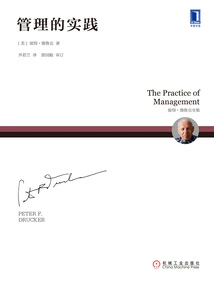
This book discusses "Managing Enterprises", "Managing Managers" and "Managing Employees and Work", which are the titles of the first, second and fourth parts of the book respectively. It also talks about "The Structure of Management" (Part 3) and "Decision Making" (Chapter 28). On the one hand, this book explores the "nature of management", the roles, responsibilities and challenges faced by management. On the other hand, it also examines managers from a human perspective and discusses managers who hold management positions and perform management work: what qualifications they need, how to develop management capabilities, and their responsibilities and values. This book also devotes a chapter to "the spirit of the organization" (Chapter 13). Almost all current discussions on "corporate culture" can be found in this chapter. This book is also the first to discuss "goals", define "key result areas", explain how to set goals, and use goals to guide the direction of the enterprise and evaluate performance. Indeed, the management term "goal" may have been invented by this book, at least it has not appeared in various previous discussions. In addition, this book is the first book that addresses both managing existing businesses and innovating future businesses.
This book discusses "Managing Enterprises", "Managing Managers" and "Managing Employees and Work", which are the titles of the first, second and fourth parts of the book respectively. It also talks about "The Structure of Management" (Part 3) and "Decision Making" (Chapter 28). On the one hand, this book explores the "nature of management", the roles, responsibilities and challenges faced by management. On the other hand, it also examines managers from a human perspective and discusses managers who hold management positions and perform management work: what qualifications they need, how to develop management capabilities, and their responsibilities and values. This book also devotes a chapter to "the spirit of the organization" (Chapter 13). Almost all current discussions on "corporate culture" can be found in this chapter. This book is also the first to discuss "goals", define "key result areas", explain how to set goals, and use goals to guide the direction of the enterprise and evaluate performance. Indeed, the management term "goal" may have been invented by this book, at least it has not appeared in various previous discussions. In addition, this book is the first book that addresses both managing existing businesses and innovating future businesses.
This book discusses "Managing the Business," "Managing Managers," and "Managing People and Work," which are the titles of Parts One, Two, and Four of the book respectively. It also talks about "The Structure of Management" (Part Three), and "Making Decisions" (Chapter 28). On the one hand, this book explores the "nature of management", the roles, responsibilities and challenges faced by management. On the other hand, it also examines managers from a human perspective and discusses managers who hold management positions and perform management work: what qualifications they need, how to develop management capabilities, and their responsibilities and values. This book also devotes a chapter to "the spirit of the organization" (Chapter 13). Almost all current discussions on "corporate culture" can be found in this chapter. This book is also the first to discuss "goals", define "key result areas", explain how to set goals, and use goals to guide the direction of the enterprise and evaluate performance. Indeed, the management term "goal" may have been invented by this book, at least it has not appeared in various previous discussions. In addition, this book is the first book that addresses both managing existing businesses and innovating future businesses.

Business is about doing the right things, management is about doing things right. Management is about looking outward, about opening up resources, making more money, and drawing "three buckets of water" from the market. And management means looking inwards, saving money, spending less money, and even dry towels should be squeezed out with "three drops of water". The 20th century was the era of production management, and enterprises mainly relied on management to improve efficiency. Today is the era of operation and management, and enterprises mainly relied on operation to improve efficiency. In the 20th century, the problems of most companies were due to poor management, and since the 21st century, the problems of most companies are due to poor management. Enterprises cannot use excessive management to make up for the lack of operation, and cannot use management diligence to replace slackness in operation. In the face of many uncertainties, the most important job of business leaders is to make the right choice. They should focus on business operations, transfer management work to subordinates, and shift from management to operation. This does not mean that management is not important, but that operation is more important. The author of this book combines his 40 years of practical business experience and his observations and thoughts on hundreds of companies in recent years to propose the concept and logic of effective operators, and summarizes the 5 tasks, 10 abilities, and 16 common sense of effective operators!
Today's management education has become more and more popular. Why do many managers still have poor results in practice? Why are the same resources handed over to different managers with very different results? Why do so many managers get stuck in a cycle of ineffective work? Why do many employees feel that their strengths are not being used in the company? Where does the real value of management lie? The author points out in the book that the core value of management lies in activating people and maximizing the output of the combination of people, things, and people and resources. The quality of management should not be judged by managers themselves, but should be measured through results inspection and external evaluation. Management is about turning theory into common sense. The author sorted out the common problems in daily management, and through in-depth exposition of 8 basic concepts that allow management to exert performance, it helps managers avoid common management traps, correct wrong management concepts, and improve management methods, thereby improving management performance and realizing the common growth of organizations and individuals.

The Six Points of Advancement - hard work, humility, reflection, gratitude, altruism, and optimism - are Mr. Kazuo Inamori's six methods of self-cultivation. They are not only applicable to operators, but also to employees and even people in general society. How to practice the six advancements in daily life? Mr. Murata Tadatsuki summed up his more than ten years of practical experience, summarized it in plain and easy-to-understand language into imitable and replicable methods, and shared them with everyone.
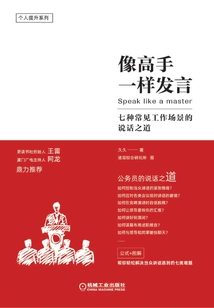
The expression and communication of civil servants is not only a simple expression of personal wishes, but also an externalization and reflection of job behavior, which has special restrictions and requirements. This book combines the common work scenarios of civil servants, disassembles, demonstrates, and analyzes many real workplace cases to explore the characteristics and rules of speech in them, and provides formulas and methods for civil servants to "speak well". As the saying goes: If you have food in your hands, you will not panic in your heart. Once you are familiar with the rules of speaking in various situations and master the ideas of speaking, it will no longer be difficult to speak in front of everyone!

It was written by two authors, one a psychologist and the other a science writer. More than 10 years ago, we began to frequently discuss the topic of outstanding people and "deliberate practice", and 5 years ago we began to write a book on this topic seriously. During that time, the book slowly took shape in the collision of ideas between the two of us, so much so that it is now difficult for us to distinguish which part of the book's ideas came from whom. All we know is that the two of us writing this book together are a much better and completely different book than either of us could have written alone.

Beginning with a close-up look at a drug addict, the author unabashedly dissects his own addiction to classical music recordings and fame. Weaving together real stories with recent scientific research and science-based solutions, it ends with empathetic advice on what each of us can do to avoid addiction, and what we as a society can do to help those with addiction.

A profound and powerful description of the father-son relationship. Author Michael J. Diamond has conducted research on father-son relationships for more than 30 years. He firmly believed that fatherhood was crucial to the development of both sons and fathers in each other. The father will profoundly influence his son, and the son will influence his father. The development of the father-son relationship crosses certain developmental milestones. He proposed the concept of a "good enough father"-a person who nurtures his own emotions, devotes himself to his child's inner world, and promotes his child's growth. His purpose in writing this book is to help men raise their sons well. In this book, he analyzes the father-son relationship throughout the life cycle, depicting the father's growth stages (starting with the wife's pregnancy); tracing the father-son relationship from the "guardian" stage in the son's early childhood to the father allowing the son to become independent and mature, guiding the son into adulthood. As his father grows older, father and son draw closer to each other again, and death becomes a reality that must be accepted. This book will lay a solid foundation for readers to understand the father-son relationship.
 32
32Schopenhauer's Treatment
General Fiction叔本华的治疗
K
"Schopenhauer's Treatment" is a profoundly influential and widely disseminated psychotherapy novel. It is one of the most representative novels by the master of existential psychology Irving Yalom. When psychotherapist Julius, who suffered from cancer and had only one year left to live, was surprised when he saw Philip, an old patient he had not contacted for many years. 23 Years ago, Philip had a serious addiction. Today, Philip is still arrogant and cold, wholeheartedly advocating Schopenhauer's pessimism. Julius dislikes Philip, but agrees to supervise him on the condition that he first participates in group therapy. When Philip walked into the group therapy room, he was like a special stone, causing ripples in the group, accompanying Julius through the final journey of his life... The complete reproduction of group therapy in the book is shocking, and it cleverly interweaves and unfolds the life experiences of the existential philosopher Schopenhauer.
"Schopenhauer's Treatment" is a profoundly influential and widely disseminated psychotherapy novel. It is one of the most representative novels by the master of existential psychology Irving Yalom. When psychotherapist Julius, who suffered from cancer and had only one year left to live, was surprised when he saw Philip, an old patient he had not contacted for many years. 23 Years ago, Philip had a serious addiction. Today, Philip is still arrogant and cold, wholeheartedly advocating Schopenhauer's pessimism. Julius dislikes Philip, but agrees to supervise him on the condition that he first participates in group therapy. When Philip walked into the group therapy room, he was like a special stone, causing ripples in the group, accompanying Julius through the final journey of his life... The complete reproduction of group therapy in the book is shocking, and it cleverly interweaves and unfolds the life experiences of the existential philosopher Schopenhauer.
The profoundly influential and widely disseminated psychotherapy novel is one of the most representative novels by the master of existential psychology Irving Yalom. When psychotherapist Julius, who suffered from cancer and had only one year left to live, was surprised when he saw Philip, an old patient he had not contacted for many years. 23 Years ago, Philip had a serious addiction. Today, Philip is still arrogant and cold, wholeheartedly advocating Schopenhauer's pessimism. Julius dislikes Philip, but agrees to supervise him on the condition that he first participates in group therapy. When Philip walked into the group therapy room, he was like a special stone, causing ripples in the group, accompanying Julius through the final journey of his life... The complete reproduction of group therapy in the book is shocking, and it cleverly interweaves and unfolds the life experiences of the existential philosopher Schopenhauer.
While more and more people feel the hustle and bustle and loneliness of bustling urban life, they begin to feel psychological rejection of social life. A person lives too lonely, and is "allergic" to human beings in crowds. When socializing, he becomes anxious. For matters that can be resolved through text messages, never communicate on the phone or in person, and try to minimize opportunities for face-to-face social interaction. Is this a result of his innate personality, or is it a manifestation of escape brought about by the exhaustion of involution? Self-blame, self-sin, self-violation, self-abandonment, and even determination to separate from oneself create a lasting conflict with the true self, causing people to fall into the abyss of "self-war", accompanied by anxiety. Choosing "safety" to avoid coping because of fear seems to be a reasonable choice, but as a result, people with social phobia lose the opportunity to be aware of themselves, understand themselves, and achieve spiritual growth in pain. How to get rid of inner conflicts and struggles and find your true self? The road to transformation is also the road to growth.