C
by H
About This Novel
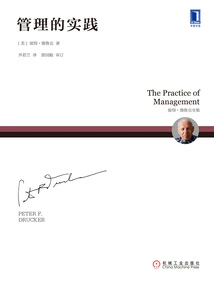
This book discusses "Managing Enterprises", "Managing Managers" and "Managing Employees and Work", which are the titles of the first, second and fourth parts of the book respectively. It also talks about "The Structure of Management" (Part 3) and "Decision Making" (Chapter 28). On the one hand, this book explores the "nature of management", the roles, responsibilities and challenges faced by management. On the other hand, it also examines managers from a human perspective and discusses managers who hold management positions and perform management work: what qualifications they need, how to develop management capabilities, and their responsibilities and values. This book also devotes a chapter to "the spirit of the organization" (Chapter 13). Almost all current discussions on "corporate culture" can be found in this chapter. This book is also the first to discuss "goals", define "key result areas", explain how to set goals, and use goals to guide the direction of the enterprise and evaluate performance. Indeed, the management term "goal" may have been invented by this book, at least it has not appeared in various previous discussions. In addition, this book is the first book that addresses both managing existing businesses and innovating future businesses.
Official Sources
What Readers Think
Rating
Community(0)
Official(4)Scraped 1mo ago
A great and classic book on management!
This book is one of the representative works of Drucker (1909~2005). It provides a comprehensive analysis and discussion of the work of managers and the practice of management. Although the book was published in 1954 (hard to imagine 70 years ago!), It does not affect its practical value at all. It places deep expectations and positive comments on companies and managers in the near future. It is both practical and sincere. Here is a brief excerpt from a personal record: First, "There are 8 areas in which companies should set performance and outcome goals, including market position, innovation, productivity, physical and financial resources, profitability, manager performance and manager training, employee performance and work attitude, and social responsibility." Second, "Find out the necessary general concepts, formulate correct principles, establish reasonable systems and methods, and propose the most basic working model. All of this is the main content of this book that I want to tell readers." All of them are impressive. There are too many incisive, practical and sincere discussions that cannot be captured. Finally, the author proposes that no matter how technology, technology, environment, and policies change, the most important characteristic of managers is "honesty and integrity". This is the only unchanging foundation and principle. Mutual encouragement.
In this book, he teaches not only management skills, but also what human nature is like, and how to use human nature to manage well. This is very poignant for scholars.
The author is not only a leader in modern management, he is also a social ecologist. I have written many books on management, and the content in this book is very detailed.
Today's society is a society composed of multiple organizations, and managers in this society are not like extreme managers. Sometimes management also requires learning.
Rating
Community(0)
Official(4)Scraped 1mo ago
A great and classic book on management!
This book is one of the representative works of Drucker (1909~2005). It provides a comprehensive analysis and discussion of the work of managers and the practice of management. Although the book was published in 1954 (hard to imagine 70 years ago!), It does not affect its practical value at all. It places deep expectations and positive comments on companies and managers in the near future. It is both practical and sincere. Here is a brief excerpt from a personal record: First, "There are 8 areas in which companies should set performance and outcome goals, including market position, innovation, productivity, physical and financial resources, profitability, manager performance and manager training, employee performance and work attitude, and social responsibility." Second, "Find out the necessary general concepts, formulate correct principles, establish reasonable systems and methods, and propose the most basic working model. All of this is the main content of this book that I want to tell readers." All of them are impressive. There are too many incisive, practical and sincere discussions that cannot be captured. Finally, the author proposes that no matter how technology, technology, environment, and policies change, the most important characteristic of managers is "honesty and integrity". This is the only unchanging foundation and principle. Mutual encouragement.
In this book, he teaches not only management skills, but also what human nature is like, and how to use human nature to manage well. This is very poignant for scholars.
The author is not only a leader in modern management, he is also a social ecologist. I have written many books on management, and the content in this book is very detailed.
Today's society is a society composed of multiple organizations, and managers in this society are not like extreme managers. Sometimes management also requires learning.
Featured in 2 Booklists
Official(2)
Management truths that are still valid after 60 years: Drucker teaches you to use "management by objectives" to reconstruct organizational effectiveness and make the enterprise everlasting.




This book discusses "Managing the Business," "Managing Managers," and "Managing People and Work," which are the titles of Parts One, Two, and Four of the book respectively. It also talks about "The Structure of Management" (Part Three), and "Making Decisions" (Chapter 28). On the one hand, this book explores the "nature of management", the roles, responsibilities and challenges faced by management. On the other hand, it also examines managers from a human perspective and discusses managers who hold management positions and perform management work: what qualifications they need, how to develop management capabilities, and their responsibilities and values. This book also devotes a chapter to "the spirit of the organization" (Chapter 13). Almost all current discussions on "corporate culture" can be found in this chapter. This book is also the first to discuss "goals", define "key result areas", explain how to set goals, and use goals to guide the direction of the enterprise and evaluate performance. Indeed, the management term "goal" may have been invented by this book, at least it has not appeared in various previous discussions. In addition, this book is the first book that addresses both managing existing businesses and innovating future businesses.