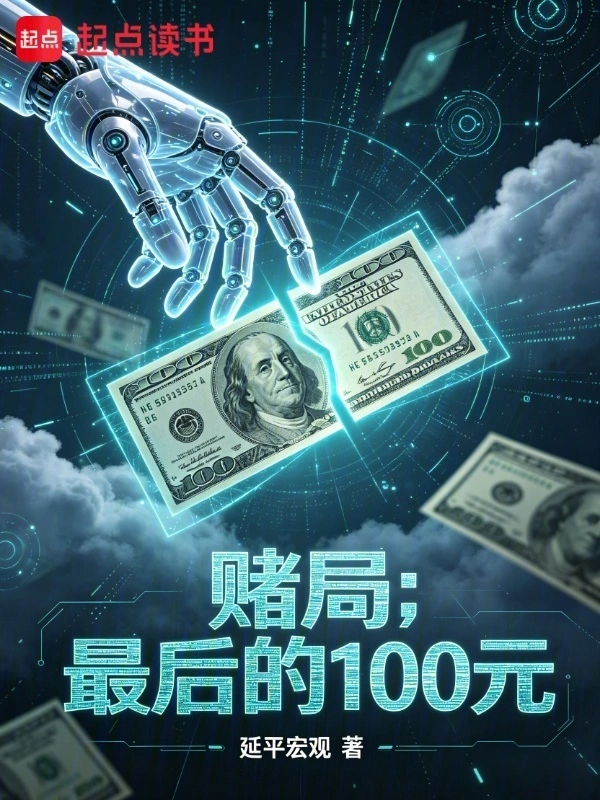
Gamble: the Last 100 Yuan
赌局:最后的100元
- Status
- Ongoing
- Length
- 106k Words
- Genre
- Western Fantasy
- Audience
- Male
- Subgenre
- Alternative Fantasy
- Updated
- 1mo ago
- Source
- Qidian
Stats
0Monthly votes
20Recommends
0Fans
49Chapters
Synopsis
Reader comments
Readers also read
 The Alchemist Girl Is Becoming a God
 Open Your Adventure Log
 I Won the Favor of Ms. Quiet
 Kobold Wizard: What the Hell Is Your Attainment Status?
 Criminal Investigation Notes 2: Buried Corpse in Songhu
 A Lifetime of Wealth
 Long Wanshengshi
 The Black Witch's Journey to Another World
 Douluo Laid the Foundation, Waves in the Sky
 Jinghong's Son
 Demon Judge
 Daming Under Facebook
 Love Sword Rivers and Lakes Record
 Quantitative Trap: Chief Secretary's Resignation Sheet
 The Watcher at the Head of the Stream
 Wasteland Logic: Broken Age
Thoughts after reading "The Peak of Game: The Promise of the Mountain": The Essence of Finance and High-Dimensional Nihilism Experiments
As an observer who has been in the capital market for more than 20 years, I have seen countless algorithms trying to interpret market rules, and I have also seen countless capital bosses trying to change their fate. But after reading the "Game of the Mountains" series - from "The Last 100 Yuan" to the final chapter "The Final Observer", I felt a rare sense of trembling. This is not literature, this is a thorough, hands-on guide to "how civilization capitalizes itself and commits the ultimate default." It strips away the glitz of literary criticism and analyzes the entire novel as a "high-dimensional chip manipulation experiment." 1. Market disenchantment: reject the "devil" and return to the "vector" Most financial-themed works fall into a huge misunderstanding: personifying the market. They are keen to portray that "short-sellers are devils" and "bookmakers are greedy beasts". But the mountain in the book breaks this stereotype with extreme ruthlessness. The motto mentioned repeatedly in the book - "On the capital table, there are no devils, only winners" - is the most accurate definition I have heard in my nearly twenty years of work. The financial market is essentially a huge energy converter without moral attributes. Dashan's operations in the book, whether it is re-pricing of resources or extreme control of capital flows, its core logic is highly consistent with the ultimate application of Kelly Criterion: in uncertainty, through continuous recursive deduction, the deterministic path to the optimal solution is found. What really touched me was that Dashan stripped away all the pretense of "fairness" and "morality" and reduced "financial operations" to a pure "probability theory game." This is the watershed between the top traders and the mediocre ones: the mediocre ones are staring at the red and green of the K-line, while the top traders are staring at the psychological thresholds of market participants and the distribution structure of system chips. 2. Nested Games and "Systematic Formatting" If the first two films, "The Foundation of the Mountain" and "The Top of the Mountain", show how to become a winner by manipulating chips within the existing rules framework, then "The Final Observer" elevates game theory to the level of ontology. As financial practitioners, what we fear most is "black swans", because black swans represent the subversion of system rules. In the book, Dashan's operation is more radical: he is not looking for black swans, he personally creates a black swan that is enough to cause "system formatting" by triggering logical paradoxes within the system. This is an extreme, high-dimensional financial game. When a civilization realizes that it is a specimen being observed, most people react by panicking or praying for mercy from the observers. But Dashan's logic is very clear: "If observation itself is the consumption of value, then let the value return to zero." In financial investment science, this corresponds to "asset liquidation". When the expected benefits of a project can never cover its depreciation and risk costs, the best financial decision is to stop capital injection, liquidate assets, and exit completely. Dashan conducted a "total liquidation" of the entire civilization as an asset. This is an ultimate game that transcends any economics textbook. 3. The Essence of Assets: From Money to Monetization of Consciousness The most core aspect of "Game Peak" is that it explores the ultimate form of capital logic. In the real capital market, what we trade is currency, debt, and equity. In the book, what Dashan is trading is "civilization itself." He transformed the emotions of the residents of the core sector into "capital fuel" and packaged historical memories into "art premium". This kind of thinking is a profound warning to every investor in reality: in the eyes of capital, everything can be capitalized as long as it can be measured. When you look at the rise and fall on the screen, ask yourself: Are you analyzing the value of a company, or the joys and sorrows of a civilization? Dashan completed a perfect compliance fraud through the label of "artistic appeal is too strong", which is the most pungent satire on the loopholes in real financial supervision. He told us: As long as you master the pricing and definition rights, any rules are just a shield for you to achieve your profit goals. 4. Conclusion: The eternal silence behind the card table After closing this book, I couldn't calm down for a long time. It is not a good story because it does not give readers a comfortable ending. It is a mirror that reflects the deepest cruel truth in the capital market. I often tell my analysts that if you feel "fear" at the poker table, it means you haven't seen the true nature of it yet. In this world made of chips, fear is superfluous, pity is superfluous, and even the concept of "winning" itself seems a bit funny when faced with the nothingness of higher dimensions. Da Shan's last sentence, "Formatting the card table," is the most shocking financial metaphor in the entire work. When gamers defeat the market by destroying it, is this the highest level of victory or the greatest failure? This is an ending without an answer. In other words, the answer is not important. Because as Dashan said: "The game has been played, and the winner is determined." For every reader who plays games in the secondary market, the primary market, or the broader power structure, I strongly recommend reading this book. It won't make you richer, but it will give you a "win-loss brain" as cold as a mountain and as precise as logic when facing ruthless market fluctuations. In this universe built by computing power and greed, may you be the last winner to leave the table.
Self-recommended preface to the series "The Game of the Mountains": This card game will never leave the game
On the capital table, there is never a devil, only a winner. If you clicked on this preface to find a soothing inspirational fairy tale or a routine slap-in-the-face article, I suggest you leave it now. Not only does this save you time, but it also respects the brutal nature of the story. The "Game of the Mountain" series I created - from "Gamble: The Last 100 Yuan" to "The Game of the Mountain: The Final Observer" - is not to create heroes, but to conduct a thorough dissection of power, capital, logic and existence itself in reality through the carrier of "mountain". 1. Bet: From 100 Yuan to the Collapse of the Star Sea Many people asked me, why is the starting point of this series a trivial "100 Yuan"? Because the nature of the game never depends on how many chips you have in your hand, but on how you "define" the chips. In that wasteland, 100 yuan is the bottom line for survival and the starting point of logic. When the protagonist Dashan starts from this chip and tries to leverage the financial structure of the entire civilization, he faces not only hunger and plunder, but also the logical deadlock of the operation of the entire civilization. From "Gamble: The Foundation of the Mountain" to "The Top of the Mountain", what you will see is that the "rules of power" packaged in glamor are ruthlessly stripped away one by one. Dashan is not playing a game, he is using the rules as building blocks to dismantle, reconstruct and overthrow! When you see him facing hypocritical accusations from federal ministers, or even those indifferent high-dimensional observation systems in outer space, every word he utters is a scalpel that accurately inserts holes in his opponent's logic. 2. Strategy: There are no villains, only prey. This is my core principle throughout the book. In traditional online novels, we are used to seeing the dualistic confrontation between good and evil, and are used to the protagonist destroying the "villain". But at my table, there are no villains. Every opponent Dashan faces - whether it is the minister in charge of the galaxy or the high-dimensional "recorder" that monitors the evolution of hundreds of millions of years - they are just certain nodes in the capital logic chain. They are obsessed with maintaining the so-called "order", and Dashan has only one goal: to completely crush this order into his own fuel. In this work, there is no overflowing brilliance of humanity, because in the face of absolutely rational games, emotions are just the noise of the system's operation. I hope that when you read, you will not feel cheap empathy, but experience a "logical tremor." Like a mountain, peel off all the emotional filters and gaze into the cold, deep game world full of calculations and reversals. 3. Ending: Not only a game, but also a dimension reduction countermeasure to "The Game of the Mountain: The Final Observer", the plot will completely break out of the atmosphere. When the card table extends from the surface of the planet to outer space, and when the opponent changes from greedy politicians to an indescribable high-dimensional civilization, the chips in the game are no longer currency, but physical constants, energy cores and computing power star rings. At this stage, Dashan's ultimate resort is: format the entire system. When the gamer discovers that he is just a data point being fed, the ultimate "win" is not to defeat the observer, but to prove to the observer that this gaming environment has no record value. This is the only and final freedom of civilization in the face of ultimate nothingness. 4. Why do you need to read it? This is not a book written for "fun". It is written for those who feel depressed in the capital market, in the workplace, and in the whirlpool of power, but still long for a breakthrough. If you are tired of fake chicken soup and tired of plots that forcibly subdue your wits to satisfy your lust, then this "Game of the Mountains" is prepared for you. It's cold, precise, logical and leaves no stone unturned. It will teach you how to calculate probability in despair and how to find the weak profit margin under the collapsed rules. I don't promise to give you a happy ending, because in that kind of logical evolution, a happy ending is blasphemous to the game. But I promise, I will take you to the end and see with your own eyes how the "wall" that monitors civilization collapses before your eyes. The cards have been laid. The admission fee is a test of deep logic, and the benefit is a complete reshaping of your cognitive boundaries.
Young people, how to read well and follow the right path?
Today, a junior student at school wrote a message while reading my new book. I find it very touching and would like to share it with a wider audience. His original message: "Reading the whole book in one breath, my feeling is that I read a good book. Take the right path." So my question is what is a good book and what is the right path? "Read the whole book in one go, get some feelings, read good books, and take the right path." When these short twenty words came out from the mouth of a college student who was still in the ivory tower, the entire noisy Internet seemed to be quiet for a second. In this fast food era where everyone is pursuing "three seconds to catch the eye" and the screen is full of "five minutes to show you through", a young man, with an almost old-school, almost clumsy determination, taught the most hard-core lesson to all his peers who were still confused. This is not just a book review, it is a "cognitive awakening" for young people. In this era dominated by algorithms and short videos, our time is cut into pieces. We are used to being fed, used to looking for cheap emotional resonance in other people's explanations, but we have gradually lost the patience to chew hard bones. And this college student, with the vigor of "reading it in one breath", tore through this impetuous filter. What he reads is not words, but logic; what he reads is not stories, but underlying laws. This kind of concentration that is not disturbed by the outside world is the most scarce asset in this era. What's even more amazing is the phrase "I'll express my feelings later." This is simply "delayed gratification" at the textbook level. How many people read a page of a book and couldn't wait to post it on WeChat, along with a few incomprehensible sentences, just to get a few likes and vanity? But he didn't. He chose to settle his emotions and ferment his thoughts. Because he knows that truly profound knowledge is never blurted out, but is the crystallization that comes out naturally after chewing it over and over again late at night and building a complete logical closed loop in his mind. This kind of restraint, this kind of reverence for knowledge, is the real high IQ. So, how can young people "read good books and follow the right path"? Read good books, not those successful academic chicken soups that teach you "how to get rich in three days" or "how to make a quick counterattack". Those books, the faster you read, the harder you fall. Really "good books" are those that can reshape your worldview and allow you to see the underlying logic of things. They are words that are as simple as soil, but can take root very deeply. They may be boring or obscure, but they can give you a "perspective eye" to see through the laws of the world. To take the right path is to maintain an "anti-fragile" determination in a world full of temptations and shortcuts. There is a saying in the financial market: "Living long is always more important than walking fast." The same is true in life. Those seemingly smart shortcuts are often marked with the most expensive price; those seemingly clumsy persistence are the only moat across the life cycle. The twelve words of this college student have actually given the most perfect answer: use the execution power of "reading it in one go" to break the information cocoon, use the determination of "send it out later" to fight impetuous anxiety, and finally, use the confidence of "reading good books" to take the "right path" of your life. Stop wasting your time on cheap pleasures. Go read, read good books that make you ache, make you think, and make you wake up in the middle of the night. When you carve the wisdom accumulated over the years into your own bones little by little, you will find: There is no so-called shortcut in this world. Every good book you read and every right step you take will eventually turn into your most indestructible armor in this cruel world.