


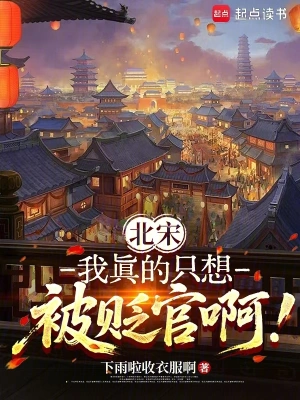
Northern Song: I Really Just Want to Be Demoted!
北宋:我真的只想被贬官啊!
- Status
- Completed
- Length
- 1.2M Words
- Genre
- Historical
- Subgenre
- Song-Yuan-Ming Dynasties
- Updated
- 6mo ago
- Source
- Qidian
Stats
329Chapters
0Votes
6.3kRecs
59kFans
Tags
Synopsis
More by this author
Readers also read
 Daming: Asking for the Throne at the Beginning, Lao Zhule Went Crazy
 A Guide to Building Civilization in a Primitive Tribe
 My Father Is Wen Tianxiang, and We Win the Battle of Yashan from the Start
 My Only Method: I Will Add More Points to Become Stronger at the End of Ming Dynasty
 Great Ming: Brother, You’ve Ruined Me
 The Ming Dynasty’s Useless Third-Place Scholar
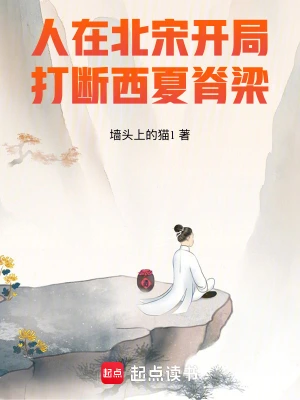 In the Northern Song Dynasty, Breaking Western Xia’s Backbone from the Start!
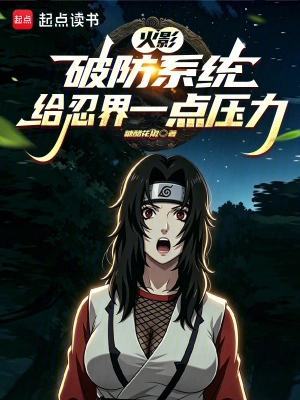 Naruto: The Defense-Breaking System Brings a Little Pressure to the Shinobi World
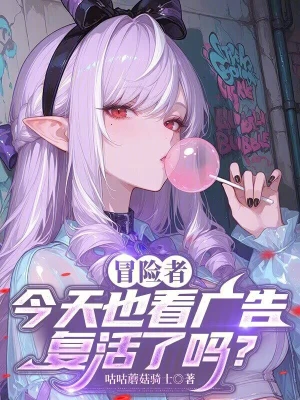 Who Says Adventurers Can't Watch Ads to Revive?
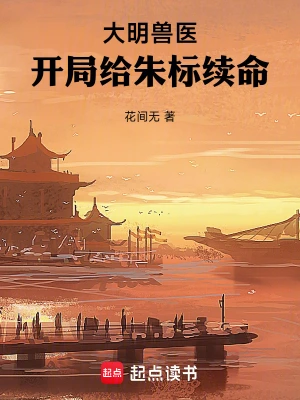 Ming Dynasty Veterinarian: From the Start, I Save Zhu Biao's Life
 Ten Years as a Study Companion, and the Entire Court Begs Me to Shut Up
 I Transmigrated to the Ming Dynasty and Trained Old Zhu to Become a Great Navigator
 Northern Song: Seizing Zhao Ji’s Throne
Reader comments 36
Google Translate
What mistakes are easy to make in historical novels❓
Before the Ming Dynasty, the emperor was not called "Emperor". In the Song Dynasty, he was mostly called "Guanjia", and in other dynasties, he was called "Your Majesty". In the Ming Dynasty, the emperor was occasionally called "Emperor", and in most cases he was called "Your Majesty". After Kangxi of the Qing Dynasty, people began to be generally called "Emperor". Princes and princes call themselves: Princes in the pre-Qin and Han Dynasties can be called "Gu", and a few can be called "Ignores". After the Wei, Jin, Southern and Northern Dynasties, the title of "Ignores" gradually became exclusive to the emperor, and princes, princes and princes can only be called "Gu" or "I". Song, Yuan and Ming called themselves "I" or "I". Before the Qing Dynasty, princes and princes rarely called themselves "this king". Starting from the Kangxi year of the Qing Dynasty, princes generally called themselves "this king". In ancient times, women called themselves: "nujia" was a modest name for women after the Song Dynasty. Women in the Han and Tang Dynasties more often called themselves "concubine", and noble women could call themselves "I" and "I". Before the mid-Ming Dynasty, most dynasties used copper coins for daily transactions, with very little gold and silver. It was only in the mid-to-late Ming Dynasty that silver became the mainstream currency. In the late Ming Dynasty, "meeting votes/deposit checks" appeared among the people. There were no unified rules. Most of them were deposits and withdrawals/exchange receipts from acquaintances or local circulation, and were not legal currency. In the early years of Daoguang in the Qing Dynasty (1823): Rishengchang Bank was established, and private banks began to issue standardized banknotes, focusing on cross-regional exchange. They were only circulated in Shanxi merchant trade circles and major commercial ports, and were not yet popular. In the third year of Xianfeng in the Qing Dynasty (1853): the official issued the Ministry of Revenue official banknotes (official banknotes), which were forced to circulate nationwide. At the same time, the network of private banknotes expanded to the whole country, and official and private banknotes ran parallel. The use of banknotes entered an explosive period and became the "starting point of popularization." High-leg tables and chairs only completely replaced the low tables for sitting on the floor in the Song Dynasty. During the Han and Tang dynasties, people knelt and sat on the tables to eat and discuss matters. The furniture was mainly low tables and couches. The memorial system was only established during the Kangxi period of the Qing Dynasty. Officials in the Tang and Song Dynasties used "memorials", "tables" and "statements" when submitting memorials, while in the Ming Dynasty they used "memorials" and "memorials". There is no such thing as "memo" or "zhezi". In ancient formal occasions, the hand-over gesture was performed with the left hand outside and the right hand inside. The right hand outside was a special "unlucky gift" for funerals. "Better greetings" is a unique etiquette of the Qing Dynasty. It was mostly used by subordinates to superiors and juniors to elders. During the Tang and Song dynasties, people often performed cross-hand salutes and bows to greet greetings when they met, and there was no such thing as "sending greetings". {"NickName":"Restriction and Supervision","UserId":417773267} Before the Yuan Dynasty, subordinate officials rarely called superior officials "adult". In some dynasties, subordinates called eunuchs "adult", and in some dynasties, they called their parents and elders "adult". Beginning in the Yuan Dynasty, lower-level officials would occasionally call officials of second-rank and above "sir". From the middle and late Ming Dynasty, only officials of third-rank and above would be called "sir" by their subordinates. Officials with lower ranks could not be called "sir". However, in the late Ming Dynasty, there began to appear a few cases where officials above the fourth rank were called "adult". Before the mid-Qing Dynasty, following the rules of the Ming Dynasty, only officials of third rank or above would be called "adult". Starting from the mid-Qing Dynasty, calling officials "adult" gradually became common for lower-level officials. Attention! ! ! What is mentioned above is that lower-level officials refer to higher-level officials. No matter which dynasty, it is absolutely impossible for higher-level officials to call lower-level officials "sir". Some novels even write about emperors or nobles calling other officials "sir". This is simply contrary to Tiangang! ! ! Finally, let's talk about the problem of civilians calling officials Before the middle and late Qing Dynasty, civilians in various dynasties and generations called officials differently, and most of them called them "officials" and "masters". From the middle to late Qing Dynasty, civilians also called officials "adult".
In fact, Wang Anshi's filter was too heavy. If you peel back the filter and look at Wang Anshi and the New Party, you will find that the people with the least political ethics in the Northern Song Dynasty were these people. It is impossible for Wang Anshi and others not to know the consequences of the entire new law. And when the old and new parties were debating, these issues were actually discussed openly. Wang Anshi's group of people are all familiar with the grassroots level in the local government. They have a good reputation in terms of the virtues of the officials below. It's just that Shenzong wanted to seize power at that time, and Wang Anshi also wanted to gain political capital, so the bastard fell in love with Mung Bean. And the reason why Wang Anshi and his family are said to be one of the original sins of Jingkang in the Northern Song Dynasty is because Wang Xianggong was so dirty that dogs would shake their heads after seeing it.
This reward is indeed unattractive. People reward you for going back to modern times. There are no various entertainment activities in ancient times. Even if you have a fortune, you don't have as many consumption methods as modern ones.
Was this introduction written by a normal person? You are a demotion system, not a death system. Did the author make a wrong setting?
In the Northern Song Dynasty, corrupt officials were not sentenced to death, and at most they were demoted. The system was to demote officials and get rich, so just be greedy and get rich no matter what.
This kind of uprightness doesn't suit me
Is the system flow system broken?
It says that the system has run down? Kind of funny.
"Northern Song Dynasty: I really just want to be demoted!" "The title of the book is like a sharp lightning, splitting the established channel of "promotion and wealth" in the historical time-travel theme.
It completely changes the ultimate goal of the protagonist Zhao Ye from the "rising to the top" pursued by thousands of people to the unavoidable "retreat bravely". This ultimate "anti-routine" setting not only instantly establishes the comedy tone of the work, but also packages a profound political survival fable into an officialdom adventure full of absurdity and wisdom. The narrative power of this setting comes from the fact that it places personal wishes and the current of history in a very tense dislocation. In the Northern Song Dynasty, a specific stage where party disputes were fierce and the political situation was turbulent, being demoted from an official position was a setback in political life for ordinary people, but for the protagonist Zhao Ye, it might be a carefully calculated "safe exit" strategy, a kind of "great wisdom" away from the eye of the storm of power. However, the paradox of history is that the more people want to escape from the center of the whirlpool, the more they will be thrown to the core of the incident by greater forces. Every one of his "begging for relegation" - whether it is being straightforward, deliberately making mistakes, or showing inaction - may accidentally touch the pain points of the times. Instead, he will be interpreted by the emperor or the current situation as "loyal and commendable", "late bloomer" or "with profound meaning", thereby pushing him to a more prominent and dangerous position. This "backfire" comedy effect is the most powerful engine that drives the story. From a creative perspective, the title of this book provides us with a very ingenious template: how to deconstruct traditional narratives and open up new plot possibilities and ideological depth by setting a core action goal for time travellers that is completely contrary to historical common sense. It requires the author to have a deep understanding of the political ecology and officialdom rules of the Northern Song Dynasty in order to make the protagonist's "seeking derogation" method appear reasonable, diverse and interesting. At the same time, this also prompts the story to go beyond simple comedy to touch on serious propositions such as the nature of power, the ideals of literati, and the way to protect oneself in troubled times. We look forward to the protagonist Zhao Ye using his helpless wisdom on this rebellious road of "seeking benevolence but not benevolence" to reveal to us another real and absurd picture of the officialdom of the Northern Song Dynasty, and finally answer an ultimate question: In an era where one has no choice but to do one's own, can a person win real success that belongs to him through "active failure"? This is undoubtedly a wonderful start full of historical insight and narrative ambition.
In the Northern Song Dynasty, you had to be an official to live comfortably. Official salaries were the highest in the history. Without an official position, no matter how rich you were, you were just a fat pig waiting to be slaughtered. The old and new parties fought to the point of death. To the death, it was just exile or demotion. Moreover, there was no real evidence for major crimes, and exile was rare. There was a high probability of being exiled. Demoted, kept demoted, Su Dongpo is an example. He committed crimes again and again, and was demoted every time. Then every time his brother took advantage of him, the worst he could do was resign and go home to become a country squire, something like an official. Such unspoken rules cannot be touched. Unless there is revenge for killing his father or something, no one will commit this taboo.
I feel like the plot is too sloppily handled. Tomato's good writing is a bit uninteresting at the starting point.