


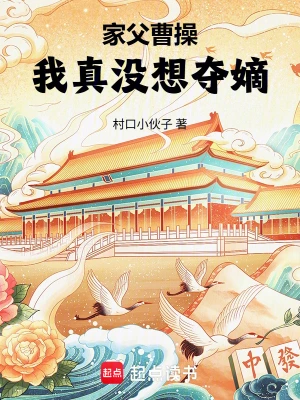
My Father Is Cao Cao, but I Never Planned to Usurp the Throne
家父曹操,我真没想夺嫡
- Status
- Ongoing
- Length
- 974k Words
- Genre
- Historical
- Subgenre
- Qin-Han & Three Kingdoms
- Updated
- 19h ago
- Source
- Qidian
Stats
383Chapters
214Votes
1.8kRecs
21.9kFans
Tags
Synopsis
More by this author
In booklists 1
Readers also read
 A Literary Master in Ancient Greece
 Seizing the Direct Descendant in the Red Mansion
 Great Ming: His Father Is Useless, So He Must Summon the Founding Emperor
 Germany: 1914
 Simultaneous Transmigration: Is Everyone Starting Out in Prison?
 The Succession Struggle in the Flourishing Tang Dynasty
 The Tang Dynasty's Rebellious Grandson: Your Majesty, Call Me Crown Prince!
 A Dual Status Panel Descends into the Abyss, and the Assassin's Potion Is Right at the Entrance
 The Black Witch's Journey to Another World
 I Am Ma Su, Fit for Great Things
 The Great Ming's Useless Duke
 Northern Song: Seizing Zhao Ji’s Throne
 Three Kingdoms: Starting by Stabbing Cao Cao in the Back
 My Father Is Liu Bei, but I'm a Shu-Han Hater
Reader comments 29
Google Translate
The writing and plot are both good, but the author keeps emphasizing how weak and annoying the protagonist is, so that the plot twist later will be more exciting, but I really can't stand it anymore.
Cao's backyard is written like a palace fight
While Cao Ang is alive, no one hopes to succeed Cao Cao. I don't know why you can write Cao Pi as an ambitious person at this time?
Every time I see this kind of low-key profile, I know what it is without even looking at it. It is a clichéd thing that has been around for thousands of years. It is too pretentious, and it is really just what it is and what it is.
Stop writing your bad jokes, okay?
I originally felt that the writing was okay, but I kept making bad homophonic jokes every day. . .
Really awesome
Sleeping during a meeting in the military camp 6666 Is this what anyone can think of? What do you think of a military camp if you don't follow any discipline at all?
The author clearly equates disobedience with disobedience to orders; disobedience means bargaining before formal orders, asking for treatment, evading things, and swearing; disobedience is a direct sign of civil strife, failure to carry out orders after giving them, not obeying orders at all, and doing things on one's own; the author should have no work experience, because people with work experience should understand the difference between the two.
Let's talk about Chapter 53 again, where Cao Cao's military generals are given power over the protagonist's son to gain a sense of presence. This is not how we did it. 1. Someone comes forward to choke the protagonist first A few thorns come in and say a few words, making it difficult for the young master to get off the stage and giving him power. 2. Immediately someone came out to "play the red face" The veteran leader and the junior leader immediately rushed over and scolded the soldiers: "Presumptuous! How can you talk to the young master!" They even kicked and slapped them in public, teaching them a lesson in public. 3. Give me another step at the end The leader turned around and apologized to the young master: "I have taught my subordinates a lesson for being ignorant, so don't be as ignorant as them." ——This approach has a full effect: - The Qingzhou Army's arrogance and hard-to- trifle embody - It gave the young master power, but did not break his face - On the surface, it gave Cao Cao enough face - The young master was obviously defeated, but he could not get angry, so he could only eat Coptis chinensis in silence This is called a conflict with brains, it is reasonable, real, and tasty enough. Instead of writing: Everyone was in public, publicly slapped in the face, leaving no room for anything... That was not an army, that was a group of lunatics who had just escaped from a mental hospital.
The plot of Chapter 53 has been a bit broken recently.
This plot really can't be called unreasonable. It simply rubs all the rules, machinations, logic, and worldliness of the ancient army on the ground, making people feel uncomfortable watching it. The direct descendants of the Cao family came to the Qingzhou Army. To put it bluntly, they came to gild, brush their resumes, accumulate military merits, and establish prestige. He was the son of the lord and someone who would hold great power in the future. He was not on the same track as the generals who led the troops below. Generals compete for merit in battle and promotion, while princes seek seniority and prestige. There is no question of whether to grab merit or not. Ranks are all different. In reality, if such masters really come down, no matter how much the generals look down on these noble disciples in their hearts, they still have to treat them with respect and provide them with good food and drink. Why? Because the young master has direct access to Cao Cao, when the logistics and food supplies are stuck, even if the general runs and breaks his legs, the young master can clear the way with just one word; if the soldiers want to improve their food and get meat, the young master can do it better than anyone else. As long as the young master does not give blind orders or meddle in military affairs, the generals would like to worship him as the God of Wealth. How could they jump out and ridicule him in front of his face and call him a waste? What's even more outrageous is that someone actually dared to accuse Cao Cao of nepotism in public. This is no longer crazy, but a slap in the face of the lord in public, which is tantamount to conspiracy. The army can tolerate no matter how chaotic it is. It can tolerate massacres, looting, and poor military discipline, but it cannot disobey orders and respect the Lord. Once his generals dare to openly challenge the lord's authority, the army will be out of control, which will be a serious problem for Cao Cao. In the end, for such a serious matter, a top strategist like Xi Zhicai did not control the situation, protect the master, or deal with the people who stirred up the trouble. Instead, he said lightly "We will discuss it next time", and the protagonist and his group withdrew in despair. It's like Cao Cao's face, the dignity of the Cao family, and the order of dignity in the army have all been stepped on, so let's forget it. Looking at the whole paragraph, the protagonist is cowardly, the counselor is unconscious, the general is crazy, and the logic is broken. There is no normal person in the whole team. It is completely written to create conflicts forcibly, and it can't be more fake.
After checking Cao Shuo, it is strange that a person who died young still has descendants.
Xiao Baiwen is weak and does many evil things. His servants don't listen to his master 😒. How can he do evil things?