


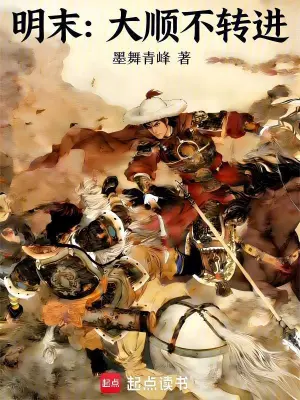
Late Ming: Dashun Never Retreats
明末:大顺不转进
- Status
- Ongoing
- Length
- 1.3M Words
- Genre
- Historical
- Subgenre
- Song-Yuan-Ming Dynasties
- Updated
- 3d ago
- Source
- Qidian
Stats
346Chapters
161Votes
16.5kRecs
15.6kFans
Tags
Synopsis
In booklists 1

Readers also read
 Great Ming: His Father Is Useless, So He Must Summon the Founding Emperor
 A Literary Master in Ancient Greece
 Seizing the Direct Descendant in the Red Mansion
 Germany: 1914
 Simultaneous Transmigration: Is Everyone Starting Out in Prison?
 At the End of the Jin Dynasty: From Human Livestock to Emperor
 Sun and Moon: Yongli 1656
 A Great Industrial Nation, Starting with a Fake Student Abroad
 A Dual Status Panel Descends into the Abyss, and the Assassin's Potion Is Right at the Entrance
 Reviving Han Prosperity, 1844
 The Taiping Heavenly Kingdom, 1854
 Three Kingdoms: Cross the River by Following the Sima Clan
Reader comments 36
Google Translate
Li Laiheng, the last general of the Han people who conquered captives, persisted in resisting the Qing Dynasty for more than 20 years. He resisted the Ming Dynasty with the first half of his body, and attacked the unruly Manchu Qing Dynasty with the second half. Speaking of the heroes of the late Ming Dynasty, everyone knows that Zheng Chenggong, Li Dingguo, and Li Laiheng are also well-deserved heroes of the late Ming Dynasty.
It's better to help Li Zicheng than to do it yourself. Li Zicheng's grass-roots team is worse than the Taiping Heavenly Kingdom.
Novel related combat illustrations
Some readers said that it would be more convenient to have pictures. Since the author has not signed a contract yet, he can only post pictures in the comment area using a small account. Some illustrations will be updated here as the situation develops. The first is the situation on May 9, 1644 (the day the battle of Chengan Town started)
What mistakes are easy to make in historical novels❓
Before the Ming Dynasty, the emperor was not called "Emperor". In the Song Dynasty, he was mostly called "Guanjia", and in other dynasties, he was called "Your Majesty". In the Ming Dynasty, the emperor was occasionally called "Emperor", and in most cases he was called "Your Majesty". After Kangxi of the Qing Dynasty, people began to be generally called "Emperor". Princes and princes call themselves: Princes in the pre-Qin and Han Dynasties can be called "Gu", and a few can be called "Ignores". After the Wei, Jin, Southern and Northern Dynasties, the title of "Ignores" gradually became exclusive to the emperor, and princes, princes and princes can only be called "Gu" or "I". Song, Yuan and Ming called themselves "I" or "I". Before the Qing Dynasty, princes and princes rarely called themselves "this king". Starting from the Kangxi year of the Qing Dynasty, princes generally called themselves "this king". In ancient times, women called themselves: "nujia" was a modest name for women after the Song Dynasty. Women in the Han and Tang Dynasties more often called themselves "concubine", and noble women could call themselves "I" and "I". Before the mid-Ming Dynasty, most dynasties used copper coins for daily transactions, with very little gold and silver. It was only in the mid-to-late Ming Dynasty that silver became the mainstream currency. In the late Ming Dynasty, "meeting votes/deposit checks" appeared among the people. There were no unified rules. Most of them were deposits and withdrawals/exchange receipts from acquaintances or local circulation, and were not legal currency. In the early years of Daoguang in the Qing Dynasty (1823): Rishengchang Bank was established, and private banks began to issue standardized banknotes, focusing on cross-regional exchange. They were only circulated in Shanxi merchant trade circles and major commercial ports, and were not yet popular. In the third year of Xianfeng in the Qing Dynasty (1853): the official issued the Ministry of Revenue official banknotes (official banknotes), which were forced to circulate nationwide. At the same time, the network of private banknotes expanded to the whole country, and official and private banknotes ran parallel. The use of banknotes entered an explosive period and became the "starting point of popularization." High-leg tables and chairs only completely replaced the low tables for sitting on the floor in the Song Dynasty. During the Han and Tang dynasties, people knelt and sat on the tables to eat and discuss matters. The furniture was mainly low tables and couches. The memorial system was only established during the Kangxi period of the Qing Dynasty. Officials in the Tang and Song Dynasties used "memorials", "tables" and "statements" when submitting memorials, while in the Ming Dynasty they used "memorials" and "memorials". There is no such thing as "memo" or "zhezi". In ancient formal occasions, the hand-over gesture was performed with the left hand outside and the right hand inside. The right hand outside was a special "unlucky gift" for funerals. "Better greetings" is a unique etiquette of the Qing Dynasty. It was mostly used by subordinates to superiors and juniors to elders. During the Tang and Song dynasties, people often performed cross-hand salutes and bows to greet greetings when they met, and there was no such thing as "sending greetings". {"NickName":"Supervision and Restriction","UserId":406440657} Before the Yuan Dynasty, subordinate officials rarely called superior officials "adult". In some dynasties, subordinates called eunuchs "adult", and in some dynasties, they called their parents and elders "adult". Beginning in the Yuan Dynasty, lower-level officials would occasionally call officials of second-rank and above "sir". From the middle and late Ming Dynasty, only officials of third-rank and above would be called "sir" by their subordinates. Officials with lower ranks could not be called "sir". However, in the late Ming Dynasty, there began to appear a few cases where officials above the fourth rank were called "adult". Before the mid-Qing Dynasty, following the rules of the Ming Dynasty, only officials of third rank or above would be called "adult". Starting from the mid-Qing Dynasty, calling officials "adult" gradually became common for lower-level officials. Attention! ! ! What is mentioned above is that lower-level officials refer to higher-level officials. No matter which dynasty, it is absolutely impossible for higher-level officials to call lower-level officials "sir". Some novels even write about emperors or nobles calling other officials "sir". This is simply contrary to Tiangang! ! ! Finally, let's talk about the problem of civilians calling officials Before the middle and late Qing Dynasty, civilians in various dynasties and generations called officials differently, and most of them called them "officials" and "masters". From the middle to late Qing Dynasty, civilians also called officials "adult".
History of the Southern Ming Dynasty, what is it about?
Just edit Gu Cheng's "History of the Southern Ming Dynasty". People will immediately discover that in the late Ming Dynasty, the only ones who insisted on fighting against the Manchus and defending the people were the peasant army. Whether it was the remnants of King Chuang or the remnants of Zhang Xianzhong, they were the main force in the southern resistance to the Qing. The gentry, who had been favored by the people of the Ming Dynasty for more than two hundred years, besides fighting for each other's orthodoxy and stabbing the peasant army in the back, immediately surrendered when they encountered the Qing army. They were rarely able to deal a heavy blow to the Qing army. But under the propaganda of these Ming Dynasty remnants, the emperor and the peasant rebels were at fault for the fall of the Ming Dynasty. Wanli refused to govern the country, Apocalypse appointed eunuchs, Chongzhen was self-willed, farmers rebelled and destroyed the country, and only the gentry had no way to serve the country, so the Ming Dynasty would gradually die. It is precisely because of the whitewashing of these old and young people that they also verified the orthodoxy of destiny for the Manchus to enter the customs. "History of the Southern Ming Dynasty" actually makes one thing clear. The gentry of the Ming Dynasty betrayed their monarch and people to protect their own property. It's not their own way of putting money on their faces. It's about destroying their family to repay their country, or dying to repay their father. The fact is that in order to protect their land and property, the Ming gentry neither loyal to the emperor nor the people.
This novel is not much better than those novels. The war and internal affairs are very well written, and the emotional scenes are not obtrusive. It is really good. But I don't understand that the results are not as good as those of hydrology. Some novels that look like they are written by AI still have a monthly ticket of 400 or 500 yuan. I don't understand. Is it a matter of publicity?
Don't apply the military discipline of the Red Army to the army of the 17th century. Don't impose the three-three system.
After reading the beginning, I feel that the author wants to revise the history of the Ming Dynasty. Of course, I even suspect that the author wants to revise the history of the Qing Dynasty. Very innovative. However, it is now the Post-Xinshun 1730 era. If it were still the king, the minister, the father, the son and the son, it would be difficult to write new ideas in the feudal style, and the ceiling would be here. There is no new learning system, military academy staff system, army code of conduct, no navy and sea trade going to Southeast Asia, using fleet bayonets to create markets and nurturing new production relations. Different themes. The data is as follows. Xinshun 1730 11w collection Da Ming Dynasty 1627 Currently 15w collection 1w6 are ordered. The Ming Dynasty Does Not Survive 2w Collection The theme determines the upper limit. If you want to be as famous as the Ming Dynasty 1627, there is still a lot of pressure, come on 🙂
One thing to say, if possible, I still don't want Xi'an to be lost. This means that it will be very difficult to recover after changing from hard mode to hell mode.
Firstly, Li Zicheng did not have a stable base, and secondly, his discipline was too loose and he could not control his subordinates. Don't rush to Beijing, first establish a stable base outside, lay a solid foundation and train your own officials. You have to know that our party trained more than one million cadres and one million troops during the Anti-Japanese War. Only then can we defeat millions of Kuomintang troops and win the world.