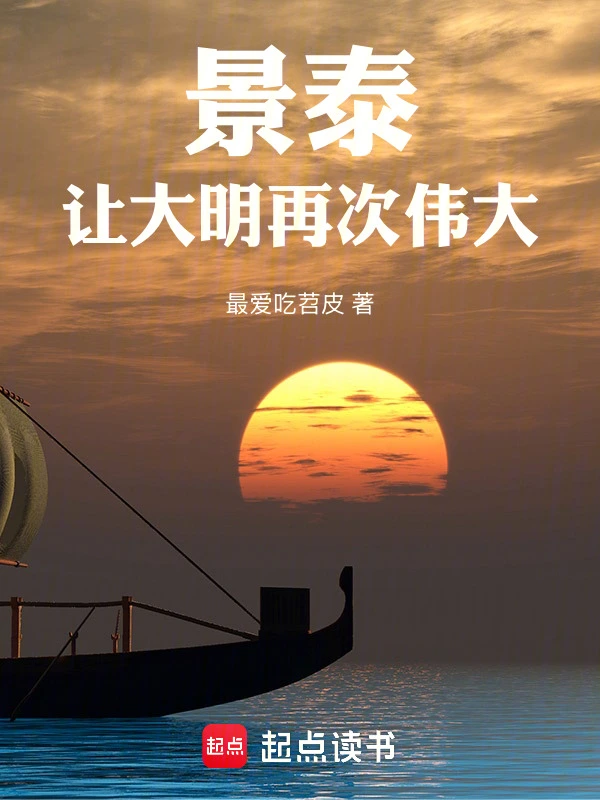
Jingtai: Make Ming Dynasty Great Again
景泰:让大明再次伟大
- Status
- Ongoing
- Length
- 1.1M Words
- Genre
- Historical
- Audience
- Male
- Subgenre
- Song-Yuan-Ming Dynasties
- Updated
- 16d ago
- Source
- Qidian
Stats
45Monthly votes
17.8kRecommends
45kFans
418Chapters
Tags
Synopsis
Reader comments
Readers also read
 Fu Ming 1627
 Red Mansion: Start Escaping and Farming from the Equipment Bar
 Northern Qi, Sage Khan
 After Lying in Bed for Three Years, He Was Forced to Help the Han Dynasty
 Datang: They Force Me to Be Emperor, Right?
 Emperor of the Song Dynasty 1066
 Huang Ming
 Anti-Qing: Start by Kidnapping Shi Dakai!
 My Father, Liu Bei, Hopes That He Will Become a Dragon.
 Northern Song Dynasty: Starting from the Interception of Hu Zhaoji's Throne
 The Resurgence of the Song Dynasty Began by Pretending to Be the Emperor
 Ming Dynasty959
 1992: Started by Raising Pigs
Unparalleled Zhu Qi Town in ancient and modern times
Hahaha
Just talk
After traveling for so long, hasn't the protagonist himself cultivated a team? All thanks to Yu Qian? I'm convinced! Does the protagonist believe in Yu Qian so much? Do you believe in historical records so much? Give the protagonist a line from the Ming Dynasty: No matter what anyone promises you, it will only count if you can make the decision yourself!
What mistakes are easy to make in historical novels❓
Before the Ming Dynasty, the emperor was not called "Emperor". In the Song Dynasty, he was mostly called "Guanjia", and in other dynasties, he was often called "Your Majesty". In the Ming Dynasty, the emperor was occasionally called "Emperor", and in most cases he was called "Your Majesty". After Kangxi of the Qing Dynasty, people began to be generally called "Emperor". Princes and princes call themselves: Princes in the pre-Qin and Han Dynasties can be called "Gu", and a few can be called "Ignores". After the Wei, Jin, Southern and Northern Dynasties, the title of "Ignores" gradually became exclusive to the emperor, and princes, princes and princes can only be called "Gu" or "I". Song, Yuan and Ming called themselves "I" or "I". Before the Qing Dynasty, princes and princes rarely called themselves "this king". Starting from the Kangxi year of the Qing Dynasty, princes generally called themselves "this king". In ancient times, women called themselves: "nujia" was a modest name for women after the Song Dynasty. Women in the Han and Tang Dynasties more often called themselves "concubine", and noble women could call themselves "I" and "I". Before the mid-Ming Dynasty, most dynasties used copper coins for daily transactions, with very little gold and silver. It was only in the mid-to-late Ming Dynasty that silver became the mainstream currency. -In the late Ming Dynasty, "meeting votes/deposit checks" appeared among the people. There were no unified rules. Most of them were deposits and withdrawals/exchange receipts from acquaintances or local circulation, and were not legal currency. In the early years of Daoguang in the Qing Dynasty (1823): Rishengchang Bank was established, and private banks began to issue standardized banknotes, focusing on cross-regional exchange. They were only circulated in Shanxi merchant trade circles and major commercial ports, and were not yet popular. In the third year of Xianfeng in the Qing Dynasty (1853): the official issued the Ministry of Revenue official banknotes (official banknotes), which were forced to circulate nationwide. At the same time, the network of private banknotes expanded to the whole country, and official and private banknotes ran parallel. The use of banknotes entered an explosive period and became the "starting point of popularization." High-leg tables and chairs only completely replaced the low tables for sitting on the floor in the Song Dynasty. During the Han and Tang dynasties, people knelt and sat on the tables to eat and discuss matters. The furniture was mainly low tables and couches. The memorial system was only established during the Kangxi period of the Qing Dynasty. Officials in the Tang and Song Dynasties used "memorials", "tables" and "statements" when submitting memorials, while in the Ming Dynasty they used "memorials" and "memorials". There is no such thing as "memo" or "zhezi". In ancient formal occasions, the hand-over gesture was performed with the left hand outside and the right hand inside. The right hand outside was a special "unlucky gift" for funerals. "Better greetings" is a unique etiquette of the Qing Dynasty. It was mostly used by subordinates to superiors and juniors to elders. During the Tang and Song dynasties, people often performed cross-hand salutes and bows to greet greetings when they met, and there was no such thing as "sending greetings". Before the Yuan Dynasty, subordinate officials rarely called superior officials "adult". In some dynasties, subordinates called eunuchs "adult", and in some dynasties, they called their parents and elders "adult". Beginning in the Yuan Dynasty, lower-level officials would occasionally call officials of second-rank and above "sir". From the middle and late Ming Dynasty, only officials of third-rank and above would be called "sir" by their subordinates. Officials with lower ranks could not be called "sir". However, in the late Ming Dynasty, there began to appear a few cases where officials above the fourth rank were called "adult". Before the mid-Qing Dynasty, following the rules of the Ming Dynasty, only officials of third rank or above would be called "adult". Starting from the mid-Qing Dynasty, calling officials "adult" gradually became common for lower-level officials. Attention! ! ! What is mentioned above is that lower-level officials refer to higher-level officials. No matter which dynasty, it is absolutely impossible for higher-level officials to call lower-level officials "sir". Some novels even write about emperors or nobles calling other officials "sir". This is simply contrary to Tiangang! ! ! Finally, let's talk about the problem of civilians calling officials Before the middle and late Qing Dynasty, civilians in various dynasties and generations called officials differently, and most of them called them "officials" and "masters". From the middle to late Qing Dynasty, civilians also called officials "adult". {"NickName":"Restriction and Supervision","UserId":417773267}
Brother, aren't you afraid that after Yu Shaobao's victory, he will hand over the military power to the Ministry of War instead of to the Governor's Office of the Fifth Army?
Yu Qian is the representative of the southern victims and a decent man.
I really don't understand why I'm still writing this kind of novel. I've probably read too many Ming Dynasty novels. This guy is a waste. I don't dare to kill this, I don't dare to kill that. To establish a prince and ask for someone else is simply a waste among wastes. Alas, in the end, nothing can be saved, not even my own life. Just be indecisive as an emperor. You actually believe in family affection and love? What's the use of a loser who can't even suppress his own queen? Tell the truth. But it's really not as good as Zhu Qizhen's. I don't understand. If this person knows what will happen next, or if he dies so miserably in the end, why does he care about his reputation? They will kill you. He died so miserably, and he still cares about his reputation and other things. If you don't die with him, isn't he a waste? What's the use of an emperor being such a loser?
Yu Qian traveled through time and became Jingtai, and Yu Qian still wanted to reform. It was all a dream. Yu Qian in history was different from what was written in the history books. He was the butt of the Shishen class, which was completely civilized and took military power away from the imperial power. During the Jingtai period, Yu Qian led a series of political affairs and some policies were all about seizing power from the emperor, regardless of military power or financial power. The majority of Yu Qian was tilted like Shishen civil servants. The time traveler dressed as Jingtai Yu Qian was seeking the skin of a tiger, and the reform was waiting to fall into the water.
An emperor actually believed in Yu Qian. As soon as the imperial power was stable, he would immediately send Empress Dowager Sun and Yu Qian to the west. There are many talents. It depends on the emperor's courage and ability to identify talents. Then the traitor who comes, the emperor said that you are a traitor, even if you are loyal, you can only be a traitor.
Please support us as much as possible
I read the author's comment section, and there are some negative comments. To be fair, this book is currently at an average level for Qidian history writing. You can give the author some time and more encouragement.
There is another saying that the civil servants were suppressed too hard by Zhu Yuanzhang, Zhu Di and Zhu Zhanji, but there was nothing they could do. The young emperor wanted to take power, so he planned a personal expedition to the imperial court and brought in all the civil and military department bosses in the dynasty, hoping to use this opportunity to establish prestige. However, when the civil servants saw it, they were still disobedient, so they simply changed the emperor and secretly carried out the plan. Small tricks, cluttered procedures, and ink marks for transporting food. In addition, with Wang Zhen as the eunuch, he can still take the blame. If the head of the department dies, he can gain a good reputation as a loyal and patriotic person. The middle and low-level officials can go further and suppress the line of generals. After torture, it is not a loss at all.
If the Empress Dowager Sun is not dead, how can you implement the New Deal? If the Empress Dowager Sun is not dead, how can the old officials obey the orders of the new emperor? If the Empress Dowager Sun is not dead, Zhu Qizhen will be brought back sooner or later. He has been working hard for 20 years without any plan. The author is mentally retarded in writing a book.
Author, please cut it off, you are not suitable for the history track.
I'm not trying to knock you. There's nothing wrong with your writing, but the problem is that your political level is too low. Please change the channel label. It's better to write novels with system and brainlessness. This kind of novel does not need to consider political intrigues. Everything is left to the system. If you write about systems that kill the Japanese and the Qing Dynasty, people will read it. If you are not convinced, I suggest you read it. Look at the posthumous work of the new master who died young in July, and there is also a novel about Zhu Qiyu, I am the King of the Subjugated Country. The author of this novel is definitely a civil servant. See how you are different from this novel. Face yourself and choose a track that suits you. If you like to generate electricity, you will treat what I say as farts.
Giving Yu Qian military power is a serious brain disease
A question
"In the fourteenth year of Orthodoxy, Zhu Qiyu almost laughed out loud when he heard the news about the Tumubao Incident." Is this human talk?
Yu Qian deserves to die just for taking the military power from the Fifth Army Protectorate to the Ministry of War.
Now I'm curious, is this the official version? Wala is multi-talented. He can raise tens of thousands of troops in one generation. He also shows that he is so fearless that everyone feels that he can carry out a comprehensive invasion of the Qing Dynasty. If you changed the name, I thought you were writing about the Ming Dynasty after the Battle of Saarhu.
The imperial doctors, eunuchs, and palace maids have not been cleaned up yet. Everything was infiltrated from the outside. How can we rest assured about food and accommodation? Didn't you know that many royal baby boys in the Ming Dynasty died suddenly and the emperor was easily soluble in water? Time traveled to a dog
It's extremely poisonous, and the author is very stubborn. Whenever someone has an opinion in the comment section, the author is waiting for a lot of words. The key is that he always writes some inexplicable plots about mindless young people pretending to be cool. It's super poisonous...
Tell Yu Qian that Western medicine is more effective in treating cancer than traditional Chinese medicine
I really don't know what kind of brain can come up with such a plot. How about you let AI help you write it?
These letters tell the ministers that these are the fairy words and magic used by the immortals. Haha, author, are you afraid that you have some serious illness in your brain? When you meet a ghost in the future, will you use this Ming Emperor to kneel down to the immortal?
Chapter 19, I won't read the rest of it for free
When an emperor is an emperor, he has only those who can be used and those who cannot be used. There are checks and balances. Everyone is suspicious of their motives. Do not give them a chance to dominate. This is a check and balance. Do you understand, a lonely person? From ancient times to the present, interests are eternal. Loyalty has always been just because the interests are not in place. Why the minister Yu Qian, the emperor does not consider who will benefit the most from Tumu Fort, his motives, who will do it to the emperor in front, it is not easy to use, find an excuse to kill him after using up. I don't know what to expect. In fact, I was sold and still praised it. The author's pattern determines the protagonist's IQ.
This is why you are bragging that the Ming Dynasty emperor had no military power. After searching, I found out that Chongzhen was more ruthless than Lao Zhu.
1. Governor/supervisor level (military general or military commander): 7 people (all beheaded/executed) 1. Yuan Chonghuan (Governor of Jiliao): 1630, Ling Chi 2. Liu Ce (Governor of Jiliao): 1630, beheaded 3. Yang Yipeng (Governor of Water Transport): 1634, beheaded (Fengyang fell) 4. Zheng Chongjian (Governor of Three Borders): 1641 , beheaded (inexplicable unjust killing) 5. Xiong Wencan (Prime Minister of Military Affairs, Minister of War): 1640, beheaded (failed to recruit) 6. Fan Zhiwan (Governor of Jiliao): 1643, beheaded (lost city) 7. Zhao Guangfeng (Governor of Jiliao): 1643, beheaded 2. Governor level (mainly military and military positions): It is clear that 8 people can be tested (beheaded/abandoned the city) - Sun Yuanhua (Governor of Denglai, firearms expert): 1632, beheaded - Geng Ruqi (Governor of Shanxi): 1631, beheaded - Yan Jizu (governor of Shandong): 1639, beheaded - Shao Jiechun (governor of Sichuan): 1640, beheaded - Li Yangchong (governor of Xuanfu): 1630, beheaded - Yu Yinggui (governor of Huguang): 1644, beheaded - Wang Zhaokun (Governor of Shanyong): 1636, beheaded - Chen Zubao (Governor of Shuntian): 1639, sentenced to death 3. General/deputy general/senior general (list available for examination): at least 12 people 1. Yang Hao (Minister of War, Manager): 1629, beheaded (old account of Sarhu) 2. He Renlong (General Soldier): 1642, beheaded (without fighting) 3. Zu Kuan (Deputy Chief Soldier): 1639 , beheaded (lost the vassal title) 4. Zhang Qijie (general soldier): 1639, beheaded 5. Ni Chong (general soldier): 1639, beheaded 6. Wang Pu (general soldier): 1642, beheaded (pine) Jin deserter) 7. Tang Tong (general soldier): not killed (surrendered later) 8. Bai Guangen (general soldier): not killed (resigned later) 9. Ma Ke (general soldier): not killed 10. Liu Zeqing (General Soldier): Not killed (rebellion later) 11. Huang Degong (General Soldier): Killed in battle (not killed by Chongzhen) 12. Cao Bianjiao (General Soldier): Captured and killed (not killed by Chongzhen) 4. One-time collective execution (the most brutal) - 1639: Chongzhen executed 36 generals at the general and deputy general levels (including Yan Jizu, Zu Kuan, etc.) At one time. According to historical records, "the execution in the capital resulted in rivers of blood." - Supervisors/Governors: 7 people - Governors (military commanders): 8 people - General soldiers, deputy generals, etc.: 12 People - One-time collective execution in 1639: 36 people 2. Middle and senior civil servants: 15 people - Chief assistants of the cabinet: 2 People - Liubu Shangshu: 4 people - Ministers and deputy censors: 3 people - Chief envoys, inspectors, governors (civilian officials): 6 people 2. One-sentence summary - Killing military generals: 63 people (extremely ruthless, killing the most) - Killing of civil servants: 15 people (only killing top-level officials, relatively restrained) - Chongzhen killed a total of 78 middle- and high-level civil and military officials: 78 people This is what history says: In the Chongzhen dynasty, the killing of ministers was the most in the 276 years of the Ming Dynasty.
Forget it if there are typos. The most annoying thing is that if you don't have the ability, don't write about those conspiracies and conspiracies. I'm just picky about food. Writing about war is okay. Write more about this and just leave the rest out.
I've watched too many short video accounts and marketing accounts. Let's first see what the teachers say about Zhu Qizhende. I really think he is called the Emperor of the Clan and has no merit! Look at how few civil servants were involved in the Tumu Fortress and how many emperors died in the Ming Dynasty. It would be naive to think that it was just like the TV series.
Yu Qian, the powerful official of the Five Dynasties, laughed like a pig, and the two brothers competed with each other
Fame and power cannot be compromised. The author does not know that he wants to turn Yu Qian into Cao Cao.
Black smoke can be particularly dazzling in the dark night. As an emperor, the protagonist has to fight repeatedly in person. I can't appreciate the childishness of this article. Farewell!
You will know who will benefit the most after Tumu Fort. Military generals have completely withdrawn from the stage of history.
Changing the posthumous title is very retarded and will do no good to the protagonist. It will only cause backlash from nobles and the outside world will only say that the emperor is mean and ungrateful. Only I feel better. You thought it was now, when something came out, the Internet was boiling, and countless netizens were discussing it. That's Ming. Those who can understand this matter are only at the reading level. Those below will not care and cannot understand the truth. The author thought it was a refreshing point. Ling Ran was so righteous, but in fact he only showed an incompetent emperor.
After seeing the thirty-three immortal spells, he was immediately poisoned to death. Fortunately, I didn't spend any money, so I gave up decisively.