


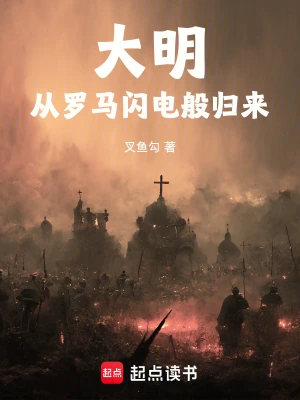
Great Ming: A Lightning-Fast Return from Rome
大明:从罗马闪电般归来
- Status
- Completed
- Length
- 1.1M Words
- Genre
- Historical
- Subgenre
- Song-Yuan-Ming Dynasties
- Updated
- 2mo ago
- Source
- Qidian
Stats
350Chapters
0Votes
6.9kRecs
17.1kFans
Tags
Synopsis
More by this author
In booklists 1
Readers also read
 The Corpse Plague of 1916
 In the Ming Dynasty, the Days When the Cows and Horses Turned Over
 Chronicles of the Red Mansion
 An Important Town in the Residual Tang Dynasty
 The Winds Rise in North America, 1625
 1422: The Rules Horror of Rome’s Revival
 I Became the Founding Father of America
 The Father of France
 The Zombie Calamity of 1644
 The Fall of the Qing
 1853: My Struggle
 Southern Ming: This Emperor Is a Little Too Steady
 Am I Really an Immortal?
Reader comments 34
Google Translate
The prerequisite for Wang Xuance to put out the fire is the Tang Dynasty behind him. The Ming Dynasty is less than three provinces behind the protagonist.
It's confusing to look at the resume. Ming's national power is very embarrassing after the Yongli Western Hunt. In this context, the protagonist wants to make a comeback. . . . Well, unimaginable
The protagonist really wants to bring reinforcements back to the Ming Dynasty? But at this time, the loss of ocean-going troop transport was extremely high. In the fifth year of Qianlong's reign, Britain sent a fleet led by George Anson to Southeast Asia to attack the Spanish fleet in the Philippines. This fleet of about 2,000 people was killed by the Spaniards, and about 1,500 people were killed by scurvy. Coupled with other reasons such as shipwrecks, only about 200 people returned to Britain alive. In the twenty-seventh year of Qianlong's reign, the British army attacked Havana, Cuba, and was severely hit by insufficient supplies and the epidemic of plague. The British mobilized 10,000 troops and navy. From June to October, 560 people were killed by the Spaniards and 4,708 died of illness. This was true in the 18th century, and it could only be worse in the 17th century. And even if they were transported, they still wouldn't be able to defeat the Qing army at this time. The Portuguese mercenaries that were so popular at the end of the Ming Dynasty were useless. They had to rely on Jiao Lian's northern Shaanxi cavalry as the main force to attack the green camp, let alone fight against the Eight Banners.
As a newcomer, it's too nb. I can say that newcomers are monsters. The diction and sentence construction are concise and not artificial, and it is completely readable As a work, although the main task has always been hidden in the dark, the protagonist's current actions can also feel that he is serving the ultimate goal. The work does not have the dryness of other foreign historical books, which makes people feel boring after reading it. In this book, the Eastern protagonist and the Western background are well integrated For now, it is very good
If the protagonist does not become the emperor, then the protagonist must carry out comprehensive changes that limit the emperor's rights. It is useless if the protagonist just copies the technology of later generations and adds a few reforms. If a country wants to produce a large number of original inventions and creations, it must carry out systematic changes in ideological foundation, political structure, legal system, social forces and other aspects. The reason why Britain was the first to enter the Industrial Revolution is that after experiencing the ideological changes of the European Renaissance, coupled with the British Glorious Revolution of 1688, the king's rights were further restricted. Britain established the framework of parliamentary sovereignty and the rule of law, and the bourgeoisie, the new aristocracy, and the king formed a check and balance, which allowed British civilians to gain unprecedented freedom. At this time, the degree of freedom of scholars, craftsmen, and farmers in Britain was higher than that of other European countries at the same time, and it was far more liberal than the civilians of China's Ming and Qing dynasties. The high degree of freedom of all British civilians fully inspired everyone's strength. The power of the Chinese emperor was not greatly restricted, and all officials, gentry and landlords were dependent on the imperial power. The freedom of civilians, who account for the vast majority of the country's population, is too low. This system inhibits innovation and hinders social development. China's Zhou Dynasty was a feudal system, and the central government could not control much of the local princes' affairs. The princes competed with each other. During this period, Chinese civilization truly allowed a hundred flowers to bloom. Most of the essence of Chinese civilization came from this period. During the Spring and Autumn Period and the Warring States Period, the "Mo Jing" recorded the principles of optics and mechanics, and the germination of geometry had emerged; the "Gan Shi Xing Jing" recorded astronomical observation data. But from the Qin Dynasty to the Qing Dynasty, there was almost no progress! The institutional innovation of the Spring and Autumn and Warring States periods stagnated after the Qin and Han Dynasties, lacking the ability to dynamically adjust. Since the Qin Dynasty, especially since the Han Dynasty deposed all schools of thought and only respected Confucianism, Chinese civilization has almost stood still and entered a dead end. The Zhou Dynasty and the Spring and Autumn Period and the Warring States Period were similar to the ancient systems of most European countries. They were all feudal systems. Even in successive years of war, less than 10% of the country's total population died directly or indirectly as a result of the war. But from the Qin Dynasty to the Qing Dynasty, every dynasty would kill half or more of the country's population due to war! What is even more tragic is that every time there is a change of dynasty, there is almost no progress in the system and culture! {"NickName":"Restriction and Supervision","UserId":417773267}
I heard that evidence of Donglin Party treason was unearthed from Qian Qianyi's tomb?
A few statements
First of all, a new book for a newbie, thank you all for your support. The second issue is about the setting of the protagonist, because the protagonist was a diplomat before time travel, and spent most of his time learning languages and diplomacy-related knowledge. As for history, he is just a lover; for technology, he only has some memories from before the liberal arts and sciences. Therefore, what the protagonist says is not necessarily correct (for example, the outrageous oxygen accounts for 1/3 of the air, and no one has discovered this problem yet). Note: This is done with reference to the author's own memory of physics and chemistry students. The author took 282 points in comprehensive science in the college entrance examination. I don't think a liberal arts student will be taller than me. As for the name of the protagonist, I have been thinking about it for a long time, Chen An or Chen Ande (especially Chen Ande, there is an extra word). As far as the protagonists are currently called "Anderson" in Europe, they still self-identify as Chen An. Of course, there are also interpretation methods in the French environment, Ann de Chen. In addition, the writing in the early stage was indeed a bit messy. A lot of things I wanted to express were not expressed, and the things I wanted to do were not laid out well, so it ended up like this. If forced to explain, it can be said that this is the protagonist's first time traveling, he has no experience, and he is a bit like a headless fly in a foreign country. Of course, if I have time and opportunity in the future, I will make modifications. I apologize to you for this. Finally, this book will refer to historical data as much as possible. If there are any missing or conflicting historical data, a more suitable creative direction will be chosen. Thank you everyone!
Make a suggestion
The author had better not keep talking about Chinese proverbs in Europe. There is a sense of inconsistency with an old Chinese saying. It looks very funny.
Do you really like being a paper framer?
The Ming Dynasty is dead, just start over, don't go back and get involved in Nan Ming's disgusting things, abandon the book! Obviously France and Spain have written quite well.
Meda's feelings
Constitutional monarchy, federal provincial autonomy, free market, lifting restrictions on population movement, parliamentary system, voting democracy, separation of powers
Have you ever been a diplomat? This is what you write 😏