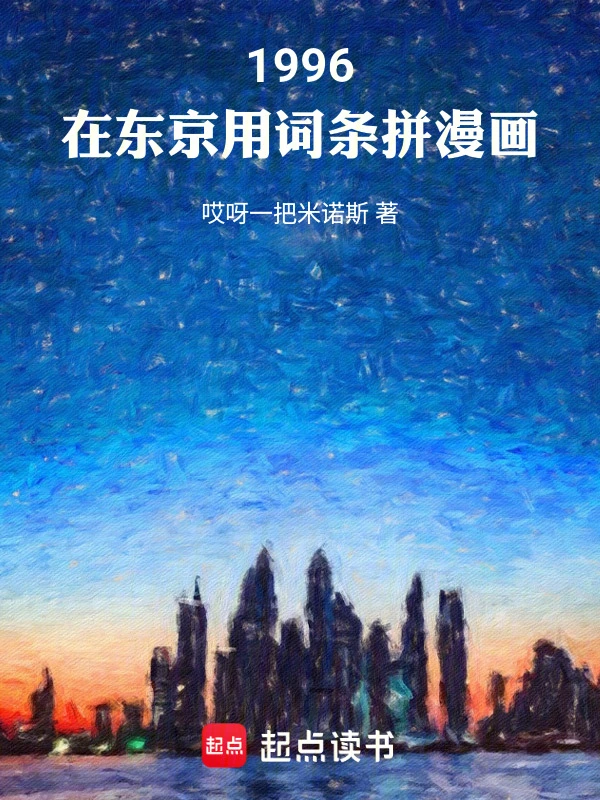
Tokyo, 1996: Making Manga with Skill Tags
1996,在东京用词条拼漫画
- Status
- Ongoing
- Length
- 219k Words
- Genre
- Light Novel
- Audience
- Male
- Subgenre
- Original Fantasy
- Updated
- 3d ago
- Source
- Qidian
Stats
104Chapters
305Votes
1.1kRecs
7.6kFans
Tags
Synopsis
More by this author
Readers also read
 Naruto: A Uchiha Prodigy, but with a Sage Body from the Start
 The Online Friend I Chat With Is My Future Daughter!
 So You're All Losers Because of Me?
 Take Your Mouse to the World
 Please Call Me Your Majesty, the Tsar
 Tokyo: From Manga Assistant to the God of Jump
 I Will Increase the Intensity of Daily Entertainment
 Popularity Above All: My Art Style Is Way Too Eccentric!
 I Just Went to College and Was Laid Off. the Counterattack System Is Coming.
 Tokyo: Earth Online Cartoonist
 From Bad Movie Set to Tokyo Movie God
 Reborn as a Literary Prodigy in Tokyo After My Readers Destroyed Me
 The Only Player in the World of Death
Just like what most people say
Just from the topic selection, this book is not a simple and refreshing type of book If you want to copy casually, just write about a parallel world If you want to focus on the work, just write about a genius protagonist But the gold water finger copy given by the author requires a word search, and if you don't have super memory, you have to draw the comic book by yourself The protagonist's ability values need to be practiced and grown, and learning other people's styles can only provide bonuses, not points. Without copywriting, it is not considered a professional level In addition, the specially selected era background, the opening work of the well-known comic book by the original author of the film, a little-heard opening work, the unique setting of a rich peasant family, and the choice of the school route It is obvious that the author has his own considerations. Compared with ordinary urban affairs essays, it is actually positioned more like a professional novel + a historical novel, and because the professional literary part is introduced through the personal growth of the protagonist, so compared to "1979: The Golden Age", which is a more famous combination of professional novels + historical novels, the parts where the protagonist stands out in front of others are inevitably less. At the beginning of several other works that are also in the comic book + era, the protagonist did not contact famous figures of the same era to become assistants or something to transition to the growth stage, but was directly serialized. For this work, which is not a genius and uses a numerical system, it is indeed better for the protagonist to quickly stand on his own, but it will inevitably make some readers feel uncomfortable with the lack of interactive exercises and The painting process feels boring Although it suits my personal taste, for example, it can evoke my personal feelings about the work "Dream Eaters", but after all, it cannot be suitable for everyone, so I will vote for you first to encourage it. I also hope that the author can write more books in his spare time between work and life. Please believe that this book must have many readers who are interested in reading. Please do not question your written expressions at will.
Writing too detailed will lead to a slow start. Many details that have no effect on advancing the plot can be skipped. There is no need to write them in such detail. Most people don't want to see the boring creative process that details every stroke. Seeing this will neither give them a sense of expectation nor arouse their emotions. If they see too much, they will just want to sleep. More than 40 chapters have not yet been published in the first work, which is already very, very slow. Copying itself is a kind of shortcut. Readers who read this kind of novels read it with the expectation of taking shortcuts. As a result, they procrastinate for a long time without starting to achieve results. It is easy to make people impatient, so it is not advisable to wait and see slowly. In short, please refer to the rhythm of other popular works of the same type. To be honest, I almost fell asleep after reading this book in one sitting.
It looks good and is somewhat different from most transcripts on the market.
When I read this book, my biggest feeling was that the author should be a very serious person. When I read novels, especially those with professional themes, I actually want to experience another kind of experience. The protagonist went to draw comics, and I wanted to follow him to see what it was like to draw comics—how to conceive a story, how to draw storyboards, whether serialization is stressful, and how editors communicate with authors. If these details are written sparingly, the story will float on top and there will be no sense of immersion after reading a few chapters. The good thing about this book is that it fills in such details realistically. The protagonist stayed up late to finish the manuscript, struggled with the picture and speed, and considered the pressure of serialization. It is not a list of dishes, but it is integrated into the daily serialized life. When you read it, you will feel that the protagonist is really living a life of painting. Another point that shows that the author put a lot of thought into it is the choice of the timing of his debut. The story sets the protagonist's serialization start time in 1996. At that time, "Dragon Ball" had been completed for a year, and "Slam Dunk" and "Ranma 1/2" were also nearing their end. It happened to be the time when "Weekly Shōnen Jump" was changing from old to new and was lacking a mainstay. The protagonist chose this juncture to launch "Your Name", which was consistent with the background of the magazine at that time. Of course, there are also small problems. For example, sometimes the details are too full, the main plot progress is slow, and the rhythm is a little delayed. But overall it does not affect reading. In short, the amount of details in this book is enough for me, allowing me to follow the protagonist and live a cartoonist's life in a down-to-earth manner. As a reader who likes to read professional articles, this experience is quite satisfying.
In fact, it seems better if there is no system, because the role of the system is not reflected. For example, Shinkai Makoto's paintings are more experienced in aesthetics, and Oda's paintings, for example, reflect his understanding of architecture. If you have weak painting skills, you will not be able to draw Shinkai Makoto's feeling, so it will be better without a system.
It was too slow. I skipped through more than sixty chapters, but I only read seven or eight chapters, and it didn't feel like it had any impact.
Overall attractive. Mainly because of the water, it was not a good read. What I expected to finish in 40 or 50 chapters during the exam and interview was delayed to more than 70 chapters. The pace is too slow. The writing can cover up some of the pacing problems but cannot solve them, especially during the catch-up period. This book is suitable for raising a large family and then finishing it.
The pace is too slow. The college interview lasts for three chapters. After finishing the first comic, this situation is at least 300 chapters up. This is still the middle chapter of Your Name. I still prefer the plot to advance faster. It is better to read this kind of book after finishing it!
The author wrote a series of theories about comics in his article, but as a result, he did not apply these universal theories to his novels. The first comic was only officially confirmed for serialization at chapter 69 If he changed to another novel, the first short comic was serialized.
It looks good. The author's system settings for the protagonist are not too big. You can see the protagonist's decision-making direction step by step. It is not that there will be a big hit after copying some famous comics. It still depends on the aesthetics of the times and the popularity of the audience. I look forward to the follow-up performance of the author's settings for the protagonist.
You are writing this as a professional article, the copy is just a tack.
If you want to write like this, you have to describe the background of the times and not just use it as a background board. There must also be some daily life and anecdotes from the comic industry, and it must have a feeling that the protagonist is living in that era. The recent book "Tokyo Criminal 1962" has a bit of this feeling.
The writing is very detailed and avoids the cycle of most manuscripts that can only produce new works and then react to the market. It has a sense of daily life and a sense of comics, but it has the feel of an old comic, which is also in line with the setting of the work. The disadvantage is that the pace is so slow. The free chapters are okay, but the paid chapters may be written like this. Some people may think it is unfair.
It can only be said that it is a pity that it is rated as slow to gain popularity and difficult to follow.
Generally speaking, it is actually a manga transcript, but the writing method is too delicate. I only realized that it was gone after reading chapter 82 Then I found out that the author actually only had transcript elements, but it was still similar to a light novel about the life of a cartoonist But [because of the delicate writing, there are too few updates, which makes it impossible to follow up...]
I feel that the protagonist is in too much of a hurry, but at the same time there is no need to rush. The male protagonist is not short of money, nor is he a comic book addict. Originally, the man wanted to go to college, but his skills were insufficient. He should take extra classes while creating, and at the same time get to know people in the circle to improve his painting skills. The focus should be on upgrading. It would be better to wait until the exam is over and serialize it as the focus.
It's a bit too thin, it feels like reading a textbook, I skipped reading 😴
Perception
Advantages: The author writes very carefully, as if he has told everyone all the work to be done. Zhong Wen's copying is not just copying, but also the protagonist's gradual improvement, showing every idea, change and difficulty. Disadvantages: It is also too detailed. If you read it for a long time, you may feel that it is watery. You will feel that you have read a lot of pictures but there is no particularly outstanding information. It's too detailed, and some of the points you want to emphasize are hard to remember. You need to confirm the progress quickly, otherwise you may crash.
Suitable to watch once in a few days
But not suitable for the type of subscription
Many other texts are much more interesting than this
Very interesting! There is nothing too speechless or outrageous, so I added it to my bookshelf to read more.
The author really wanted to write a way of speaking in that context, and he did write it. It can be said that it is very restorative, but it is a bit too restorative. It made me a little tired when I read it. Some people said that this was also the reason for the slow pace. I can't say it's not good, but it's a bit picky for readers, so I might consider restraining it a little bit. It would be good as it is now, but the audience might be smaller. Also, the slow pace does not necessarily mean that the protagonist Golden Finger should speed up, as that would not look good. It's just that the author's writing is a bit detailed, but it may also be to pave the way for the social environment in the early stage, such as writing about where to take the college entrance examination. It is very detailed, but it has not been published yet. This part is OK, but try to complete the preparation before publishing, otherwise it will be GG.
As a student in a similar major (animation major, with one semester of comics), the author has written very good and complete information on techniques and creation. Beginners who really want to get into the industry will definitely gain something from reading this book. However, the problem is also that there is too much work, or that the cool points are too sparsely distributed. If appropriate explanations can be placed before and after the protagonist is pretending to be cool or showing off in front of others, the perception will be much improved.
Nice
Although it is a bit slow, it is still eye-catching! Come on
Okay, it feels a bit slow, but it's good to write the details carefully, don't just drive around and talk all day like Pujitang Dependence.
OK work
Positive review - The article's work brings the author's own thoughts Negative review - The pace of the article is too slow
I feel like there's going to be a plagiarism plot, it's really disgusting
It's a rare comic book, not in a cookie-cutter style, I personally think it's good. The comics are full of details in all aspects (such as the newcomer's choice of pen and paper). The male protagonist is also thinking about how to improve his abilities, such as the help of university majors and assistants, painters and storyboards, the differences in male and female body shapes, speed lines, etc. The advantages and disadvantages are the same as other comments said, too detailed. For example, the professional interview part was written from the 12th to the 15th. Although I know it was for the future growth of the protagonist and the characterization of the supporting characters, you wrote it for 4 days. Obviously, it would be better to streamline the content and shorten it to 1.5-2 Days. It is recommended that the author seriously consider the rhythm and simplification of the story, and increasing the excitement, especially the excitement. Should the excitement of the comic be published at the moment of publication and reader feedback? At present, the proportion of cool content is very low. For the sake of your performance and more readers, you might as well improve it appropriately, otherwise it will only be praised but not popular.
This kind of slow feeling is what I prefer, but it also varies from person to person. Slower is indeed more detailed, but you must consider that this is paid at the starting point, so the disadvantage of being slow will also cause some people to give up, so the author, you have to make a good balance, come on, I think the author will definitely succeed, don't stop updating.
To be fair, the plot is a bit slow and has too much foreshadowing. Chapter 40 has not yet been published as a comic, so I am scratching my head.
Generally
This way of writing will definitely have a small audience. It's 30 chapters, and I haven't seen the reaction after serialization. If there is no description of market feedback, it will ultimately be self-entertainment without a sense of substitution.
Very good, this is the cartoonist-themed novel I want to read, instead of spending a lot of space on useless places, and then directly printing popular comics in the comics section, and then praising them in the same way. Rather than saying that it is a cartoonist-themed novel, it is an alternative viewing experience
Goodgood, love this style
When do you get an occupational disease?
Also, it's too detailed and too slow.