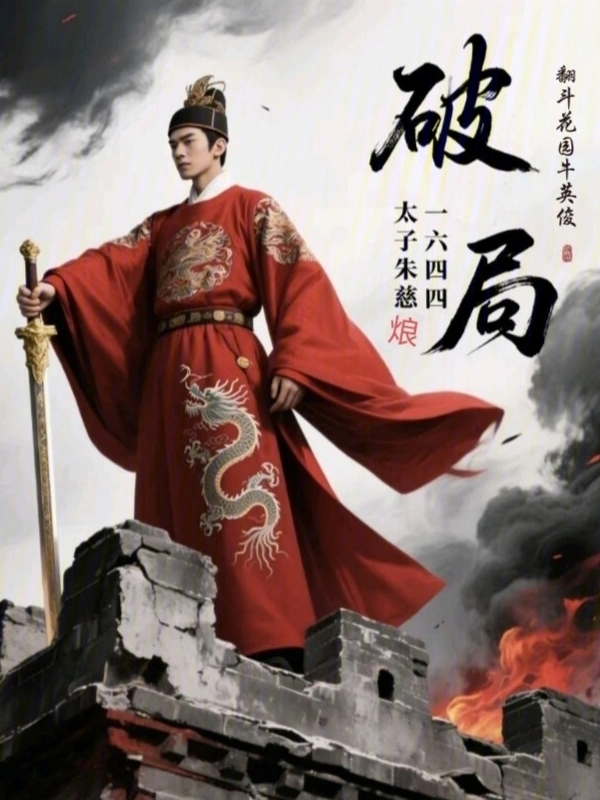
Breaking the Situation in the Late Ming Dynasty: Prince Zhu Cihong
破局明末:太子朱慈烺
- Status
- Ongoing
- Length
- 640k Words
- Genre
- Historical
- Audience
- Male
- Subgenre
- Song-Yuan-Ming Dynasties
- Updated
- 10mo ago
- Source
- Qidian
Stats
0Monthly votes
2.3kRecommends
7.6kFans
188Chapters
Tags
Synopsis
Reader comments
Readers also read
 Fu Ming 1627
 Northern Qi, Sage Khan
 Red Mansion: Start Escaping and Farming from the Equipment Bar
 After Lying in Bed for Three Years, He Was Forced to Help the Han Dynasty
 If You Are Already an Adventurer, Who Should Work Hard on Your Own?
 Sun and Moon: Yongli 1656
 Nanming, This Emperor Is a Bit Stable
 The Artist Begins in Prison
 Traveling at the Same Time: Great Love to the Heavens
 I Want to Revive the Tang Dynasty!
 I Am a Tyrant in Nanming
 Daming: Moral Kidnapping? I, Chongzhen, Have No Morals!
The author really takes it for granted. If you want to say that as the prince, before the city is destroyed, you can take your small group and ask Chongzhen for a favor and let you go south. You actually fantasize about launching a coup at the last moment and forcing Chongzhen and a bunch of ministers to go south together. This is completely nonsense. Beijing City has been besieged at least seven times in less than 200 years since the Tumubao Incident. Even the peasant uprising army, Liu Liu and Liu Qi in the fifth year of Zhengde, had already besieged Beijing. Boiled frogs in warm water, the Ming Dynasty has been desensitized from top to bottom. It is not just because of your simple words that officials dare to stage a coup.
Chongzhen was hopeless, so he quickly went to Nanjing to ascend the throne.
Shennong post...
An ordinary person, Chongzhen, will change the world in sixteen years. There is no golden finger in the system... I'm afraid you are not dreaming.
With an emperor like Chongzhen as his father, it is really difficult for the protagonist to break the situation. Emperor Chongzhen has the blood and backbone to dare to die, but other than that? He is headstrong, mean, ungrateful, biased, indecisive, duplicitous, suspicious, and selfish.
Please readers, please don't keep books 😭😭
I know why Chongzhen was kept alive
Suppressing the protagonist, and stumbling upon him, right? You lost your country, you killed your loyal ministers, and you still have the nerve to live? Are you still embarrassed to make trouble? Are you embarrassed to care about face? If you don't have a long memory, my suggestion is that the protagonist lets Chongzhen crush him to death and then perish.
As the saying goes, secrets make things happen, words make things worse, but those who want to undermine me can't keep their mouth shut and talk so much, it feels quite funny.
The author may not understand why this book has such poor performance. Your novel is written in the late Ming Dynasty, when the world was in chaos. The protagonist, as a time traveler, used his own shortcomings to engage in power struggles with the ancients. Why would readers like to read this? Travelers must take advantage of their strengths and not always do things that the ancients were good at, not to mention when the world is in chaos! Although the author's writing style is very good, does the author not investigate the readers' preferences at all when writing novels? I see that many novels at the top of the rankings are much worse in writing than you, but their results are many times better than yours.
When reading Ming Dynasty novels, I am afraid of seeing Yu Sanjia
The article is still clearly visible, but the setting is stinky. There is no action at all in the time travel of more than ten years. After dozens of chapters, it is still here and there. It is like a book I have read before. It is so bad that I can't understand it even if I copy it. A rubbish man like Chongzhen, the king of the subjugated country, appears so high that he is going to die. He just kills him with one stroke and directly starts the struggle of the prince.
The whole world is the enemy, so we must write in a self-motivating way until the last moment.
If you travel through ancient times to engage in power-based tactics, without climbing the technological tree, or by innovating the system, everything in the late Ming Dynasty will be ruined. You can really make a difference.
Suddenly I remembered something about the flintlock gun. The flintlock gun was invented in 1547 and became popular in Europe in 1705. The early flintlock gun had many problems. It had a high misfire rate, cost-effectiveness, and practicality similar to the matchlock gun. It was later upgraded and improved that it surpassed the matchlock gun. Even in the late Ming Dynasty, if you want to equip a large number of flintlocks unless they are improved versions, it is really not cost-effective😅😅😅😅😅 After the Battle of Sternkirk in 1692, the French army was hurt and ordered to adjust the ratio of pikemen, fusiliers and arquebusiers to 10:21:21. After the end of the War of Spanish Succession, the whole system was replaced with flintlock muskets 🙂🙂🙂 From the invention, improvement and popularization of flintlock muskets, it can be seen that European technology did not reach the sky in one step🤣The real world is not like a video game where you can make a qualitative leap instantly by clicking "upgrade"😆😆
It was impossible for the prince to go south to Chongzhen for his consent. At the most critical moment, Li Banghua and Li Mingrui asked Chongzhen to arrange for the prince to go south. As a result, Chongzhen was afraid that when the prince went south, the incident of Tang Suzong proclaiming himself emperor and respecting Tang Xuanzong would be repeated. He did not dare to let the prince go south.
In this novel, the male protagonist can't do anything in this position. It's so difficult to change the above thoughts, let alone the male protagonist's character.
The Ming Dynasty's health schools and other systems should be improved and restored, as well as talent training. Don't make them as bad as they were during the Chongzhen period. Weixue (Weixue School) in the Ming Dynasty was the school set up by the guards. It was a public school opened by Zhu Yuanzhang for the children of military households. It was found in every guard. Moreover, the proportion of military households passing the Jinshi examination is second only to civilian households. In the 13th year of Yongle's reign, the proportion of children from military households in the imperial examination reached 15.4%. After Jingtai, it remained around 30% for a long time, and even reached more than 40%. The establishment of martial arts has been since the Hongwu period when Daning and other Wei Confucian schools were established to teach the children of military attachés. In the orthodox tradition, Zhu Yong, the Duke of Cheng, selected fifty-one brave military commanders and other officers, and one hundred junior officers skilled in riding and shooting, and ordered the two capitals to establish martial arts schools to train them. Those whose children are over ten years old and who should be attacked by the Ming Dusi or Wei Suo, will be sent to martial arts by the academic officials. Those who have no martial arts will be sent to Wei Xue or nearby Confucianism. In Chenghua, the imperial department took the year-end examination to enroll martial arts students. Those who have been unable to study for more than ten years will be sent to the camp for training. During the Hongzhi period, Ma Wen, the minister of the Ministry of War, was promoted to Yan, and the "Seven Books of Martial Arts" were published to disperse the martial arts and Yingshe people in the two capitals. During the Jiajing period, the martial arts school in the east of the capital was moved to the abandoned temple in the west corner of the imperial city, so that the children of military attachés and newcomers to the lord could study there and be taught by important civil and military ministers. Health education is not limited to military attachés, military households in the health institute can also attend school. First of all, a military household is usually a large family, because the Ming Dynasty law prohibits military households from dividing their families. As long as one male in a military household can serve as a soldier, the rest of the males can make a living on their own, and it is not a problem to go to school. "A Study of Military Households in the Ming Dynasty" by Zhang Jinkui clearly states that the political status of military households in the Ming Dynasty was higher than that of civilian households, and that after the mid-Ming Dynasty, military households could change their registration, sell their own land, and gain free time by paying taxes and grain. At the end of the book, the essential difference between military households in the Ming Dynasty and those in the Wei and Jin Dynasties was particularly emphasized. Military households in the Ming Dynasty had no personal dependence The politics of the Ming Dynasty established by Zhu Yuanzhang needed to be cultivated. Therefore, at the same time that Zhu Yuanzhang established official government schools across the country, Zhu Yuanzhang said to the officials of the Zhongshu Province: "The teachings in the schools were extremely harmful in the Yuan Dynasty. Up and down, ups and downs were prevalent, and although the schools were established, they existed in name only. Since the mutiny, people have learned war, but only If you know how to fight, you can't know what you are doing. I only govern the country with education as the first priority, and education as the foundation." ("History of the Ming Dynasty, Election Records 1") Students who have not entered the government-run Confucian school, whether they are children or older people, are called "tongsheng". It means children who study. Once these young children enter a government-run Confucian school, whether it is a government school, a state school, or a county school, they all become Confucian students, and they begin to have an identity that is different from ordinary people. They are what we often call talented people. The prefecture, state, and county Confucian schools established by Zhu Yuanzhang are actually like our municipal middle schools, state middle schools, and county middle schools today, but there is only one in each prefecture, state, and county. The school level is the same, but the instructor level is different. School instructors at the prefecture level are called "professors", at the state level they are called "Xue Zheng", and at the county level they are called "Jiao Yu". There are also teachers below them called "disciples". Among the instructors at these levels, only the professor of Fu Xue is a ninth-grade official, which is the lowest grade among graded officials. The other instructors do not even have a grade, so they are not considered to be in the mainstream. Although these instructors are of very low grade or have no grade at all, even if they are ordinary instructors, they still have crowns, that is, official uniforms and hats, which are different from ordinary scholars; and local officials are not allowed to send instructors to show the importance of the court. Zhu Yuanzhang attached great importance to education, so there should be as many schools as there are prefectures, states, and counties in the country. At that time, there were only twelve provinces, prefectures, prefectures, and counties, plus the schools established by the military and garrison stations, with a total of more than 4,200 teachers. To us today, we think it's so little. But at that time, it was considered quite a lot. The school with the most students is Yingtianfu School. Yingtianfu is the seat of the capital, so there are more students, with a total of 60 students. In other places, there are only a quota of 40 students in a school in a prefecture, and only 30 students in prefectures and counties. With just such a small number of students, it can be regarded as a key and important school, right? These students are called students and scholars. I did some calculations and estimated that when there were many students in the country at that time, there were 30,000 to 50,000 students, accounting for a little more than one thousandth of the country's population. Even though these scholars are just middle school students, they are the treasures of the country. They were all students at public expense. Each person was given six buckets of rice per month, which was later increased to one stone. They were also given fish and meat. They were not only responsible for food, but also for clothing. However, the clothes also have prescribed styles, which are uniform school uniforms: wear a square scarf, a student uniform, and a robe, one inch above the ground, with sleeves longer than the hands, and the turned-back cuffs cannot exceed three inches above the elbow. Later, because this suit of clothes was somewhat similar to the clothes of officials, the style was improved. The improved clothes had a proper name, called shirt, which was made of jade-colored cloth and silk, with wide sleeves. Later, they were also required to wear a sun hat. Historical books say: "Taizu personally inspected, and all three changes were finalized." Unified school uniforms such as "History of the Ming Dynasty·Yu Fu Zhi San" were all approved by Zhu Yuanzhang personally
The country is dead, but it's still moaning and groaning. It's funny.
Chongzhen's most fatal mistake
The core and most fatal mistake of Emperor Chongzhen was that during his tenure, the situation in Dongjiang Town was messed up and beyond control. At the same time, precious human, material and financial resources have been used to maintain the military presence north of Ningyuan for a long time, and even attempted to regain the Guangning area. This is the most terrible mistake Chongzhen made. In the last years of the Ming Dynasty, we should be on the defensive and awaiting attack, strengthen Dongjiang Town, monitor the bulk trade between North Korea and Houjin, and most importantly, cut off North Korea's ability to carry out shipping to Panjin. Secondly, there is no need to maintain any military presence north of Ningyuan. Manpower and material resources should be focused on strengthening the Yanshan Mountains defense area, especially Huailai, Zunhua, Miyun, Qianxi and other areas. The reason for guarding Ningyuan is that Ningyuan can be transported by sea, which can appropriately increase the depth of Shanhaiguan. More importantly, given Houjin's grain production capacity and supply level, it was impossible for the Eight Banners of Manchuria and Mongolia to siege Ningyuan for a long time. The Eight Banners of Manchuria and Mongolia can bring a monthly ration by themselves, but this kind of action cannot defeat Ningyuan. Especially if Dongjiang Town can be maintained, the Koreans will not be able to transport rations to the Panjin area by sea ships, and the Manchu and Mongolian Eight Banners' siege capabilities will be even weaker. Sticking to the rear of the Yanshan Mountains will greatly save the transportation losses of the Ming Dynasty's official army. The establishment of 30,000 garrison troops and 20,000 field troops in the western Liaoning region can be reduced, and the establishment can be expanded to 50,000 to 60,000 new garrison troops and 30,000 to 40,000 field troops behind the Yanshan Mountains, relying on Tianjin's role as the hub of the Grand Canal. Maintaining heavy military groups around Beijing instead of the Western Liaoning Corridor will significantly reduce the probability that the Eight Banners of Manchuria and Mongolia will break through and enter the East China Plain. This is also the fundamental intention of Zhu Di, the founder of the Ming Dynasty, to move the capital to Beijing. At a time when the empire was in decline and the situation outside the customs was in turmoil, placing the most financially powerful military group in the Liaoxi Corridor instead of around Beijing could be said to be the most serious mistake made by Zhu Youjian, Sizong of the Ming Dynasty! It extremely undermined the fundamental purpose of moving the capital to Beijing and the idea of defending the Yanshan Mountains.
In this year, he is still the son of Chongzhen, and he can't think of a way to make a comeback. After reading these chapters, I feel that the protagonist is still very urgent. Now the main plot is to gain Chongzhen's trust through one thing after another, so as to gain a little power and change the current desperate situation. The pace is already fast, but at this point in time, the pace still feels very slow.
Zhu Yuanzhang's regulations on selecting queens for future generations of the Ming Dynasty are mainly included in the "Ancestor Instructions of the Emperor Ming Dynasty". The relevant original text is as follows: - "The emperor, princes, empresses, concubines, palace servants, etc. Must choose children from good families and marry them with courtesy, regardless of location; they must not be escorted by ministers, for fear of treacherous plots." - "The queen is only allowed to govern the women in the palace internally, and she is not allowed to interfere with the affairs outside the palace gate." In addition, according to the records of "Allusions Chronicles", in the third year of Hongwu, Zhu Yuanzhang officially made it clear that "the queen's dignity can only govern the affairs of the concubines in the palace, that is, outside the palace gate, nothing can be done in advance." "History of the Ming Dynasty: Biography of Concubines" also mentions that "all emperors, princes, concubines, and concubines should carefully select daughters from good families. Those who succeed will not be accepted, so concubines and concubines are among the common people." It only says that you want a good family, but it doesn't stipulate that you must be from a small family in the private sector.
Did you become a eunuch just after voting for your monthly vote?
To be honest, I feel like I'm still a eunuch, so stop writing. After all, you won't make much money, and the author doesn't need to write so late every day. Driving screws in the factory is also tiring, so he might as well rest.
Please update soon, many people are waiting for it.
It was the first time I saw Chongzhen and the prince going south together.
The author must persevere✊
Chongzhen's most fatal mistake was that the king died in the country. Take the world as your responsibility and abandon this responsibility. Just follow the example of the United States. If they don't make any money, just abandon them. If they want to protect the world's literati and bureaucrats as parasites, just rebel. It's cheaper than the maintenance cost
Is this a mess? Long time no update
I understand the plot in the book
Hello, author, I can understand the Machiavellian planning you wrote. I feel that the protagonist's plan is linked to each other, but it lacks passion and is not vivid enough. The book has become a Machiavellian article.