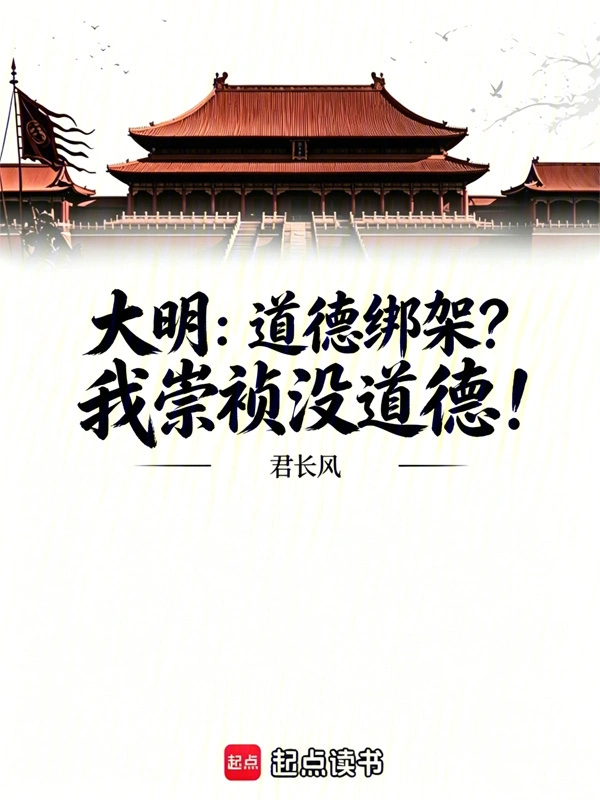
Daming: Moral Kidnapping? I, Chongzhen, Have No Morals!
大明:道德绑架?我崇祯没道德!
- Status
- Ongoing
- Length
- 1.2M Words
- Genre
- Historical
- Audience
- Male
- Subgenre
- Song-Yuan-Ming Dynasties
- Updated
- 3d ago
- Source
- Qidian
Stats
351Monthly votes
15.4kRecommends
42.4kFans
424Chapters
Tags
Honours
Synopsis
Reader comments
In booklists 1
Readers also read
 I Am a Tyrant in Nanming
 Red Mansion Xiaoke
 Fu Ming 1627
 At the Beginning, Please Ask Chongzhen to Abdicate!
 Daming: Attack, Emperor Yongle!
 No One Knows How to Save Daming Better Than Me
 Ming Dynasty: Return of the Dead
 I Get a New Character Every Week
 Transform into Tang Monk and Become Stronger Starting from Covering the Sky to Obtain Scriptures
 In the Late Ming Dynasty, I Pretended to Be a Descendant of Jianwen
 Anti-Qing: Start with a Piece of Stone!
 Datang: They Force Me to Be Emperor, Right?
 Machiavellianism in the Late Han Dynasty
 Three Kingdoms: I Am Zhang Jiao, the Great Man Is Zhongliang
I have merit for opening up new territories; I owe it to tradition to fall behind and be beaten. Horizontal comparisons have always been made in prosperous times; only I, the Qing Dynasty, flatter myself! The proportion of the population is reduced by half; culture, education, science and health are reduced. Everyone can be scolded from Xia to Ming; only I, Nuqing, cannot touch! ... When he is strong, he shaves his head and is easy to obey, but when he is weak, he loudly shouts "unity"; The Eight Banners account for half of their salary; they are deposed to prevent the establishment of the Constitution in 1898. Once a master of the Eight Banners, he now dominates the entertainment, film and television circles. Forbid intermarriage and build a city full of people; appoint yourself agents of all ethnic groups. ...... A "visa" is required within a country, and the border is moved along the coast to the wicker border. The cession of territory and compensation were in the past, but outsiders are treated favorably until today. Kant had a record of committing a crime against Japan, but now he is falsely accusing the masses of treason. The Association for the Restoration of the Puppet Manchukuo said that the people were divided; ... Wearing clothes with sand mixed with Han clothes, people wearing pigtails and baskets filled the streets. Praising the Qing Emperor and being a dirty hero, he also wanted to cause disaster for five hundred years. Nurha only fights against oppression; Zheng Sen successfully fights for separatism! Three views are reversed and double standards are bitches; anti-black people are not objective; A collection of black materials from past dynasties; speaking and speaking is "just as bad". Not only the royal family and scholar-bureaucrats; but also the Eight Banners and a mountain. Laughing at the vassal king as a burden, with two and a half million bannermen! The so-called "fusion" is a big talk; it is not as good as Xiaowen's thousands of years ago. ...... Self-proclaimed "no tax", the regular tax is even worse than the "three rates"! The previous dynasty occupied people's land for a hundred years; it did not last more than ten years of enclosure. Human sacrifice lasts for thousands of years, not as good as dozens of days in Yangzhou. Binding the feet and girdling the waist to shape the body, until my dog's bones are broken. ...... At the end of each dynasty, territory was lost; claiming one's name does not count. The Qing Dynasty decreed that no one should leave the Forbidden City; "legal principles" were on the tongue of foreigners. Wuchang Shouyi collapsed overnight; the most fragile in history was destroyed. Change your name and cut your braids; is this a coward as good as Yan Yingyuan? ...... In those days, books were destroyed to change history, but now they are blamed and spread rumors. The strange sculptures are bad for Feng Shui, and the teaching materials are tampered with. The demographic data has changed, and the crisis of life insurance and family planning has emerged. In the past, marriage was forbidden to separate Han and Hu, but now false accusations are being made to revive Han. ...... The fellows outside the customs blocked the "return to the east"; Yunnan Wenxiu chased the Tartars! Two hundred years of fighting against the Qing Dynasty and expelling the captives; the "Revival of the Ming Dynasty" has a bright blue flag. The fathers of the country once rebelled against the Qing Dynasty, but today's descendants are clearing up the cause. The road to cultural self-reliance is a blue ray, and you and I are like a spark that started a prairie fire.
Without morals and political rules, low-level people will obey the rules and violate the rules. However, it was already a double act, so we had to start over again. So, the idea is good.
I'll go, it's so cool!
Finally met a normal person! There are too many novels that travel through Chongzhen. You can't do this, you can't do that. There is so much nonsense. What's the point of arguing with officials? This is what a normal time traveler should do. Forcibly extend Ming's life! But. This is a novel. It's really cool, but I'm worried that I won't have anything to write about later. No wonder some novels are nonsense. However, I do appreciate this kind of writing. Really well written. But I can't understand a phenomenon. Just some junk novels, dominating the rankings. On the contrary, some high-quality novels like this end up lonely, and I don't know why.
Zhu Youjian, just write Zhu Youjian, still write Zhu Jian
Moreover, the favorite saying of those who promoted Chongzhen is that he succeeded to the throne at a young age and had no one to teach him. It was already great. I don't deny that Chongzhen succeeded to the throne and may have made mistakes because no one taught him. But he has been the emperor for 16 years. Even if you only learn a little a year, you should have made progress in 16 years. How can anyone in a key junior high school or a key high school fail to go to college? They were taught by elementary school teachers without good instruction. Then why did you go to junior high school and high school?
Scary to think about
Suddenly I discovered that the Song Dynasty actually emphasized culture and suppressed military affairs much better than the Ming Dynasty. I found that the Song Dynasty had better discrimination against military attachés than the Ming Dynasty. They were just big-headed soldiers with a low status. Some hereditary military families who were similar to Jiedushi had a not low status. They had controlled part of the military strength for a long time and were associated with the royal family. Their status has been passed down. On the contrary, in the Ming Dynasty, it was not just big-headed soldiers and senior generals who were still inferior to civilian officials. The main military leaders were civilian officials. Song Dynasty: The polarization between "nobles" and "low-ranking soldiers". The Song Dynasty did not suppress military attachés equally. For the bottom soldiers, their status is indeed very low. But for those top generals who were married to the royal family and had hereditary military positions (such as the Cao Bin family and the Zhe family), they could still maintain their prominent status through marriage and hereditary privileges. However, even a top military officer like Privy Councilor Cao Bin had to take the initiative to avoid civilian officials when they saw their carriages and horses; the famous general Di Qing, who had made great achievements in battle and reached the rank of Deputy Privy Councilor (Second Grade), was still jealous of civilian officials. He was falsely accused of treason just because he burned paper and fire at home, and was eventually demoted. Ming Dynasty: Overall "the military attache is humble". In the early Ming Dynasty, the status of military generals was once very high, even equal to that of civilian officials. However, after the "Tumubao Incident" (1449), the elite of the military general group was almost wiped out, and they lost their right to speak in the court. Since then, the top military leaders of the Ming Dynasty (such as military governors and military officers) were almost exclusively civilian officials, and it became the norm for civilian officials to command generals. Military generals are even more humble when meeting civil servants: a fourth-grade military general will nod and bow when meeting a seventh-grade civil servant; a deputy general will call himself a "lackey" when meeting the chief minister of the cabinet; Qi Jiguang, Li Chengliang and other famous generals will call themselves "men's gentlemen" when meeting Zhang Juzheng.
Apart from being a time-traveler, the main character is no better than the original protagonist Chongzhen. Apart from being a bit hot-tempered, I don't see him having any abilities.
The domestic traitor lackeys were dealt with first, then the heretics were attacked in the United Spanish Church, and then the stolen Chinese technical books were burned.
Some people accuse Chongzhen from the God's perspective of future generations, saying that in that position, some people can tie up dogs better than him. I really laughed to death. Some people can only rely on the nine-year compulsory education in the novel (maybe incomplete) and the brainwashing of the marketing account to get to the country. I hope that one day when your child asks you why you didn't do the slip dance when short videos first emerged, and you can make money with just two twists, you can be so condescending and tell him that dogs can do it, and I don't care. Or maybe in the later period, I was beating my chest because I didn't buy Bitcoin, gold, etc. Instead of secretly thinking, if I had known, I would have gone a long time ago. You can judge others from God's perspective, and others can judge you from God's perspective. What are you without God's perspective?
Chongzhen is indeed immoral. If he has morals, his country will not be subjugated. This guy has never done human affairs. The only time he was right is Meishan. Why is it difficult to write novels in the late Ming Dynasty? Because they all infer the reasons from the results. Because Chongzhen subjugated the country, it must be difficult. Basically, the game will be lost. Historically, it is more rare than Chongzhen. How did others succeed? Take stock of Chongzhen's succession. After killing Wei Zhongxian, he had no powerful ministers around him. Chongzhen was 16 years old. There were at least seven or eight battles involving more than 100,000 people. Killing ministers and general soldiers by Chongzhen is like killing a dog. This is called having no money and no power. To Donglin, Chongzhen also tried to control Donglin. It is difficult to reshape the Ming Dynasty, but it is not difficult to extend the Ming Dynasty. As long as Chongzhen is not as evil as Chongzhen, any of the four emperors of the Southern Ming Dynasty can be stable.
Why does the author always write about traitors to the Qing Dynasty, but not traitors to the Qing Dynasty? Could it be that the Ming Dynasty already recognized the status of a slave-building country?
If the emperor of the late Ming Dynasty had not cheated, there would have been no hope of salvation, and even a rebellion would have been impossible. Because you are the emperor, you are stuck there. The entire court is bound by you, and the whole world is watching you. You have basically no chance to run out and start a new business. You are not an insurrectionist like Li Zicheng. No one paid attention to Li Zicheng in his early days, so he took advantage of the situation and raised a large group of people to rebel. Under what circumstances can you, an emperor, sneak out of the capital and start a rebellion? If you don't cheat, you will be stuck in this first step.
A very good book. This book explains the problems of the Ming Dynasty very thoroughly. The reform of the protagonist has entered the deep water area. The problem of the late Ming Dynasty is not the issue of a single group selling the country and smuggling, or the issue of tax resistance, but the systemic collapse. If you pick any point, as long as money is involved, there will be no pitfalls. In a way, the money that Chongzhen could collect was the money that the entire nation could use, that is, the excess taxes paid by the homesteaders and slightly wealthy tenants who owned 10% of the land. It was even a fishing-like search. The number of troops that Chongzhen could raise was only over 100,000 at the Battle of Songjin. It was not even as good as Qin and Zhao in the Battle of Changping. The two sides fought for three years with more than one million troops, and the population of both sides was only about ten million. A large amount of wealth is all dead money. It is almost as good as not having it, or even worse than not having it. In the end, it was all cheaper for the Qing Dynasty.
This book is good for your appetite. Chongzhen can only be saved by killing people. Anyway, it sucks. After cutting down the money from the quarrel, just give it to the soldiers. It's a waste to kill those people in Jiangnan. They will all be exiled to the whole world in the end.
At present, I don't feel that there is anything sinister about it. If there is something unreasonable, it would be the personal expedition to confirm the status at the beginning, but it can also be explained. At that time, the Tatars only wanted to invade and harass, and it was normal to be timid in fighting. The starting point of the protagonist's series of operations is the army he mastered after successful conquest, and then it snowballs. Overall, it's pretty good and worth a look.
This book is so good, it's only first level
What mistakes are easy to make in historical novels❓
Before the Ming Dynasty, the emperor was not called "Emperor". In the Song Dynasty, he was mostly called "Guanjia", and in other dynasties, he was often called "Your Majesty". In the Ming Dynasty, the emperor was occasionally called "Emperor", and in most cases he was called "Your Majesty". After Kangxi of the Qing Dynasty, people began to be generally called "Emperor". Princes and princes call themselves: Princes in the pre-Qin and Han Dynasties can be called "Gu", and a few can be called "Ignores". After the Wei, Jin, Southern and Northern Dynasties, the title of "Ignores" gradually became exclusive to the emperor, and princes, princes and princes can only be called "Gu" or "I". Song, Yuan and Ming called themselves "I" or "I". Before the Qing Dynasty, princes and princes rarely called themselves "this king". Starting from the Kangxi year of the Qing Dynasty, princes generally called themselves "this king". In ancient times, women called themselves: "nujia" was a modest name for women after the Song Dynasty. Women in the Han and Tang Dynasties more often called themselves "concubine", and noble women could call themselves "I" and "I". Before the mid-Ming Dynasty, most dynasties used copper coins for daily transactions, with very little gold and silver. It was only in the mid-to-late Ming Dynasty that silver became the mainstream currency. -In the late Ming Dynasty, "meeting votes/deposit checks" appeared among the people. There were no unified rules. Most of them were deposits and withdrawals/exchange receipts from acquaintances or local circulation, and were not legal currency. In the early years of Daoguang in the Qing Dynasty (1823): Rishengchang Bank was established, and private banks began to issue standardized banknotes, focusing on cross-regional exchange. They were only circulated in Shanxi merchant trade circles and major commercial ports, and were not yet popular. In the third year of Xianfeng in the Qing Dynasty (1853): the official issued the Ministry of Revenue official banknotes (official banknotes), which were forced to circulate nationwide. At the same time, the network of private banknotes expanded to the whole country, and official and private banknotes ran parallel. The use of banknotes entered an explosive period and became the "starting point of popularization." High-leg tables and chairs only completely replaced the low tables for sitting on the floor in the Song Dynasty. During the Han and Tang dynasties, people knelt and sat on the tables to eat and discuss matters. The furniture was mainly low tables and couches. The memorial system was only established during the Kangxi period of the Qing Dynasty. Officials in the Tang and Song Dynasties used "memorials", "tables" and "statements" when submitting memorials, while in the Ming Dynasty they used "memorials" and "memorials". There is no such thing as "memo" or "zhezi". In ancient formal occasions, the hand-over gesture was performed with the left hand outside and the right hand inside. The right hand outside was a special "unlucky gift" for funerals. "Better greetings" is a unique etiquette of the Qing Dynasty. It was mostly used by subordinates to superiors and juniors to elders. During the Tang and Song dynasties, people often performed cross-hand salutes and bows to greet greetings when they met, and there was no such thing as "sending greetings". Before the Yuan Dynasty, subordinate officials rarely called superior officials "adult". In some dynasties, subordinates called eunuchs "adult", and in some dynasties, they called their parents and elders "adult". Beginning in the Yuan Dynasty, lower-level officials would occasionally call officials of second-rank and above "sir". From the middle and late Ming Dynasty, only officials of third-rank and above would be called "sir" by their subordinates. Officials with lower ranks could not be called "sir". However, in the late Ming Dynasty, there began to appear a few cases where officials above the fourth rank were called "adult". Before the mid-Qing Dynasty, following the rules of the Ming Dynasty, only officials of third rank or above would be called "adult". Starting from the mid-Qing Dynasty, calling officials "adult" gradually became common for lower-level officials. Attention! ! ! What is mentioned above is that lower-level officials refer to higher-level officials. No matter which dynasty, it is absolutely impossible for higher-level officials to call lower-level officials "sir". Some novels even write about emperors or nobles calling other officials "sir". This is simply contrary to Tiangang! ! ! Finally, let's talk about the problem of civilians calling officials Before the middle and late Qing Dynasty, civilians in various dynasties and generations called officials differently, and most of them called them "officials" and "masters". From the middle to late Qing Dynasty, civilians also called officials "adult". {"NickName":"Restriction and Supervision","UserId":417773267}
Economically pretty good
Provide a new perspective for the late Ming Dynasty.
There is an anomaly: the protagonist has offended so many people and has not even failed to be assassinated, murdered or poisoned once. This is very abnormal. Even though he has military power, the enemy has not resisted even once? ? Is it the virtue of those beasts to let others slaughter them? Isn't it rare that former emperors and princes were murdered?
The writing is really good (*^ー^)👍The main character has a wife and children, right? (Ő∀Why don't you write about some daily life (。・ω・。)ノ♡ This kind of book is very good (・ω・) Now I feel uncomfortable after reading it for a long time
It's so cool. The most enjoyable Ming Dynasty novel I've ever read.
The method adopted by the protagonist of this book seems wild, but the success rate and feasibility of his method are not low. After all, there are already two successful examples of Li Zicheng and the Manchu Qing Dynasty. Chongzhen had much more capital and strategic depth in 11 years than these two. The ability to destroy the Crooked Neck Tree was purely due to his own incompetence - he could not even sneak away to Nanjing.
Is it still necessary to struggle in the eleventh year of Chongzhen?
In the ten years of Chongzhen, the Yellow River dried up. . . . . There is no water in the Yellow River when it reaches Kaifeng. The mouth of the Yellow River flows directly into the sea. Why bother at this time? Just run to the north of Nanjing and get rid of it. It would be safest to wait for seven or eight years for the drought to pass before cleaning up the mountains and rivers. Even if you are hungry, you will get money after you die.
The emperor called his subordinates, He Renlongming (人龙), Hong Chengchou (Chengchou), and Zhang Bingwen (Bingwen). Why does it sound so twisted? Is this normal? Isn't it called Cousin or full name?
Beautiful
Is the heat so low? There is less discussion. Pity
Don't list names, water, and word count...
I only read the introduction. But the result is the same as what I thought. To save the Ming Dynasty at the end of the Ming Dynasty, the only way is for the emperor to have breakfast. There is no other way.
The Ming Dynasty's industrial development was a dead end. There was not such a big market in the world to support the Ming Dynasty. The gap between the rich and the poor was accelerating, and the country died faster. At the end of the Guangming Dynasty, the handicraft industry was so crowded that many countries around the world went bankrupt. Pirates became popular and carried out the so-called geographical development to search for gold and silver mines all over the world.
What couldn't be saved was that the real reason for Chongzhen's failure was that he had no military power. It was only after he lost military power that Zhang Juzheng reformed.
In the 14th year of Chongzhen, Li Dingguo was not yet an adult, right?