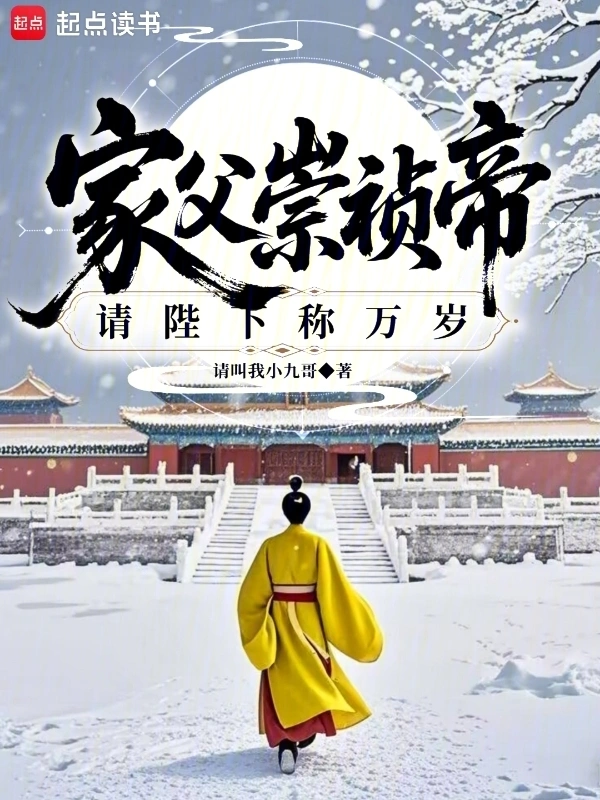
My Father, Emperor Chongzhen, Please Call Me Long Live!
家父崇祯帝,请陛下称万岁!
- Status
- Ongoing
- Length
- 2.9M Words
- Genre
- Historical
- Audience
- Male
- Subgenre
- Song-Yuan-Ming Dynasties
- Updated
- 1mo ago
- Source
- Qidian
Stats
14Monthly votes
35.9kRecommends
107.9kFans
638Chapters
Tags
Synopsis
Reader comments
Readers also read
 Northern Qi, Sage Khan
 Red Mansion: Start Escaping and Farming from the Equipment Bar
 After Lying in Bed for Three Years, He Was Forced to Help the Han Dynasty
 Fu Ming 1627
 If You Are Already an Adventurer, Who Should Work Hard on Your Own?
 The Ming Dynasty Started with Taking Zhu Yuanzhang to Visit the Forbidden City.
 Ming Dynasty: Picking Attributes from the Battlefield to Create the Ming Dynasty in the Heavens
 The Artist Begins in Prison
 Traveling at the Same Time: Great Love to the Heavens
 Reveal the Truth!
 Northern Song Dynasty: Spoiler of the Future, Zhao Kuangyin Collapsed
 Daming: Moral Kidnapping? I, Chongzhen, Have No Morals!
 Don't Be Afraid, Brother! No One Understands Chongzhen Better Than My Sister
 A Small Soldier from Liaodong in the Late Ming Dynasty
 Zhu Yuanzhang Traveled Through Li Zicheng!
 American Comics: Superman's Younger Brother, the Twelve Opening Spells
 American Comics: Evolution Begins from the Vampire Clan
 American Comics: Starting from the Adventures of Jackie Chan
The more I watched, the more furious I became, and I really couldn't stand it anymore. There is something wrong with playing this game at the end of the Ming Dynasty! If you really have this ability, it would be no better than accumulating strength to destroy it and rebuild it. And that technology, if you are a time traveler, you have to get a flintlock gun. Isn't everyone in trouble with a flintlock gun? It's already Emperor Chongzhen. With that kind of technology, is it difficult to provide ideas for making a musket? The Fran cannon was produced during the Jiajing period. Do you really think the ancients were stupid? Have ideas but can't come up with something good? Even if you can't get a modern firearm, haven't you ever played with a match gun? Even a winch-charged repeating crossbow or a lever-type repeating crossbow is more powerful than a flintlock gun. There is absolutely nothing new in everything from politics and law to military system and technology. It's just like not wearing any clothes. So what's the point of wearing them? The environment at the end of the Ming Dynasty when you were playing tricks? I'm sick!
At the end of the Ming Dynasty, I was playing a ridiculous political battle, and I ate too much to support it. The cost of re-conquering the world is much lower than the cost of re-establishing the Ming Dynasty. You want to engage in reform without killing everyone? People nowadays have really burned their brains after seeing too much marketing, and they often become narcissistic and engage in Machiavellian tactics.
Author, you have made several mistakes. I don't like to see systematic things in historical articles. Historical articles should be rigorous. The protagonist has never even met anyone, so he only relies on historical records to determine who are loyal ministers and who are traitorous ministers. This is outrageous. You have to know that history cannot be trusted, and the history of the Ming Dynasty was compiled in the Qing Dynasty!
Ji Ji Wai Wai Wai Wai, if labor and management have to have this system, those messy civil servants would have been killed long ago.
This introduction is so funny. Minister: The old men are all trying their best to help, so why does His Highness want to rebel on his own?
In the late Ming Dynasty, political struggle was of no use, so we started anew to kill and kill.
Why did the people rebel? Because there is not enough food to eat, you hit the Little Ice Age and the food production was greatly reduced. No matter how much money you get from the political struggle with them, you can't buy food. War is the fastest way to reduce the population. If the people don't have enough to eat, the rebellion will not stop. The officials will not stop the government. Food will not be given to you. Even if you get some food, it will not be enough. The rebellion cannot be stopped. The only way is to rely on war. The population is small enough. Only when enough people are fed will the rebellion stop. Either foreign war or internal war. There are only two methods. Then kill all the families and redistribute interests. Of course, I only think of these two methods. If you have other methods, you can also tell me.
Bring out the murderous intention of the Chinese people and train the soldiers of the Five Dynasties. Learn from Huang Chao and kill from the north to the south. Why Huang Chao has such a bad reputation is because he only kills scholars and local ruling classes. There is also an unimportant Jew who wants to establish a country in Guangdong. His reputation is bad because he lost. Otherwise, look at how many people were killed by the Mongolian, Yuan, Manchu and Qing Dynasties. There are still some people who want to be officials. In the Ming Dynasty, the ministers still scolded the emperor, but the Qing Dynasty could only kneel down. When I entered the Pass, there was a great scholar who would argue for me.
It really made me laugh. There are so many flaws in such a short paragraph. I really want to learn history through self-media. What kind of winch-type crossbow and lever-type crossbow. . These things are from the Roman and Shu Han eras, and have been eliminated for more than a thousand years since the Ming Dynasty. Why do you want to do this? Please, it's the 17th century, let's play with chemical energy. Mechanical energy is a thing that has been completely exploded by chemical energy. If you still use it as a new thing, I think you are treating the ancients as fools. In addition, I mentioned earlier that the ancients had a Folan gun, and later the protagonist was asked to invent a Zimu gun. You are so humorous. Don't you know that the Folan gun and a Zimu gun are the same thing? Zimugun is the Qing Dynasty who changed the name of the French cannon. Because of taboo, it is the same as the Hongyi cannon was changed to the red cannon. And when you hear the name of the Flange gun, you will know that it is imported. The Flange gun comes from the Portuguese Eagle Cannon imitated after the Tuen Mun Battle. It has a fast rate of fire. , Has good firepower sustainability, so it was imitated and modified by the Ming Dynasty. The Portuguese light matchlock technology was also introduced by the Ming Dynasty at the same time, but it was not as popular as the Flange cannon. The disadvantage of the Flange gun was that ancient casting technology was poor, and the air tightness was not good. The structure of the Flange gun also destined that it could not be made too big, so its lethality and penetration were weak, and it was unarmored. The Mongols were just fine, but later the Qing army learned better and was pushed by three armored vehicles with shields. They were not afraid of your Franchise and general cannons at all, so they had to build red barbarian cannons later. The red barbarian cannons were twelve-pound naval guns used by the Dutch to salvage British merchant ships. They were far more advanced than the 16th-century eagle cannons introduced by the Ming Dynasty. Therefore, both sides in the subsequent Ming and Qing wars were crazy about building red barbarian cannons. As for your question about why everyone who writes historical novels likes flintlock guns, don't talk nonsense. Flintlock guns are easy to use. Flintlock guns were the best individual firearms from the early 18th to the middle of the 19th century. The intensity of European wars was so high that flintlock guns were used from the Grand Alliance War to the First Opium War. With flintlock guns and bayonets, you can change the fancy troops into pure troops and abandon the cold war. The hot mix uses large square formations that are difficult to form, and uses pure line infantry units. Both the difficulty of training and the mobility on the battlefield are greatly improved. Moreover, the flintlock gun is very easy to use even if you don't know how to train. It has high armor-breaking lethality and good concealment (the matchlock gun has an open flame). In the 18th and 19th centuries, indigenous people all over the world did not hesitate to exchange all kinds of good things for flintlock guns with European colonists. I haven't read this book yet. I don't know what the author's level is, but if I were the author, I would be sick to death when I see you guys pointing fingers at things who don't understand anything. https://h5. If. Qidian. Com/h5/share/post/base? CircleId=30821124604953709&postId=1093 001395949207552&shareUserCode=E3VOfw8t&spdt=14&spdid=18&ex1=1093001395949207552
The author actually still believes in Ming history. Oh my god, how has Ming history been revised by the Qing Dynasty? Moreover, everyone knows the virtues of the civil servants of the Ming Dynasty. They all had their heads shaved and became slaves. Can the things written by those slaves be trusted? Are those slaves writing about loyal ministers and loyal ministers who died for their country believable? History written by a group of traitors, and loyal ministers written by a group of traitors must also be traitors.
Carving a boat and seeking a sword
No loyal ministers! No loyalty! . In other words, they are all loyal ministers! They are all loyal ministers! It is common interests and common ideals that form loyalty. The so-called person who has the same desires from above and below wins. As a leader, the important thing is the distribution of resources, and the distribution of interests is dividing the cake. You can't tell who is the enemy and who is the friend, how dare you say who is the loyal minister? Fortunately you are not in politics, otherwise, you must be a corrupt official, a mediocre official or a scapegoat.
When you travel to the Ming Dynasty, the first thing you do is to clean up the palace first. If you don't clean up the palace first, I'm afraid that the policies you want to implement will be known to people outside the palace before you leave the palace! Then clean up the institutions such as the Jinyi Weidong Factory, then the civil servants in the capital, the capital camp, and the court, and then Shanxi merchants, border troops, Manchu and Qing Dynasties, and the south. Whichever one is done first, the south must be killed at least several times, otherwise sooner or later they will be stabbed in the back. The first thing I do when reading many Ming Dynasty novels is to establish a clan, but in my personal opinion, the clan in the Ming Dynasty is the least urgent and the best to deal with! And why do you have a clan? Isn't it just money? If you don't clean up the court, how much money do you think you can get by setting up a clan? Of course, if there is an awesome system, pretend I didn't mention it.
If you save Ming Dynasty, then start killing. Form your own army, and control all the captured territories. The young and strong will go to the combat barracks, the children will go to the children's camp, and the old, weak, and sick will go to the logistics camp. Once the organization is established, they will start killing Kill corrupt officials, evil gentry, and bandits. The rest will be sent to work. All money, food, and land will be confiscated. All the Qing Dynasty people who refused to obey were killed, and the literati who were treated as dogs and wanted to start a party dispute were killed directly The acquired territory should be re-formulated through military control, otherwise the same old methods will be useless Anyway, you can't live forever, build a good country, and leave your own footprints in history
I am really addicted to persuading people to surrender. I feel that the Zhu family has failed the people, and you are just a time traveler, so you really think of yourself as Niu Cihong.
Just kill the enemy with a sudden force. If there is no food, just massacre the enemy. There is food everywhere. At the end of a dynasty, you still want to engage in politics. You have no money, no food, no power, and no ability to control people. Who is following you? You are not afraid that you are easily soluble in water, right?
With so much money issued, are you not afraid of inflation? In ancient times, food was the foundation. Giving money would only increase food prices. Money is just a medium of exchange for goods
If Chongzhen doesn't kill him, why should he keep it? I'm really convinced.
There is already a standard answer to the situation in the late Ming Dynasty. Just copy the Qing Dynasty. The only difficulty is that it is a bit difficult to get started.
This book is suitable for young people who have little interest in understanding history but want to enjoy it. Those who are a little older and have little understanding of the struggle can't stand it. But yes, if the protagonist really understands this, this book will not be happy. The reason why Chongzhen was able to subjugate his country in more than ten years is because he was too young and had no political means to do things that were either good or bad. There are always people who blame the previous emperors. Please. The country was destroyed only in the 17th year of Chongzhen. How can you put the responsibility on others? Many emperors of the Ming Dynasty did not reign for more than 10 years.
How many chapters do you want to write about Li Zicheng?
Author Li Zicheng How many chapters do you want to write? Is he so awesome? Why is it that the Qing Dynasty was so awesome that it was the Qing Dynasty that later conquered the world? Immediately kill Li Zicheng and directly confront the Manchu Qing Dynasty. Then open up the Maritime Silk Road and open up the Western Regions. Grind the tofu around Li Zicheng. Can you learn from Bai Qi?
Seeing that Li Zicheng was about to die and wanted to persuade him to surrender, he was completely poisoned. Is the Ming army completely out of talent? He must be persuaded to surrender. You can get high-ranking officials after surrendering. What do you want the officers in the system to do and think? If you can only lead an army after surrendering after being defeated by the rebels, why should the generals in the system fight? They risk their lives to defeat the peasant army. In the end, they will become your immediate boss as soon as they surrender? Li Zicheng has surrendered and rebelled many times, and the political status of the protagonist also determines that he must die. This is determined by his seat position. It's impossible to change just for a reduced general. It's understandable that the generals are trying to persuade them to surrender, but the rebel leaders are too cruel to persuade them to surrender. Without them, they wouldn't be able to defeat Jiannu, or what? In the end, Li Zicheng was beaten like a dog after the Qing soldiers entered the pass. Weapon iterations are out of whack. The role of generals is actually not that great. There is no need to just persuade this or that general to surrender. What do you think of the soldiers and generals who died in the decisive battle?
It's a no-brainer, and if you think it's a fun read, you should be able to read it. .
Cheating is cheating, there is no difference between small cheating and big cheating. There is no difference between selling resources and nuclear bombs, consciousness control, and world modulation. It means it is hung up. It doesn't matter just because you drive it small, nor does it matter just because you use it less. The author is just a loser. He cheated and deducted Sosou. It was me who directly verified and tied the game. It was at least fun to see who could level with whom.
The protagonist's golden finger doesn't work! If you want to be unparalleled, you need a dead soldier system! Recruit a dead soldier for one penny, who brings his or her own identity, weapons, dry food, and is absolutely loyal. There is no limit to recruitment.
This is a thinking of Ming history
When the Ming Dynasty was established in 1368, years of wars had led to desolation of the land, a sharp decline in population, and a serious lack of social productivity. Recuperation and recuperation were a must-have national policy. In 1371, Ming Taizu issued the "Sea Ban", which prohibited all Chinese ships from going to sea and severely punished private traders and ship owners. In 1374, the Baobao Promotion Department was established, and the Ming Dynasty Baobao was officially issued the following year. It was initially put on the market through financial channels such as salary and military pay, and the paper currency standard was forcibly implemented, severely cracking down on privately minted copper coins, and prohibiting the circulation of gold and silver. (Since the imperial court banned the circulation of gold and silver, then the gold and silver circulating among the people Where did it come from? It is obvious that precious metals such as gold and silver have not needed national power to give them credit value since ancient times. Through border smuggling and the trade development of the land and sea Silk Road in the past dynasties, bureaucratic capital and private tycoon families have accumulated a large amount of hard currency gold, silver and copper. Since the Song Dynasty, A large amount of precious metals in society are no longer in the hands of the court, and the newly established Ming Dynasty court has almost no gold and silver reserves. In order to maintain the operation of the country, it needs to continue to make financial expenditures. If precious metals are directly used as the national currency, it is tantamount to the country voluntarily giving up its monetary sovereignty, and the court will only have one. It is an empty shelf and exists in name only. For example, if banknotes are forced to be used as national currency without reserves, the country will still be subjugated if the country's credit is completely overdrafted) In 1381, Ming Taizu further strengthened the sea ban policy and issued the "Da Ming Huidian", which required all merchant ships to go to sea with government approval. (While prohibiting private overseas trade, the tribute trade system was used to establish maritime trade monopolized by the central royal power. Earning overseas gold and silver provided credit support for the Ming Dynasty treasure banknotes. Hedging bureaucratic capital and private capital used hoarded precious metals to seize the country's monetary sovereignty. All foreign trade was settled with treasure banknotes. The Ming Dynasty purchased precious wood and spices. , Foreign luxury goods, foreign trade silk, porcelain, iron pots, prices were all set by the Ming Dynasty) In 1402, Emperor Yongle ascended the throne. In addition to continuing to maintain Zhu Yuanzhang's national policy, he also sent Zheng He on seven voyages to the West from 1405 to 1433 (expanding trade routes, destroying pirates and escorting merchant ships, and monitoring private smuggling). Zhu Yuanzhang established the rules of living for the people when he founded the country, and set the tax rate at a very low level. Emperor Yongle was able to move the capital to Beijing, build the Forbidden City, build the Ming Tombs, conduct five expeditions to Mobei, conduct an expedition to Vietnam, repair the Great Wall, and dredge the North-South Grand Canal. Compiling the Yongle Canon, any of the above items would be enough for the whole court and the public (such as Emperor Yang of the Sui Dynasty and Emperor Wu of the Han Dynasty), but if the Yongle Dynasty did all these things, then he must have the money to do these things, and where does this money come from? It can only be the Western trade. It is easy to earn, otherwise there is no way to explain the national finances (all the vassal states at that time accepted the Ming Dynasty treasure banknotes. Zheng He used such depreciating banknotes to exchange for a large amount of gold, silver and various physical objects. The Ming Dynasty treasure banknotes can be printed as much as they want, and the Ming Dynasty does not need to worry Regarding the issue of inflation, Zheng He sold high and bought low. Ming historians estimate that Zheng He made seven voyages to the West and earned 720,000 taels of gold and 12.76 Million taels of silver. This is the total income. At the same time, he spent a total of 6 million taels of silver on the seven voyages. The total cost was that when Ming Xianzong Zhu Jianshen became emperor, there were still 2.4 Million taels of silver in the treasury) In 1435, Ming Xuanzong died at the age of 37, and Ming Yingzong, who was only 8 years old, succeeded to the throne. Amid the cry of "wasting people, hurting money, and not beneficial to the national economy", all data and information related to the maritime trade in the Western Sea and the maritime fleet were basically sealed or destroyed, causing the central finance of the Ming Dynasty to shrink significantly. Even with the support of the wealth accumulated in previous maritime trade, the national credit of the Ming Dynasty treasure banknotes began to gradually decline and depreciate. (From the epitaph of Guo Yan, we can learn that he was ordered to supervise the construction of 120 "Xiaban sea ships" in the eighth year of Zhengtong (1443) of Emperor Yingzong of the Ming Dynasty, and was appointed as the "general coordinator of the eight prefectures". Due to his good supervision, "the military and the people benefited from it". After the completion, "tens of thousands of military and civilian officials from the eight prefectures came to the mansion to express their thanks." This confirms Emperor Yingzong of the Ming Dynasty was preparing to restart the national plan for the Western Ocean trade. After the ship was built, it was first put on hold due to the civil uprising, and then the Tumubao Incident occurred in 1449. In 1457, just a few months after the restoration of the Emperor Yingzong of the Ming Dynasty, he wanted to start the Western Ocean trade plan again. Zhang Zhao objected on the grounds of needing disaster relief. In order to provide relief to the former. Let him clean up the mess and sail to the West. By the Chenghua period in 1464, Emperor Xianzong of the Ming Dynasty Zhu Jianshen ordered the Ministry of War to search for archives of Zheng He's voyages to the West, but found that the relevant documents (including charts) were missing, and Liu Daxia, an official of the Ministry of War at the time, was accused of hiding or destroying them. Archives, since then the imperial court has completely lost the ability to return to the Western Ocean) In 1567, Longqing Emperor Zhu Zaijing was forced to shut down the business due to the increasing national financial deficit. Bureaucratic capital and private capital began to encroach on the maritime trade that was originally a monopoly of state-owned enterprises in the Ming Dynasty. With the massive inflow of wealth and silver, most of the tax revenue went into the hands of bureaucratic capital and private capital, except for the imperial court. The amount of silver in private circulation also increased massively, and the monetary sovereignty of the Ming Dynasty was gradually being eroded. Longqing Emperor Zhu Zaijing was an adult and knew the stakes. Silver must not be allowed to become the legal currency of the Ming Dynasty. However, this was the last step for bureaucratic capital and private capital plutocrats to steal the monetary sovereignty of the Ming Dynasty. From the death of Ming Xuanzong at the age of 37 to the ascension of Emperor Longqing to the throne, it was 1 In 31 years, it was 132 years before Emperor Longqing switched on and off. How could the century-old plan of bureaucratic capital and private capital plutocrats stop progressing and fall short? Therefore, Emperor Longqing had to die in 1572, five years after the switch, in pursuit of beauty and lust, in order to ensure that Emperor Wanli, who was only 10 years old, ascended the throne. In 1581, Zhang Juzheng promoted a whip law to abolish treasure banknotes and use silver as the national currency. As a result, the country lost its monetary sovereignty, and its economic lifeline gradually fell into the hands of bureaucratic interest groups, Jiangnan gentry and maritime merchants who controlled large amounts of gold and silver. They emptied the country's wealth and got rid of the control of the central royal power. After Zhang Juzheng's death, Emperor Wanli liquidated him on charges of "authoritarianism and chaos in government", deprived him of his title and ransacked his home. Wanli once ordered "dissection of coffins and slaughter of corpses", intending to dig graves and whip corpses to vent his anger. However, due to the strong persuasion of officials such as Chief Assistant Shen Shixing, this was not actually implemented. In the Chongzhen period, there were no eunuchs to check and balance, and Chongzhen could only borrow money from ministers to pay the army, until the Manchu Qing Dynasty, the collaborator selected by the capital tycoons, entered the customs in 1644 (I just want to be the wife of the county magistrate, I don't care who is the county magistrate, this is the fundamental reason why the Song and Ming Dynasties fell from the world twice). By 1662, the Southern Ming Dynasty fell, and the Manchu Qing Dynasty began a 295-year dark rule.
Don't forget that the West is still fighting with cold weapons. The artillery is from the Ming Dynasty. It was Europa who came to China to find medicine to treat syphilis. Then the missionaries spread it in China specially and asked the imperial doctors to study it. Then the artillery was discovered in this process. The missionaries stole it. The nautical chart was changed into a map dedicated to Wanli😤The Jews in Kaifeng helped them kidnap the artillery builders, and used their Western knowledge and Chinese technology to improve the artillery. In particular, the Chinese treasure ships were changed to look like Galen ships. Why are the treasure ships and navigation records gone? Don't forget that there is a Jew in Kaifeng. The Jew parasitizes the whole world and then sorts out the world's technology to be so awesome. How many things have he stolen from China? To this day, these Jews in Kaifeng still have not returned home.
In fact, all I need is 5 undamaged heavy machine guns with unlimited ammunition. I only need to train a few hundred soldiers. In ancient times, no matter how many people you came, I would kill them all for you, even if there were 1 billion people, so do you think I can be a captain?
There's a huge problem with the title of the book, and I'm too lazy to say it
One suggestion, although it is coming to an end, is that you should not engage in enfeoffment here. This can only be said to be a bad ending. The enfeoffment system itself is a strategy implemented by a relatively weak country in order to expand its sphere of influence. However, after becoming a unified country, the enfeoffment policy has become a tasteless thing, or a burden. , Don't say anything about pushing favor orders. Pushing favor orders has a premise, that is, the central court's control over local areas and the comparison of the strength of the vassal kings are much higher than them, forming a situation where they dare not and cannot counterattack. Furthermore, in the situation of the Ming Dynasty, the kinship relationship between the local vassal kings and them was not significant at all, and I don't know how far it is.
Red River Plain and Mekong River Plain
After the Red River Plain and the Mekong River Plain are captured, it can be guaranteed that there will be no shortage of food. Vietnam has become a major food exporting country because of these two plains. The Red River Plain originally belonged to the Chief Secretary of Cochin. The Ming Dynasty had a history of ruling for several decades, but it was lost long ago by the end of the Ming Dynasty. The Mekong Plain is very large. Taking control of the Mekong River can not only ensure food security, but also open up the Mekong River transportation and promote the economy.
In the first chapter, poison was released. Chongzhen himself had no money, not even a few thousand taels of silver. How could you, an empty-headed prince, get the money and food to feed three thousand soldiers?