


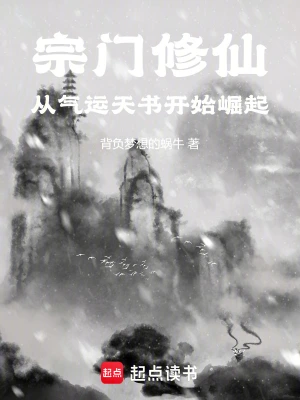
Cultivation in a Sect: Rising to Power with the Heavenly Book of Fortune
宗门修仙:从气运天书开始崛起
- Status
- Ongoing
- Length
- 4.4M Words
- Genre
- Cultivation
- Subgenre
- Cultivation Civilization
- Updated
- 1d ago
- Source
- Qidian
Stats
1.2kChapters
284Votes
41.1kRecs
88.9kFans
Tags
Synopsis
Readers also read
 Cultivation of Immortality: Picked up Half a Book of Centuries
 A Record of a Mortal's Journey to Immortality: From the Start, Lying in Wait at the Seven Mysteries Sect to Take Han Li as My Disciple
 Eternal Life for 80,000 Years
 Strange Tales from a Chinese Studio: The Most Sinister One Has Arrived
 Simultaneous Transmigration: Is Everyone Starting Out in Prison?
 Clan Cultivation: Rising in the Untamed Wilderness
 Immortality Begins with Inheriting a Qi Refining Sect
 A Great Industrial Nation, Starting with a Fake Student Abroad
 A Dual Status Panel Descends into the Abyss, and the Assassin's Potion Is Right at the Entrance
 The Qinghe Immortal Clan
 Hunyuan Immortal Sect
 The Boundless Dao Lord
Reader comments 39
Google Translate
In many sect novels, the protagonist claims to be the leader, but is actually the nanny. Logically speaking, a sect is similar to a modern enterprise. A company is created to make money, while a sect is created to allow disciples to better collect resources to assist the protagonist in cultivating immortality. As for the sect inheritance and cultural core mentioned by some authors, unless the ancestor has a spirit in the sky, it is just to fool Sha Zi, and it is the same as the so-called wolf culture now.
Write down the shortcomings and poisonous points of your reading, personal opinions, for reference only, the author can delete the post if he mind.
The first and most uncomfortable point is that if you lead a spirit to build a foundation, your lifespan will be increased by 60 years, while building a foundation will only have a lifespan of 180 years, and condensation pills will only have a lifespan of 240 years. No matter how you look at it, it seems awkward. Although the short life span is a foreshadowing according to the author's intention, a famous writer once said that newcomers are not worthy of foreshadowing (that's what the original words meant). The early plot itself can only be regarded as fodder, and a very unconventional setting will make the desire to read even lower. As for the self-created realms of opening pulses, attracting spirits, and condensing pills, they can only be regarded as weak points. Second: The protagonist is indeed not a nanny, but very much like a nanny. The reason is that the protagonist's cultivation level is always incomparable with that of several other people. This does not make sense logically. The protagonist is already considered a genius, but the speed of entering the world of several junior disciples can not be left behind at all. In terms of character, because I have very little description of the character's character, I can't tell what makes them better than other monks. In other words, I don't feel that they have extraordinary understanding or a rock-solid heart for seeking the truth; in terms of talent, the two juniors at the beginning have low-grade spiritual roots, and Li Hai has a marginal mid-grade spiritual root, which is already a poor level; in terms of resources, if there are a lot of resources, The source can make up for the lack of spiritual roots, so the advantage of the large monks over the small monks should be overwhelming; as for the last luck, this setting does not feel like it has played its role, it is more like giving the author a reason to give the character whatever it lacks. The biggest reason is that none of the supporting characters have a distinct and profound image that can ignore their talents. As for those monks who advance rapidly in the same sea area, it is even worse. The overall progress speed of the monks in the entire Yunsha Sea area is like spiritual energy recovery. Third, I came to read this book because of the sect, but as far as I can see from the dozens of chapters after the protagonist's foundation building, the sect is now as established as it is not built, and the sense of existence is too low, including the sect's recruitment of disciples, training of disciples, disciples performing tasks, the inheritance of the sect's masters and apprentices, the specific scope of the sect's influence, the distribution of mortals, etc. There are too few descriptions. Moreover, the entire sect only has ten or twenty people, but it wants to include many institutions, names, decentralization of powers, etc. Early on, giving people the feeling that they are all officials in one class in elementary school. Another author seems to be reluctant to part with the characters in his works. He rarely sees sacrifices, and rarely sees disciples who are still powerless and lonely after hard work. He drags them away together. In any case, the fairy spirit will be much weaker. Exercise resources: The sect does not seem to be that rich, but it seems that there is no shortage of anything. The reason is the aforementioned luck. Rather than saying that luck improves the luck and fortune of the disciples, it is better to say that it gives the author a reason to send supplies. No matter what is lacking, just go out and have it. The techniques and skills were passed down too easily. Financial system: There are no problems with prices, but there are bigger problems with making money. The first one is poor and the second one is white. When you open the pulse, you can earn one or two hundred spirit stones a year. When you are guiding the spirits in the next few, you can buy thousands of spirit stones. Each time you kill the spirit-guiding monks, you can get thousands of spirit stones. The middle-grade spirit stones can be used in dozens of places. However, when the protagonist builds the foundation, he invites the protagonist to the demon hunting group for only one thousand a year. Moreover, when the protagonist upgrades the magic weapon, he cannot get four thousand spirit stones. No matter how you look at it, it is unreasonable. In terms of combat: The simplicity of fighting scenes is a common problem, and it also exists in this book. When fighting, you can only see the strength ratio and the danger of fighting, but there is very little mention of moves and spells. Another thing is that the monks' strength is not written out. So far, I only remember that the protagonist uses a halberd and is strong, Li Hai uses a sword and is talented, and Wang Qing uses a bow. As for what is different about them from ordinary people, what kind of recruitment they can do, and what spells come with their exercises, I have no impression at all. Zong's Hundred Arts: It's too easy to pass them on. As mentioned earlier about luck, the other thing is that the disciples of the sect have only been practicing the hundred arts for a short time, but they can master them as long as they need them. This is the same as the previous use of luck to send skills and resources to the sect. Others are just minor problems. As for the name of the area, every sea area is called xx sea area regardless of its size. I have no idea about the size of the area. It is recommended to refer to the division of states, counties, counties, etc. On land. There are relatively few descriptions of high-level forces. Fubo Sect is only known to be a Jindan force. What are the specialties of the sect, what are the important affiliated forces, the number of disciples, and the gap between the disciples of the big sect and the disciples of the small forces are not described. The setting of spiritual veins is also quite awkward. When I think about the time before and after the protagonist builds the foundation, the whole sect only has one micro-spiritual vein that is not in the sect, and most of the forces in the entire sea area do not have a spiritual vein, I wonder if this setting is really from Xian Xia. The last thing is the issue of colloquialism. Many of the dialogues are very modern colloquialisms. Of course, I don't mean to play modern jokes or anything. It's just that many of the dialogues feel like two modern people chatting at a glance.
It's very interesting, but I don't want the protagonist to have a female protagonist. I feel that when the protagonist reaches a certain level, he will accept disciples, let the ancestors do it, and then give the pen and ink to the sect theme. In the early stage, the protagonist can be the center, and in the later stage, the sect is the theme. The disciples he accepts must not be female disciples. It really feels disgusting.
New authors should not create any new settings by themselves. The traditional mortal realm still accounts for the majority of the audience. I think what people in the comment area said is absolutely right. You have to get a bucket for the spiritual rain technique. How about lighting it first for the fireball technique? There is nothing wrong with what I say. It nourishes the Qi, opens the pulse, and guides the spirit. To be honest, the new setting does not have any sense of superiority. If the new book can write the story I want to write in the setting of the old book, it will be very good once it is written. Personal opinion, don't criticize if you don't like it. I wish you a great success in this book.
Growth always requires sacrifice, compared to the Xuanjian Immortal Clan
1. There is a problem with the setting of Goldfinger. The protagonist kills people alone and raises a sect. Although he does not support all the sects, the sects and him seem to be of no use. Moreover, the level is low now. When you get to Genshin Impact, there will be a few enough for you to kill and accumulate luck. 2. The protagonist looks decisive and cautious in killing, but in fact he is very stupid. Every time he kills someone with a background, he always relies on a group of people not to tell anyone. It's not who you are. If you don't tell, you won't tell. This is the case with the Chen family, and the same is true with the Fengpeng family.
Thank you for your support!
Thank you for your advice. What can be modified has been modified. The first and second volumes have been reorganized. Thank you very much! There are a few questions, let's explain them together: 1. The protagonist is not a nanny. If the junior brother should be allowed to practice, he will let the junior brother practice, but he will never let it go and watch indifferently! 2. The survival of the sect is better than anything else! 3. There is no forced intelligence, the supporting characters and villains all have their own plans! If you have any ideas, you can reply here. Book reviews will not be deleted!
In the early stage, shouldn't we give priority to giving luck points and resources to the strongest protagonist, trying to break through to the next big realm as soon as possible so that he can deal with the enemy? However, without any planning, the junior brother's own realm is lower than that of the protagonist and then breaking through to a small realm will not be of much use in dealing with the enemy.
The Nine Transformations of the True Spirit is really powerful. Even now, 10 years later, it is no problem to book ten thousand orders from the starting point. The world view is really well written. If you can learn from it, it will be a masterpiece easily. Nine Transformations of the True Spirit was written in an ordinary way in the early stage. It slowly unfolded from the middle stage and became more and more enjoyable in the later stage. I have read it three times and it is really good.
The protagonist of this novel has no secrets of his own. Every time he has a secret, he has to confess to others who are a level better than the protagonist. The immortal cultivators all have their own secrets. Whoever has nothing to do always tells others. You should write about casual cultivators.
You wrote a protagonist who has his own power. Every time he has a secret, he has to confess to others. The golden elixir confesses to others. The Dongtian Token also has no secrets of his own. I feel that the protagonist really doesn't have any secrets of his own. Everyone knows the golden elixir exercises. They are all other people's. The protagonist's underwear is his own. Anyway, this protagonist basically has no secrets. Some secrets have to be revealed in the end. Is it better to write about casual cultivators in the future? To avoid being picked on by others all day long. Besides, why do others have to take advantage of every good deed or why do others have to know everything they do? If you have a token and sneak in, there will be some top secret realm resource points that cannot be controlled by other forces. Even if you can control them, you can't control them. All casual cultivators can enter.