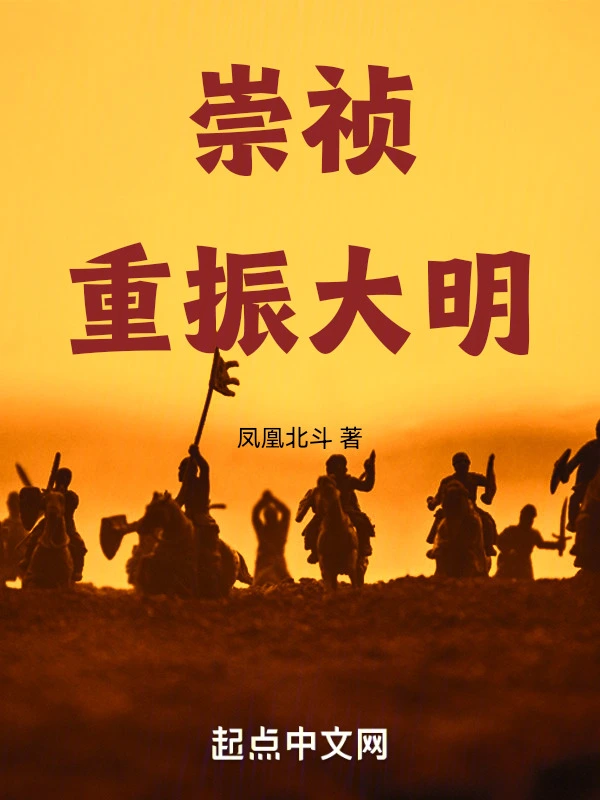
Chongzhen Revived the Ming Dynasty
崇祯重振大明
- Status
- Ongoing
- Length
- 3.9M Words
- Genre
- Historical
- Audience
- Male
- Subgenre
- Song-Yuan-Ming Dynasties
- Updated
- 1mo ago
- Source
- Qidian
Stats
Tags
Synopsis
Reader comments
In booklists 4
Traveling Through History, Exquisite Products Dominate China and Foreign Countries
Travel to ancient times and achieve hegemony

Chu Qiu's Book List
Writing value: As the name suggests, it refers to an author's basic writing level and mastery of narrative skills. Intentional value: that is, the ideological theme in traditional literary creation. Of course, online articles have their own particularities. I personally believe that the level of intention of an online article can be evaluated from two aspects. First, the issues that the author wants to reflect on through the work, the principles he elaborates, and the emotions he expresses; sec

History Department Book List
I recommend those that I am currently reading or have already read, those that are serialized or completed, and those that are good to memorize.

A Calm and Engaging Slow-Burning Masterpiece
It records many years of classics. The protagonist is calm and rational, the supporting characters have online IQs, the plot is exciting, and it is beneficial to open the book.
Readers also read
 After Lying in Bed for Three Years, He Was Forced to Help the Han Dynasty
 Northern Qi, Sage Khan
 Fu Ming 1627
 Red Mansion: Start Escaping and Farming from the Equipment Bar
 Siheyuan: Start by Picking up Attributes
 Nanming, This Emperor Is a Bit Stable
 Huang Ming
 Beastmaster: I Can See the Evolutionary Path
 Immortal Who Seizes the Body
 1848 Qing Dynasty Charcoal Burner
 Sun and Moon: Yongli 1656
 Daming: Moral Kidnapping? I, Chongzhen, Have No Morals!
Let's not talk about whether the system mentioned by the author is useful 😰. Anyone with some political and economic literacy would not dare to write like this. It is impossible for those who have studied politics and economics to read it. The most fundamental gap between ancient society and contemporary society is low productivity, that is, a very thin economic foundation. Weak, without the support of advanced productive forces, those systems of yours are bullshit to say the least. People in ancient times did not have enough to eat and clothing, and the annual grain output was very low. None of your systems require financial support. In ancient times, fiscal revenue was not taxes collected from farmers, and you want to reduce exorbitant levies and miscellaneous taxes. Do you think this is wrong? Is it self-contradictory? After saying so much, the author has not found the main contradiction of society at all. The lack of advanced productivity is the main contradiction of feudal society 😡. I feel angry when I see it. After writing so much, the author must feel that his writing is rigorous, but in fact he is not rigorous. How many are there, and as a novel, what you wrote is not up to standard. There are no three-dimensional characters, only your own rhetoric, and no climax. Where does the reader get the interest in reading? To be honest, this book is quite a failure. The writing is not as refreshing as the writing, rigorous and full of gaps 😄
After reading three hundred chapters, I can't help but feel unhappy! And some of my own ideas.
I think that during the power vacuum period mentioned in the book, we should not be busy with immediate reforms, but should be planning how to regain power and recruit people. No matter how beautiful your organization is, it doesn't matter. The same group of people are still doing the work. If the organization is well reformed and there are no loopholes so that those who work can't benefit from it, the efficiency may be even lower and you will directly destroy it. If these people find new loopholes, they may be greedy even more. Wang Anshi and Zhang Juzheng were so powerful and powerful in carrying out reforms, but in the end they were not allowed to go astray by the people below. This was just a small adjustment of some policies and did not fully involve the central agencies. First of all, if the emperor wants to reform the strongest code, he must have personnel power, financial foundation, high prestige, ministers who support the reform (one or two cabinet ministers level), a complete team that can implement the reform (some courtiers, some local ministers, grassroots cadres), and directly affiliated armed forces. Only with the above conditions can comprehensive reforms be carried out. In the book, it is purely conjecture that the emperor reformed the institutions without any foundation. Considering the conditions of the Ming Dynasty and the efficiency of those officials, it would take at least ten years to achieve the (central institutions) written in the book. After the fall of Wei Zhongxian in the book, a few core people should be promoted immediately to take full control of the inner court, factory guard and other auxiliary institutions, and then rectify these institutions and clean up some people to achieve the purpose of taking full control of the imperial city and the capital. It will take at least half a year to do the above. The emperor must personally rectify the above institutions to fully understand how these institutions operate, how to improve efficiency, and to effectively promote reliable talents to maintain loyalty to the emperor. In the future, instructions to do things will not appear so abrupt. At the same time, on the basis of maintaining general stability in foreign affairs, we should use existing political resources to promote and adjust some people. Shanhaiguan will go to Datong to arrange reliable personnel to garrison and protect the Great Wall. As long as Yuan Chonghuan is transferred and Mao Wenlong is appeased, the Manchus will definitely not be able to enter the pass in the second year of Chongzhen. It is estimated that these contents can be written clearly in about 100,000 to 200,000 words, allowing readers to have a comprehensive understanding of the various offices, court structure and other background conditions at that time. You can write some content about supporting roles such as inner court eunuchs, court ministers, and factory guards as filler, so as to interpret the specific operations and changes of some institutions. So I really don't know why the author is so anxious. I feel that the reform cannot be carried out within two years. The Qing Dynasty is about to invade. There are so many institutions and personnel in the inner court, factory and guard. In the book, the emperor just casually mentioned a plan and then it can operate efficiently. I am really speechless. If all of these people are so efficient, loyal and capable, then we can simply rely on them to reopen the Ming Dynasty. Especially in banks, do the eunuchs and service officials know how to operate them? It's so ridiculous that it can start working immediately and make transfer operations just by saying it casually! How was this account transferred when the banknotes of the Ming Dynasty were not yet mature, and the book did not mention the training of professionals? Even if you are an emperor and can provide a lot of resources, no one understands bank operations! At that time, the high-end business of big banks was just flying tickets, which was completely different from the money transfer mentioned by the protagonist, the emperor. Under the conditions at that time, it would take only two or three years for anyone to understand the planning, recruiting of professionals, systematic training, trial camps and operations. Open a bank and you'll find a functioning bank immediately. Even if all of them are self-taught geniuses, it still takes time! After taking control of the inner court, factory guards, and capital, it will take more than a year to build a new army of about 10,000 people under the direct control of the emperor. This new army must be controlled by subordinates who are absolutely loyal to the emperor. The emperor personally supervised the training of this new army and maintained the loyalty of the soldiers. The inner court provided logistical equipment and the army could be expanded after the finances were good. At the same time, well-trained eunuchs and factory guards were dispatched to monitor local conditions. Some who needed to confiscate their homes used factory guards to supplement their money. Now that the imperial court has not collapsed and is still obedient, what do these Donglin Party have to fear? Wei Zhongxian can suppress them. You, the emperor, control the factory guards and are afraid of Mao. Build up this absolutely loyal 10,000 new army, win over Lin Dan Khan and give him some resources to investigate the movements of the Manchu and Qing Dynasties, and make some moves in Jinzhou to attract the main force of the Manchu and Qing Dynasty. Then, with the cooperation of Mao Wenlong, the new army will take the initiative to recover the empty cities in southern Liaoning. After boasting a little prestige, they can start to slowly regain power and reform. Or follow the original historical trajectory and leak the gaps in the Great Wall defense line to the Manchu Qing Dynasty, and send the New Army and Manchu and Guangxi forces to ambush and attack in a sneak attack. In short, the Manchus must not be allowed to break the barrier, or they must immediately fight back to win the battle to increase the emperor's prestige. With the above foundation, you can start trying to reform the mechanism. Starting from Beizhili, the reform system is planned to take five years (not involving taxation of local gentry for now) and the central agencies are also slowly adjusting. First, establish a reform agency responsible for the emperor to take charge of comprehensive matters: 1. Promote capable, thoughtful and loyal ministers to start preparing to preside over local or military reforms (there were still many such ministers in the late Ming Dynasty, and Sun Chuanting was the representative). 2. Start cultivating grassroots implementation talents for reform, such as running schools and so on. 3. Use eunuchs to attack disobedient, incompetent, and inactive ministers (Donglin Party and the like) so that reform policies can be promulgated. 4. Part of the funds can be solved by using various institutions in the inner court, Huangzhuang, and Huangdian to run industries nationwide. 5. Factory health supervision investigates the local situation, and officials who find specific evidence of illegal corruption and other violations directly raid their homes. And focus on supervising the important tax areas in the south to ensure that the original basic taxes can be transferred to Beijing. 6. The original new army continued to expand and develop, and began to rectify the border army. 7. The new army and newly trained reform talents secretly organize the tax army to attack wealthy families who do not pay taxes. 8. Cultivate obedient imperial literati, write articles and run newspapers to advocate the emperor's implementation of the New Deal.
After reading more than a hundred chapters, there are only reforms by the emperor and discussions by ministers. The reformed subjects, especially the people at the bottom, are not treated as human beings. There is no feedback on the reform at all. I really can't stand it anymore. The author has probably never written a novel, nor has he done any specific practical work! Although the intention is good and it pays special attention to conforming to historical reality, it is really bad. It feels worse than a historical article that can only read a dozen or even three or five chapters.
It was a mess at the beginning, then picked up in the mid-term, and now it's a mess again, and I'm not interested in watching it at all. . . Author, you are writing a novel, not information. You rewrite it here and there every day, and post a bunch of data. . . Can you write about the characters and their conflicts, and intersperse the transformation into them as an introduction? . . Putting the cart before the horse😥
Seeing that the author was engaged in system construction throughout the article, I was thinking that Hongwu was also like this back then! As a result, the two lives were almost ruined. In fact, the core of the problem is not to establish a good system, because no matter how good the system is, it will be corrupted in the face of people's selfish desires. What is in line with everyone's interests will be observed, what is not in line with the interests will be distorted, and those who have no interests will twist the rules to gain profits. If the interests are too small, they will find ways to extract more. This is the way of heaven The emperor is also a man who divides flesh. Why were the emperors suppressed in the middle and late Ming Dynasty? It was because the emperor could no longer share meat for everyone. Everyone had to fight for whatever they wanted to eat. The author's establishment of a system seems to be to divide the flesh, but more importantly, it is to limit his own right to divide the flesh, and he has entered into a misunderstanding with Chongzhen.
At the end of the Ming Dynasty, 30% of the land in the world was occupied by the royal family, 30% was occupied by nobles, and 30% was owned by bureaucrats and gentry. These were all tax-free, leaving only 10% that was responsible for 90% of taxes. If the land issue is not resolved, there will be no salvation for the Ming Dynasty. However, the vassal kings and nobles were the foundation of the Ming Dynasty's rule. Whether they changed or not, they would die.
Maps involved in this book [This post is locked]
I have sorted out the maps involved in this book and put them together in this post.
The enfeoffment in the Zhou Dynasty was a military-oriented result. The purpose was to defend the country's security against the surrounding barbarians. The main force in maintaining the enfeoffment system was the Sixth Division of the Emperor. Therefore, when the Emperor Zhou's military strength weakened, the enfeoffment came to an end. The era that the Ming Dynasty lived in was an era of colonization and trade. Therefore, if we want to enfeoff overseas, colonization and trade are the purposes of enfeoffment. We must make full use of Ming's advantages in handicrafts and build enfeoffment into an industrial chain distribution system with Ming Dynasty as the core. The Ming Dynasty was responsible for the manufacturing industry, and the enfeoffed areas were responsible for serving as raw materials and dumping markets. Trade and industrial chains tightly bound the Ming Dynasty to the enfeoffed areas. Hundreds of years of experience and lessons from Britain and the United States prove that this path is feasible.
Isn't the author afraid that he and his descendants will be sidelined by power? It's enough to set up a Privy Council civilian to control the army. Local guards will also be established. In the future, there will be no civilian officials. The guard's power is still so great. Local officers have no room for advancement. The Governor's Office of the Five Armies is in vain. No one will work for you in the future. You can't stand this kind of financial management.
In ancient times, decentralization was shit, and guns were introduced. We couldn't help but control guns. The one who died must be the emperor. It was very easy to bring in guns and kill the emperor.
I'm not happy if I don't vomit.
The author's historical information is detailed, and the protagonist has the perspective of the emperor, starting from the system and rules. It is just too dry, too many framework reforms, the time is too short, and it involves the construction of so many departments. It's only been a year or two since he took the throne, and all the upper and lower classes in the country are involved. It's too natural to take it for granted. Make the reform deeper and longer.
I feel that the author's biggest problem is that the terminology and proprietary political behaviors of the Ming Dynasty are not explained, which leads to readers' incomprehension. As a result, although the book is good, there are not many collections. I personally suggest that the author try to write a separate chapter based on the difference between novels and official histories of the late Ming Dynasty on the market. Popular science terminology and bureaucratic political behaviors of the Ming Dynasty.
The advantages of traveling through the early years of Chongzhen were too great. Knowing what had happened in early October of the second year of Chongzhen (due to the economic difficulties of Houjin itself, the invasion of the customs and robbery was inevitable), as long as we dealt with the first invasion and robbery of the Qing army, no matter how much sacrifice we made and the Qing army paid a heavy price, the road ahead would be smoother. If the Qing army fails to enter the customs for the first time, Huang Taiji's life will not be easy. The other three Baylors will not listen to him, and Huang Taiji's reforms will not be so smooth.
The author is of a very high standard and has written a lot about reforming the system. It is full of useful information, but you cannot immerse yourself in writing the information, as it will weaken the readability. When I encounter this kind of content, I always skim through it quickly. Hopefully lessons will be learned and more character and plot descriptions will be added.
There are really few reforms that talk about point by point. Most of them are about rectifying the elites in the capital camp and training an elite army, and then the situation looks like cheating. The problem is that there are many elite soldiers trained in the late Ming Dynasty, but the basic economy collapsed and financial difficulties made it difficult to maintain a field force of tens of thousands of people for a long time and use it intensively to deal with the real threat of 50,000 cavalry being concentrated on local battlefields after the mobilization of the Later Jin Dynasty. This is the deadlock. Only by continuing reform and accumulating food and training troops can we solve the problem
The author needs to subscribe
Come back soon😭😭😭If you keep it, you will die😭😭😭
The author is too whimsical
Reform, change the court structure, change scientific research, change the army, etc. The author is too whimsical. These high-rise buildings cannot be built without the support of class and feudal forces. Landowners, civil servant groups and aristocratic families are the real beneficiaries of the feudal dynasty. These people influence and change the development of the country. The country's social economy is in the agricultural and manual stage, armed violence is greater than anything else, and the armed force is subordinate to the feudal ruling class, not the people's class or the capitalist class. The feudal ruling forces are vested interests and the rulers of the country. Thus, these reforms were not consistent with the actual situation. The civil servants in the Ming Dynasty were very powerful and the imperial power did not leave the palace. It was far worse than the Qing Dynasty in centralizing power. These reforms have no military power and cannot be considered without breaking up the civilian clique. Moreover, the actual social situation will not support the promotion of reforms because there are not enough signs of capitalization and there is no proletarian thinking. The author thinks too much, bye bye👋
The author is not writing a novel at all. It feels like he is teaching readers to travel through time and become the Ming emperor, and how to govern and adjust the Ming official system in this way, hahahahahaha
The Beiyuan Jade Seal has been obtained, and the grassland tribute system has been initially established. It's time to rewrite the history of the Yuan Dynasty. Not to mention the poor quality of Yuan History itself, it is necessary to rewrite Yuan History just to integrate Mongolian legal principles into Chinese legal principles and better govern the grasslands. Regarding the history of the Yuan Dynasty, Kublai Khan should be emphasized and his status should be higher than that of his grandfather. In particular, the sinicization part should be written in a big book to emphasize that he became powerful because of sinicization. Then we should focus on describing the bloody degree of the high-level struggle in the Yuan Dynasty, and then connect this part with Temujin and the grasslands, emphasizing that this is the bad nature of nomadicism. The decline of the Yuan Dynasty is due to the bad nature of nomadicism, and argue that only sinicization can achieve long-term peace and stability.
What impressed me most about this book, apart from the court games and system changes in the previous sections, I think the most skillful part is the industrial products and firearms technology design section written by the author. It does not briefly mention the existence of such a thing like most time-traveling articles, and then copies the production and installation.
The author's method of large-scale enfeoffment, secondary enfeoffment, tribute, internal and external fan kingdoms, internal vassals, and marriage alliances will probably give future historians a headache when they draw the map of the Chongzhen year.
Unlike many people's stereotype of weak scholars who only read the Four Books and Five Classics, social studies in the Ming Dynasty actually taught arithmetic, crossbows, and weightlifting, and they also had to take exams. If you failed the monthly exam, you had to memorize it in a small notebook. If you failed the three-month exam, you would be fined half a month of tuition in the subject. [Chigua] The selected officials are divided into professors. Etiquette, law, and calligraphy are all one subject. They train two members and are responsible for teaching etiquette, law, and calligraphy. Those who have learned and practiced among Confucian scholars, are familiar with laws and regulations, are familiar with ancient and modern rituals, and can write calligraphy. Archery, music, and arithmetic are all one subject. Teach music, teach numbers, and teach archery. Those who know the rhythm of music and can shoot bows, crossbows, and arithmetic. The order of study for student members is to explain the classics, history and laws in the morning, study books after meals, etiquette, music, and arithmetic. In the meantime, they learn to shoot bows and crossbows, teach instruments, and learn to perform heavy stones. After learning this, if you have spare time, if you are willing to learn edicts, notes, comments, and inscriptions, please follow them.
The emperor does not necessarily have only one position. He can learn from Europe and serve as the emperor of Korea, Japan, and even the emperor of Pan. In this way, after the death of the Ming Dynasty, he was also the emperor of Korea, Japan and other countries, and then the Chinese national government was established through the conference of various countries and he became the emperor of the Chinese nation.
Finally, an author realizes the importance of political democratization and must support it
The author writes about colonization and the establishment of vassal states, but doesn't he write more about surrounding forces and colonial stories? It can be modeled after the stories of conquest and plunder during the colonial period of European powers. We also need to promote innovation and write more about the impact and feedback on China. For example, the transformation of handicraft into industry, the story of the industrial foundation revolution, iron and steel making, the textile industry revolution, the foundation of ocean navigation, educational reform, and the conflict that cultivated ideological enlightenment. Wait for a lot of conflicts to be written. . It is also recommended that the author play the two games v3 and Europa Universalis 4. There are various power maps, map markers, local cultural beliefs, and technology trees, as well as the basic conditions of the industrial revolution (ideology, technology, industry) and other ready-made materials. Although it is from a Western perspective, I believe it will be of great help to you when writing a book.
In the Chongzhen period, the Ming Dynasty is already dead. The lifespan of the feudal dynasty has come to an end. Land annexation has reached a very serious level. Even if you defeat the foreign enemies, internal uprisings will continue. Because most of the taxes you collect are from ordinary people. Don't worry about it. You don't have that prestige. Even if you push it, it is almost done. The south will still push a vassal king to be the emperor. Anyway, they are all Emperor Zhu.
It's too fast. When the protagonist ascends the throne, everything must be reformed.
The reform of the system is too fast. In less than a hundred chapters, even the parliament has come out. There are a lot of reforms since he ascended the throne. It seems that if the protagonist says reforms, the people below will follow them. There is no disturbance at all. It is too idealistic. It is like writing a novel, otherwise the protagonist will be the second Jianwen Emperor.
The best thing about this book is that the war is very fast. In the past, some history books would go back and forth endlessly as soon as the war scenes were introduced.
Can the author create or designate a character for the defender who died tragically in the Battle of Tashan City in 1642?
Very well written
Maybe I read few online articles, but I have almost no recollection of novels with hundreds of them all in the palace and the emperor not running around, except for this one, which is from the Northern Song Dynasty. I think this kind of writing is better. The majestic emperor runs around every day 😅 and the waiters are under great pressure. Come on, author! I recently read about the religious reform. Taoism only exists in China, but Buddhism also has roots overseas. Why not directly introduce Catholicism officially after stabilizing the local religion? Then, the emperor was given further titles and canonizations to fundamentally cut off the influence of random spread of beliefs on the rule. I read that the article also said that the existing religious system is very confusing and has limited communication capabilities. The Holy See of this period should be very willing to do such a thing. Moreover, the Holy See of this period has almost no intention to interfere with non-European countries. It can also smoothly introduce various technologies. Wouldn't it be wonderful to have funds 🤭? And it can also avoid quite a few cultural conflicts.