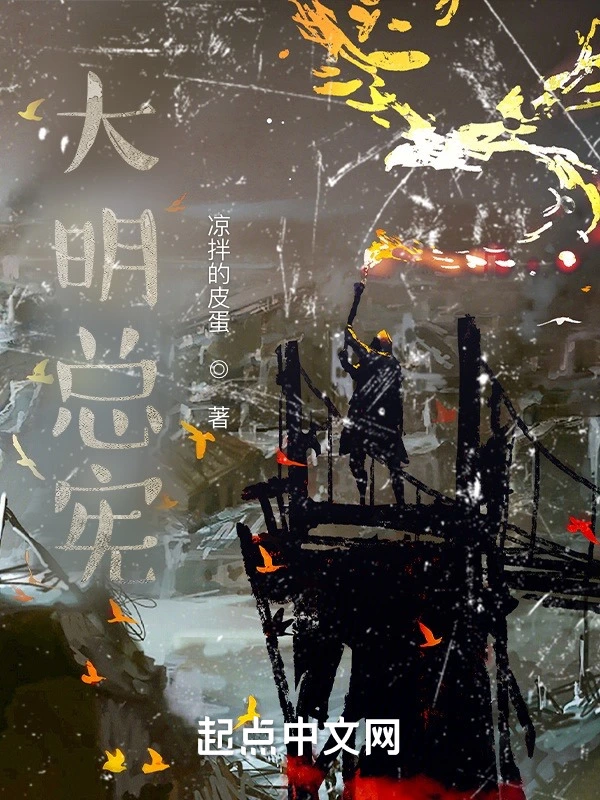
Ming Dynasty General Constitution
大明总宪
- Status
- Completed
- Length
- 659k Words
- Genre
- Historical
- Audience
- Male
- Subgenre
- Song-Yuan-Ming Dynasties
- Updated
- 1y ago
- Source
- Qidian
Stats
Tags
Synopsis
Reader comments
In booklists 9

Wild List, Book Shortage Can Be Read
Lv5 and masters who are on the road to high-quality products, and potential new books that are about to embark on the road to high-quality products.

Overcome Book Shortage
Some of the books I like are really good



Raise a Glass to the Bright Moon and Make Three People in the Shadows!
I like the afterglow of the sunset, but it will not always exist in front of my eyes because of my liking, but this does not affect my liking for it.
"Those Things About the Ming Dynasty" When Will the Bright Moon Come? Ask the Sky for Wine!
Book list focusing on various Ming Dynasty languages If you have relevant book recommendations, you can leave a message in the comment area

New Books Test Poison and Destroy Seedlings
Creative books always stand out among countless new books, not only because a good idea attracts attention, but also because creativity is the most intuitive expression of the concept of a new book, allowing readers to see the uniqueness of the book at a glance. The new book "Testing Poison" has different experiences from the past routines and writing methods.

Omnivore, I Personally Think This Book Is Well Written and Has a Good Plot. Please Give It a Thumbs up and Add It to Your Collection.
Not novice, not brainless, any new ideas in subject matter or writing style are welcome I haven't been able to find a book that suits my taste recently, so I haven't updated it for a long time. It takes me longer to look for books than to read them.
Recommended Relaxing and Interesting Articles
Recommend good articles that you have read. Recommended standards: It should be interesting, not dark, not depressing, and the writing should not be sloppy. The protagonist must have a charming personality, not be too pretentious, and reject the obscene style of a stallion harem. In addition to books that suit my personal taste, I also recommend books that are objectively good but do not suit my personal taste. Plagiarism is rejected. If there is plagiarism, it will be deleted immediately afte

Casual Book List
I only upload good books that I have read. If you have any good books, please leave a message.
Books That I Think Are OK
Just watch it for fun
Readers also read
 1914 Begins with the Rejection of the Schlieffen Plan
 In the Red Mansion: Escort Daiyu to Beijing at the Beginning
 Talker in the Song Dynasty
 Please Call Me Your Majesty the Tsar
 I Studied Abroad in Modern Times
 Why Were the Civil Servants in the Northern Song Dynasty so Bad?
 In the Late Ming Dynasty, I Pretended to Be a Descendant of Jianwen
 Daming: I, Yan Maoqing, Really Smoked
 My Portable Ming Court
 I Am Loyal to the Qing Dynasty
 Holy Ancestor Jiajing
 Taichang Daming
My humble opinion, the author can think about it. First, because the core plot of this article is seeking death, this thing must not be biased. Because it is seeking death rather than looking for death, the protagonist's behavior must at least be logical. The top standard for civil and military officials in ancient times was to fight to the death by admonishing civil servants and admonishing military officers. Yan Guan can be said to be the death squad among civil servants, so the protagonist's official position cannot be changed, and he must focus on the right path. The specific manifestation is to criticize the emperor, civil servants, nobles and feudal kings, speak the truth, and criticize anyone who is dissatisfied. By the way, it muddies the water of party struggle and harms the interests of all parties. At the same time, in order to ensure that he will not drag down the people around him, and that no one can protect him, he must be an independent man, not be able to make friends with anyone easily, not have a close relationship with Zhang Juzheng, and not be partial to the prince. As long as he has different political opinions, no one will dare to scold him. No political party can try to win over him, and no one can try to keep him. The second thing is that in Chapter 77, it is written that the male protagonist dreams that he returns to modern times and finds that he has not changed history. That makes me think that the male protagonist's current thinking may be that no matter what he does, the huge inertia of the wheel of history will eventually bring things back to their original trajectory. He cannot change everything that happened in the past. He is actually pessimistic about what he is doing now. So even if he has done so many actions to try to change history, he is just seeking death. He has no expectations of the added value of this matter. As long as I don't have hope, I will not be disappointed. But as a reader, I hope to see the male protagonist's thought process. Starting from keeping the prince alive and preventing foreign enemies from invading, to successfully opening the sea, taking back the Hetao area, and expanding the territory of the Ming Dynasty, let him see step by step that he actually changed the course of history, instead of just affecting the lives of a few people around him. As a little butterfly, he really stirred up a storm. While committing suicide, he longed to use his own life in exchange for a major turning point in history. He decided to do something for this dynasty before he died. This sudden second life should be vigorous, and his death should not be so slight, but more important than Mount Tai. I have always believed that Confucianism is the most romantic, and the life-long dream of scholar-bureaucrats is Hengqu's four sentences: "Establish a heart for the world, establish a destiny for the people, carry on the unique knowledge for the saints, and create peace for all generations." A person with conscience and who has studied history will not easily let go of the opportunity to change this matter after seeing the disaster of the entire century from 1840 to 1949. And who doesn't want to make a great contribution? The opportunity is now in front of him. Even if you lose and die, you can still go back to modern times and get high compensation, and you can make a sure profit without losing money. This is not a trade-off. It is no different from the Teenage Mutant Ninja Turtles. Third, is my small suggestion for the development of this book. The protagonist should start writing a book. No matter whether he can change history or not, he should at least struggle for a while. Because if you seek death, you might actually die one day, and you won't be able to accomplish what you want to accomplish. I feel that even if the protagonist does not transfer things like Ma Zhe, The Wealth of Nations, and Capital, and does not leave behind many science and technologies for later generations, he still needs to write down the many historical doubts he remembers about the Jiajing Dynasty and beyond, as well as the various problems that emerged in the late Ming Dynasty, and make simple evaluations and on-demand broadcasts from a God's perspective. Don't underestimate the political wisdom and historical foresight of the emperor and the civil and military officials of the Manchu Dynasty. Just like he discussed opening the sea with Zhang Juzheng before, they can understand the things behind many things with just a little reminder from you. Giving this book to the emperor or Zhang Juzheng before the death of the protagonist will definitely benefit them a lot, and even leave it as a family heirloom to future generations. Anyway, if you die, you can completely reveal part of the truth that you are a time traveler (of course, if there are restrictions from heaven, then just pretend that I didn't say it). The most important thing is to leave behind a world map and 🇬🇧development history. 🇬🇧Development history is the most suitable for the Ming Dynasty to learn from. Moreover, the name of the Empire on which the sun never sets was so popular during World War I. I don't believe that any ambitious and capable emperor would not be greedy. How tempting it is to "replace it with another". What happens after that has nothing to do with the protagonist, and the future generations will have to make their own way. In the end, whether it will be a constitutional monarchy like 🇬🇧, or a democratic republic like 🇺🇸, or whether it will still move towards communism in the end depends on the development. After all, "I won't care about the flood after I die." He will go back to enjoy peace and happiness. ,,,,
It is so well written. This is the most memorable Ming Dynasty text. Reform has never been that simple. It is too difficult for the protagonist to push the Ming Dynasty through the reform that should have lasted for more than a hundred years. The historical process is inevitable. This is the first online article that I didn't get angry when I saw the author, Eunuch. Instead, I understood it very well. It was too difficult to write later and it was very reasonable that I couldn't continue writing. I wanted to vote for all the monthly votes I had, but I could only vote for two. Are there any other similar historical texts to recommend? If the author opens a new book, I will definitely continue to support it.
Very well written😜😜😜
I don't have anyone in my family who is an official, so I can't write in such a depressed way 😏 There is a county party secretary in my family.
When I saw the introduction, I almost persuaded me to leave. After reading two chapters, I realized that it was actually quite well written.
It's written like a pig's feet. Also brought along Zhang Juzheng's second wife
I don't think this author is a novice and doesn't know whose source it is.
The Yuan Dynasty had the most prosperous overseas trade in Chinese history. The Yuan Dynasty government relied on this extra income to conquer Japan twice in a row, conquer Myanmar three times, violently assault Vietnam countless times, and even taught Indonesia a lesson thousands of miles away. It also conquered Thailand along the way. Such huge military expenditures not only did not bring down the domestic economy, but made all walks of life in the country prosper. This is what Marco Polo saw before leaving China. But not long after Marco Polo left, the economy of the Yuan Dynasty ran into problems. The first big problem was that as overseas trade became more and more prosperous, the income of the Yuan Dynasty government was getting lower and lower. When Kublai Khan was in power, the Yuan Dynasty government The government only levied a 10% tariff on luxury goods and a 5% tariff on general items, which was enough to fill the Yuan Dynasty's treasury. However, shortly after Kublai Khan left, the Yuan government doubled the tax, but the revenue was plummeting. What's going on? To understand this problem, we must first understand who is paying taxes in a society? We generally think that the wealthy class is the main source of national tax revenue, but the fact is exactly the opposite. No matter in which society, the wealthy class pays the least taxes. Why would Trump rather take the lawsuit to the Supreme Court than make his tax reports public? Why is Buffett ashamed to say that he pays more taxes than his secretary? Because no matter in any society, the wealthy class can always control more resources, so they can always pay the least taxes. The richest class in the United States basically do not pay taxes because they can always find loopholes in the policy. This is the so-called establishment of a charitable foundation, so Bill Gates donated all his assets, and Zuckerberg followed suit. We used to think that these two people were extremely noble, and we were moved to tears by their selfless feats. But now we all know that they are just to evade taxes. The real main force of taxation in American society is actually the less wealthy middle class. The same was true in the Yuan Dynasty. In the early days of the establishment of the Yuan Dynasty, the shipping industry of the Yuan Dynasty had a large number of small and medium-sized shipowners. They made money by transporting grain from the south to the north and overseas trade for the Yuan Dynasty government. However, due to their small capital and weak ability to resist risks, they would immediately go bankrupt if they encountered natural disasters. For example, it is recorded in "Da Yuan Shipping Records" that in the fourth year of the Great Yuan Dynasty, the small and medium-sized boat owners who undertook the transportation of grain from the south to the north were hit by a wind on the way and suffered sea damage. Not only were they unable to earn the freight of 11 taels and 5 yuan per stone, but they had to compensate for the official grain transported. In the end, they had to sell fifty-six ships with a total of 26,230 grain to compensate for the official debt. Not only are their ability to resist risks lower, but shipowners with smaller capital are also less able to establish government relations. Therefore, they pay higher operating costs than big businessmen during the business process, but their profits are much less than those of big businessmen. Of course, this is true in any country today. According to the records in Volume 6 of Yu Ji's "Ancient Records of Dao Yuanxue", "Two Envoys to Send Concubines to the Temple", the wealthy family's boat received a large amount of millet, and the commission was very generous, and it was half-realized to make profits from private goods; the middle-class family often bribed officials to seek exemption, while the lower-class boat households had to pay for grain in dangerous distances, and could not get good grain, so their boats often failed. Not only were they at a disadvantage in domestic trade, but even in overseas trade, they could not compare with big merchants. According to the records in Volume 4 of "Guangdong Customs Chronicle", the maritime merchants of the Yuan Dynasty were quite complex. They included not only ordinary merchants, but also princes and ministers, religious forces, and even queens. These people had great hands and eyes and could not pay taxes, so they had an absolute advantage in the competition. The Yuan Dynasty engaged in a free market economy, so after a period of survival of the fittest, the domestic and foreign trade of the Yuan Dynasty gradually concentrated in the hands of a small group of wealthy and powerful people. For example, "Historical History of the Yuan Dynasty" and "Ahema Zhuan" recorded that the powerful minister Ahema Zhang Hui "narrowed the power of the prime minister and served as a merchant to attract huge profits from all over the world." It is recorded in "Remaining Stories from the Farm" that Zhu Qing and Zhang Xuan, the great merchants who led 500 giant ships to surrender to the Yuan Dynasty at the end of the Southern Song Dynasty, by the middle of the Yuan Dynasty, had become "wealthy than the feudal lord, with jewels and goods worth tens of thousands of dollars." Capital will definitely form a monopoly, and this is true both at home and abroad in ancient and modern times. So, just like if you drive in the United States today, the gas stations, hotels, and places to eat that you see along the way are almost all chain stores. This situation is not only happening in the United States, but China today is also developing in this direction. In fact, this is an inevitable law of history. As long as capital reaches a certain level, it will inevitably be able to interfere in politics, so these rich people basically do not pay taxes. Therefore, as the overseas scale of the Yuan Dynasty became larger and larger, fewer and fewer people paid taxes, and the revenue of the national treasury began to plummet, so the government increased taxes. As a result, small and medium-sized businessmen went bankrupt, capital became more concentrated in the hands of large chaebols, and the government was even more stretched. Some people may wonder, is this caused by the corruption of the Yuan Dynasty government? Of course there is this reason, but even if the Yuan Dynasty government is not corrupt, big businessmen will not easily hand over money to the government. This has been the case from ancient times to the present. Do you know why Trump scolds Apple every day? Because they keep all their profits in Ireland and do not remit them to the United States, they do not pay taxes. Large companies have many capable people and many ways to evade taxes. Since the rich do not pay taxes, the country has no choice but to exploit the poor. The tariffs the country loses in overseas trade will have to be made up for in other industries, and a lot of new problems will arise. This brings up the second major problem of the Yuan Dynasty, the unprecedented scale of land annexation. What will a businessman do when he has money? Of course, they have to buy land. Previous dynasties also had land annexation issues, but they were usually very slow. Firstly, the landlords did not have much money, so it was difficult to make a fortune from farming. Secondly, it was also difficult for them to buy farmers' land. Unless there was a natural or man-made disaster, farmers would not easily sell their land. But the Yuan Dynasty was different. The Yuan Dynasty was a commercial society, so there were many rich people. That is to say, people in the Yuan Dynasty were not short of money. Secondly, the Yuan Dynasty was different from other dynasties. Farmers in the Yuan Dynasty planted a large number of cash crops, and the division of labor was very detailed. This made them particularly vulnerable to market fluctuations. So much so that if a butterfly flaps its wings thousands of miles away, the economy of the Yuan Dynasty will have a bad cold. After the middle period of the Yuan Dynasty, major changes took place in the world. The Ilkhanate established by the Mongols split, the Ottoman Turks rose, and the Black Death broke out in Europe. This caused the Sino-European trade routes to be often blocked, and demand in Europe dropped sharply. This in turn caused China's external exports to plummet, and overproduction actually occurred in the Yuan Dynasty. As a result, Dayuan had domestic problems. Handicraftsmen began to lose their jobs. Farmers who planted cash crops naturally went bankrupt. Land was quickly acquired by businessmen with large capital. This led to another problem. More and more industrial and commercial households and farmers who provided tax revenue to the country became bankrupt. The less, but the state's expenditure cannot be less, which forces the government to continuously increase taxes, which in turn leads to the bankruptcy of a large number of industrial and commercial households and farmers, and then causes a new round of land annexation, making it more difficult for the government to collect taxes, and is forced to raise taxes again, and then enters a vicious circle. Moreover, there were continuous rains when the house leaked. Natural disasters continued from the middle to the mid-Yuan Dynasty, resulting in a reduction in food production. The Yuan Dynasty was a society with a high degree of division of labor. There were particularly many people who were engaged in industry and commerce full-time, so people who ate commercial grains were also the same in all dynasties. However, the Yuan Dynasty was the era when the proportion of cash crops was the highest and the proportion of commercial grains was the smallest. Therefore, famines began to break out continuously from the middle period of the Yuan Dynasty. Zhu Yuanzhang's parents both starved to death because of this reason. Under the influence of these factors, after the mid-term of the Yuan Dynasty, a large number of refugees appeared. According to the records in "History of the Yuan Dynasty", because "rich households in the south of the Yangtze River invaded people's fields, causing the poor to become homeless", in the first year of the Da dynasty, there were more than 1.3 Million households in Jiangsu and Zhejiang alone. By the fourth year of the reign of Emperor Shun of the Yuan Dynasty, there were more than 5 million hungry people along the Yellow River, so it didn't take long for the Red Turban Army to revolt. So trade must bring benefits? Depends on who you ask! ! ! If we draw our vision back to the late Yuan Dynasty and look at it from Zhu Yuanzhang's perspective, without large-scale overseas trade, there would not be a large amount of commercial capital involved in national politics, causing corruption in the bureaucratic system, large-scale land annexation, and the collapse of the national tax system. If it collapses, there will not be a large number of refugees, there will not be a large number of people quitting their jobs to engage in handicrafts, and there will not be a large number of farmers to plant cash crops. In this way, a slight drought or flood will not trigger a large-scale famine, starving Zhu Yuanzhang's parents to death, causing him to rebel and directly destroy the country. So faced with so many unforgettable lessons, what should Zhu Yuanzhang do when he becomes emperor?
At first I thought it was a nonsensical type, but in the end the plot turned out to be quite interesting, and it also explained my own views on historical cases. I just can't bear it anymore, why would I just write such rubbish on the shelves? I hope I can get my subscription money back. Even though it's not much, I don't care. You can just find a charity to donate to. I just want to express my worthlessness, I don't understand what is written after it is put on the shelf? Emperor Jiajing is not even as good as Chongzhen, right? Emotional Jinyiwei is all a background board, right? Jiajing's decrees can't leave the imperial city, right? There is also a setting. Since the protagonist is going to die, why not just open the city gate or directly enter the palace? Also why not go directly to the emperor and tell him to flee south. Or simply force Jiajing to learn from Jingkang and bring the harem to peace talks? Finally, refund the money
This book friend is not revolutionary at all. He sympathizes with the emperor in the book every day and is worried about what happened to the revolution in the book. Let's not talk about the extremely short life span of workers in the early days of capitalism. Child labor basically did not survive for five years. It took more than a hundred years for the French Revolution. For a strong centralized country like China, if you want to overthrow the monarchy, you must wait until the Bolsheviks after the second-dimensional industrial revolution Putting aside these things, is revolution a bad thing? Shouldn't the feudal autocratic monarchy be overthrown? Shouldn't they be eliminated? It's too outrageous for you to empathize with an autocratic monarch.
The law of historical development must not be violated. The protagonist of the Jiangnan chapter is still too soft-hearted. Since he was exploited by Jiajing's short selling, capitalism will definitely not be able to stop it. We can't just want and want, and be thrown into jail at every turn. If it's too long, we should engage in party struggle fiercely. Only when we enter the cabinet can we have the right to speak. No one is invincible. I want to see blood flowing like a river.
I compared this book and dry skills again today. It's completely two directions. One is to look at the imperial court from the bottom up, from the local level, with the promotion and progress of ideology, culture, science and technology as the leading role. One is from top to bottom, from the court to the local governments, led by the implementation and results of changes and reforms in the court system. One writes that Jiajing is hopeless and needs to be pushed back to the beginning The other writes that Jiajing can still be saved and needs to be reformed One protagonist is smooth in everything One protagonist is strong and would rather die The most interesting thing is. The current plot. One is that the imperial court forced the people to plant mulberry trees to waste food. The other is that the people forced the court to grow mulberry and waste grain. There are a lot of complementarities among them, which is really interesting to watch at the same time.
I saw Chapter 100 today and I was confused, really confused. Did the author sell the book? Or has it become more popular? I can't understand the chapters after they are released. I don't know what the protagonist wants to do? What are you doing? Inside, from Jiajing, Yan Song, and Xu Jie to the passers-by and soldiers below, are they really big question marks? What are they doing? The plot is completely disconnected, the text has no preface and follow-up, and the protagonist simply disappears or does some inexplicable things. As soon as it was put on the shelves, the quality plummeted. How can I subscribe?
The first seventy-five chapters are about fairy grass, but the quality plummets in the following chapters. I won't comment on poisonous grass. I'll run it first.
The quality of the book has been declining since the protagonist was assassinated. I hope the author can adjust it. Now the protagonist is basically invisible. Regardless of whether it is a group portrait or not, if there is a protagonist, the story should revolve around the protagonist. But in the last ten or twenty chapters, it does not matter whether there is a protagonist or not 🤔
Don't read it after it's released, you'll be poisoned
I gave up reading. If you write a novel without writing about the protagonist, is it a group portrait novel? The author may have let himself go too far.
The author still writes in this way after it is published. Wait for it to hit the street. There are few updates and the plot is boring. It obviously relies on the protagonist to commit suicide to create conflict effects, but it is written from the perspective of passers-by. The protagonist is seriously injured and pushed offline to push Zhang Juzheng to show off. Who is the protagonist?
The last two chapters have destroyed all the goodwill I had accumulated in the past. If I continue to criticize for another two chapters, then I will go to the bookshelf to eat ashes first. I will just feed myself to death. It's not like I have no books to read.
An author with 640,000 words is considered Level 4. Some authors with millions of words are still Level 1. If it doesn't work, you can come back and let Jiajing kill the protagonist.
Damn eunuch! Get your money back! Get your money back! Get your money back!
Why do all the Great Ming Dynasties have to involve civil servant interest groups (derived from the Donglin Party conspiracy theory) that the scholar-bureaucrats have a modern political party. And the hidden idea behind it is that the emperor and nobles are good people, but the civil servants have done things wrong. There are so many papers criticizing it in the academic world, but they still focus on fighting against corrupt officials rather than against the emperor, and they reread the conspiracy of civil servants every day.
The ending of this book has actually been doomed for a long time. What kind of world is "The General Constitution of the Ming Dynasty" written about? It is not the official world in history. And based on the characters behind the original work "1566", the revolution set off by Ning Que will definitely usher in a low ebb. (The most important thing in "1566" is that it does not belong to a world that can be changed by just one person who turns on the death wish. . And it is obvious that Yan Shifan, Jiajing and others are all from the "1566" version. For example, Jiajing said "My money!" In advance, and Yan Shifan is not the one-eyed counselor in the official history, but the old Xiao Ge who was an official in the court in 1566. When his family was about to die, he couldn't recognize the form of the Jin Yiwei Zhu Qi, but he was stunned in the TV series and was smashed with his bare hands. The first pioneer, the fiery version of Yan Shifan who violently cursed and famously said "it hurts my head" before forcing Hu Zongxian to copy the resignation letter he wrote to Hu Zongxian before forcing Hu Zongxian to copy it, thought that Jiajing's Jin Yiwei was dead. Mr. Xiaoge actually shouted to Hu Zongxian in private, "The two capitals and thirteen provinces of the Ming Dynasty are carried on my shoulders." , Does it make Jiajing feel happy? It is not the world of official history, but according to the original work of this fan novel, the people of the Ming Dynasty were harmed by destroying embankments and flooding the fields, and Jiajing also knew this, but when Zhang Juzheng first learned about Hai Rui's ability, he talked about being righteous and righteous, but he refused to do anything to help Hai Rui solve his mother's problems. Tan Lun, the Minister of War who was waiting for Zhang Juzheng as his first assistant, would only flatter Zhang Juzheng and say, "I, Tan Lun, will have multiple mothers." (After Hai Rui died, he treated Hai Lao Niang as his biological mother. But what would he do? It just means letting Hai Rui charge. Tan Lun also tricked Hu Zongxian many times to do practical things in the anti-Japanese war, which made Hu Zongxian lament that "there are no real friends in the officialdom." ) Later, the empress Dowager Li and Princess Yu proposed that preparations should be made to bring Hai Rui's mother to Beijing to take care of her after she died. The expressions of Tan Lun, Zhang Juzheng and Wang Yu were: Ah Zhen... Princess, are you serious? This ending is doomed. If you don't recognize the enemy clearly, you can't kick Jiajing in the butt. Moreover, Jiajing's eldest son is destined to betray the protagonist later. After all, he will stand in that position. Then the protagonist is surrounded by enemies on all sides and cannot be defeated by God's insurance. Unless this is an immersive historical game like the Three-Body Game in "Three-Body", Ning Que is Wang Miaocao. It is the kind of game character that can die and be reborn multiple times to watch the revolution in other periods, like in Xuanjian, where the protagonist becomes an object and watches the revolution of several generations. The protagonist at the beginning of Sword of the Dawn waits for a hundred years (because of the early stage and the dangerous situation) for Ning Que to be resurrected and lead the mature revolution team to carry out the step of successful revolution.
I am pursuing two books at the same time. Both of them are about Jiajing and both have good results. Today I suddenly discovered that these two books are about social changes, but they are in two opposite directions. They are both very good. When I read Bo'er together recently, I suddenly felt a strange sense of complementarity. Quite interesting.
At first I thought it was a Le Zi article, but I didn't expect that the content involved in it was so profound. The smiles contained socio-economic, humanistic, philosophical and human nature. It was really a treasure.
There are three books. The one about Jiajing is covered in various layers, but in fact it is all about political strategy. There are all kinds of distractions at work, but I'm really not in the mood to watch them. The book is a good book, but...
Good books, no water, platinum resources. Left, right, and capital are not important. The most important thing is that the story is interesting.
It's quite beautiful, I've been watching it over and over again for so long
Curious? If you wrote Journey to the West, which character would Ning Que be? It can't be some monkey, right?
This is the first time to rank so high