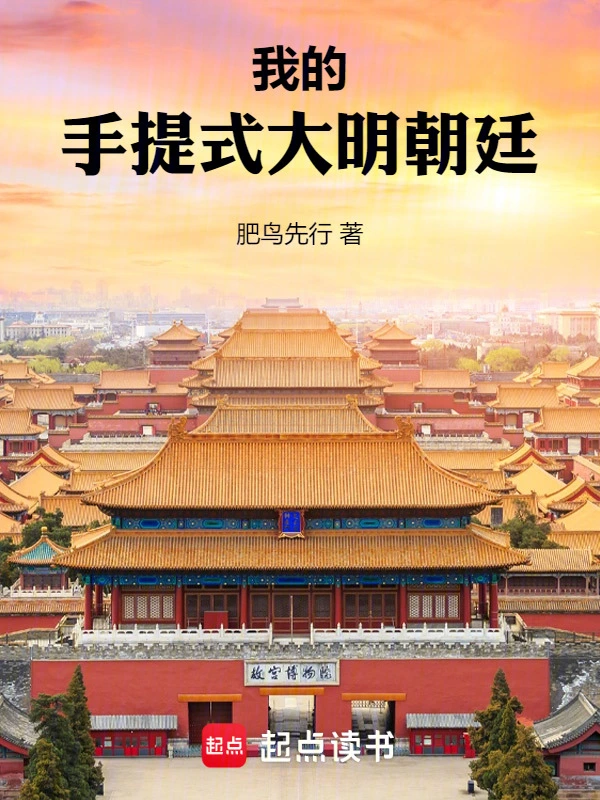
My Portable Ming Court
我的手提式大明朝廷
- Status
- Ongoing
- Length
- 4.1M Words
- Genre
- Historical
- Audience
- Male
- Subgenre
- Song-Yuan-Ming Dynasties
- Updated
- 17h ago
- Source
- Qidian
Stats
Tags
Honours
Synopsis
Reader comments
In booklists 22

515 Good Books Half Price: Week 3
[New discounted books are coming out one after another, 50% off on all purchases] [New time for good books in the book list: 6.1-6.7] [How to participate: Me → Activity Center → "New! The half-price masterpiece has been updated again"] [The discount launch time varies depending on the book, some discounts only last for 3 days, please stay tuned] [Click on my avatar to view more book lists]
Shenzhou Canglong Recommends Books
Learn it eruditely, examine it carefully, think it over carefully, discern it clearly, and practice it sincerely.
Flying Book List
Because they like online literature, love originality, and love online articles, there are many friends who write about the world by themselves. They like simple and clear articles and in-depth articles. I recommend articles that are useful and worth reading.

[Shennong Is Actually Myself]
🍀When will a good book come out? Ask the sky for wine. I don't know what year it is today. I want to ride the wind back home, but I am afraid that the more poisonous weeds will be cut off, and the book shortage will be overwhelming. When Shen Nong tasted hundreds of herbs, it seemed like he was in the human world. 🌙Turn around the Zhu Pavilion, look down at the Qihu, and the light will make you sleepless. There should be no hatred, so why are eunuchs so immortal? People have joys and sorrows, an

Yinglong's Black Library Is Open
This is a personal book list that uses love to promote new books and serial works. Completed books will be deleted after a period of time. Please watch and collect. Recently, there have been more and more fantasy writing about dragons, and I have found more interesting books. Recently, there have been more and more COC steampunks. I just found out today that many old authors have opened new books and continue to find their favorite books. The quality of new books in Qidian History District conti
Historical Time Travel Novels of Song, Yuan, Ming and Qing Dynasties
Novels that travel through the Song, Yuan, Ming and Qing dynasties
Book List I Read
Some daily books

Mainly Recommend Otherworld Novels and Love Dog Food Novels (Game Novels Are Also from Another World)
I haven't seen any good love dog food lately T^T Can you leave a message after you come in and get the book?⊙▽⊙ Ps: It's been a long time since I found a suitable book, I'm in tears.

Seedlings Chasing
Like a single name in a book~
"Crab's 25Th January Recommended Books"
Fattening: I only watched the beginning, not the rest. It's OK to read: It's an okay read Seedlings: New book, too few words Readable above, not full of grain and grass: good, but not amazing enough Dry Food: Great Books with Faults Grain and grass: good books Xiancao: the best book
Spare Bookshelf for Personal Bookshelf
Put some books that you have read, most of which are unfinished, so you can dig them out and read them again when there is a shortage of books. It is purely based on personal reading interests. If the style of the book list does not suit your taste, just change the book list. Why do you keep reading? If you don't like the style of the books on the list, just don't pay attention to them. I have read at least thirty chapters of each book in it.

Hongchen Bookstore
Twenty-year-old bookworm ginseng
History Book List, Mainly History.
Mainly history. Full Stars: Ten stars, you can watch it from one star to the next.
Kunlun Mirror
Some of my favorite books have both male and female protagonists, non-stallion, not ambiguous, and no CP. Mainly fantasy, fairy tales, ancient times, cities, interstellar, rebirth or time travel, Goldfinger is a must-have. I don't read suspense thrillers and gay stories, I don't like sadistic stories, well, I don't read all sadistic stories. In the midst of a book shortage, I beg you all to recommend some good novels.
Save the Book Famine, Lao Bai's Special Show! ! !
I personally recommend it as a bookworm of ten years. I have read every one of them myself. I guarantee that it will not be boring, cliche, or brainless. It will not be embarrassing, stupid, bland, or too cliche. I don't want any of them! Ps: I am more inclined to recommend niche themes, tight logic, and big ideas.


My Own Miscellaneous Books
Personal fattening


Focus on Relaxation, Online IQ, and Reasonable Plot Data
Personally, I have high requirements for the protagonist's character. You need to have a decent personality, act calmly, and not be a saint. Simply put, you should be a relatively rational and calm ordinary person. The plot should be reasonable and do not add contradictions for the climax of the novel, making this plot untenable. The plot should not be too tight, but should be tight and tight. The world setting must be logical, and the power system must have design content that is not just a sim
A Must-Read Book in Life
No regrets
Interesting Soul
The soul is dancing
Carefully Selected by Veterans
1. The writing style is good, only those who can write heartily will be accepted. The standard is very subjective, so please don't criticize; 2. Mainly those who are catching up on updates, and those who are too old will be too lazy to sort out; 3. The mediocre dry food will not be harvested, including the mediocre ones in the early stage and will be sorted out and eliminated later.

Shuangwen Secondary 2 Novels Collection
I usually list some novels that I like that don't have many problems with the protagonist, setting, and plot.
Mark
None
Readers also read
 After Lying in Bed for Three Years, He Was Forced to Help the Han Dynasty
 Red Mansion: Start Escaping and Farming from the Equipment Bar
 Fu Ming 1627
 Northern Qi, Sage Khan
 Siheyuan: Start by Picking up Attributes
 Daming: I, Yan Maoqing, Really Smoked
 I Was a Literary Giant in Ming Dynasty
 Immortal Who Seizes the Body
 Devouring the Starry Sky: Infinite Opportunities to Hoard Treasures at the Beginning
 Daming: Your Majesty, It's Time to Drink Medicine!
 No One Knows How to Save Daming Better Than Me
 I Was a Demon in the Northern Song Dynasty
 Stand-Alone Northern and Southern Dynasties
 There Was No War in the Northern Song Dynasty
 Rebuilding the Prosperous Tang Dynasty Starts with Calling Players
 My Life Skills in Daming Liver
Today you mention the Ming Dynasty, the day after tomorrow you mention the Qing Dynasty, then the Republic of China, and what do you mention after that?
The words are ugly, Erjia! ! ! ! Do you want to think about what you are writing? Do you want to look at the various test papers held in major collections? Your handwriting is ugly and you failed the first level. How can you still be in the top two? Believe it or not, someone immediately checked why your handwriting suddenly became ugly? ? ?
I thought the protagonist traveled through ancient times to rebel, but it turned out that a modern cow and horse traveled back to ancient times to work as slaves for people!
Author, don't you really want to go back and revise it?
The experiment in which a wooden ball and an iron ball fell to the ground at the same time. The original experiment was that a large iron ball and a small iron ball with different weights fell to the ground at the same time. Although the weights were different, the density of the large and small iron balls was the same, which was enough to offset the influence of air resistance. But your wooden ball and iron ball have different densities. If they can land at the same time, wouldn't it mean that if I take a foam ball and the iron ball can land at the same time? Feathers and iron balls can land at the same time in a vacuum, but can feathers and iron balls land at the same time in reality? The lower the density of an object, the greater the air resistance it will encounter when falling in reality... Author, you'd better go back and change it quickly.
Read Chapter 34
Identified as a good article, one proposal was passed, one was passed, and one was successful. The consequences and chain reactions were rarely written, and the deduction was not enough. I couldn't stand the drawing of lots from the golden urn. I took advantage of the civil strife and sent troops to fight. After winning, the decision was made. I don't expect it to be similar to history, but it needs to be written logically.
Abandoned in five chapters, the advantage is that the setting itself is automatically established when submitting the national policy. The disadvantages are constant small poisonous points. I really don't care about you saying that your writing is ugly, but you keep mentioning it. If you come up with a newcomer, mention it again. Colleagues, superiors, and even the emperor, everyone will tell you that your writing is ugly. I really can't stand it anymore. I don't know what this setting is used for, but if you mention it repeatedly, it is already disgusting readers. Just read it if you can accept it.
The protagonist is currently engaged in top-down reform, but which of these top-down reforms in history has been more or less successful? The protagonist is the paper-pastor, tinkering.
It feels like a purely streamlined account. The protagonist proposes a policy, everyone discusses and implements it, and then the results are released. If it is gone, the protagonist continues to come up with policies and repeats the above process.
The subject matter is interesting, but there are too many flaws. The writing level is average and mediocre. I like to write details but the details are my weak points. I am not happy enough and talk too much. You can read the book in the desert.
If the protagonist does not become the emperor, then the protagonist must carry out comprehensive changes that limit the emperor's rights. It is useless if the protagonist just copies the technology of later generations and adds a few reforms. If a country wants to produce a large number of original inventions and creations, it must carry out systematic changes in ideological foundation, political structure, legal system, social forces and other aspects. The reason why Britain was the first to enter the Industrial Revolution is that after experiencing the ideological changes of the European Renaissance, coupled with the British Glorious Revolution of 1688, the king's rights were further restricted. Britain established the framework of parliamentary sovereignty and the rule of law, and the bourgeoisie, the new aristocracy, and the king formed a check and balance, which allowed British civilians to gain unprecedented freedom. At this time, the degree of freedom of scholars, craftsmen, and farmers in Britain was higher than that of other European countries at the same time, and it was far more liberal than the civilians of China's Ming and Qing dynasties. The high degree of freedom of all British civilians fully inspired everyone's strength. The power of the Chinese emperor was not greatly restricted, and all officials, gentry and landlords were dependent on the imperial power. The freedom of civilians, who account for the vast majority of the country's population, is too low. This system inhibits innovation and hinders social development. China's Zhou Dynasty was a feudal system, and the central government could not control much of the local princes' affairs. The princes competed with each other. During this period, Chinese civilization truly allowed a hundred flowers to bloom. Most of the essence of Chinese civilization came from this period. During the Spring and Autumn Period and the Warring States Period, the "Mo Jing" recorded the principles of optics and mechanics, and the germination of geometry had emerged; the "Gan Shi Xing Jing" recorded astronomical observation data. But from the Qin Dynasty to the Qing Dynasty, there was almost no progress! The institutional innovation of the Spring and Autumn and Warring States periods stagnated after the Qin and Han Dynasties, lacking the ability to dynamically adjust. Since the Qin Dynasty, especially since the Han Dynasty deposed all schools of thought and only respected Confucianism, Chinese civilization has almost stood still and entered a dead end. The Zhou Dynasty and the Spring and Autumn Period and the Warring States Period were similar to the ancient systems of most European countries. They were all feudal systems. Even in successive years of war, less than 10% of the country's total population died directly or indirectly as a result of the war. But from the Qin Dynasty to the Qing Dynasty, every dynasty would kill half or more of the country's population due to war! What is even more tragic is that every time there is a change of dynasty, there is almost no progress in the system and culture! {"NickName":"Restriction and Supervision","UserId":417773267}
It is a book with some culture but not much. The author likes to write some small details, but many readers in the comment area have pointed out errors, such as about burning charcoal poisoning, brushing teeth with willow branches, and writing words that are not good enough to be admitted to the Imperial Academy. Personally, I suggest that it is better to write more clearly.
What a coincidence, it always has just enough prestige, what a coincidence.
How is it possible to go to court every day? Modern people don't hold meetings every day! Especially when your level is so high!
There are no big things that are too inkling, good things are all trivial and boring.
Virgin nanny protagonist
Blast furnaces, cannons, telescopes, soap... All are wanted by others, and the protagonist takes them out. You are really a good person without earning a penny. After the protagonist gets married, the family expenses will still be the woman's dowry! So invincible!
The most basic historical knowledge for popularizing science is that the Little Glacier is a global climate phenomenon, and Europe has also encountered it. China is very big, and there are natural disasters almost every year, and the disasters are no less than the Little Ice Age. The flintlock is a firearm invented in Europe during the same period of the Ming Dynasty. Copernicus, Galileo, and Newton were all Europeans during the same period of the Ming Dynasty. The Renaissance started in Europe in the early Ming Dynasty.
Don't you think it's strange that the handwriting is not good?
What mistakes are easy to make in historical novels❓
Before the Ming Dynasty, the emperor was not called "Emperor". In the Song Dynasty, he was mostly called "Guanjia", and in other dynasties, he was called "Your Majesty". In the Ming Dynasty, the emperor was occasionally called "Emperor", and in most cases he was called "Your Majesty". After Kangxi of the Qing Dynasty, people began to be generally called "Emperor". Princes and princes call themselves: Princes in the pre-Qin and Han Dynasties can be called "Gu", and a few can be called "Ignores". After the Wei, Jin, Southern and Northern Dynasties, the title of "Ignores" gradually became exclusive to the emperor, and princes, princes and princes can only be called "Gu" or "I". Song, Yuan and Ming called themselves "I" or "I". Before the Qing Dynasty, princes and princes rarely called themselves "this king". Starting from the Kangxi year of the Qing Dynasty, princes generally called themselves "this king". In ancient times, women called themselves: "nujia" was a modest name for women after the Song Dynasty. Women in the Han and Tang Dynasties more often called themselves "concubine", and noble women could call themselves "I" and "I". Before the mid-Ming Dynasty, most dynasties used copper coins for daily transactions, with very little gold and silver. It was only in the mid-to-late Ming Dynasty that silver became the mainstream currency. -In the late Ming Dynasty, "meeting votes/deposit checks" appeared among the people. There were no unified rules. Most of them were deposits and withdrawals/exchange receipts from acquaintances or local circulation, and were not legal currency. In the early years of Daoguang in the Qing Dynasty (1823): Rishengchang Bank was established, and private banks began to issue standardized banknotes, focusing on cross-regional exchange. They were only circulated in Shanxi merchant trade circles and major commercial ports, and were not yet popular. In the third year of Xianfeng in the Qing Dynasty (1853): the official issued the Ministry of Revenue official banknotes (official banknotes), which were forced to circulate nationwide. At the same time, the network of private banknotes expanded to the whole country, and official and private banknotes ran parallel. The use of banknotes entered an explosive period and became the "starting point of popularization." High-leg tables and chairs only completely replaced the low tables for sitting on the floor in the Song Dynasty. During the Han and Tang dynasties, people knelt and sat on the tables to eat and discuss matters. The furniture was mainly low tables and couches. The memorial system was only established during the Kangxi period of the Qing Dynasty. Officials in the Tang and Song Dynasties used "memorials", "tables" and "statements" when submitting memorials, while in the Ming Dynasty they used "memorials" and "memorials". There is no such thing as "memo" or "zhezi". In ancient formal occasions, the hand-over gesture was performed with the left hand outside and the right hand inside. The right hand outside was a special "unlucky gift" for funerals. "Better greetings" is a unique etiquette of the Qing Dynasty. It was mostly used by subordinates to superiors and juniors to elders. During the Tang and Song dynasties, people often performed cross-hand salutes and bows to greet greetings when they met, and there was no such thing as "sending greetings". {"NickName":"Restriction and Supervision","UserId":417773267} Before the Yuan Dynasty, subordinate officials rarely called superior officials "adult". In some dynasties, subordinates called eunuchs "adult", and in some dynasties, they called their parents and elders "adult". Beginning in the Yuan Dynasty, lower-level officials would occasionally call officials of second-rank and above "sir". From the middle and late Ming Dynasty, only officials of third-rank and above would be called "sir" by their subordinates. Officials with lower ranks could not be called "sir". However, in the late Ming Dynasty, there began to appear a few cases where officials above the fourth rank were called "adult". Before the mid-Qing Dynasty, following the rules of the Ming Dynasty, only officials of third rank or above would be called "adult". Starting from the mid-Qing Dynasty, calling officials "adult" gradually became common for lower-level officials. Attention! ! ! What is mentioned above is that lower-level officials refer to higher-level officials. No matter which dynasty, it is absolutely impossible for higher-level officials to call lower-level officials "sir". Some novels even write about emperors or nobles calling other officials "sir". This is simply contrary to Tiangang! ! ! Finally, let's talk about the problem of civilians calling officials Before the middle and late Qing Dynasty, civilians in various dynasties and generations called officials differently, and most of them called them "officials" and "masters". From the middle to late Qing Dynasty, civilians also called officials "adult".
I'm sick, I have to add a stupid setting with the word "ugly"
Run, run fast, the idea is good but there is a hidden defense inside.
Pure delay
Just like a fairy tale, who is the target audience of such a virtuous minister style? Place your wishes on a wise king and a good appearance. Such people will not have to live in their old age. I will sell you health care products now You can watch the Xie Xuan commentary version of "The Ming Dynasty 1566" and you can feel that the feudal system cannibalism is by no means an empty talk.
The title of the book is wrong. "My Portable Ming Dynasty Super Imperial Court" At first glance, I thought it was a real imperial court, so when I just read the title of the book, I was still thinking that the protagonist was holding a mini imperial court. Could it be that the actual content is about understanding the Ming Dynasty through this imperial court in modern society and revising the wrong history to create a more enjoyable novel? It is actually a petition deduction simulator, used to predict the results of petitions, and forcibly modify the results when the predicted results are not satisfactory. This book is unlucky and unlucky because of the plug-in that forced the letter to pass. If you want to advance, you must suppress first. If you want to create something exciting, you must have supporting characters who suppress the protagonist and problems that hinder the protagonist. This plug-in directly omits these. The author may think that it would be better to skip the suffering and enjoy the game directly, but we can see a clue from the gaming industry - it is difficult to find a game where a player can directly kill the game with one click and reach full level and full equipment after entering, and it is still very popular. When there is no suffering, those virtual gains have no meaning. So when the plug-ins in this book skip over the problems that should exist, the plot is basically the same as how the protagonist writes the letter, and how the Ming court in the book does it. Generally speaking, in a time-travel historical novel, this kind of plot will only appear in the later garbage stage with a low word count, which is used to harvest those novice readers who have never read historical novels and have no idea of the possible direction. So the final result is that the protagonist of this book almost gets his wish, but it is not that satisfying.
Is the author here?
It's very well written. I originally planned to read it later, but I've learned a lot recently and can't read the history category. The author might as well check something out, that is, "Silk Road Landscape Atlas" seems to have been returned to China in 2017. I suggest you start a new book. I like the writing style better, but the content is too different from history and I can't read it.
Issues found
The writing is too long, and the characters are inconsistent One performance in the front is followed by another It's weird to read them together.
Survival is the main body of life. Thought, spirit, material, civilization, and culture all serve survival. In the final analysis, survival is the continuation of genes. It must be made clear who is in charge and who is second. Unite the historical perspective to separate the beginning and the end. The historical view of unity is a system based on the theory of guilt of the dominant nation and the sacrifice of the interests of the dominant nation. How many Han people have no descendants and cannot continue their family lineage? You can't even talk about continuation. You still have to talk about unity, generosity to others, and generosity to future generations.
Nice
Although many knowledgeable brothers are not good at this or rigorous at that, I think it looks good! Already updated to the latest chapter
Changes in Su Ze's official status
1.25 Years old, Shujishi, no rank; 2.25 Years old, editor of Hanlin Academy, seventh rank; 3.25 Years old, Zuo Chunfang Zuo Zanshan, from sixth rank; 4.25 Years old, Zuo Chunfang Zuo Zhongyun, the sixth rank; 5.26 Years old, Wailang, the official secretary of Shandong Qing Dynasty in the Ministry of Household Affairs (from the fifth rank), Zuo Zhongyun of Zuo Chunfang, an official in Japan, and the lecturer of the East Palace; 6.26 Years old, Zuo Shuzi of Zhan Shifu (the fifth rank) ), Wailang, a member of the Shandong Qing Li Department of the Ministry of Household Affairs, an official on the day, and a lecturer in the East Palace; 7.28 Years old, you Tongyi (from the fourth rank) of the Secretary of General Affairs, the left concubine of Zhan Shifu, an official on the day, a lecturer in the East Palace; 8.30 Years old , Zhongshu Jianzhengguan (zhengsi 4th grade), Riyaoguan, East Palace Lecturer; 9.33 Years old, Minister of the Ministry of Personnel (zhengsanzhengzhengzheng), Rijiaoguan; 10.35 Years old, Libu Shangshu (zhengzhengzhengzhengzhi), Rijiaoguan.
It's not right that the Cossacks appeared in the Northeast in the early Wanli period, right?
In the early Wanli period of 1582, the Cossacks were still helping Tsarist Russia to fight against the Siberian Khanate east of the Ural Mountains. It was still far to the northeast.
Technology is developing rapidly, but top talent selection has not kept pace. What we are cultivating is more technicians. At present, we don't see the soil where Gauss and Newton can be cultivated.
It feels like you are riding on the heat of Corpse Disaster 1644.