Library
Browse and search novels
25,832 novels found
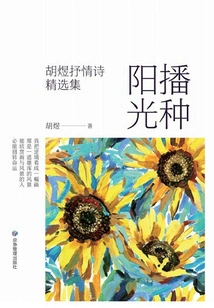
播种阳光:胡煜抒情诗精选集
Hu Yu
This book is a selection of the author's works from 1982 to 2017, with rich objects and profound artistic conception. It expresses some of the author's insights on life, including the exploration of lost youth and human nature, as well as the perception of future time and life. Each poem embodies the author's poetic concepts and aesthetic attainments.
This book is a selection of the author's works from 1982 to 2017, with rich objects and profound artistic conception. It expresses some of the author's insights on life, including the exploration of lost youth and human nature, as well as the perception of future time and life. Each poem embodies the author's poetic concepts and aesthetic attainments.
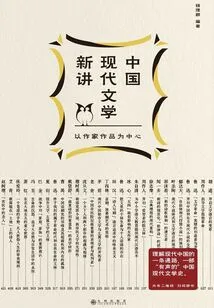
中国现代文学新讲
Compiled By Qian Liqun
One way to open up modern China is to open up modern literature. As part of the "Qian Liqun Modern Literature Course" series, this "New Lectures on Modern Chinese Literature" is essentially a "Qian Liqun's New History of Modern Chinese Literature". It uses the "Thirty Years of Modern Literature" development context as the basic framework, selects 45 writers and more than 60 works, and uses a close reading of the text to return to the starting point and origin of literary reading, literary education and literary history research, and return to literature itself - whether "new edition" or "new lecture", the "new" lies in "centering on writers and works". A basic fact: the edifice of literary history is mainly supported by writers, especially great writers and classic writers; and the main value expression of a writer is the text of his work. Without the two basic elements of writers and works, there would be no literary history. Since the birth of the magazine "New Youth" in the 1910s, modern literature has gone through enlightenment, construction, and in-depth development for thirty years, and its fire is endless. There are not only "Lu (Xun), Guo (Moruo), Mao (Dun), Ba (Jin), Lao (She), Cao (Yu)", but also Zhou Zuoren, Zhu Ziqing, Shen Congwen, Feng Zhi, Xiao Hong , Zhang Ailing, Ai Qing, Zhao Shuli, Ding Ling, Qian Zhongshu, Fei Ming, Mu Dan, Wang Zengqi... The entire history of modern literature is a history of the soul of modern Chinese people. It is a history of modern writers as modern Chinese people and modern Chinese intellectuals, making inner and aesthetic responses to the changes and shifts in Chinese society. Research questions and input academic theories. As the main author of "Thirty Years of Modern Chinese Literature", an advocate and practitioner of the concept of "big literary history", and a senior historian of modern Chinese literature - Professor Qian Liqun of the Department of Chinese at Peking University, this "New Lectures" is his 100th book. He was written in a nursing home when he was over 80 years old. It is also the "final work" of Qian Liqun's literary history writing series. He said it still only had "defective value." He also said that education without literature and people's lives without literature would lose their "soul" and would lead to a spiritual crisis for the nation.
One way to open up modern China is to open up modern literature. As part of the "Qian Liqun Modern Literature Course" series, this "New Lectures on Modern Chinese Literature" is essentially a "Qian Liqun's New History of Modern Chinese Literature". It uses the "Thirty Years of Modern Literature" development context as the basic framework, selects 45 writers and more than 60 works, and uses a close reading of the text to return to the starting point and origin of literary reading, literary education and literary history research, and return to literature itself - whether "new edition" or "new lecture", the "new" lies in "centering on writers and works". A basic fact: the edifice of literary history is mainly supported by writers, especially great writers and classic writers; and the main value expression of a writer is the text of his work. Without the two basic elements of writers and works, there would be no literary history. Since the birth of the magazine "New Youth" in the 1910s, modern literature has gone through enlightenment, construction, and in-depth development for thirty years, and its fire is endless. There are not only "Lu (Xun), Guo (Moruo), Mao (Dun), Ba (Jin), Lao (She), Cao (Yu)", but also Zhou Zuoren, Zhu Ziqing, Shen Congwen, Feng Zhi, Xiao Hong , Zhang Ailing, Ai Qing, Zhao Shuli, Ding Ling, Qian Zhongshu, Fei Ming, Mu Dan, Wang Zengqi... The entire history of modern literature is a history of the soul of modern Chinese people. It is a history of modern writers as modern Chinese people and modern Chinese intellectuals, making inner and aesthetic responses to the changes and shifts in Chinese society. Research questions and input academic theories. As the main author of "Thirty Years of Modern Chinese Literature", an advocate and practitioner of the concept of "big literary history", and a senior historian of modern Chinese literature - Professor Qian Liqun of the Department of Chinese at Peking University, this "New Lectures" is his 100th book. He was written in a nursing home when he was over 80 years old. It is also the "final work" of Qian Liqun's literary history writing series. He said it still only had "defective value." He also said that education without literature and people's lives without literature would lose their "soul" and would lead to a spiritual crisis for the nation.
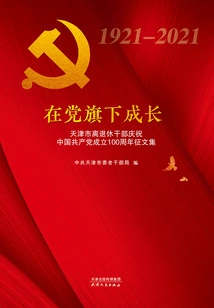
在党旗下成长:天津市离退休干部庆祝中国共产党成立100周年征文集
Bureau Of Veteran Cadres Of Tianjin Municipal Committee Of The Communist Party Of China
This book is a collection of essays. In order to warmly celebrate the 100th anniversary of the founding of the Communist Party of China and fully demonstrate the ardent passion of retired veteran comrades to love the party, patriotism, and love socialism, the Municipal Party Committee Veteran Cadres Bureau and the Municipal Party Committee Branch Life Society jointly launched an essay collection activity among retired cadres in the city on "The most unforgettable thing about growing up under the party." This book is a collection of articles from this essay competition. This book collects and summarizes 100 excellent essay works, in the form of prose, essays, poems, etc., Through one red story after another, recalling one's own combat experience, party membership story, growth story, learning insights, etc., Praising the great achievements of the founding of the party over the past century, and expressing the true feelings of love for the party and patriotism.
This book is a collection of essays. In order to warmly celebrate the 100th anniversary of the founding of the Communist Party of China and fully demonstrate the ardent passion of retired veteran comrades to love the party, patriotism, and love socialism, the Municipal Party Committee Veteran Cadres Bureau and the Municipal Party Committee Branch Life Society jointly launched an essay collection activity among retired cadres in the city on "The most unforgettable thing about growing up under the party." This book is a collection of articles from this essay competition. This book collects and summarizes 100 excellent essay works, in the form of prose, essays, poems, etc., Through one red story after another, recalling one's own combat experience, party membership story, growth story, learning insights, etc., Praising the great achievements of the founding of the party over the past century, and expressing the true feelings of love for the party and patriotism.
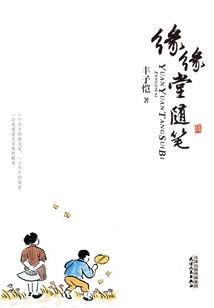
Yuanyuantang Essays
Literature缘缘堂随笔
Feng Zikai
"Yuanyuantang Essays" is Mr. Feng Zikai's main prose selection. Feng Zikai is a famous local cartoonist and essayist in the history of modern Chinese painting and literature. He was born in Shimen Bay, Tongxiang County, Zhejiang Province in 1898, and lived there for seventeen spring and autumn years. The customs and customs of his hometown left an indelible impression on him. The book is full of cartoons with rich local customs, meaningful prose with clear language and profound meaning, and supplemented by the unique natural features of Jiangnan water towns, it will make friends who love water town literature feel heartstrings and feel warm after reading it.
"Yuanyuantang Essays" is Mr. Feng Zikai's main prose selection. Feng Zikai is a famous local cartoonist and essayist in the history of modern Chinese painting and literature. He was born in Shimen Bay, Tongxiang County, Zhejiang Province in 1898, and lived there for seventeen spring and autumn years. The customs and customs of his hometown left an indelible impression on him. The book is full of cartoons with rich local customs, meaningful prose with clear language and profound meaning, and supplemented by the unique natural features of Jiangnan water towns, it will make friends who love water town literature feel heartstrings and feel warm after reading it.
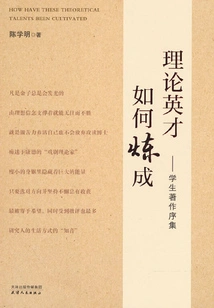
理论英才如何炼成:学生著作序集
Chen Xueming
This book is a compilation of prefaces written by teacher Chen Xueming for his students. Teacher Chen has made great achievements in the field of Marxist philosophy and is a representative figure in this field. Most of his students are also engaged in philosophical research and have become leaders among young scholars. The characteristic of this collection of prefaces is that Teacher Chen wrote the preface as a student tutor, and the books on which the preface is based are all written by his students. These prefaces were written affectionately by Teacher Chen and contain two parts: first, introducing the students' situation, including family and academic aspects. Secondly, I introduce the value of this book, which contains Teacher Chen's academic views. These prefaces can not only show his care for students, but also reflect his deep affection for philosophy and his dedication to provide academic guidance for academic juniors. They are very beneficial and inspiring to young students and student mentors.
This book is a compilation of prefaces written by teacher Chen Xueming for his students. Teacher Chen has made great achievements in the field of Marxist philosophy and is a representative figure in this field. Most of his students are also engaged in philosophical research and have become leaders among young scholars. The characteristic of this collection of prefaces is that Teacher Chen wrote the preface as a student tutor, and the books on which the preface is based are all written by his students. These prefaces were written affectionately by Teacher Chen and contain two parts: first, introducing the students' situation, including family and academic aspects. Secondly, I introduce the value of this book, which contains Teacher Chen's academic views. These prefaces can not only show his care for students, but also reflect his deep affection for philosophy and his dedication to provide academic guidance for academic juniors. They are very beneficial and inspiring to young students and student mentors.
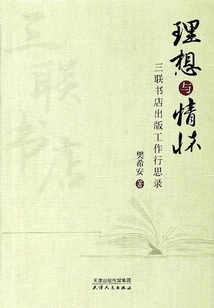
理想与情怀:三联书店出版工作行思录
Fan Xian
This book is a collection of essays. This book is divided into five series: "Three Links of Heart", "Aspirations for Good Books", "Deeds Depend on Human Resources", "Sentiments in All Directions" and "Examples", and contains a total of 78 articles. The whole book shows what the author experienced, saw, thought, and felt while working in Sanlian Bookstore. The article discusses one issue and one policy. The language is vivid and lively, with a sense of the scene and a reading appeal. The content in the book condenses practical publishing experience, systematically demonstrates the author's original intention of publishing, and can be used as a reference for news and publishing practitioners. It also includes some articles commemorating the predecessors of Sanlian and the older generation of publishing workers, which better presents the publishing brand of Sanlian Bookstore to readers, sets a benchmark for the publishing industry, and can also enlighten and inspire the majority of readers.
This book is a collection of essays. This book is divided into five series: "Three Links of Heart", "Aspirations for Good Books", "Deeds Depend on Human Resources", "Sentiments in All Directions" and "Examples", and contains a total of 78 articles. The whole book shows what the author experienced, saw, thought, and felt while working in Sanlian Bookstore. The article discusses one issue and one policy. The language is vivid and lively, with a sense of the scene and a reading appeal. The content in the book condenses practical publishing experience, systematically demonstrates the author's original intention of publishing, and can be used as a reference for news and publishing practitioners. It also includes some articles commemorating the predecessors of Sanlian and the older generation of publishing workers, which better presents the publishing brand of Sanlian Bookstore to readers, sets a benchmark for the publishing industry, and can also enlighten and inspire the majority of readers.
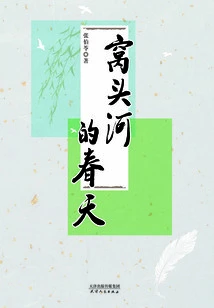
Spring in Wotou River
Literature窝头河的春天
Zhang Boling
"Spring at Wotou River" is a collection of essays by the author. The collected essays record his observations and thoughts on life, with themes about family affection, nostalgia, mission, celebrity interviews, anti-epidemic, and creative process. Zhang Boling's collection of essays has a strong autobiographical nature. Each of his essays contains real experiences, real characters, real scenes, and real emotions. He rose from the basis of reality to rational perception, from the scenes around him to the ideal pursuit of the country's cause, from regional phenomena to the spirit of the times, from personal work to organizational behavior, from the subtle to the big realm, and achieved a subtle understanding of the matter, the form is dispersed but the spirit is not dispersed. This is a work that reflects the growth process of rural grassroots cultural cadres. It is of great practical significance and is worthy of publication.
"Spring at Wotou River" is a collection of essays by the author. The collected essays record his observations and thoughts on life, with themes about family affection, nostalgia, mission, celebrity interviews, anti-epidemic, and creative process. Zhang Boling's collection of essays has a strong autobiographical nature. Each of his essays contains real experiences, real characters, real scenes, and real emotions. He rose from the basis of reality to rational perception, from the scenes around him to the ideal pursuit of the country's cause, from regional phenomena to the spirit of the times, from personal work to organizational behavior, from the subtle to the big realm, and achieved a subtle understanding of the matter, the form is dispersed but the spirit is not dispersed. This is a work that reflects the growth process of rural grassroots cultural cadres. It is of great practical significance and is worthy of publication.
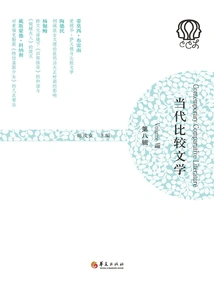
当代比较文学(第八辑)
Editor-in-chief Chen Rongnu
"Contemporary Comparative Literature" is a collection of journals on the field of comparative literature research. The purpose of this book is to present the research hot spots and cutting-edge discussions of comparative literature and world literature in recent years, and to grasp the pulse of discipline integrity and innovation in the new era. The eighth volume has columns such as "Comparative Literature and Said", "Cross-Cultural Drama: Content and Form", "Research on the Relations between Chinese and Japanese Modern Literature", "New Translation of Classics", "Classics Research", "Classics and Interpretation", and "Book Reviews". The themes covered by the essays and translations in this collection cover a long time span, from ancient Greece to 20th century comparative literary theory. The space involved is also extremely broad, with China, Japan, Europe, etc. All involved. In this volume, translations still occupy a large proportion, including analysis of Said's academic contribution, Hooke's classic work "On the Political Consequences of the Reformation", and research on the exchange of modern literary ideas between China and Japan.
"Contemporary Comparative Literature" is a collection of journals on the field of comparative literature research. The purpose of this book is to present the research hot spots and cutting-edge discussions of comparative literature and world literature in recent years, and to grasp the pulse of discipline integrity and innovation in the new era. The eighth volume has columns such as "Comparative Literature and Said", "Cross-Cultural Drama: Content and Form", "Research on the Relations between Chinese and Japanese Modern Literature", "New Translation of Classics", "Classics Research", "Classics and Interpretation", and "Book Reviews". The themes covered by the essays and translations in this collection cover a long time span, from ancient Greece to 20th century comparative literary theory. The space involved is also extremely broad, with China, Japan, Europe, etc. All involved. In this volume, translations still occupy a large proportion, including analysis of Said's academic contribution, Hooke's classic work "On the Political Consequences of the Reformation", and research on the exchange of modern literary ideas between China and Japan.
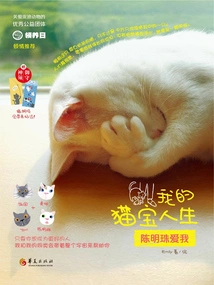
我的猫宝人生:陈明珠爱我
Drawing By Emily
Cats and cats continue to love and kill each other, and humans and cats continue to fall in and out of love. There is no limit to loving cats. Only by loving cats can you know how to love yourself. Emily, a cat baby suffering from severe cat dependence, is hopeless. How much do you love cats? After installing a webcam and monitoring obsessively 24 hours a day, I discovered that the cat really slept for 20 hours a day without moving. I started to miss my cat after three or four days of traveling away from home. The spotless hotel with no cat hair did not feel like home at all because of the absence of the cat. Have you ever done a moral test? If you speak kind words to rice every day, it will slow down the rate at which it gets moldy. How would your cat's attitude change if he was showered with compliments all day long? Anyway, Meimi, who is sensitive and loves to hide from others, listens to "flattery" all day long, and gradually likes to show up in front of others. What would happen if she was a giant cat and I was a little human, and the roles of human and cat were reversed? The giant cat monster will probably do whatever he wants, like forcing your cat to wear a grapefruit hat. What if your cat could talk? Does it talk sweetly to you or complain to you? Is it moving to tears, or is it like listening to a stand-up comedy and making you burst into laughter? When you love to the extreme, your imagination will wander. Living with cats, every day is full of wonderful thoughts. Two people, four cats, life is difficult but luckily there is love floating in the universe.
Cats and cats continue to love and kill each other, and humans and cats continue to fall in and out of love. There is no limit to loving cats. Only by loving cats can you know how to love yourself. Emily, a cat baby suffering from severe cat dependence, is hopeless. How much do you love cats? After installing a webcam and monitoring obsessively 24 hours a day, I discovered that the cat really slept for 20 hours a day without moving. I started to miss my cat after three or four days of traveling away from home. The spotless hotel with no cat hair did not feel like home at all because of the absence of the cat. Have you ever done a moral test? If you speak kind words to rice every day, it will slow down the rate at which it gets moldy. How would your cat's attitude change if he was showered with compliments all day long? Anyway, Meimi, who is sensitive and loves to hide from others, listens to "flattery" all day long, and gradually likes to show up in front of others. What would happen if she was a giant cat and I was a little human, and the roles of human and cat were reversed? The giant cat monster will probably do whatever he wants, like forcing your cat to wear a grapefruit hat. What if your cat could talk? Does it talk sweetly to you or complain to you? Is it moving to tears, or is it like listening to a stand-up comedy and making you burst into laughter? When you love to the extreme, your imagination will wander. Living with cats, every day is full of wonderful thoughts. Two people, four cats, life is difficult but luckily there is love floating in the universe.
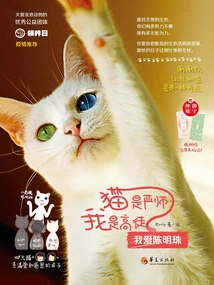
猫是严师,我是高徒:我爱陈明珠
Drawing By Emily
Emily is a timid and conscientious scavenger who is always at the bottom of the family. No cat is afraid of her even if she roars intolerable. Together with her fellow tenant, Ms. Jiang, she lives with four cats with different personalities: Tovi, Fantuan, Meimi, and Chen Mingzhu. While she devotedly served the four teachers at home who had many demands, she also learned the philosophy of life from them and constantly reflected on where she had not served them well enough. The stray cat Chen Mingzhu was picked up from the street. The reason why she was named Mingzhu was because she hoped that the name would bring her hope of life. She was about three months old when she was picked up. She was malnourished, skinny, with sparse hair, respiratory infections, asthma, skin diseases, gastrointestinal problems, a belly full of worms, unable to make a sound, and rotten teeth that were so rotten that her gums would break into black bones. Next... She was dying, full of stench, and full of diseases. Doctors thought she wouldn't live long, but under the careful care of Emily and Miss Jiang, she stubbornly transformed into a sexy actress and Instagram celebrity, and was loved by three thousand people. On the one hand, she is lively and considerate, optimistic and strong, and does everything she can to please others by acting coquettishly and cutely; on the other hand, she is wreaking havoc at home all day long, picking fights, bullying her brothers and sisters, being naughty, arrogant, unscrupulous, and shameless. But Emily learned that people who make people feel warm and calm, interesting and make people laugh will be welcomed wherever they go.
Emily is a timid and conscientious scavenger who is always at the bottom of the family. No cat is afraid of her even if she roars intolerable. Together with her fellow tenant, Ms. Jiang, she lives with four cats with different personalities: Tovi, Fantuan, Meimi, and Chen Mingzhu. While she devotedly served the four teachers at home who had many demands, she also learned the philosophy of life from them and constantly reflected on where she had not served them well enough. The stray cat Chen Mingzhu was picked up from the street. The reason why she was named Mingzhu was because she hoped that the name would bring her hope of life. She was about three months old when she was picked up. She was malnourished, skinny, with sparse hair, respiratory infections, asthma, skin diseases, gastrointestinal problems, a belly full of worms, unable to make a sound, and rotten teeth that were so rotten that her gums would break into black bones. Next... She was dying, full of stench, and full of diseases. Doctors thought she wouldn't live long, but under the careful care of Emily and Miss Jiang, she stubbornly transformed into a sexy actress and Instagram celebrity, and was loved by three thousand people. On the one hand, she is lively and considerate, optimistic and strong, and does everything she can to please others by acting coquettishly and cutely; on the other hand, she is wreaking havoc at home all day long, picking fights, bullying her brothers and sisters, being naughty, arrogant, unscrupulous, and shameless. But Emily learned that people who make people feel warm and calm, interesting and make people laugh will be welcomed wherever they go.
缪斯之灵:荷马史诗导读
Cheng Zhimin
"Spirit of the Muses - An Introduction to Homer's Epic" uses unique insights to carefully interpret and sort out Homer's own ideological image and the history of his epic, and analyzes the content structure, text body and metaphorical classical political philosophy of Homer's two epics, "The Iliad" and "The Odyssey". This book "Spirit of the Muse - An Introduction to Homer's Epic" is an introductory book written by the author who has been deeply involved in the study of Homer's epic and has devoted many years of painstaking efforts. It is written in simple language for many students. It explains clearly the ideological portrait of Homer's epic in the length of a book. The author once taught Homer studies courses in colleges and universities and used this book as a teaching material. Even today, the mission of this book remains timeless, and Homer's epic is still looking forward to its younger generation of readers. As the author admits frankly, this book still retains the "ambition" of his youth: "All great dreams must be implemented and based on detailed work. To put it more bluntly, the author's ambition is to attract more young people to enter classical thinking, to participate in grand events, and to join hands together. Not only can everyone (first let themselves) learn from each other, but it may also slightly change the spirit of the times."
"Spirit of the Muses - An Introduction to Homer's Epic" uses unique insights to carefully interpret and sort out Homer's own ideological image and the history of his epic, and analyzes the content structure, text body and metaphorical classical political philosophy of Homer's two epics, "The Iliad" and "The Odyssey". This book "Spirit of the Muse - An Introduction to Homer's Epic" is an introductory book written by the author who has been deeply involved in the study of Homer's epic and has devoted many years of painstaking efforts. It is written in simple language for many students. It explains clearly the ideological portrait of Homer's epic in the length of a book. The author once taught Homer studies courses in colleges and universities and used this book as a teaching material. Even today, the mission of this book remains timeless, and Homer's epic is still looking forward to its younger generation of readers. As the author admits frankly, this book still retains the "ambition" of his youth: "All great dreams must be implemented and based on detailed work. To put it more bluntly, the author's ambition is to attract more young people to enter classical thinking, to participate in grand events, and to join hands together. Not only can everyone (first let themselves) learn from each other, but it may also slightly change the spirit of the times."
Song of Self-improvement (volume 2019)
Literature自强之歌(2019年卷)
Chief Editor Of China Disabled Persons' Federation
In order to actively promote humanitarian ideas, carry forward the national spirit of continuous self-improvement and the good custom of helping the disabled, and encourage disabled people to become self-reliant. In 1991, the Propaganda Department of the CPC Central Committee, the Ministry of Civil Affairs, the Ministry of Personnel, the General Political Department of the People's Liberation Army, the All-China Federation of Trade Unions, the Central Committee of the Communist Youth League, the All-China Women's Federation, and the China Disabled Persons' Federation hosted the first national commendation conference for self-improvement models and advanced collectives and individuals in helping the disabled. This commendation meeting has been held six times so far. In 2019, the Ministry of Human Resources and Social Security and the China Disabled Persons' Federation selected 167 self-improvement models nationwide, including Jin Zhanpeng and Du Fuguo, and commended them at the Sixth National Self-Reliance Model and Advanced Recognition Conference for Disabled Persons held on May 16. This book selects 36 national self-improvement models, interviews and reports on their advanced deeds, and compiles them into the 2019 volume of "Songs of Self-Improvement".
In order to actively promote humanitarian ideas, carry forward the national spirit of continuous self-improvement and the good custom of helping the disabled, and encourage disabled people to become self-reliant. In 1991, the Propaganda Department of the CPC Central Committee, the Ministry of Civil Affairs, the Ministry of Personnel, the General Political Department of the People's Liberation Army, the All-China Federation of Trade Unions, the Central Committee of the Communist Youth League, the All-China Women's Federation, and the China Disabled Persons' Federation hosted the first national commendation conference for self-improvement models and advanced collectives and individuals in helping the disabled. This commendation meeting has been held six times so far. In 2019, the Ministry of Human Resources and Social Security and the China Disabled Persons' Federation selected 167 self-improvement models nationwide, including Jin Zhanpeng and Du Fuguo, and commended them at the Sixth National Self-Reliance Model and Advanced Recognition Conference for Disabled Persons held on May 16. This book selects 36 national self-improvement models, interviews and reports on their advanced deeds, and compiles them into the 2019 volume of "Songs of Self-Improvement".
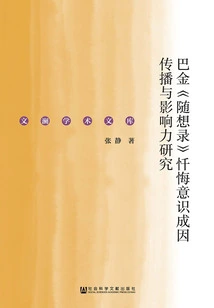
巴金《随想录》忏悔意识成因传播与影响力研究
Zhang Jing
The reason why Ba Jin's "Random Thoughts" is known as "the pinnacle of China's contemporary literary world" is that it is a big book that "tells the truth" with "power, emotion, and warmth that penetrates the back of the paper." "Give your heart to the readers" is the most obvious embodiment of Ba Jin's way of "expressing true feelings". The internal communication influence of "Random Thoughts" lies in criticizing "ultra-left" ideological trends and enlightening the souls of Chinese people; sincere confession saves people's hearts, and literature saves the world and society. The external communication influence of Ba Jin's "Random Thoughts" lies in the fact that the study of Ba Jin's works has become an effective medium for the mutual dissemination of Chinese and foreign cultures.
The reason why Ba Jin's "Random Thoughts" is known as "the pinnacle of China's contemporary literary world" is that it is a big book that "tells the truth" with "power, emotion, and warmth that penetrates the back of the paper." "Give your heart to the readers" is the most obvious embodiment of Ba Jin's way of "expressing true feelings". The internal communication influence of "Random Thoughts" lies in criticizing "ultra-left" ideological trends and enlightening the souls of Chinese people; sincere confession saves people's hearts, and literature saves the world and society. The external communication influence of Ba Jin's "Random Thoughts" lies in the fact that the study of Ba Jin's works has become an effective medium for the mutual dissemination of Chinese and foreign cultures.
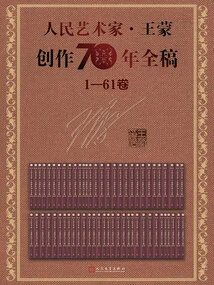
人民艺术家·王蒙创作70年全稿(1—61卷)
Wang Meng
Wang Meng is nearly 90 years old and his creative career is coming to an end. "People's Artist: Complete Works of Wang Meng's 70 Years of Creation" is a comprehensive summary of Wang Meng's creative achievements, and is also a side note on the history of contemporary literature, politics, and cultural thought. "People's Artist - Complete Manuscripts of Wang Meng's 70 Years of Creation" includes 12 novels, 2 series of novels, 1 volume of poetry, 5 studies of "Dream of Red Mansions", and 11 interpretations of ancient Chinese cultural classics such as "The Analects", "Mencius", "Laozi", "Zhuangzi", "Xunzi" and "Liezi" There are about 3 million words of short stories and short stories, about 1.5 Million words of essays, about 1.5 Million words of literary theory, creative theory and criticism, and about 2.5 Million words of speeches and other transcripts. There are also about 600,000 words of endorsements and suggestions (articles and constructive opinions published in a public capacity), etc. After the work, important information such as "Chronology of Wang Meng's Literature", "Summary of Wang Meng's Main Works" and "Summary of Wang Meng's Research Papers" are attached.
Wang Meng is nearly 90 years old and his creative career is coming to an end. "People's Artist: Complete Works of Wang Meng's 70 Years of Creation" is a comprehensive summary of Wang Meng's creative achievements, and is also a side note on the history of contemporary literature, politics, and cultural thought. "People's Artist - Complete Manuscripts of Wang Meng's 70 Years of Creation" includes 12 novels, 2 series of novels, 1 volume of poetry, 5 studies of "Dream of Red Mansions", and 11 interpretations of ancient Chinese cultural classics such as "The Analects", "Mencius", "Laozi", "Zhuangzi", "Xunzi" and "Liezi" There are about 3 million words of short stories and short stories, about 1.5 Million words of essays, about 1.5 Million words of literary theory, creative theory and criticism, and about 2.5 Million words of speeches and other transcripts. There are also about 600,000 words of endorsements and suggestions (articles and constructive opinions published in a public capacity), etc. After the work, important information such as "Chronology of Wang Meng's Literature", "Summary of Wang Meng's Main Works" and "Summary of Wang Meng's Research Papers" are attached.
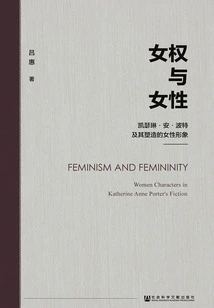
女权与女性:凯瑟琳·安·波特及其塑造的女性形象
Lu Hui
Katherine Ann Porter is one of the representative writers of Southern literature, an important literary genre in the history of American literature, and one of the important writers in the history of American female literature. This book selects 24 of Porter's 26 short stories and short stories and only one female character in one novel for analysis, studies the author's literary representation of the gender identity of these female characters in different contexts, and comprehensively explores the vastness, complexity, diversity, and individuality of Porter's representation of female gender identity.
Katherine Ann Porter is one of the representative writers of Southern literature, an important literary genre in the history of American literature, and one of the important writers in the history of American female literature. This book selects 24 of Porter's 26 short stories and short stories and only one female character in one novel for analysis, studies the author's literary representation of the gender identity of these female characters in different contexts, and comprehensively explores the vastness, complexity, diversity, and individuality of Porter's representation of female gender identity.
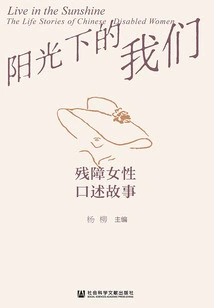
阳光下的我们:残障女性口述故事
Editor-in-chief Yang Liu
This book is one of the few books in China that records the life stories of women with disabilities. The book involves 20 women with disabilities. They live in different cities, have different ages, have different disabilities, and have different life experiences. From middle-aged women who experienced the early days of China's reform and opening up, to college students who received the first batch of integrated education in the country in the early 20th century, to those who went abroad to study. Disabled scholars; from entrepreneurs with dreams, to community store managers who live in small towns, to hard-working frontline social workers engaged in disability causes, to happy mothers who return to their families, each story reflects the trajectory of changes in Chinese society and reflects the development and change process of today's Chinese society.
This book is one of the few books in China that records the life stories of women with disabilities. The book involves 20 women with disabilities. They live in different cities, have different ages, have different disabilities, and have different life experiences. From middle-aged women who experienced the early days of China's reform and opening up, to college students who received the first batch of integrated education in the country in the early 20th century, to those who went abroad to study. Disabled scholars; from entrepreneurs with dreams, to community store managers who live in small towns, to hard-working frontline social workers engaged in disability causes, to happy mothers who return to their families, each story reflects the trajectory of changes in Chinese society and reflects the development and change process of today's Chinese society.
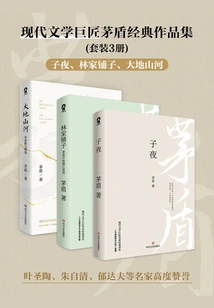
现代文学巨匠茅盾经典作品集(套装3册)
Mao Dun
This set includes "Midnight", "Lin's Shop: Selected Novels and Novels by Mao Dun", and "Mountains and Rivers of the Earth: Selected Prose by Mao Dun". "Midnight" is a novel that vividly depicts characters from all walks of life such as businessmen, soldiers, educated youths, socialites, elderly people, workers, etc. It reflects the face of Chinese society when the revolution developed in depth around 1930 and sparked a prairie fire. "Lin's Shop: Selected Novels and Novels by Mao Dun" uses the story of Lin's Shop from struggle to bankruptcy to outline a picture of the exploitation and oppression of small business practitioners in the old society of the 1930s, reflecting the background and social tragedy of the time. "The Great Land, Mountains and Rivers: Selected Prose by Mao Dun" contains more than 60 essences of Mao Dun's lifelong prose, including "Praise to Poplars", "Skylight", "Reminiscences of Xian Xinghai", "The Great Land, Mountains and Rivers", "Winter", etc. Some of the chapters have been selected as Chinese textbooks for primary and secondary schools and are literary classics that accompany the growth of a generation.
This set includes "Midnight", "Lin's Shop: Selected Novels and Novels by Mao Dun", and "Mountains and Rivers of the Earth: Selected Prose by Mao Dun". "Midnight" is a novel that vividly depicts characters from all walks of life such as businessmen, soldiers, educated youths, socialites, elderly people, workers, etc. It reflects the face of Chinese society when the revolution developed in depth around 1930 and sparked a prairie fire. "Lin's Shop: Selected Novels and Novels by Mao Dun" uses the story of Lin's Shop from struggle to bankruptcy to outline a picture of the exploitation and oppression of small business practitioners in the old society of the 1930s, reflecting the background and social tragedy of the time. "The Great Land, Mountains and Rivers: Selected Prose by Mao Dun" contains more than 60 essences of Mao Dun's lifelong prose, including "Praise to Poplars", "Skylight", "Reminiscences of Xian Xinghai", "The Great Land, Mountains and Rivers", "Winter", etc. Some of the chapters have been selected as Chinese textbooks for primary and secondary schools and are literary classics that accompany the growth of a generation.
曾有天真少年时
Zhang Xiaoci
This book selects 12 representative poets of the Song Dynasty, mainly based on their life experiences, accompanied by the appreciation of more than a hundred poems, to create this feast of Song poetry that is as beautiful as jade and tastes delicious. Such as Su Shi, who is full of flowers; Xin Qiji, who takes pictures of the railings; Ouyang Xiu, who wears hairpins; Qin Guan, who is loved by everyone; Liu Yong, who is despised; Li Qingzhao, the best among flowers; rebellious girl Zhu Shuzhen... Observe the lives of the ancients from a modern perspective, understand the hardships they were trapped in the times, and admire their persistence in daring to break through themselves.
This book selects 12 representative poets of the Song Dynasty, mainly based on their life experiences, accompanied by the appreciation of more than a hundred poems, to create this feast of Song poetry that is as beautiful as jade and tastes delicious. Such as Su Shi, who is full of flowers; Xin Qiji, who takes pictures of the railings; Ouyang Xiu, who wears hairpins; Qin Guan, who is loved by everyone; Liu Yong, who is despised; Li Qingzhao, the best among flowers; rebellious girl Zhu Shuzhen... Observe the lives of the ancients from a modern perspective, understand the hardships they were trapped in the times, and admire their persistence in daring to break through themselves.
Explosion
Literature炸裂志
Chen Nianxi
"Explosion" is Chen Nianxi's masterpiece of poetry and his most important work as a "miner's poet". It contains 153 of his poems, from the turbulent life in the mines to the urban survival in Pi Village, Beijing, and covers his difficult explosions Working life, there are also his daily thoughts that combine humanistic imagery and historical nostalgia. The openness and desolation, care and compassion, present a person who is closest to the land. The poems written with a weather-beaten pen have not given up even if they are pushed by fate in various ways. "I spent my middle age at a depth of five thousand meters/I exploded the rock formations again and again/Through this/I reassembled my life." The weight of each word struck down contains tremendous power.
"Explosion" is Chen Nianxi's masterpiece of poetry and his most important work as a "miner's poet". It contains 153 of his poems, from the turbulent life in the mines to the urban survival in Pi Village, Beijing, and covers his difficult explosions Working life, there are also his daily thoughts that combine humanistic imagery and historical nostalgia. The openness and desolation, care and compassion, present a person who is closest to the land. The poems written with a weather-beaten pen have not given up even if they are pushed by fate in various ways. "I spent my middle age at a depth of five thousand meters/I exploded the rock formations again and again/Through this/I reassembled my life." The weight of each word struck down contains tremendous power.
Ground Food (translation Classic)
Literature地粮(译文经典)
H
Gide's passionate spiritual monologues, winner of the Nobel Prize for Literature, are regarded as "the Bible of a restless generation." Gide unreservedly condensed the truest emotions in his heart into a long and affectionate poem, translated by Sheng Chenghua, an expert on Gide's works. "Food from the Earth" is a series of poetic fragmentary thoughts written by Gide in a lyrical way, combining traditional short poems, odes, melody and other forms after he traveled to North Africa and Italy. He senses the flowers and fruits of life with his fiery soul, and turns this sincere love into carols and poetry.
Gide's passionate spiritual monologues, winner of the Nobel Prize for Literature, are regarded as "the Bible of a restless generation." Gide unreservedly condensed the truest emotions in his heart into a long and affectionate poem, translated by Sheng Chenghua, an expert on Gide's works. "Food from the Earth" is a series of poetic fragmentary thoughts written by Gide in a lyrical way, combining traditional short poems, odes, melody and other forms after he traveled to North Africa and Italy. He senses the flowers and fruits of life with his fiery soul, and turns this sincere love into carols and poetry.
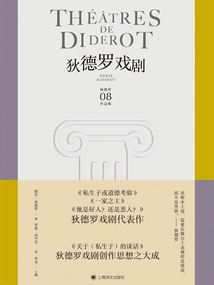
狄德罗戏剧(狄德罗文集08)
H
What needs to be expressed on the stage is the situation, not the character. The masterpiece of drama by Diderot, the outstanding French Enlightenment thinker, is the culmination of Diderot's drama creation thoughts. "The Dramas of Diderot" is the eighth volume of the "Collected Works of Diderot" and contains three representative works of Diderot's plays - "The Bastard or the Test of Morality", "Head of the Family" and "Is He a Good Man?" Or a villain? ", And a talk about theater - "A Talk About." Among them, "The Bastard" tells the story of Dorval, an illegitimate son who was invited by Clavier and his sister to stay at their home. During this period, Doval fell deeply in love with Clavier's fiancée Rosalie, and was tortured by his conscience for this. "A Conversation About" explains Diderot's thoughts on drama creation through the dialogue and debate between Doval and Diderot, the male protagonists of "The Bastard". Diderot's "serious drama" - "People cannot always be happy without pain, so there must be a middle ground between comedy and tragedy" - advocates no longer focusing on myths and historical legends, but getting the source of life from the joys and sorrows of ordinary people.
What needs to be expressed on the stage is the situation, not the character. The masterpiece of drama by Diderot, the outstanding French Enlightenment thinker, is the culmination of Diderot's drama creation thoughts. "The Dramas of Diderot" is the eighth volume of the "Collected Works of Diderot" and contains three representative works of Diderot's plays - "The Bastard or the Test of Morality", "Head of the Family" and "Is He a Good Man?" Or a villain? ", And a talk about theater - "A Talk About." Among them, "The Bastard" tells the story of Dorval, an illegitimate son who was invited by Clavier and his sister to stay at their home. During this period, Doval fell deeply in love with Clavier's fiancée Rosalie, and was tortured by his conscience for this. "A Conversation About" explains Diderot's thoughts on drama creation through the dialogue and debate between Doval and Diderot, the male protagonists of "The Bastard". Diderot's "serious drama" - "People cannot always be happy without pain, so there must be a middle ground between comedy and tragedy" - advocates no longer focusing on myths and historical legends, but getting the source of life from the joys and sorrows of ordinary people.
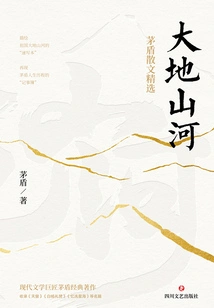
大地山河:茅盾散文精选
Mao Dun
This book contains more than 60 essences of prose by Mao Dun, a master of modern literature, including "Praise to Poplars", "Skylight", "Remembering Xian Xinghai", "Mountains and Rivers of the Earth", "Winter", etc. Some of the chapters have been selected as Chinese textbooks for primary and secondary schools and are literary classics that accompany the growth of a generation. Mao Dun's prose has formed a distinctive narrative method. He is good at using narrative techniques of using objects to express emotions and using reality to set off imaginary. His writing is delicate, profound and powerful. This book is both a "sketchbook" depicting the mountains and rivers of the motherland and a "notebook" reproducing Mao Dun's life history. It fully demonstrates Mr. Mao Dun's profound literary attainments and is a rare treasure in modern Chinese prose.
This book contains more than 60 essences of prose by Mao Dun, a master of modern literature, including "Praise to Poplars", "Skylight", "Remembering Xian Xinghai", "Mountains and Rivers of the Earth", "Winter", etc. Some of the chapters have been selected as Chinese textbooks for primary and secondary schools and are literary classics that accompany the growth of a generation. Mao Dun's prose has formed a distinctive narrative method. He is good at using narrative techniques of using objects to express emotions and using reality to set off imaginary. His writing is delicate, profound and powerful. This book is both a "sketchbook" depicting the mountains and rivers of the motherland and a "notebook" reproducing Mao Dun's life history. It fully demonstrates Mr. Mao Dun's profound literary attainments and is a rare treasure in modern Chinese prose.
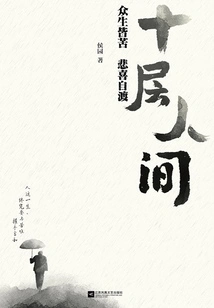
Tenth Floor Human Room
Literature十层人间
Hou Yuan
Some people live in high-rise buildings, some live in deep ditches; some are radiant, and some are covered in rust; some are free, relaxed and romantic, and some make a living and support their families with a heavy burden... There are smooth roads and ravines in the world. Living on the tenth floor of the human world, who has not encountered this charming and torturous life? Among these encounters, there is a father who drove a big car into a ditch three times and had to die to stay alive; a mother who was suddenly seriously ill and did not want to spend money for treatment and almost killed herself by drinking pesticide; ; There are villagers who dare not go out to work with their families and their monthly income is less than 1,000 yuan; there are people on the edge of the city who carry the darkness and walk between buildings, for survival, responsibility, and for a distant future... They are born broken and can only repair them while living. They may spend their whole lives cleaning up the messy life, but they still choose to walk toward the light and live upward. The mud plow is also the sign of all living beings, and the confusion in the ten directions will be opened from now on. The road of the world is rough, whether it is sweet or bitter may only depend on a thought between you and me.
Some people live in high-rise buildings, some live in deep ditches; some are radiant, and some are covered in rust; some are free, relaxed and romantic, and some make a living and support their families with a heavy burden... There are smooth roads and ravines in the world. Living on the tenth floor of the human world, who has not encountered this charming and torturous life? Among these encounters, there is a father who drove a big car into a ditch three times and had to die to stay alive; a mother who was suddenly seriously ill and did not want to spend money for treatment and almost killed herself by drinking pesticide; ; There are villagers who dare not go out to work with their families and their monthly income is less than 1,000 yuan; there are people on the edge of the city who carry the darkness and walk between buildings, for survival, responsibility, and for a distant future... They are born broken and can only repair them while living. They may spend their whole lives cleaning up the messy life, but they still choose to walk toward the light and live upward. The mud plow is also the sign of all living beings, and the confusion in the ten directions will be opened from now on. The road of the world is rough, whether it is sweet or bitter may only depend on a thought between you and me.
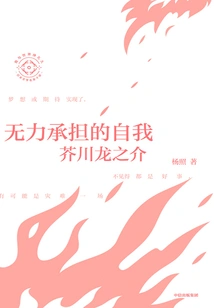
The Unbearable Self: Ryunosuke Akutagawa (ten Lectures by Famous Japanese Literary Masters 03)
Literature无力承担的自我:芥川龙之介(日本文学名家十讲03)
Yang Zhao
The standard-bearers of literature in the 20th century were also laggards of their respective eras. "Classic Reader" Yang Zhao's ten-lecture series on Japanese literary masters: Using literature, listen to their struggles and answers. Yang Zhao, the "classic reader" of this volume × Ryunosuke Akutagawa, "the ruthless writer who faces the world squarely": When a dream or expectation comes true, it may not always be a good thing, it may be a disaster. Ryunosuke Akutagawa is one of the most cosmopolitan among modern Japanese writers. From "Rashomon", which transcends tradition, to "Hell Transformation", which shows the magic of art, and crazy writing that is far away from daily life, such as "Kappa" and "Gear", reading his works is like being in the labyrinth of human nature, standing on the opposite side of the natural, to explore the chaos and confusion that neither reason nor sense can reach, but that modern life has to face and deal with. What he repeatedly shows in his works is how people who are deeply penetrated by "human feelings and principles" completely confuse the external and internal aspects of themselves. Many times people simply don't know what their true feelings and thoughts are, and what their performance is in line with the expectations of others in the outside world. Only in a few moments of sudden inspiration do people suddenly gain insight into the complex psychological operations of others, or suddenly understand their own subtle thoughts. And those moments of inspiration are what Akutagawa believes the novel should capture.
The standard-bearers of literature in the 20th century were also laggards of their respective eras. "Classic Reader" Yang Zhao's ten-lecture series on Japanese literary masters: Using literature, listen to their struggles and answers. Yang Zhao, the "classic reader" of this volume × Ryunosuke Akutagawa, "the ruthless writer who faces the world squarely": When a dream or expectation comes true, it may not always be a good thing, it may be a disaster. Ryunosuke Akutagawa is one of the most cosmopolitan among modern Japanese writers. From "Rashomon", which transcends tradition, to "Hell Transformation", which shows the magic of art, and crazy writing that is far away from daily life, such as "Kappa" and "Gear", reading his works is like being in the labyrinth of human nature, standing on the opposite side of the natural, to explore the chaos and confusion that neither reason nor sense can reach, but that modern life has to face and deal with. What he repeatedly shows in his works is how people who are deeply penetrated by "human feelings and principles" completely confuse the external and internal aspects of themselves. Many times people simply don't know what their true feelings and thoughts are, and what their performance is in line with the expectations of others in the outside world. Only in a few moments of sudden inspiration do people suddenly gain insight into the complex psychological operations of others, or suddenly understand their own subtle thoughts. And those moments of inspiration are what Akutagawa believes the novel should capture.
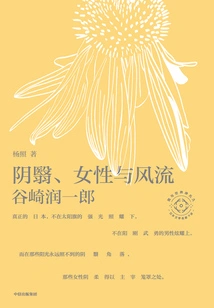
Shadow, Women and Romance: Junichiro Tanizaki (ten Lectures by Famous Japanese Literary Masters 02)
Literature阴翳、女性与风流:谷崎润一郎(日本文学名家十讲02)
Yang Zhao
The standard-bearers of literature in the 20th century were also laggards of their respective eras. "Classic Reader" Yang Zhao's ten-lecture series on Japanese literary masters: Using literature, listen to their struggles and answers. This volume's "classic reader" Yang Zhao × "the aesthetic master hidden in the corner of the great era" Junichiro Tanizaki: Writing all the way without echoing any era is his most remarkable achievement. From the "demonist" fantasy writing to the classical aesthetics of "Snow", passion that is not accepted and should not exist under collective standards will not really disappear from human reality. This is Tanizaki's basic creative attitude in his 50-year writing career. He spent 30 years and translated "The Tale of Genji" three times, which inspired him to create a unique "shadow aesthetic" writing, and then created a lifetime classic work "Snow". When the whole society was forced to sing for war, in his writing, the daughters of the Makoka family still cared about love, singing and dancing, catching fireflies, and admiring flowers. Are war, bushido, militarism, etc. Really more representative of Japan and closer to the Japanese people than their lives?
The standard-bearers of literature in the 20th century were also laggards of their respective eras. "Classic Reader" Yang Zhao's ten-lecture series on Japanese literary masters: Using literature, listen to their struggles and answers. This volume's "classic reader" Yang Zhao × "the aesthetic master hidden in the corner of the great era" Junichiro Tanizaki: Writing all the way without echoing any era is his most remarkable achievement. From the "demonist" fantasy writing to the classical aesthetics of "Snow", passion that is not accepted and should not exist under collective standards will not really disappear from human reality. This is Tanizaki's basic creative attitude in his 50-year writing career. He spent 30 years and translated "The Tale of Genji" three times, which inspired him to create a unique "shadow aesthetic" writing, and then created a lifetime classic work "Snow". When the whole society was forced to sing for war, in his writing, the daughters of the Makoka family still cared about love, singing and dancing, catching fireflies, and admiring flowers. Are war, bushido, militarism, etc. Really more representative of Japan and closer to the Japanese people than their lives?
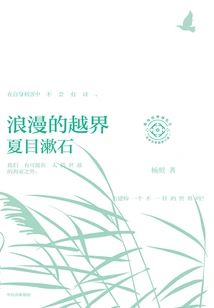
浪漫的越界:夏目漱石(日本文学名家十讲01)
Yang Zhao
The standard-bearers of literature in the 20th century were also laggards of their respective eras. "Classic Reader" Yang Zhao's ten-lecture series on Japanese literary masters: Using literature, listen to their struggles and answers. Yang Zhao, the "classic reader" of this volume, × Natsume Soseki, the translator of the word "romance": Life is not easy, and it is difficult wherever you go. Is it possible for us to build a different world outside of the constraints of human society? From "I Am a Cat" to the unfinished work "Light and Dark", Natsume Soseki created 15 novels in just over ten years. Each work has different styles and characteristics, but they are all about the wrestling and confrontation between "human feelings" and "inhuman feelings". This also points to the collective confusion of an era. After the Meiji Restoration, the "modernity" of rapid Westernization did not bring the expected freedom to Japan, and traditional human ethics still fully enveloped individual lives. Over time, people lose their self, are unable to behave without social roles, and do not know who they are or where they are. Therefore, Soseki, who was determined to fight against the trend, used protagonists with "inhuman" qualities to illustrate that there are no established boundaries and there is no so-called "normal". People have the freedom and potential to choose. The standard answer of this era can only be faced and decided by oneself.
The standard-bearers of literature in the 20th century were also laggards of their respective eras. "Classic Reader" Yang Zhao's ten-lecture series on Japanese literary masters: Using literature, listen to their struggles and answers. Yang Zhao, the "classic reader" of this volume, × Natsume Soseki, the translator of the word "romance": Life is not easy, and it is difficult wherever you go. Is it possible for us to build a different world outside of the constraints of human society? From "I Am a Cat" to the unfinished work "Light and Dark", Natsume Soseki created 15 novels in just over ten years. Each work has different styles and characteristics, but they are all about the wrestling and confrontation between "human feelings" and "inhuman feelings". This also points to the collective confusion of an era. After the Meiji Restoration, the "modernity" of rapid Westernization did not bring the expected freedom to Japan, and traditional human ethics still fully enveloped individual lives. Over time, people lose their self, are unable to behave without social roles, and do not know who they are or where they are. Therefore, Soseki, who was determined to fight against the trend, used protagonists with "inhuman" qualities to illustrate that there are no established boundaries and there is no so-called "normal". People have the freedom and potential to choose. The standard answer of this era can only be faced and decided by oneself.
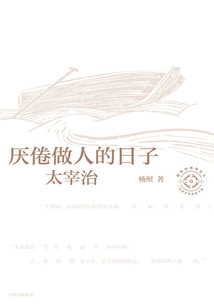
厌倦做人的日子:太宰治(日本文学名家十讲05)
Yang Zhao
The standard-bearers of literature in the 20th century were also laggards of their respective eras. "Classic Reader" Yang Zhao's ten-lecture series on Japanese literary masters: Using literature, listen to their struggles and answers. This volume's "classic reader" Yang Zhao × "the unusual libertine in the literary world" Dazai Osamu: How should a turbulent soul that cannot be classified into a framework be placed? The 26-year-old Osamu Dazai was shortlisted for the first "Akutagawa Prize", but was opposed by the judge Kawabata Yasunari: "This does not seem to be a work written by an author who lives a decent life." Dazai Osamu retorted: "Raising birds and watching Butoh, is it called a 'decent life'?" This "undecent" writer committed suicide three times and committed suicide five times, and his various debaucheries can be found in his final work "Disqualification in the World". However, what "Disqualification in the World" really explores is not how a person loses the qualification to be a human being. It forces us to reflect back on the "human world" including ourselves: What exactly do we pursue in life, and where are we going? Osamu Dazai's consistent contribution is to pierce our comfortable protective layer and unearth the experiences and feelings of people we are unfamiliar with, giving us the opportunity to review whether we lack sufficient understanding of the diversity and complexity of people, so that we self-centeredly regard the phenomenon of people who are different from ourselves as bad, terrible, and dark. Darkness is not just darkness, darkness may be more content and richer than light. When we are willing to admit this, we begin to truly know people. --Yang Zhao.
The standard-bearers of literature in the 20th century were also laggards of their respective eras. "Classic Reader" Yang Zhao's ten-lecture series on Japanese literary masters: Using literature, listen to their struggles and answers. This volume's "classic reader" Yang Zhao × "the unusual libertine in the literary world" Dazai Osamu: How should a turbulent soul that cannot be classified into a framework be placed? The 26-year-old Osamu Dazai was shortlisted for the first "Akutagawa Prize", but was opposed by the judge Kawabata Yasunari: "This does not seem to be a work written by an author who lives a decent life." Dazai Osamu retorted: "Raising birds and watching Butoh, is it called a 'decent life'?" This "undecent" writer committed suicide three times and committed suicide five times, and his various debaucheries can be found in his final work "Disqualification in the World". However, what "Disqualification in the World" really explores is not how a person loses the qualification to be a human being. It forces us to reflect back on the "human world" including ourselves: What exactly do we pursue in life, and where are we going? Osamu Dazai's consistent contribution is to pierce our comfortable protective layer and unearth the experiences and feelings of people we are unfamiliar with, giving us the opportunity to review whether we lack sufficient understanding of the diversity and complexity of people, so that we self-centeredly regard the phenomenon of people who are different from ourselves as bad, terrible, and dark. Darkness is not just darkness, darkness may be more content and richer than light. When we are willing to admit this, we begin to truly know people. --Yang Zhao.
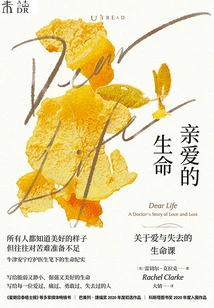
Dear Life: Life Lessons on Love and Loss
Literature亲爱的生命:关于爱与失去的生命课
(uk) Rachel Clark
Rachel Clark is a hospice doctor in the UK. Her daily work in the hospice is to care for and comfort patients and their families who are about to die soon, and to help them face death calmly. In that place full of life and death, in the every detail of dealing with patients, and in the personal experience of my father being diagnosed with terminal cancer, it takes us to deeply understand the meaning of life. And with frank, humorous, courageous, wise and beautiful words, through those moments that may be considered the most unbearable in life by ordinary people, it shows us how life completes its last move forward in suffering.
Rachel Clark is a hospice doctor in the UK. Her daily work in the hospice is to care for and comfort patients and their families who are about to die soon, and to help them face death calmly. In that place full of life and death, in the every detail of dealing with patients, and in the personal experience of my father being diagnosed with terminal cancer, it takes us to deeply understand the meaning of life. And with frank, humorous, courageous, wise and beautiful words, through those moments that may be considered the most unbearable in life by ordinary people, it shows us how life completes its last move forward in suffering.
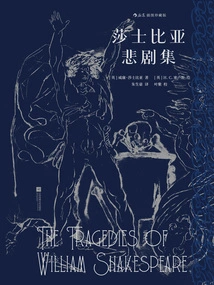
莎士比亚悲剧集(插图珍藏版)
S
This book contains Shakespeare's five representative tragedies: "Romeo and Juliet", "Hamlet", "Othello", "King Lear" and "Macbeth". The play carries fierce dramatic conflicts with wild imagination, tense language and strict structure, focusing on depicting the contradictory and complex inner world of the characters, implying concern and exploration of human nature.
This book contains Shakespeare's five representative tragedies: "Romeo and Juliet", "Hamlet", "Othello", "King Lear" and "Macbeth". The play carries fierce dramatic conflicts with wild imagination, tense language and strict structure, focusing on depicting the contradictory and complex inner world of the characters, implying concern and exploration of human nature.
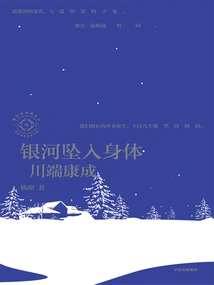
The Milky Way Falls into the Body: Kawabata Yasunari (ten Lectures by Japanese Literary Masters 04)
Literature银河坠入身体:川端康成(日本文学名家十讲04)
Yang Zhao
The standard-bearers of literature in the 20th century were also laggards of their respective eras. "Classic Reader" Yang Zhao's ten-lecture series on Japanese literary masters: Using literature, listen to their struggles and answers. Yang Zhao, the "classic reader" of this volume × Yasunari Kawabata, the "reconstructor of Japanese beauty": What we have is not this life, but a few accidental moments. In this world, while looking at the flowers, you are walking towards hell. Kawabata Yasunari, who grew up at the funeral of his relatives when he was young, was hit by the double blow of the country's defeat and the death of his best friend. He early felt the "futility" of life: How could he continue to survive for the rest of his life? Delicate and sensitive, he found a way in novels: novels can condense time - it is both an instant and an eternity fixed by condensation. There is a huge conflict and tension between the two, bursting out an indescribable beauty. In the post-war atmosphere of advocating the West, the multi-layered circulation of people's hearts, human kindness, strong time perception and social care perspective in Kawabata Yasunari's works not only revitalized Japan's own civilizational value, but also allowed it to be seen and valued by the world again. He was determined to preserve the beauty of Japan while preserving the country and find a reason for its continued existence amidst the ruins of defeat.
The standard-bearers of literature in the 20th century were also laggards of their respective eras. "Classic Reader" Yang Zhao's ten-lecture series on Japanese literary masters: Using literature, listen to their struggles and answers. Yang Zhao, the "classic reader" of this volume × Yasunari Kawabata, the "reconstructor of Japanese beauty": What we have is not this life, but a few accidental moments. In this world, while looking at the flowers, you are walking towards hell. Kawabata Yasunari, who grew up at the funeral of his relatives when he was young, was hit by the double blow of the country's defeat and the death of his best friend. He early felt the "futility" of life: How could he continue to survive for the rest of his life? Delicate and sensitive, he found a way in novels: novels can condense time - it is both an instant and an eternity fixed by condensation. There is a huge conflict and tension between the two, bursting out an indescribable beauty. In the post-war atmosphere of advocating the West, the multi-layered circulation of people's hearts, human kindness, strong time perception and social care perspective in Kawabata Yasunari's works not only revitalized Japan's own civilizational value, but also allowed it to be seen and valued by the world again. He was determined to preserve the beauty of Japan while preserving the country and find a reason for its continued existence amidst the ruins of defeat.
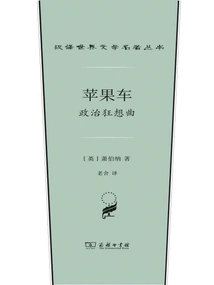
The Apple Cart: Political Rhapsody (chinese Translation of World Literature Masterpieces Series)
Literature苹果车:政治狂想曲(汉译世界文学名著丛书)
(british) Bernard Shaw
"The Apple Cart: A Political Rhapsody" is a play written by Irish playwright Bernard Shaw in 1928. The title of the book "The Apple Cart" comes from the British proverb "overturning the apple cart", which means "upsetting a wishful thinking". This is a satirical comedy about political philosophy. The author expresses his hidden worries about British politics through this fictional story. Synopsis: The fictional King Magnus of England has a dispute with Prime Minister Brotus and his cabinet. The prime minister and cabinet tried to deprive the monarchy of its remaining political influence. The king used his wisdom to resolve the crisis, and everything was business as usual. But in the end, a political problem was left unresolved... Bernard Shaw expressed his hidden worries about British politics through this fictional story. Although it has certain limitations, it is very prescient. This book is translated by Lao She and is the crystallization of the wisdom of two Chinese and foreign drama masters.
"The Apple Cart: A Political Rhapsody" is a play written by Irish playwright Bernard Shaw in 1928. The title of the book "The Apple Cart" comes from the British proverb "overturning the apple cart", which means "upsetting a wishful thinking". This is a satirical comedy about political philosophy. The author expresses his hidden worries about British politics through this fictional story. Synopsis: The fictional King Magnus of England has a dispute with Prime Minister Brotus and his cabinet. The prime minister and cabinet tried to deprive the monarchy of its remaining political influence. The king used his wisdom to resolve the crisis, and everything was business as usual. But in the end, a political problem was left unresolved... Bernard Shaw expressed his hidden worries about British politics through this fictional story. Although it has certain limitations, it is very prescient. This book is translated by Lao She and is the crystallization of the wisdom of two Chinese and foreign drama masters.
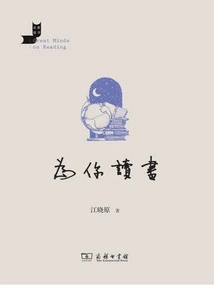
Reading for You
Literature为你读书
Jiang Xiaoyuan
This book tells the story of Professor Jiang Xiaoyuan, a famous bibliophile and book critic, about his reading, reviewing and writing process. The book contains 33 relevant articles recently published by the author, divided into four series, including Jiang Xiaoyuan's personal stories and experiences of reading, his thoughts and questions while reading, as well as his academic book reviews, film reviews and appreciation comments. It not only analyzes the methodological nature of reading, but also demonstrates Jiang Xiaoyuan's rich and extensive reading scope and professional evaluation. He uses his own example and personal demonstration to tell readers how to read, covering world history and geography, science fiction film and television works, scientism, Chinese classical literature, world literary masterpieces, literary criticism, etc.
This book tells the story of Professor Jiang Xiaoyuan, a famous bibliophile and book critic, about his reading, reviewing and writing process. The book contains 33 relevant articles recently published by the author, divided into four series, including Jiang Xiaoyuan's personal stories and experiences of reading, his thoughts and questions while reading, as well as his academic book reviews, film reviews and appreciation comments. It not only analyzes the methodological nature of reading, but also demonstrates Jiang Xiaoyuan's rich and extensive reading scope and professional evaluation. He uses his own example and personal demonstration to tell readers how to read, covering world history and geography, science fiction film and television works, scientism, Chinese classical literature, world literary masterpieces, literary criticism, etc.
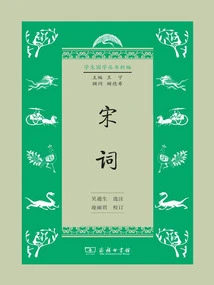
宋词(学生国学丛书新编)
Selected Notes By Wu Dunsheng Edited By Ling Lijun
"Song Ci" (original title "Selected Annotations of Song Ci") was compiled and selected by Wu Dunsheng during the Republic of China. The book is divided into three volumes, with a total of 142 poets from the Song Dynasty and more than 300 poems, totaling 115 tones and 136 styles. The first volume is a "Biography of the Author", which introduces the life and achievements of the selected poets. This book is organized by the name of the ci brand, in order of the number of words in the ci score. As the name of the formal lexicon, it is often also marked with tone, rhyme, sentence pronunciation, etc. Judging from the compilation and selection style of the entire book, the purpose of the editor is not to allow readers to purely appreciate the literary and artistic beauty of the lyrics and understand the creative style of a certain lyricist, but rather to allow readers to understand the rhythm of each lyric score, and to gain a deeper understanding of the creation of lyrics through representative lyrics and gain a glimpse of its secrets.
"Song Ci" (original title "Selected Annotations of Song Ci") was compiled and selected by Wu Dunsheng during the Republic of China. The book is divided into three volumes, with a total of 142 poets from the Song Dynasty and more than 300 poems, totaling 115 tones and 136 styles. The first volume is a "Biography of the Author", which introduces the life and achievements of the selected poets. This book is organized by the name of the ci brand, in order of the number of words in the ci score. As the name of the formal lexicon, it is often also marked with tone, rhyme, sentence pronunciation, etc. Judging from the compilation and selection style of the entire book, the purpose of the editor is not to allow readers to purely appreciate the literary and artistic beauty of the lyrics and understand the creative style of a certain lyricist, but rather to allow readers to understand the rhythm of each lyric score, and to gain a deeper understanding of the creation of lyrics through representative lyrics and gain a glimpse of its secrets.
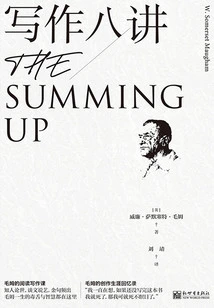
Eight Lectures on Writing
Literature写作八讲
H
"Storymaster" Maugham's guide to reading and writing is dedicated to everyone. Maugham, known as the "story master", is well-deserved for his global reputation. His works have been introduced and published in many countries, and his writing experience and writing skills are also talked about by the majority of literature lovers. In his later years, Maugham published the book "The Summing Up", which is not only a review of Maugham's life writing career, but also a summary of Maugham's many years of writing experience. Through this book, readers can comprehensively master writing skills. For example, how to read a book efficiently? How to improve writing skills? How to enhance sensitivity? How to write good articles that are clear, concise and pleasant to the ears? How to write a drama to quickly win hearts and minds? How to use techniques when writing novels? How to improve comprehension and cognition through reading? In this book, Maugham explains the profound meaning of reading and writing with humorous language and sharp and concise style.
"Storymaster" Maugham's guide to reading and writing is dedicated to everyone. Maugham, known as the "story master", is well-deserved for his global reputation. His works have been introduced and published in many countries, and his writing experience and writing skills are also talked about by the majority of literature lovers. In his later years, Maugham published the book "The Summing Up", which is not only a review of Maugham's life writing career, but also a summary of Maugham's many years of writing experience. Through this book, readers can comprehensively master writing skills. For example, how to read a book efficiently? How to improve writing skills? How to enhance sensitivity? How to write good articles that are clear, concise and pleasant to the ears? How to write a drama to quickly win hearts and minds? How to use techniques when writing novels? How to improve comprehension and cognition through reading? In this book, Maugham explains the profound meaning of reading and writing with humorous language and sharp and concise style.
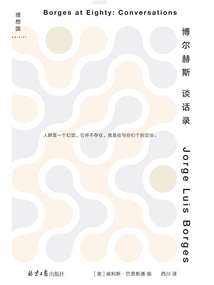
Borges' Conversations (2023 Edition)
Literature博尔赫斯谈话录(2023版)
(us) Willis Barnstone
Jorge Luis Borges (1899-1986), a world-renowned Argentine poet, writer, and translator. The father of Spanish-American literature, his creative style is profound, erudite and unique. He is especially famous for his labyrinth-like conception that blends reality with fiction to achieve mystery. He has a significant influence on contemporary literary creation and literary criticism around the world. In 1976, Borges participated in a series of conversations about his life and work at Indiana University. In the spring of 1980, he returned to Indiana as Professor Paden and spent a month there. He also visited Chicago, New York and Boston, walking and talking along the way. This book is a collection of interviews conducted during these two trips to the United States, with a total of eleven conversations involving Borges's many views on the times, religion, philosophy, literature and writing. Borges's character and conversation are at least as meaningful and witty as his works. During the last decades of his life, he traveled widely dictating poems, fables, and stories. In his travels and chats, he developed a special oral literature. The ubiquitous themes in Borges's works and the mature thoughts of his octogenarian are intertwined and shining in these eleven conversations, giving people a glimpse into the soul of this literary giant. "Borges Conversations" is a poetic collaboration between three poets, Borges, Barnstone and Nishikawa, that spans time, space and language. Nishikawa began translating and introducing Borges in the 1980s, and re-edited and refined the translation twenty years later; the editor Barnstone's new "Postscript" re-evaluated Borges's literary legacy. This book is a newly revised commemorative edition in 2023.
Jorge Luis Borges (1899-1986), a world-renowned Argentine poet, writer, and translator. The father of Spanish-American literature, his creative style is profound, erudite and unique. He is especially famous for his labyrinth-like conception that blends reality with fiction to achieve mystery. He has a significant influence on contemporary literary creation and literary criticism around the world. In 1976, Borges participated in a series of conversations about his life and work at Indiana University. In the spring of 1980, he returned to Indiana as Professor Paden and spent a month there. He also visited Chicago, New York and Boston, walking and talking along the way. This book is a collection of interviews conducted during these two trips to the United States, with a total of eleven conversations involving Borges's many views on the times, religion, philosophy, literature and writing. Borges's character and conversation are at least as meaningful and witty as his works. During the last decades of his life, he traveled widely dictating poems, fables, and stories. In his travels and chats, he developed a special oral literature. The ubiquitous themes in Borges's works and the mature thoughts of his octogenarian are intertwined and shining in these eleven conversations, giving people a glimpse into the soul of this literary giant. "Borges Conversations" is a poetic collaboration between three poets, Borges, Barnstone and Nishikawa, that spans time, space and language. Nishikawa began translating and introducing Borges in the 1980s, and re-edited and refined the translation twenty years later; the editor Barnstone's new "Postscript" re-evaluated Borges's literary legacy. This book is a newly revised commemorative edition in 2023.
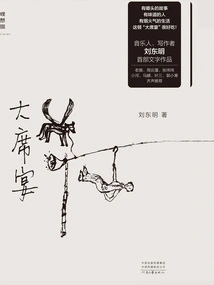
Banquet
Literature大席宴
Liu Dongming
"The Big Banquet" is the first written work of folk musician and writer Liu Dongming. It consists of 17 novels and 17 essays. The novel "The Big Banquet" of the same name creates a very vivid image of chef Liu Zhenkuan, and also spreads the customs and customs of Shandong's Big Banquet. His novels describe all kinds of things in the city, rural legends, young people's thoughts, and the songs of animals. Sometimes they are simple and lively, sometimes they are weird and interesting. His prose writes about hometown delicacies and travel experiences, about life and friends accompanied by music, about growing up and nostalgic memories, which are sincere and plain, with a long aftertaste. Sneaking between music and life, the author uses words to describe a real and free world full of wild fun: the fifth grandmother who loves soul-stirring accents, the pouring black rain falling in Stone City, the silly boy named Da Da, the young man who has just begun to have an affair, the rich man Li Wanwan who died in vain, the young man Guan Fei who fell into hallucinatory love, a stray dog named A Ming, Scar. The blind dog-peeper, the disappeared shoemaker, the "disco" hair salon, the laid-off "Queen Mother", the mountain woodcutter with good calligraphy... People walking on the earth, songs flowing in life, the author uses sensitive observation of life and poetic imagination to write a story of rural life at the end of the century, which is also a narrative poem about the growth of a musician.
"The Big Banquet" is the first written work of folk musician and writer Liu Dongming. It consists of 17 novels and 17 essays. The novel "The Big Banquet" of the same name creates a very vivid image of chef Liu Zhenkuan, and also spreads the customs and customs of Shandong's Big Banquet. His novels describe all kinds of things in the city, rural legends, young people's thoughts, and the songs of animals. Sometimes they are simple and lively, sometimes they are weird and interesting. His prose writes about hometown delicacies and travel experiences, about life and friends accompanied by music, about growing up and nostalgic memories, which are sincere and plain, with a long aftertaste. Sneaking between music and life, the author uses words to describe a real and free world full of wild fun: the fifth grandmother who loves soul-stirring accents, the pouring black rain falling in Stone City, the silly boy named Da Da, the young man who has just begun to have an affair, the rich man Li Wanwan who died in vain, the young man Guan Fei who fell into hallucinatory love, a stray dog named A Ming, Scar. The blind dog-peeper, the disappeared shoemaker, the "disco" hair salon, the laid-off "Queen Mother", the mountain woodcutter with good calligraphy... People walking on the earth, songs flowing in life, the author uses sensitive observation of life and poetic imagination to write a story of rural life at the end of the century, which is also a narrative poem about the growth of a musician.
热风(鲁迅自编文集)
Lu Xun
"Hot Wind" contains forty-one essays written by the author from 1918 to 1924. Lu Xun made some short comments in the "Reflections" of "New Youth" in the previous year. Because most of the comments he made were minor issues, they were insignificant and the reasons were mostly forgotten. But as far as the current text appears, apart from a few general comments, some of them are about supporting the si, sitting quietly, and boxing; some are about the so-called "preserving the national essence"; some are about the old bureaucrats at that time who were proud of their experience; some are about the caricatures of the Shanghai Times. I remember that at that time, "New Youth" was under attack from all sides, and Lu Xun could only deal with a small part of it.
"Hot Wind" contains forty-one essays written by the author from 1918 to 1924. Lu Xun made some short comments in the "Reflections" of "New Youth" in the previous year. Because most of the comments he made were minor issues, they were insignificant and the reasons were mostly forgotten. But as far as the current text appears, apart from a few general comments, some of them are about supporting the si, sitting quietly, and boxing; some are about the so-called "preserving the national essence"; some are about the old bureaucrats at that time who were proud of their experience; some are about the caricatures of the Shanghai Times. I remember that at that time, "New Youth" was under attack from all sides, and Lu Xun could only deal with a small part of it.
Lovely China
Literature可爱的中国
Fang Zhimin
This book selects six essays written by Mr. Fang Zhimin in prison: "Autobiography of Fang Zhimin", "A Brief Account of My Revolutionary Struggle", "Lovely China", "Death", "Poverty", and "Prison Records". The article is permeated with patriotic ideas and enthusiasm to devote oneself to the country and the people, showing the fearless spirit of sacrifice and firm will of a Communist. His inspiring words are still exciting to read today, giving the Chinese revolution the poetic light.
This book selects six essays written by Mr. Fang Zhimin in prison: "Autobiography of Fang Zhimin", "A Brief Account of My Revolutionary Struggle", "Lovely China", "Death", "Poverty", and "Prison Records". The article is permeated with patriotic ideas and enthusiasm to devote oneself to the country and the people, showing the fearless spirit of sacrifice and firm will of a Communist. His inspiring words are still exciting to read today, giving the Chinese revolution the poetic light.
China Wings
Literature中国之翼
Zhan Dongxin
The long documentary "Wings of China" focuses on elaborating on a series of fundamental, overall and strategic issues related to the development of aviation since the 18th National Congress of the Communist Party of China. China's aviation people have adhered to the path of independent innovation with Chinese characteristics, strived to achieve major breakthroughs in advantageous areas and key technologies, and made unremitting efforts to become an aviation power in the new era. It eulogized China's aviation spirit of "never giving up, seeking excellence and advancing bravely" and China's aviation people's selfless dedication and fear of difficulties.
The long documentary "Wings of China" focuses on elaborating on a series of fundamental, overall and strategic issues related to the development of aviation since the 18th National Congress of the Communist Party of China. China's aviation people have adhered to the path of independent innovation with Chinese characteristics, strived to achieve major breakthroughs in advantageous areas and key technologies, and made unremitting efforts to become an aviation power in the new era. It eulogized China's aviation spirit of "never giving up, seeking excellence and advancing bravely" and China's aviation people's selfless dedication and fear of difficulties.

May You Grow up Slowly
Literature愿你慢慢长大
Liu Yu Zhou Guoping
"May You Grow Up Slowly" is a collection of essays by famous writers on "slow parenting". It contains nearly 30 essays, including letters written by parents to their children, talks about their own growth experiences, and views on their children's education. It provides many educational experiences worth learning from. The authors of these essays come from different fields, including teachers, writers, scholars, scientists, businessmen, and ordinary people. The letters they write to their children are warm and touching. Their understanding and thinking about children's personalities are true, objective, and full of humanity. They are full of reflections on their own growth experiences, and they have relatively unique views on the education of the next generation.
"May You Grow Up Slowly" is a collection of essays by famous writers on "slow parenting". It contains nearly 30 essays, including letters written by parents to their children, talks about their own growth experiences, and views on their children's education. It provides many educational experiences worth learning from. The authors of these essays come from different fields, including teachers, writers, scholars, scientists, businessmen, and ordinary people. The letters they write to their children are warm and touching. Their understanding and thinking about children's personalities are true, objective, and full of humanity. They are full of reflections on their own growth experiences, and they have relatively unique views on the education of the next generation.
The Origin of Modern Ciology
Literature现代词学的起源
Zhang Yaozong
The book starts from the inheritance of modern Chinese academic context, and focuses on the origins of modern Ci poetry masters such as Long Yusheng, Xia Chengtao, Tang Guizhang, Zhang Ertian, Liu Yongji, Shen Zufen and Ye Jiaying. They had a greater influence, and the tradition of Ci poetry of their teachers basically came from the tradition initiated by Zhang Huiyan in the 18th century. This tradition was different from Wang Guowei's tradition, and it was also different from the tradition of Ci as a kind of vernacular literature summarized by Hu Shi at that time. This tradition means the extension of the 18th century into the 20th century. It is what Long Yusheng said, "the lingering waves of the wind have never stopped."
The book starts from the inheritance of modern Chinese academic context, and focuses on the origins of modern Ci poetry masters such as Long Yusheng, Xia Chengtao, Tang Guizhang, Zhang Ertian, Liu Yongji, Shen Zufen and Ye Jiaying. They had a greater influence, and the tradition of Ci poetry of their teachers basically came from the tradition initiated by Zhang Huiyan in the 18th century. This tradition was different from Wang Guowei's tradition, and it was also different from the tradition of Ci as a kind of vernacular literature summarized by Hu Shi at that time. This tradition means the extension of the 18th century into the 20th century. It is what Long Yusheng said, "the lingering waves of the wind have never stopped."
表演与阐释:早期中国诗学研究
(u. S. A.) Written By Martin Ko, Edited By Guo Xi'an
The first Chinese academic collection by the famous sinologist Martin Kern includes 16 articles discussing poetry and poetics in the Zhou, Qin, and Han dynasties from 1996 to 2022. It focuses on the development of early Chinese poetry, its connection with ritual performances, the formation of cultural memory and identity, and the interpretation tradition of early and medieval Chinese poetry. The discussion objects focus on the Book of Songs, Western Han odes, poems, Qin Shihuang stele, Chu Ci, etc. All the articles in the collection have been supplemented and improved by the author and significantly revised by the editor, and are now presented in chronological order.
The first Chinese academic collection by the famous sinologist Martin Kern includes 16 articles discussing poetry and poetics in the Zhou, Qin, and Han dynasties from 1996 to 2022. It focuses on the development of early Chinese poetry, its connection with ritual performances, the formation of cultural memory and identity, and the interpretation tradition of early and medieval Chinese poetry. The discussion objects focus on the Book of Songs, Western Han odes, poems, Qin Shihuang stele, Chu Ci, etc. All the articles in the collection have been supplemented and improved by the author and significantly revised by the editor, and are now presented in chronological order.
也曾隔窗窥新月
Liu Xinwu
This book is a concentrated writing by Mr. Liu Xinwu on the portraits of contemporary intellectuals or cultural groups. It records the turbulence of the times and the changes in the literary world, tells the unique legends and ups and downs of the protagonists, depicts the life style and philosophy of life of those gentle and wise men, and demonstrates their unswerving state of mind and gazing at the new moon after going through the dust and storms of life. The author's language is fresh and concise, and his narration is eloquent and moving. The words as calm as water contain a deep tension that washes away the lead and comforts people's hearts.
This book is a concentrated writing by Mr. Liu Xinwu on the portraits of contemporary intellectuals or cultural groups. It records the turbulence of the times and the changes in the literary world, tells the unique legends and ups and downs of the protagonists, depicts the life style and philosophy of life of those gentle and wise men, and demonstrates their unswerving state of mind and gazing at the new moon after going through the dust and storms of life. The author's language is fresh and concise, and his narration is eloquent and moving. The words as calm as water contain a deep tension that washes away the lead and comforts people's hearts.
漱石之心:夏目漱石的哲学与文学
(japan) Akio Akagi
This book is based on Natsume Soseki's historical background, the influence of philosophical science and other thoughts, and the process of conceiving "On Literature" while studying in London. Natsume Soseki's creative concept of analyzing reader consciousness and social consciousness makes his works contain the spirit of the Japanese era after modernization. The main connotation of Natsume Soseki's spiritual activities is philosophy and literature. Based on this, this book provides another reading for Natsume Soseki's works.
This book is based on Natsume Soseki's historical background, the influence of philosophical science and other thoughts, and the process of conceiving "On Literature" while studying in London. Natsume Soseki's creative concept of analyzing reader consciousness and social consciousness makes his works contain the spirit of the Japanese era after modernization. The main connotation of Natsume Soseki's spiritual activities is philosophy and literature. Based on this, this book provides another reading for Natsume Soseki's works.
Superfluous Words
Literature多余的话
Qu Qiubai
"Superfluous Words" was written by Qu Qiubai on the eve of his death. It is different from Fang Zhimin's "Prison Records", Fuchik's "Report under the Gallows", and even different from the poems in "Poems of Revolutionary Martyrs". Those works declare war on the enemy, while "Superfluous Words" digs deep into one's own soul. What one feels when reading is not the author's high-spirited fighting spirit, but the inner pain, melancholy, and boredom.
"Superfluous Words" was written by Qu Qiubai on the eve of his death. It is different from Fang Zhimin's "Prison Records", Fuchik's "Report under the Gallows", and even different from the poems in "Poems of Revolutionary Martyrs". Those works declare war on the enemy, while "Superfluous Words" digs deep into one's own soul. What one feels when reading is not the author's high-spirited fighting spirit, but the inner pain, melancholy, and boredom.
对话批评:诗·史·思之维
Zhou Xinmin
Today, literary criticism often loses the warmth of understanding others and observing oneself. Some critics only focus on self-admiration, with no works in their eyes and no readers in their hearts. The reason lies in the loss of dialogue in literary criticism. Good literary criticism should be like a deep dialogue with a close friend. Against this background, this book focuses on interviews with a number of well-known poets, novelists and literary critics from the 1960s to the 1980s. Through face-to-face conversations, it aims to build a bridge of communication, trigger a collision of ideas and generate spiritual resonance during dialogue and exchange, in order to rebuild the dialogue of literary criticism and reach the deep realm of literature.
Today, literary criticism often loses the warmth of understanding others and observing oneself. Some critics only focus on self-admiration, with no works in their eyes and no readers in their hearts. The reason lies in the loss of dialogue in literary criticism. Good literary criticism should be like a deep dialogue with a close friend. Against this background, this book focuses on interviews with a number of well-known poets, novelists and literary critics from the 1960s to the 1980s. Through face-to-face conversations, it aims to build a bridge of communication, trigger a collision of ideas and generate spiritual resonance during dialogue and exchange, in order to rebuild the dialogue of literary criticism and reach the deep realm of literature.
Factory in Sunrise Country
Literature日出国的工厂
H
It is rare to see an essay with a unique "Japanese flavor" among Haruki Murakami's works. "Adventures in the Wig Factory" is one of the inspirations for "The Journey of Strange Birds". "The Factory in the Land of the Rising Sun" is a collection of essays by Haruki Murakami,\
It is rare to see an essay with a unique "Japanese flavor" among Haruki Murakami's works. "Adventures in the Wig Factory" is one of the inspirations for "The Journey of Strange Birds". "The Factory in the Land of the Rising Sun" is a collection of essays by Haruki Murakami,\

街角:一个内城社区的一年(译文纪实)
(u. S.) David Simon Et Al.
Drugs are banned repeatedly, poverty is everywhere, and families are falling apart. Why has the street corner become a fate that the poor cannot escape? Corner of Fayette and Monroe Streets, West Baltimore. In this forgotten corner, the "American Dream" has long been fragmented to the point where only a nightmare remains. People pay an unimaginably heavy price for drugs. But at the same time, there is still hope, care and love here. "Street Corner" truly records the anxious story that happened in Baltimore, an inland city in the United States, within a year. It mainly revolves around fifteen-year-old DeAndre and his broken family. It tracks a group of marginalized people struggling for survival, reveals the complicated street corner world, and each vivid image appears in detail. Street corners teem with predators and prey, drug dealers and robbers, as well as a mixed bag of police officers, unarmed drug addicts and innocent victimized passers-by. This documentary chronicles the story of street crime in the inner-city city of Baltimore over the course of a year, capturing an unprecedented view of an America that most people know little about. Through just one street corner, the authors vividly demonstrate how little role law enforcement, moral crusaders, and the welfare system play in a landlocked city like Baltimore. "Street Corners" takes ordinary readers deep into those forgotten corners of the United States to understand what people there think, feel and understand.
Drugs are banned repeatedly, poverty is everywhere, and families are falling apart. Why has the street corner become a fate that the poor cannot escape? Corner of Fayette and Monroe Streets, West Baltimore. In this forgotten corner, the "American Dream" has long been fragmented to the point where only a nightmare remains. People pay an unimaginably heavy price for drugs. But at the same time, there is still hope, care and love here. "Street Corner" truly records the anxious story that happened in Baltimore, an inland city in the United States, within a year. It mainly revolves around fifteen-year-old DeAndre and his broken family. It tracks a group of marginalized people struggling for survival, reveals the complicated street corner world, and each vivid image appears in detail. Street corners teem with predators and prey, drug dealers and robbers, as well as a mixed bag of police officers, unarmed drug addicts and innocent victimized passers-by. This documentary chronicles the story of street crime in the inner-city city of Baltimore over the course of a year, capturing an unprecedented view of an America that most people know little about. Through just one street corner, the authors vividly demonstrate how little role law enforcement, moral crusaders, and the welfare system play in a landlocked city like Baltimore. "Street Corners" takes ordinary readers deep into those forgotten corners of the United States to understand what people there think, feel and understand.
吉星高照的男人(阿瑟·米勒作品系列)
H
"Everything I touch turns to gold. Everything." Auspicious stars are shining. Is this a blessing or a curse? Why do young winners in life choose to commit suicide? From the "American Dream" to the "American Nightmare." Arthur Miller is one of the greatest contemporary playwrights and is known as "the conscience of American drama." This play is Arthur Miller's first play on Broadway. It explores the loss of order and moral collapse during the Great Depression, and asks a question that seems to have no answer - "Is fate fair?" In the eyes of people around him, David Beavers is an out-and-out "winner in life" - he is young, has a happy family, a successful career, and a lot of good luck. All obstacles can disappear in front of him, as if some god has given him the ability to turn stone into gold. However, his auspicious stars constantly reveal the tragedy of those around him, and before he knows it, his path to success turns into a nightmare of doubt. He is struggling to find some clear operating rules in a seemingly irrational universe, and his despair brings him to the edge of madness... The play is permeated by the fear of failure and the guilt of success, which runs through almost all of Arthur Miller's subsequent works. It was through this play that Miller "began to get a taste of what it was like to be a playwright, and maybe even a human being."
"Everything I touch turns to gold. Everything." Auspicious stars are shining. Is this a blessing or a curse? Why do young winners in life choose to commit suicide? From the "American Dream" to the "American Nightmare." Arthur Miller is one of the greatest contemporary playwrights and is known as "the conscience of American drama." This play is Arthur Miller's first play on Broadway. It explores the loss of order and moral collapse during the Great Depression, and asks a question that seems to have no answer - "Is fate fair?" In the eyes of people around him, David Beavers is an out-and-out "winner in life" - he is young, has a happy family, a successful career, and a lot of good luck. All obstacles can disappear in front of him, as if some god has given him the ability to turn stone into gold. However, his auspicious stars constantly reveal the tragedy of those around him, and before he knows it, his path to success turns into a nightmare of doubt. He is struggling to find some clear operating rules in a seemingly irrational universe, and his despair brings him to the edge of madness... The play is permeated by the fear of failure and the guilt of success, which runs through almost all of Arthur Miller's subsequent works. It was through this play that Miller "began to get a taste of what it was like to be a playwright, and maybe even a human being."
村上朝日堂的卷土重来(村上朝日堂系列)
L
An excellent three-dimensional portrait of Haruki Murakami - What kind of person is the real Haruki Murakami? There are real answers here. One of the "Murakami Asahido Series", 51 articles in total. There are 52 illustrations of Anxi Shuiwan. 1. Murakami's family situation, hobbies and habits, early life and creation, interesting anecdotes after becoming famous, etc. 2. Murakami's views and discussions on social issues, such as elections, popular reading, middle age, health, movies, music, etc. Murakami combines his own personal experience with various aspects of the world, and combines narratives and discussions. He is original, humorous, lively, friendly, casual, authentic and credible, reflecting Haruki Murakami's unique unrestrained and whimsical style.
An excellent three-dimensional portrait of Haruki Murakami - What kind of person is the real Haruki Murakami? There are real answers here. One of the "Murakami Asahido Series", 51 articles in total. There are 52 illustrations of Anxi Shuiwan. 1. Murakami's family situation, hobbies and habits, early life and creation, interesting anecdotes after becoming famous, etc. 2. Murakami's views and discussions on social issues, such as elections, popular reading, middle age, health, movies, music, etc. Murakami combines his own personal experience with various aspects of the world, and combines narratives and discussions. He is original, humorous, lively, friendly, casual, authentic and credible, reflecting Haruki Murakami's unique unrestrained and whimsical style.