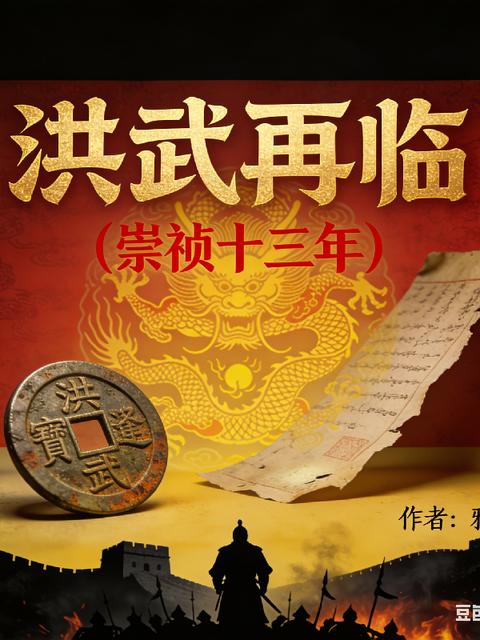
“The Taizu Emperor… really came back from the Hongwu era?!”
In the thirteenth year of the Chongzhen reign, the Ming dynasty was battered by storms. Li Zicheng swept across the Central Plains, Zhang Xianzhong carved out a kingdom, and Huang Taiji watched hungrily from beyond the passes. The overwhelmed Chongzhen Emperor, Zhu Youjian, could already see the shadow of his dynasty’s fall.
Just then, the heavens split open and crimson light streaked across the sky. An army of fifty thousand, its ranks immaculate and its killing intent soaring, appeared outside Beijing’s Meridian Gate like divine soldiers descending from the heavens. Its banners bore the long-forgotten Ming character from the Hongwu era. Under the command banner stood a general with a ruddy face and eyes like lightning, identical in every way to the founding Taizu Emperor Zhu Yuanzhang in the portraits at the Imperial Ancestral Temple!
Those who came with him were the heroes who had illuminated the founding history of the entire Ming dynasty: the God of War Xu Da, the fierce general Chang Yuchun, the strategist Liu Bowen, Chancellor Li Shanchang, and the other four founding dukes. Even more astonishing was the young prince among them, imposing and brimming with pride: the future Yongle Emperor, Prince of Yan Zhu Di!
Transmigrating across two hundred and seventy years, the founding team faced the dynasty’s end-stage disaster head-on.
Looking at Chongzhen kneeling before him, Zhu Yuanzhang burned with rage:
“The realm I conquered has been ruined by you unworthy descendants? Hundreds of thousands of parasites in the imperial clan, eunuchs sucking the people dry everywhere, and commoners forced to eat their own children! Starting today, my rules are the new ancestral laws!”
A reforming storm swept through the rotten court with unprecedented force:
· Iron-fisted land surveys: Hongwu soldiers charged into princely estates, Xu Da’s cavalry trampled the fields of the nobility, concealed lands were confiscated, and parasites thrown into prison.
· Fiscal surgery: Liu Bowen imposed a “unified grain tax on scholars and gentry,” while Li Shanchang restored customs and commercial duties, with every cut striking at vested interests…


 Seven Years on the Dragon Throne
 Rebooting the Empire: Starting at Yiling
 The Six Hundred Treaties That Shackled China: The Lives of the Common Folk in Late Qing
 The King of Fighters '97: My Trash Talk Set the Entire Fighting World Ablaze
 The Evil Minister
 Chronicle of the Wanli Flames: The Great Sage’s Battle for the Light
 Thunder over Hebei
 A Twisted Tale of the Investiture of the Gods: The Righteous Shang Zhou and the Cheating Western Zhou