


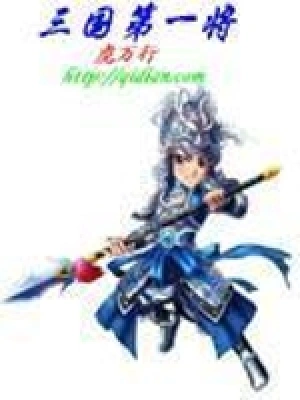
The Three Kingdoms' Greatest General
三国第一将
- Status
- Completed
- Length
- 1.3M Words
- Genre
- Historical
- Subgenre
- Qin-Han & Three Kingdoms
- Updated
- 11y ago
- Source
- Qidian
Stats
452Chapters
0Votes
10.1kRecs
41.2kFans
Tags
Synopsis
More by this author
 The Realm of Eternal Silence
 The Most Sinister Pawn Shop in History
 Endless Travel Across the World
 Game Star
 Endless Martial Arts World
 The Great Metaphysical Explosion
 The Reaper's Battle Arena
 The Three Kingdoms: Unrivaled Demon God
 The Peerless Sword Sect
 The Age of Global Conquest
 Super Warehouse Manager
 The Sword Way of the Confucian School
In booklists 1
Readers also read
 My Only Method: I Will Add More Points to Become Stronger at the End of Ming Dynasty
 A Guide to Building Civilization in a Primitive Tribe
 Daming: Asking for the Throne at the Beginning, Lao Zhule Went Crazy
 My Father Is Wen Tianxiang, and We Win the Battle of Yashan from the Start
 Slaughtering My Way Through the Marvel Universe: Starting with The Boys
 The Strongest Warrior of the Three Kingdoms
 Arms and Armor of the Three Kingdoms
 The Road Less Traveled
 The World of the Extreme Path: Tempering My Body Through Terror
 The Hegemony of Shu
 The Rogue King of War in the Three Kingdoms
 Making My Way in the Three Kingdoms, Fighting for the Realm
The Sword Way of the Confucian School
Super Warehouse Manager
The Age of Global Conquest
The Peerless Sword Sect
The Three Kingdoms: Unrivaled Demon God
The Reaper's Battle Arena
Making My Way in the Three Kingdoms, Fighting for the Realm
The Sword Way of the Confucian School
Super Warehouse Manager
The Age of Global Conquest
The Peerless Sword Sect
The Three Kingdoms: Unrivaled Demon God
The Reaper's Battle Arena
 Journey to the West: Tiger's Roar
The Great Metaphysical Explosion
Journey to the West: Tiger's Roar
The Great Metaphysical Explosion
Reader comments 33
Google Translate
In terms of merit, Lu Bu has been fighting against foreign tribes in the north since he was a child. The reputation of others is due to the Yellow Turban Army. If the Manchus did not worship Guan Yu, where would he have the reputation of a martial saint?
[Comment] Give the author some advice! ! ! !
This book has reached a dead end! What the protagonist wants in his mind is to surrender Cao Cao and speed up the reunification. Cao Cao is internal and the protagonist is external, but has the protagonist ever thought about his subordinates? Living in troubled times, one surrenders to one's master, gallops on the battlefield, becomes a prince, and becomes prime minister. The heroes under his subordinates come to join him because they see the potential of the protagonist. It doesn't matter if the protagonist is demoted to the Cao Cao. He is the protagonist, and he must be a high-ranking official. But what about the protagonist's younger brothers? Will the officials who surrender have a higher rank than the officials who followed Cao in the early days? Even if the author can write it, will it make the reader feel reasonable?
Where did Guan Yu's name come from? Can he be among the national heroes?
One Lu Bu, two Zhao Yun, three Dian Wei, four Guan Yu, five Ma Chao, six Zhang Fei, seven Huang Zhong, eight Xu Chu, and nine Sun Ce. Then Taishi Ci, Xiahou Yuan, Xiahou Dun, Zhang Liao, Zhang He, Xu Huang, Pang De, Gan Ning, Zhou Tai, Wei Yan. Zhang Xiu, Wen Chou, Yan Liang. Deng Ai, Jiang Wei. Well, these should be the characters displayed on the author's homepage, right?
[Information] A little mistake
I have obsessive-compulsive disorder, and I found it awkward when the author wrote the word Tartar. Generally speaking, Tatars, Tatars, and Tatars refer to Tatar people, that is, Tatars. They are a nomadic people living in southern Siberia. They later merged with the Mongolian people and followed Genghis Khan in his western expedition. In the late 16th century, with the rise of the Later Jin Dynasty, intermarriage with Mongolian nobles became a fashion among the Jurchen nobles. Therefore, "Tatar" became a derogatory name for the oppressed Han people towards the Manchu rulers. "Expelling the Tartars and restoring China" means Sun Yat-sen's nationalist thought, which is to use revolutionary means to overthrow the feudal rule of the Manchu Qing Dynasty and direct the struggle against the decadent Qing Dynasty, thereby attacking the aggressive imperialist forces in China. Therefore, it would be wrong to include the expulsion of the Tartars in this book. The Han Dynasty should be more appropriately called "Hulu". The author may have been deeply influenced by Sun Yat-sen's widely praised slogan in modern times and wrote this in the book, but I found it really awkward.
Lu Bu is the strongest in horse combat, and Dian Wei is the strongest in foot combat, so the strongest in the Three Kingdoms is Lu Bu riding Dian Wei🤓
An eleven or twelve-year-old boy has a cousin and can be a general. Damn it, he took the elixir. A good family does not have to create his own brains to show off, and he can travel through time.
Junior high school students' writing level
Let's not talk about the plot and unreasonableness. In the article, words such as "that is" and "that is" are added to some sentences at any time. When you read it, you just feel that the Chinese teacher died early. For example, "Immediately rush to the city gate." What is the use of these two words here? Make up the word count?
[Comment] Actually there is a BUG at the beginning...
During the Han Dynasty, the Four Books and Five Classics probably did not exist yet, and it should be a compilation of the Zi Jing~
Rubbish, the Hedong Wei family is also a powerful family, is it necessary to call him dad everywhere?