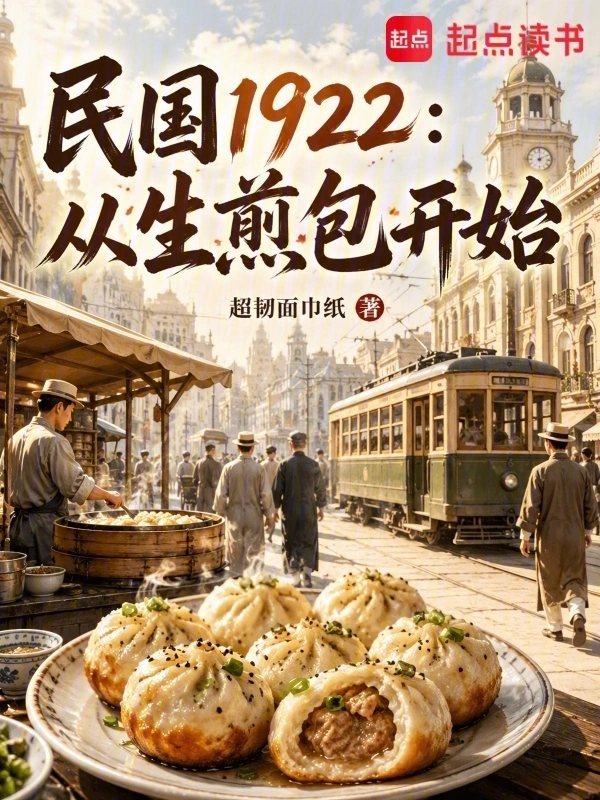
Republic of China, 1922: Starting with Shengjianbao
民国1922:从生煎包开始
- Status
- Ongoing
- Length
- 383k Words
- Genre
- Historical
- Audience
- Male
- Subgenre
- Qing & Republican Era
- Updated
- 3d ago
- Source
- Qidian
Stats
156Chapters
278Votes
1.4kRecs
11.7kFans
Tags
Synopsis
Readers also read
 Great Ming: His Father Is Useless, So He Must Summon the Founding Emperor
 A Literary Master in Ancient Greece
 Seizing the Direct Descendant in the Red Mansion
 Germany: 1914
 Please Call Me Your Majesty, the Tsar
 Rebirth 82: Starting from Selling Braised Meat at the Entrance of the Theater
 Return to 1977 County Theater Troupe
 Popularity Above All: My Art Style Is Way Too Eccentric!
 I Just Went to College and Was Laid Off. the Counterattack System Is Coming.
 Rebirth 83, Starting from the Repair Stall in Beijing
 1985: Starting in the Xing'anling Forestry Camp Canteen
 Gou Was in the Republic of China in 1938, Starting from the Wenxi Fire
This reminds me of a novel about the Republic of China a few years ago. The protagonist traveled through the Republic of China to engage in sports. He was scolded miserably because he could not ignore the ruffians, gangsters, warlords, imperialist forces and the subsequent Anti-Japanese War during the Republic of China. Sports were just for fun. What's the use of them?
The writing is ok, but in the general environment, the warlords are fighting, the Nationalist government's Northern Expedition, the Japanese army captured Shanghai, the government liquidated the country after the victory of the Anti-Japanese War, and what to do after liberation. And if it's a small thing, gangs, the police come to knock the bones and suck out the marrow. If it's a big thing, it's a little Japan, a traitor, won't high-ranking government officials come and take possession of it?
Talented people, go to the Republic of China to sell gourmet food? I can't imagine who is still in the mood to enjoy delicious food in such troubled times
In the Republic of China, Shanghai was engaged in gourmet food? The Green Gang, the patrolmen, peel off the skin layer by layer and sell it at a sky-high price. Who will buy it? Go to sleep, there is everything in your dreams! Selling gourmet food, renting a house, renting water, electricity, taxes, etc. All cost a lot of money these days! Not to mention the troubled times of the Republic of China!
During the Republic of China, how difficult was it for ordinary people to survive? Let's put it this way! The government imposes exorbitant taxes and miscellaneous taxes, the police want money and cards, local evil forces also want money, peers suppress us, and theft is rampant! The security situation is as bad as nothing. When you become big, you will arouse the covetousness of the big families in the government. Which one of Kong, Chen, Jiang, and Song has done this? The entire Shanghai beach is basically their world.
Good guy! Time travel to the Republic of China to start a food business? No, sir, in these troubled times, who has the leisure to sit down and show off the fried dumplings?
Read a few chapters
The writing is a bit unrealistic. How can any coolie buy your soup dumplings and crab roe buns? Can't fill your stomach?
Writing food articles during the Republic of China, are you crazy?
This author is really interesting
I pointed out that in the past, fat meat was more valuable than lean meat and could not be given away for free. Just come down to the comment area and criticize me and then delete the post. . Accepted
Selling lunch boxes at the pier?
Isn't the author's imagination of the Republic of China too wonderful? Dockers at that time worked the same nine-to-five job as they do now? Also, is this about Shanghai? Shanghainese never say "Mazha", and Shanghainese don't just pursue freshness when eating fried steamed buns... Hey, go and research Dahuchun.
What SB article? Going to 1922 to sell snacks would make me happy to death.
The author may have misunderstood the rickshaw driver
How much distance does a rickshaw driver have to cover in a day, and how much physical energy does it take? I buy five pan-fried steamed buns for one meal and divide them into two meals. Haha, four pan-fried steamed buns only cost one tael of flour. Shanghainese order a customer, and a serious rickshaw driver starts at least eight taels.
Hahahaha, I posted it in the middle of the night and made me laugh
The author writes well, but has no common sense at all. In that era, you actually chose fried buns to start? How many poor people are willing to eat? How many of you who have some money eat at your little stall? What people want is affordable, delicious food comes second!
How to buy fried steamed buns in Shanghai
Let me give you some knowledge. When buying pan-fried steamed buns, Shanghainese people never care about the individual, but rather the "customer". One guest has four, and they usually buy 2-3 customers. They don't wrap them in oil paper and eat them. They usually bring their own plates or eat them directly in the store, and the pan-fried buns must be paired with soup. The most important thing is that Shanghai pan-fried steamed buns can be fresh, but sugar must be added.
Is it still possible to do business in the Republic of China without its own armed forces? Just do it. After a few days, you will be kicked out by local snakes who don't know where they came from. You don't even need the warlord to take action.
. . .
As for the career goals of the protagonist in a specific context, I think it's good to focus on basic personal survival at the moment. There have been many novels written with various big goals, which is a bit aesthetically exhausting. Under the special background, ordinary life is fine, as long as the timeline is not stretched too long and ends at the right time.
This author is so inexperienced. This kind of "real history" cooking theme is about the early stage of life in the market and the human fireworks. Within two months of setting up a stall, the protagonist has been given four noble people to help him. After dozens of chapters, the food has been cooked at Lao Jiang's house. I will see how you write it later. I am afraid that the aliens will not be enough to upgrade.
That is to say, traveling through the Republic of China and not joining Little Japan, is that any different from traveling through the Qing Dynasty and not rebelling?
"The dog is reborn and works as a waiter in a dog meat shop"
In the Republic of China, it was useless even if you had a background. So many ethnic capitalists were forced to join the Communist Party. They had no background compared to you, a commoner, but they were still driven to ecstasy.
Do you have to pay for the protagonist's pan-fried buns when the Japanese come?
This kind of book is difficult to write. You either ignore history and write obscenely. Either you have to keep the perspective of the story very small, or your protagonist cannot influence history and can only go with the flow. When the Japanese come, you leave Shanghai and continue to open stores when the peace comes. But it would be a bit strange to place a book like this in the history category.
1922 If you don't let the gangsters knock your bones and suck out your marrow, then you are doing well.
Anyone who doesn't grasp the point of rebirth in the Republic of China is bullshit!
The author didn't check the people's livelihood information of that year, did he?
I just read a few chapters and I feel something is wrong. I just checked the living conditions of ordinary people in Shanghai in the past few years. As far as breakfast is concerned, the daily expenditure of manual workers is one to two copper coins, and the daily expenditure of ordinary citizens and small clerks is basically less than five copper coins. It is almost impossible for a manual laborer who pulls a rickshaw to spend more than ten coppers on breakfast. At that time, a pair of sesame cakes and deep-fried dough sticks cost two coppers, a rice ball cost two coppers, and a bowl of Yangchun noodles cost five coppers. As an ordinary person who usually spends a lot of money, it would be impossible for him to choose three pan-fried buns for five coins, right? Also, the author probably has no experience in Chinese pastry or related industries. Some of the practical points he wrote are wrong, and some of the utensils and materials described were not commonly used in Jiangsu, Zhejiang and Shanghai at that time. Personally, I think that since I'm writing a historical article, it's better to be more rigorous, or just say it's a parallel world or an imaginary world at the beginning.
The ending where Mr. Qin in the teahouse is the protagonist cannot be written unless the author makes a big mistake.
It is nothing without force. If you want to die, you will die; if you want to live, you will live. Don't talk about foreigners, Japanese invaders, local gangsters, they are enough to give you a headache. What's the use of your great wisdom? A scholar meets a soldier. I can't explain why, don't talk about local ruffians, foreigners and Japanese invaders, just go to bed early.
I feel like the subject matter is not very good
It doesn't quite match the background of the turbulent era of the Republic of China. Even if the two worlds are changed, it feels better than now.
The author has probably never had Shanghai fried pancakes before, so what's the point? Either one and a half taels, or one or two and a half taels, because one tael of flour can just make 4 pan-fried pancakes. Also, was the intention to open a dungeon in Shanghai in 2022 to seduce someone from the transportation brigade captain who was speculating in stocks in Shanghai before he became famous?