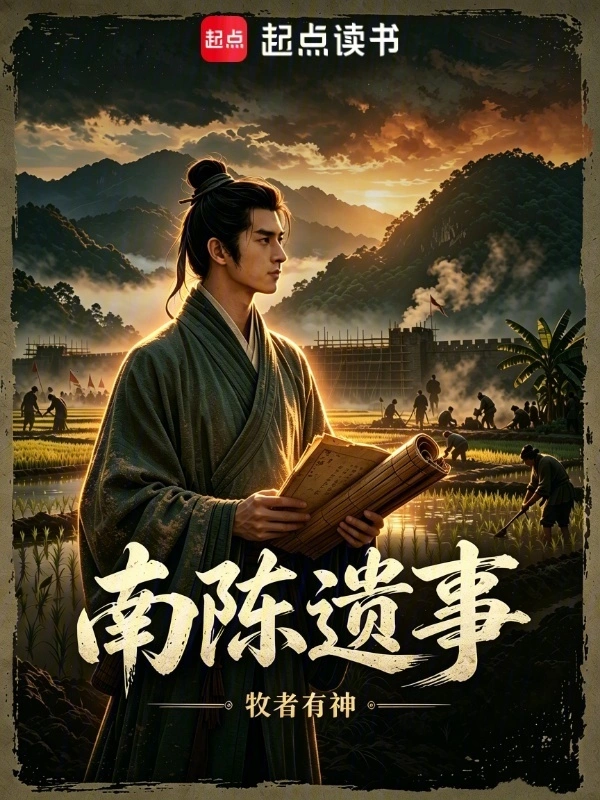
Nanchen's Legacy
南陈遗事
- Status
- Ongoing
- Length
- 442k Words
- Genre
- Historical
- Audience
- Male
- Subgenre
- Jin-Sui-Tang Dynasties
- Updated
- 3d ago
- Source
- Qidian
Stats
179Monthly votes
2.5kRecommends
1kFans
136Chapters
Tags
Synopsis
Reader comments
Readers also read
 Red Mansion Xiaoke
 I Am a Tyrant in Nanming
 Fu Ming 1627
 At the Beginning, Please Ask Chongzhen to Abdicate!
 Daming: Attack, Emperor Yongle!
 The Fierce Son-In-Law of Da Qin
 Tang Dynasty: from the Remnant Soldiers of Anxi to the Powerful Ministers of Chang'an
 I Get a New Character Every Week
 Transform into Tang Monk and Become Stronger Starting from Covering the Sky to Obtain Scriptures
 Everlasting Ming Dynasty
 Master, Gao Zai
 It's Time to Return to Heaven During the Qingming Festival
 Save Da Qin: Resurrection of the Ancestral Dragon at the Beginning to Kill Zhao Gao
 Saving the Ming Dynasty: Starting from the Last Seventeen Years of the Ming Dynasty
 Historical Infinite Loop System
Ai
The AI flavor of your introduction is too great, please change it.
Textual research answer: Why did Xiao Yan accept Hou Jing's surrender?
Xiao Yan's acceptance of Hou Jing was essentially a big gamble - he tried to use external support to solve the situation of internal and external difficulties, and even dreamed of regaining the Central Plains and gaining great achievements. Unfortunately, his ambition and strength did not match at all. In 547 AD, the Eastern Wei general Hou Jing led his troops to surrender to Nanliang. Emperor Wu of Liang, Xiao Yan, ignored the opposition of his ministers and insisted on accepting this powerful general known for his "capriciousness". This decision eventually triggered the "Hou Jing Rebellion", which directly led to the subjugation of Nanliang, and Xiao Yan himself starved to death in Taicheng. Later generations often used this to ridicule Xiao Yan for being old and confused, but looking back at the historical situation at that time, this "political deal" actually had some accounts that he had to settle. First: the "key chess piece" that can break the balance of power in the north. At that time, China was divided into three kingdoms: Nanliang, Eastern Wei, and Western Wei. The Eastern Wei Dynasty was the strongest, the Western Wei Dynasty was the weakest, and Nanliang was located in the south of the Yangtze River. Hou Jing is not a mere commander. He has 100,000 elite troops and occupies the land of thirteen states south of the Yellow River. Whoever gets Hou Jing will get the key to breaking the confrontation in the north. For Xiao Yan, who longed for the Northern Expedition and unification in his later years, this was simply "pie in the sky." He couldn't hide his excitement in the edict: "If you get the scenery, you can clear the north of the wall. It's a rare opportunity!" "Liang Shu" records that Xiao Yan even dreamed that the Central Plains returned to Liang soil, thinking that this was God's will. In the face of strategic opportunities, personal moral flaws are temporarily covered up. If he had known that since the death of the white-robed god general Chen Qingzhi, Xiao Yan would no longer have a general who could stand alone in blocking the battle in the north. Hou Jing's coming to join him could just fill this gap. Second: The increasingly acute internal conflicts in the Southern Dynasties. This is the most easily overlooked but crucial reason. It has been nearly half a century since the founding of Nanliang. On the surface, things are peaceful and peaceful, but in reality, there are turbulent undercurrents. The kings of the clan supported the army and respected themselves, while brothers, uncles and nephews each had their own evil intentions; the nobles and nobles were in a state of intoxication, only knowing that "talking about harmed the country"; the people at the bottom had a heavy burden. History records that at that time, "everyone was tired of suffering, and every family wanted to be in chaos". Small-scale uprisings occurred one after another in various places, and powerful people in various places supported the soldiers and respected themselves. Although Xiao Yan is the emperor, he does not have a truly loyal and capable direct force - the White Robe Army is gone. Therefore, he especially needs Hou Jing, a powerful general from the Northern Dynasty, to be his "sharp blade", who can not only make achievements in the Northern Expedition, rebuild the authority and credibility of the emperor, but also suppress the disobedient kings at critical moments. Using external forces to check and balance internal forces was the political calculation of the old emperor Xiao Yan. Third: Blind confidence in the "Buddha-Dharma protection". In his later years, Xiao Yan believed in F religion and sacrificed his life in Tongtai Temple four times. He believed that he had the blessing of ancestor F and had no taboos. He naively believes that as long as he is sincere to F, no matter how dangerous the situation is, he can avert the danger. The blind confidence brought about by this kind of religious fanaticism made him underestimate Hou Jing's danger and overestimate his ability to control the hero. The powerful minister Zhu Yi even saw through the emperor's thoughts and followed his wishes and said: "If Hou Jing rebels, it will be soon." After hearing this, Xiao Yan was very satisfied and no longer hesitated. The final outcome is ironic - he calculated the outside correctly but failed to calculate the inside. Xiao Yan was sure of the strategic value Hou Jing brought, but he failed to reckon that Nanliang was rotten to the core. When Hou Jing crossed the river, he only had 8,000 troops left, but he was able to defeat Jiankang with overwhelming force. The most ironic thing is that there are hundreds of thousands of troops from the Liang Dynasty clan gathered outside the city. They have heavy troops but sit back and do nothing. They all have their own agendas and are eager to get rid of the old emperor by Hou Jing's hands. Xiao Yan was besieged in Taicheng. He couldn't get a bite of honey before he died. He eventually starved to death at the age of eighty-six. Xiao Yantian really thought this deal was a good deal, but he overestimated the loyalty of Hou Jing, the "chess piece", and underestimated the seriousness of the internal decay. Moreover, while accepting Hou Jing, he also negotiated peace with the Eastern Wei Dynasty. After some coquettish maneuvers, he directly forced Hou Jing to rebel. So, the collapse of a dynasty is never caused by one straw, but by all the straws that have long since decayed.
I made two updates some time before it was put on the shelves.
The number of manuscripts I have saved is almost at the bottom. I have made two recent changes, so I can save some manuscripts. My younger brother is also an office worker. He travels 100 kilometers back and forth every day. He saves manuscripts by taking time to rub them by hand at night. It takes time to accumulate and accumulate, and he will explode before and after they are put on the shelves. This book is a bit niche and the results are not good, so please forgive me, but I guarantee it will be on the shelves and will be completed with more than one million words, so please rest assured. Some readers said that when it comes to the economic part of the Southern Dynasties, the data is not rigorous and not reasonable enough. I will try to check more information. Novels sometimes focus on being enjoyable and ignore facts and data, which inevitably leads to logical problems of one kind or another. I'm extremely sorry! ! Let me continue to strengthen and strengthen! You can also give us some ideas about the direction of Hou Andu. I don't know if you like to change history or open the ending - I'm afraid the writing will collapse - please give me more opinions and I will definitely listen to them! This first.
Textual research answer: Why is Wujiang said to be a violent river?
Wujiang is called a "violent river" by people in northern Guangdong. Its history of flood disasters is a history of survival against nature. According to Baidu Encyclopedia data - Wujiang originates from Linwu, Hunan, flows through Lechang and Shaoguan and then merges into Beijiang. More than half of its 7,079 square kilometers of drainage area are in Hunan. The unique geographical conditions make floods famous for their "frequent and fierce floods, with peak height and large volume." Before the lack of large-scale control projects in the upstream, the flood control standards in Lechang and Shaoguan were extremely low, with floods occurring only once in 10 years and once in 20 years respectively. According to Lechang hydrological data, between 1952 and 2006, Wujiang streets were flooded by more than 1 meter 50 times, on average once a year. In the 57 years from 1949 to 2006 alone, there were as many as 33 floods above the warning level in Lechang city. In the 1990s, catastrophic floods became more frequent. In the past 20 years, Wujiang has experienced many major floods such as "94·6", "98·6", "02·5", "02·10", "06·7", and "08·6". Among them, 2002 was particularly special, with two historic floods occurring in August and October. The peak of Wujiang's disaster history was the "06·7" catastrophic flood caused by the strong typhoon "Bilis" in July 2006. This flood, which occurs once in more than 500 years, reduced the urban area of Lechang to a lake with a maximum depth of 6 to 9 meters. The Wujiang Bridge was washed away and the Beijing-Guangzhou Railway was interrupted. More than 800,000 people in the city were affected by the disaster, causing direct economic losses of more than 6.2 Billion yuan in Shaoguan. The author has personally experienced Bilis - a profound memory! Fortunately, now the Lechangxia Water Conservancy Project has completely ended the history of Lechang experiencing a small disaster every two years and a major disaster every four years. The flood control standard has been raised from once in 50 years to once in 100 years. If you go to Lechang, you can go and see Lechang Gorge, the scenery is good.
Be an emperor? Just watch it when you are an emperor.
I have been a reader of time-travel historical novels for 15 years. Author, your narrative ability is very weak. You really hang yourself on the protagonist. The situation of things in the same period and what happened must be connected in series. You often just mention it in one stroke, which only means that you have not read it. Information, or you don't understand history at all. If Gao Yue was popular back then, look at the current rankings to see if his name is still there, and look at the up-and-coming authors who write together history and personal understanding. After seventy chapters, it is really boring. If you don't adjust, you are really not far away from defeat.
Textual research and answers: The origin and construction history of Lianghua (Lechang) City
Lechang County has been established for more than 1,500 years. As early as the Qin Dynasty, Nanhai Wei Renxiao built a military fortress, which was called the Ancient City of Zhao Tuo. In the seventh year of Liang Tianjian in the Southern Dynasty (AD 508), in order to facilitate management, the northwest of Qujiang County was relocated and Lianghua County was established (to the effect that it belonged to the Liang Dynasty Jiaohua, which shows the backwardness of the area at that time). It belonged to Shixing County. This was the beginning of the official establishment of Lechang County. The earliest county town in the Liang Dynasty of the Southern Dynasties was recorded to be in the eastern suburbs of today's Lechang County. In the 18th year of Emperor Kaihuang's reign in the Sui Dynasty (AD 598), Lianghua County was renamed Lechang County because of the two famous mountains "Leshi" and "Changshan" in the county. This name has been used to this day. In the Sui Dynasty, the government began to move to the ancient city built by Zhao Tuo, the king of Nanyue, which was located two miles southwest of the old county and across the Wushui River. In the twelfth year of the Yuan Dynasty (1275), it was destroyed by war. In the early Hongwu years of the Ming Dynasty, the county magistrate Suo Yansheng moved the administrative office to "Chengnandu", which is today's Lecheng Street area of Lechang City, and it continues to this day. According to the "Lechang County Chronicle", the city wall at that time was "three hundred and sixty feet long and two feet high". Throughout the history of Lianghua (Lechang) City, from a military fortress, to the construction of Lianghua City and its name changed to Lechang, to the destruction and reconstruction of the city, and multiple moves, it finally formed the North Gate of Guangdong thousands of years later. The author found several ancient city maps from the Ming and Qing Dynasties from the electronic files of the National Library of China, allowing readers to have a general understanding of the geography of Lianghua (Lechang) City.
Peripheral intertext: In the Guitou Valley one thousand four hundred and seventy-nine years later, where is Hou Andu's manor?
Taken early one morning in 2026 AD, in the Guitou Valley on the banks of the Wushui River. It reaches Lianghua (Lechang) in the north and Qujiang (Shaoguan) in the south. It has cities and towns, and the hills are still the same. It's just that the people have passed away and their traces are still there.
Knowledge supplement: Nanliang Xiao family clan relationship map
After the Hou Jing Rebellion broke out, all the vassal kings of the Xiao family supported their own troops, watched the success or failure, and fought among themselves. The vassal kings were not united, but instead attacked each other. The main reason behind this was that Prince Zhaoming Xiao Tong died early, and Xiao Yan changed his third son Xiao Gang to be the crown prince. From then on, a time bomb was planted for Nanliang. In order to make it easier for everyone to understand the Xiao family members who will appear one after another, we have made a map of the main characters of the Xiao family for everyone to read.
Textual research answer: The history of Guitou Town and Guitang Mountain in Ruyuan
Guitou Town is located in the northeast of Ruyuan Yao Autonomous County, Shaoguan City, Guangdong Province. The Wujiang River flows through Guitou Town. The northwest part of the town is mainly mountainous, and the Wujiang River Basin in the east has formed large valleys and plains with fertile land. It is less than 30 kilometers away from Shaoguan City, 25 kilometers away from Ruyuan County, and 30 kilometers away from Lechang City. In the past, this area belonged to the Guqujiang River and was an important north-south transportation artery. Expressways, railways, and high-speed rails all passed through it. Shaoguan Danxia Airport is located in Guitou Town, and the transportation is very convenient. According to current data from Baidu Encyclopedia, the administrative area of Guitou Town is 124.51 Square kilometers, with a permanent population of 27,756 and jurisdiction over 1 community and 14 administrative villages. Guitou has Guishan Mountain in its northwest, also known as Guitang Mountain. Guitou Street is at the southeast end of Guishan Mountain, so it is named Guitou. Guishan is named after the many sweet-scented osmanthus trees growing on the mountain, and its history is well documented. When talking about Guitou, one person cannot be avoided - Hou Andu, the founding father of the Chen Dynasty in the Southern Dynasties. He was a famous general in the Chen Dynasty during the Northern and Southern Dynasties, with the courtesy name Chengshi. According to historical records, he was "a native of Qujiang in Shixing". This "Qujiang" covered a large area at that time, including the current Guitou area of Ruyuan. His hometown was Xiagan Village (also called Kanxia Village) in Yangpi Village, Guitou Town. Hou Andu was both civil and military. He recruited troops and horses to defend his hometown in his early years. Later, he defected to Chen Baxian, put down the Hou Jing rebellion, designed to eradicate Wang Sengbian, and assisted Chen Baxian in establishing the Chen Dynasty. After the death of Emperor Chen Wu, he immediately supported Emperor Chen Wen and was granted the title of Sikong, General of the Northern Conquest, and the title of Duke of Guiyang. At that time, because of his great contribution, he was hailed as "a man in the south". It is a pity that his achievements later shocked the master, and he began to take credit for himself and became arrogant, and was eventually sentenced to death by Emperor Chen Wen at the age of only 44. After his death, he was buried in his hometown. His tomb is in Jiangbei Village, Guitou Town. One kilometer north of Hou Andu's tomb, there is also a Hou Sikong Temple commemorating him, also known as Shangsi Temple. The famous "Shaozhou Three Buildings" in Shaoguan are respectively the "Fenglie Building" commemorating him, the "Fengdu Building" commemorating Zhang Jiuling, and the "Fengcai Building" commemorating Yu Jing. There are now Hou Andu Memorial Hall and his related ancestral temple ruins in Guitou Town. Friends who are interested can go and have a look.
Textual research answer: The real super fierce general in history
The two generals Super Fierce and Naruhito in Chapter 94 are fictional. Naruhito made them up, but Super Fierce General is a real person. Coincidentally, he was also a general on Chen Baxian's side. Let's talk about Huang Fazhu, a truly fierce general who went from a country warrior to a founding pillar. In the history of the Southern Dynasties, Huang Fasi's name was closely connected with the word "super fierce". But this word not only describes his bravery, but also a portrayal of his life. Huang Fasu was a new man from Bashan County in the Southern Dynasty (from Le'an, Jiangxi Province). He was born with extraordinary talents. He could walk three hundred miles a day, leap three feet away, and had extraordinary courage. He is not a reckless man, he is proficient in writing and writing, and he is quite famous in the countryside. In 548, the Hou Jing Rebellion broke out and the world was in chaos. Huang Fazhu gathered a team in the countryside to protect one side. In troubled times, he made the most critical choice - to lead his troops to support Chen Baxian who was going north and join Chen Baxian's camp. In Xingan and Shengtun, he repeatedly defeated the rebels and made outstanding military exploits. In 552, Emperor Yuan of Liang specially named him "Super Fierce General". From then on, he had this unique title, which was also the highest praise given by the court for his amazing martial prowess. After that, he followed Chen Baxian to create the foundation of the Chen Dynasty and became the founding father of the country. Whether it was quelling the internal rebellions of Wang Lin, Xiong Tanlang, etc., Or personally leading the soldiers to attack Liyang and force the surrender of Hefei during the Taijian Northern Expedition, Huang Fasi showed his talent as a commander. He has strict military discipline and comforts the people, which is rare in troubled times. With his illustrious military exploits, he was promoted all the way to the rank of Shizhong and the governor of Yuzhou. He was in Shouyang, the military commander of six states, and was granted the title of Duke of Yiyang. He became a very popular minister. In 576, Huang Fasu died of illness at the age of fifty-nine. The imperial court posthumously awarded Sikong and General Zhongquan the posthumous title "Wei". "Southern History" compared him to Geng Yan and Wu Han, the heroes of Emperor Guangwu, and called him "a good minister and general of a generation." Huang Fasi's life is a legend of transforming from a country warrior to a founding pillar, which perfectly explains the weight of the word "super fierce".
Textual research answer: What is the relationship between Shixing County and the current Shixing County?
Friends in Shaoguan all know that Shixing is now a county under the jurisdiction of Shaoguan. However, if we turn back time and space for more than 1,700 years, when we open the dusty historical annals, we will find a puzzling phenomenon: the political center of that vast area called "Shixing" was not in today's Shixing County, but in Qujiang (which is today's Shaoguan City). In fact, this is not a historical clerical error, but the name "Shixing". In the long years, it has experienced a great shift from "county" to "county". The origin of this change can be traced back to the Wu Kingdom period when the Three Kingdoms were in power. In 263 AD (the sixth year of Yong'an), in order to strengthen the development of Lingnan, Sun Wu analyzed the land of Nanxiang in Nanye County and established Shixing County for the first time, and the name "Shixing" was born. However, only two years later, in 265 AD (the first year of Ganlu), a higher-level administrative region, Shixing County, was established, governing seven counties including Qujiang and Shixing. However, its county seat (that is, the administrative center) was located in Qujiang. Since then, "Shixing" has become the name of a huge administrative region. However, it is not in Shixing County, but its county seat is Qujiang City, a hundred miles away. In the nearly five hundred years since then, although the organizational system of Shixing County has gone through changes, the governance has never left Qujiang. In the first year of Taiyu in the Liu Song Dynasty (472), Shixing County was briefly renamed Guangxing County; its name was restored during the Southern Qi Dynasty. During the Liang and Chen Dynasties, Donghengzhou was established on the basis of Shixing County (Hengzhou in Lingnan during the Southern Dynasties was not the same thing as Hengyang. Its jurisdiction mainly covered the current Shaoguan and Chenzhou areas in northern Guangdong. This is also an interesting knowledge point. We will talk about it next time). The state governance of Donghengzhou was still in Qujiang. It can be said that during this period, "Shixing" as a place name referred more to a vast area centered on Qujiang, and its political weight far exceeded that of today's Shixing County. From then on, the regional concepts of Shaozhou and Shaoguan were formed in the future. However, this pattern completely changed during the Sui and Tang Dynasties. In the ninth year of Emperor Kaihuang's reign in the Sui Dynasty (589), Emperor Wen of the Sui Dynasty pacified Chen, abolished Shixing County, and replaced it with Shaozhou (named after the Shao stone in the Danxia Mountains). The establishment of Shaozhou marked the end of "Shixing" as the name of a first-level administrative region, and Qujiang's administrative center status was inherited by the new name of "Shaozhou". However, the name "Shixing County" did not disappear. In the first year of Tianbao in the Tang Dynasty (742), Emperor Xuanzong of the Tang Dynasty changed the prefecture to a county, and renamed Shaozhou Shixing County, which led to Qujiang, Shixing and other counties. However, this renaming was only short-lived. In the first year of Qianyuan (758), it was renamed Shaozhou. From then on, the name "Shixing County" completely disappeared from the stage of history, and Shaozhou continued from then on. After the changes in the Sui and Tang Dynasties, the original Shixing County that governed several counties no longer existed, and the name "Shixing" was finally firmly fixed on the original Shixing County and never changed. With the establishment of Xiongzhou (later changed to Nanxiong) in the Southern Han Dynasty, Shixing County belonged to it for a long time. Until the Ming and Qing Dynasties, Shixing County and Qujiang County stood side by side and were both subordinate to Shaozhou Prefecture. In 1983, Shixing County was officially under the jurisdiction of Shaoguan City, which continues to this day. Therefore, the dispute between "Shixing County" and "Shixing County" is a typical case of the separation of place names and governance. In ancient times, "Shixing" mostly referred to the vast county with Qujiang as its political heart; today's "Shixing" exists as a county under the jurisdiction of Shaoguan. Yu Jing, a scholar of the Song Dynasty, once pointed out the key point: "The ancient term 'Shixing', in terms of its county governance, is actually Qujiang. Only when it refers to 'Shixing County'... Can the name 'Shixing' be 'transferred to other places.'" This sentence reveals the truth about the circulation of place names for thousands of years. That's all for today. If you like it, remember to collect it! By the way, there is also my pursuit of reading and reading. The new book data is very important. Thank you all!
Textual research answer: Why is it said that Xiao Ying changed Chen Baxian's life?
There is Bole in the world, and then there is a thousand-mile horse! This sentence will never go out of style. Today I want to talk about a pair of historical figures with a sense of fate-Xiao Ying and Chen Baxian. Because without Xiao Ying's promotion, the Southern Dynasties would most likely not have had Chen Baxian, the later "Emperor of the Southern Dynasties". The story begins with Chen Baxian's origin. His background was really not high. In the era of the Southern Dynasties, he belonged to a poor family among the poor. Although he has loved reading since he was a child and has excellent martial arts skills, in an era where family background and origin were highly valued, it was almost impossible for ordinary people to turn around. The clan system is like a high wall, blocking countless talented people from poor families from power. At this moment, Xiao Ying appeared. Who is Xiao Ying? He is the nephew of Emperor Wu of Liang, Xiao Yan, and his father is Emperor Wu of Liang's younger brother, King Xiao Xing of Shixing. He belongs to the clan of the Liang Dynasty (not the one with the same surname of the Southern Qi Dynasty). He was granted the title of Marquis of Xin Yu and served as the governor of Guangzhou. He is a top-level figure in the upper class. However, he accidentally discovered Chen Baxian, who was still a low-level official at the time, and he recognized at a glance that this person was something special. The first skill of all Bo Le is to be able to recognize people at the smallest moment. Xiao Ying was not limited by the concept of family status. He saw Chen Baxian's calm, courageous and general-like temperament and concluded that this person was definitely not a creature in the pool. In that society with solidified classes, it was rare to be able to put aside the prejudice of birth and look at a low-level official. Bole's second skill is to do his best to recommend someone once he is identified. When Xiao Ying returned to Beijing to report on his duties, he strongly recommended Chen Baxian in front of Emperor Wu of Liang Dynasty, saying that he was "a dignified person, capable of succeeding in the career of a prince". You should know that a royal family member was willing to endorse a member of a poor family and risk his own credibility and vision. This was a very risky move at the time. It was this recommendation that allowed Chen Baxian to jump directly into the court's field of vision from a small local role, and from then on he started a cheating life. After that, he put down the rebellion, took control of the military, controlled Lingnan, invaded the Yangtze River, and finally became a British ruler and founded the Chen Dynasty. Looking back, all Xiao Ying did was take one more look in the crowd, and then stretched out his hand to push. Without this glance and this recommendation, Chen Baxian would probably have died in Lingnan and disappeared into obscurity. With this glance and this push, there were heroes who later calmed down the troubled times. Many times, there is no shortage of thousand-mile horses, but there is a shortage of Bole who is willing to look down and reach out to push. The story of Xiao Ying and Chen Baxian exactly illustrates this truth. There is a Bole in the world, and then there is a thousand-mile horse - this sentence is timeless in any era. New book is released, please take care of me.
Signed
Stable output, please support me!
Seeking investment
Invest, collect, read, hurry up, dear friends
This introduction, what year is it today?
Come on, author, well written!
Please support the new book release
Please collect and recommend various positive reviews.
Write Nan Chen?
I have seen many authors unable to persevere
The pace is too slow, or the rebirth time is wrong. If we follow this progress, by the time of Hou Jing's Rebellion, there will be no state-level official positions (not necessarily the governor of a state, but he must be able to speak well in the state). It is still a southern state. The strength of the southern states of Liang in the Southern Dynasties is slightly stronger than that of the overseas Chinese states. After Hou Jing's Rebellion and the chaos between the kings and various places after the rebellion, the plot at that time was bound to have greater logical contradictions due to the lack of strength and the need to forcibly strengthen the protagonist. Now it is more in line with the speed to get an official position such as a county magistrate or a county lieutenant, and the achievements of the best county in the state in three years are definitely enough for this promotion.
Author
No, many people who write historical novels choose Water Margin to make sure it will be opened.
Author
Will you start novels with multiple female protagonists in the future?
Author
Will you start reading novels about the Three Kingdoms and Water Margin in the future?
Author
Will the Water Margin novel be released?
Author
Can you answer the previous question?
Author
Do all the novels you open have multiple female protagonists?
Last time I saw a book about Hou Andu's son, I forgot the title, and I don't know if I will write it down.
I just want to ask, can you tell the winner after just one month of planting rice?
Approximately how many chapters are there? 😰
I've read Chapter 50, and it's very bland and uneventful.