


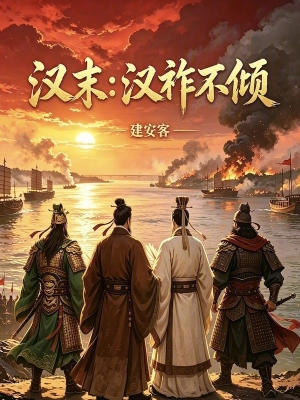
Late Han: The Han Dynasty Shall Not Fall
汉末:汉祚不倾
- Status
- Ongoing
- Length
- 1.4M Words
- Genre
- Historical
- Subgenre
- Qin-Han & Three Kingdoms
- Updated
- 1d ago
- Source
- Qidian
Stats
309Chapters
326Votes
8.6kRecs
11.2kFans
Tags
Synopsis
In booklists 2





Readers also read
 Great Ming: His Father Is Useless, So He Must Summon the Founding Emperor
 Germany: 1914
 Seizing the Direct Descendant in the Red Mansion
 A Literary Master in Ancient Greece
 Simultaneous Transmigration: Is Everyone Starting Out in Prison?
 The Glorious Journey at the End of the Han Dynasty
 Late Han Emperor Zhaolie: Rising from Liaoxi
 A Dual Status Panel Descends into the Abyss, and the Assassin's Potion Is Right at the Entrance
 The Black Witch's Journey to Another World
 Late Han
 My Father Is Liu Bei, Strive to Become a Dragon Like Your Father
 Three Kingdoms: Restoring the Han Dynasty from Changban Slope
Reader comments 28
Google Translate
Two major tactical highlights of Liu Bei after time travel
Liu Bei did not travel in vain in this plane. Starting from the end of the Battle of Chibi, there are two major tactical highlights: The first is to first determine the four counties of Jingnan and open up the strategic points of Jiaozhou. First, Zhou Yu and Cao Ren consume each other in the Battle of Jiangling. Zhou Yu failed in the attack. After retreating, he took the opportunity to capture Jiangling. He also consumed Cao Ren's reinforcements during the encirclement and reinforcements, and then took advantage of the situation to capture Xiangyang and Fancheng. This tactic is much better than the historical plane, and it did not leave Sun Quan with the excuse of "borrowing Jingzhou". The second highlight is to attack Hanzhong first and then seize Xichuan, which is also better than the historical plane. Historically, Liu Bei's only option was to attack Xichuan first and then capture Hanzhong, because Xiangyang was still in Cao Cao's hands at that time. Taking Hanzhong first became an enclave within minutes, and was attacked from both sides by Cao Cao and Liu Zhang, which was quite dangerous. Now that Xiangyang is in hand, Wei Yan has captured Shangyong, Fangling, Xicheng and other places. Taking Hanzhong is no longer an enclave, and he has saved part of Hanzhong's population and avoided the great loss suffered by Cao Cao in history when he moved millions of Hanzhong's population. Longzhong's goal of "crossing Jingyi" has been initially achieved, adding more territory to Xiangyang, Fancheng and Jiaozhou, and saving part of Hanzhong's population. Although there is still a huge disparity in strength compared to Cao Cao, at least in theory it can defeat him
To be honest, I felt buried in this book.
The writing style is really good, not the kind that is full of rhetoric, but the kind that makes you read with pictures. Liu Bei is not a sign of benevolence and righteousness. He is a man who is really planning, deducing and calculating. There is a price behind every step and there is no skipping. This way of writing is rare and very laborious to write. The group portraits are also solid. It's not like the protagonist and the supporting characters all nod their heads when they speak. Everyone has their own position, and the person opposite is not a paper person. This is a real plus in the Three Kingdoms novel. But I also understand why the data doesn't look good. The pace is slow and there are many characters. It's not the kind of story that you can read at a glance and pick your readers. The title of the book does lack the power to attract traffic. Without the word "Three Kingdoms", the search results will be reduced. However, suggestions are useless. There is only one thing the author can do, which is to finish the book first. There is no need to rush the data. It would be a real pity if it is badly written. For books with good reputation, people will gradually come to read them. Come on
As of August of the 14th year of Jian'an, some explanations of Liu Bei's power
There are only 20,000 to 30,000 real elites, most of the others are newly recruited, and Guan Yu has trained 10,000 recruits, so the difficulty of Huo Jun's defense at Hengpu Pass is also because of this. His subordinates are mainly county soldiers, and the county soldiers have 20 acres of farmland. I will write about the land transfer to the regular soldiers later, but I have not found a suitable insertion point in the war. Many feedbacks about Jiangdong's fighting will, I actually define the nature of Bu Zhi's soldiers as elite soldiers. The territory can be increased at once, and troops can be recruited, but elite soldiers are not available immediately.
Kuang Fu Han Room, author come on
I was attracted by the first chapter. The beginning of the story is tragic and the country is broken and the mountains and rivers are gone The awe-inspiring people are still there, the hero's unyielding spirit is even to death, and the writing is picturesque (xia refers to the overlap of the great ancestor when he was a knight-errant) At the beginning, I was given a cold and hazy sky, depressing, and it seemed like a rain was coming, and it continued like this in the later chapters. As a single chapter, I like it very much. The following is an immature idea. It is said that there are three golden chapters. The first chapter is actually a bit embarrassing for the readers of the Three Kingdoms Because the characters are not familiar to everyone, readers who come to the Three Kingdoms will slip away at a glance. After all, the King of the North is a bit niche? Some want to see that set of template characters in the first chapter... Secondly, there is a brother who said that the title of the book does not include Three Kingdoms. I personally think he is right. Compared with Late Han Dynasty, Three Kingdoms is indeed more popular. In a sense, I am standing on the shoulders of the author when I post this. After all, it is not difficult for others to shoulder the burden. Similarly, from the accumulation of writing a book, the author can gain far more than the readers. He can avoid some poisonous points, gain writing experience, and even be able to withstand stress, etc. However, he also faces the pressure of writing without positive and negative feedback, so he is exhausted both physically and mentally and cannot run away... I hope the author can maintain his mentality and keep making progress.
Liu Bei Group in the 15th year of Jian'an
There are about 30,000 to 40,000 elites. This group is veterans who have been with Liu Bei for many years. They have been tempered in the battles in Chibi, Jingnan, and Nanjun, and they have a strong will to fight. Guan Yu's 10,000 Northern Front Field Army, Huang Zhong's public security core, and Zhang Fei's 13,000 veterans in Jiangling are all in this category. The growing number of recruits is about 40,000. The 14,000 recruits being trained at Zhang Fei's Jiangling Camp were recruited starting in the 14th year of Jian'an, and should have basically become an army by the end of the 16th year of Jian'an. This group of people is very important, they are the new force after entering Shu. Thirty thousand county soldiers. The defense of each county in Jingjiao has the weakest combat effectiveness. It is mainly used to defend the city and maintain the place, and cannot be used for field battles. Cavalry shortcomings: The entire group has about three thousand cavalry, which is the most obvious weakness. The Jiling Racecourse is slowly being cultivated, and the battlefield seizures are limited, so it cannot be fundamentally solved in the short term. Explosion potential: Jingjiao has a population of about two million. The land grant system continued to attract refugees, and the population was growing, but the foundation was much weaker than that of Cao Cao. After entering Shu, the addition of Yizhou's population will be a major addition.
Why do Shuzhong and Guanzhong have to pass Yangping Pass when fighting against Hanzhong?
This problem can be broken down into two directions, coming from Guanzhong in the north, and coming from Shuzhong in the south.
The writing is good at describing the details, but it makes me tired to read. There are too many details and no rhythm. The biggest problem is that there is no difference in the characters. There is only narrative and no characters.
Sun Quan Group in the 15th year of Jian'an
The total strength is over 100,000. About 50,000 elites. This group was trained by Zhou Yu. They have experienced the battles of Chibi and Hefei. They are truly elite soldiers. They are the best in the world in water battles and are not weak in land battles. Zhou Yu died, but these troops were still there, and Lu Su took over a beaten army. There are about 50,000 to 60,000 new soldiers in the garrison. Scattered in various counties in Jiangdong, the quality is average, and their main function is to maintain local order and defense. Explosion potential: Jiangdong Yangzhou plus part of Jiangxia, with a population of about two to three million. After Hefei is captured, recruitment can be increased in the Huainan direction, but the population base is much smaller than that of Cao Cao, and the rate of troop deployment is slow. Sun Quan's strategy is careful calculation, not mass tactics.
The civil and military system of Liu Bei Group (15th year of Jian'an)
Civil officials Zhuge Liang, Pang Tong, Xu Shu, Liu Ba, Jian Yong, Yi Ji, Sun Qian, Ma Liang, Ma Di, Jiang Wan, Liao Li, Pan Jun , Xiang Lang, Yin Guan, Mi Zhu, Shi Yan, Fei Yi, Yang Yi, Zong Yu, Xi Wen, Xu Jing, Cheng Bing, Xu Ci, Lai Gong, Kuai Qi, Cai Dian Generals Guan Yu, Zhang Fei, Huang Zhong, Zhao Yun, Wei Yan, Chen Dao, Guan Ping, Huo Jun, Liu Feng, Xiang Chong, Liao Hua, Zhao Lei, Zhang Yu, Xizhen, Xi Zhen, Deng Fang, Feng Xi, Zhang Nan, Fu Wei, Samoko, Zhuoying, Shen Dan, Mi Fang, Zhan Yan, Wu Ju, Lei Xu
I'm going to Shu soon
Do you have any plots you would like to watch, or any good suggestions?