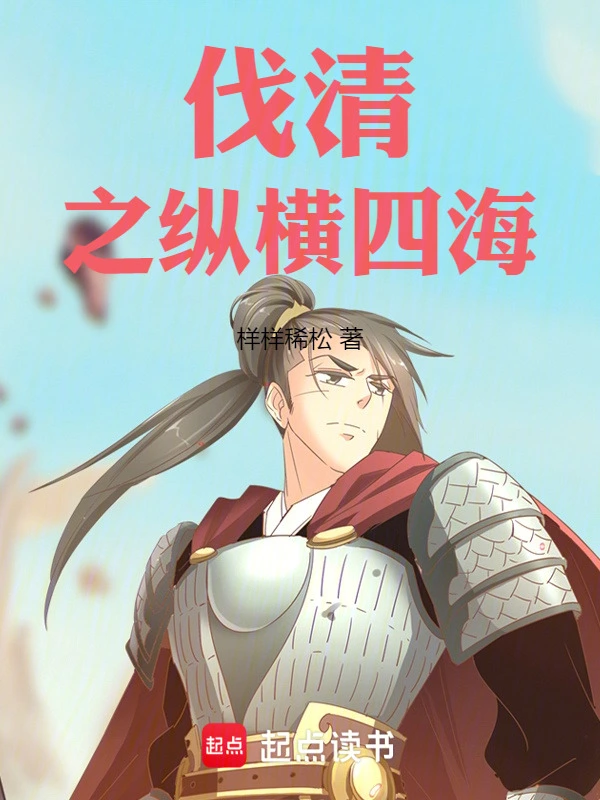
Conquering the Qing Dynasty Across the Four Seas
伐清之纵横四海
- Status
- Ongoing
- Length
- 914k Words
- Genre
- Historical
- Audience
- Male
- Subgenre
- Song-Yuan-Ming Dynasties
- Updated
- 6d ago
- Source
- Qidian
Stats
8Monthly votes
2.1kRecommends
3.4kFans
375Chapters
Synopsis
Reader comments
Readers also read
 Red Mansion: Start Escaping and Farming from the Equipment Bar
 Fu Ming 1627
 After Lying in Bed for Three Years, He Was Forced to Help the Han Dynasty
 Northern Qi, Sage Khan
 Criminal Investigation Notes 2: Buried Corpse in Songhu
 Traveling Through 1570: the Rise of South America
 The Wind Rises 1898: Becoming a Warlord from Nanyang
 Leader
 The Black Witch's Journey to Another World
 I Am a Great Power
 Peace and Prosperity in Han Dynasty 1844
 1848 Qing Dynasty Charcoal Burner
 I'm Really Not the Third Prince Zhu
 Go Against the Will and Change the Light
 Heroes of the Southern Song Dynasty
 Late Ming Dynasty: I Foresee the Future
 Wanli: I Have Become a Tyrant
 Don't Call Me the Carpenter Emperor
 The Southern Song Dynasty Is Unreliable
 I'm Really a Fool
It should be called Kang Mazi!
Kang Xiaosan doesn't sound good! It should be Kang Mazi!
What mistakes are easy to make in historical novels❓
Before the Ming Dynasty, the emperor was not called "Emperor". In the Song Dynasty, he was mostly called "Guanjia", and in other dynasties, he was called "Your Majesty". In the Ming Dynasty, the emperor was occasionally called "Emperor", and in most cases he was called "Your Majesty". After Kangxi of the Qing Dynasty, people began to be generally called "Emperor". Princes and princes call themselves: Princes in the pre-Qin and Han Dynasties can be called "Gu", and a few can be called "Ignores". After the Wei, Jin, Southern and Northern Dynasties, the title of "Ignores" gradually became exclusive to the emperor, and princes, princes and princes can only be called "Gu" or "I". Song, Yuan and Ming called themselves "I" or "I". Before the Qing Dynasty, princes and princes rarely called themselves "this king". Starting from the Kangxi year of the Qing Dynasty, princes generally called themselves "this king". In ancient times, women called themselves: "nujia" was a modest name for women after the Song Dynasty. Women in the Han and Tang Dynasties more often called themselves "concubine", and noble women could call themselves "I" and "I". Before the mid-Ming Dynasty, most dynasties used copper coins for daily transactions, with very little gold and silver. It was only in the mid-to-late Ming Dynasty that silver became the mainstream currency. In the late Ming Dynasty, "meeting votes/deposit checks" appeared among the people. There were no unified rules. Most of them were deposits and withdrawals/exchange receipts from acquaintances or local circulation, and were not legal currency. In the early years of Daoguang in the Qing Dynasty (1823): Rishengchang Bank was established, and private banks began to issue standardized banknotes, focusing on cross-regional exchange. They were only circulated in Shanxi merchant trade circles and major commercial ports, and were not yet popular. In the third year of Xianfeng in the Qing Dynasty (1853): the official issued the Ministry of Revenue official banknotes (official banknotes), which were forced to circulate nationwide. At the same time, the network of private banknotes expanded to the whole country, and official and private banknotes ran parallel. The use of banknotes entered an explosive period and became the "starting point of popularization." High-leg tables and chairs only completely replaced the low tables for sitting on the floor in the Song Dynasty. During the Han and Tang dynasties, people knelt and sat on the tables to eat and discuss matters. The furniture was mainly low tables and couches. The memorial system was only established during the Kangxi period of the Qing Dynasty. Officials in the Tang and Song Dynasties used "memorials", "tables" and "statements" when submitting memorials, while in the Ming Dynasty they used "memorials" and "memorials". There is no such thing as "memo" or "zhezi". In ancient formal occasions, the hand-over gesture was performed with the left hand outside and the right hand inside. The right hand outside was a special "unlucky gift" for funerals. "Better greetings" is a unique etiquette of the Qing Dynasty. It was mostly used by subordinates to superiors and juniors to elders. During the Tang and Song dynasties, people often performed cross-hand salutes and bows to greet greetings when they met, and there was no such thing as "sending greetings". {"NickName":"Restriction and Supervision","UserId":417773267} Before the Yuan Dynasty, subordinate officials rarely called superior officials "adult". In some dynasties, subordinates called eunuchs "adult", and in some dynasties, they called their parents and elders "adult". Beginning in the Yuan Dynasty, lower-level officials would occasionally call officials of second-rank and above "sir". From the middle and late Ming Dynasty, only officials of third-rank and above would be called "sir" by their subordinates. Officials with lower ranks could not be called "sir". However, in the late Ming Dynasty, there began to appear a few cases where officials above the fourth rank were called "adult". Before the mid-Qing Dynasty, following the rules of the Ming Dynasty, only officials of third rank or above would be called "adult". Starting from the mid-Qing Dynasty, calling officials "adult" gradually became common for lower-level officials. Attention! ! ! What is mentioned above is that lower-level officials refer to higher-level officials. No matter which dynasty, it is absolutely impossible for higher-level officials to call lower-level officials "sir". Some novels even write about emperors or nobles calling other officials "sir". This is simply contrary to Tiangang! ! ! Finally, let's talk about the problem of civilians calling officials Before the middle and late Qing Dynasty, civilians in various dynasties and generations called officials differently, and most of them called them "officials" and "masters". From the middle to late Qing Dynasty, civilians also called officials "adult".
How to cure malaria?
The main reason why the Mekong Delta has not been developed is malaria. The Mekong Delta suffers from tropical malaria, with a five-year mortality rate of less than 50%.
There are too many loopholes in soul-traveling historical novels. A modern person who accidentally travels to a certain dynasty can remember so many details in history (even better than a history expert). China has thousands of years of history, and it is impossible for historical experts to remember every detail of a certain period of history in just a few years. Unless he is a historical expert who specializes in a certain period of history, does the protagonist of Soul Transmutation happen to be a historical expert who specializes in a certain period of history? Don't say that the protagonist was a lover of historical novels before time travel. Don't be ridiculous. Historical details are not something that historical novels can cover, it's not the same thing at all! Even if the protagonist happens to be an expert specializing in the history of a certain period. If you travel to ancient times, what can you do? This involves another big loophole in historical fiction. The protagonist can draw drawings of various machines and weapons, understand metallurgy and metal processing, chemical industry, and improve agricultural tools. In fact, these loopholes are easy to solve. Since the protagonist's soul has traveled to ancient times, it proves that ghosts do exist. Then write that when the protagonist goes to sleep at night, his soul leaves his body and returns to modern times. If he doesn't understand something, he can look up information in modern times. This solves various loopholes in soul-traveling historical novels. {"NickName":"Restriction and Supervision","UserId":417773267}
Support The ocean is difficult to write and needs to be more realistic
I haven't read enough. What other books do you recommend about Kangqingwen?
After such a long time, I finally caught up with a first 🤭🤭
The historical view of the Hong and Qing dynasties can be arranged
Can you change the name of your protagonist? It sounds so awkward to read.
What's your name, Kang Xiaosan! It's really embarrassing for the old and the young! Please call Kang Mazi
Second place, I don't know who the first place is 🙂
You can all guess the bloody plot in the future: Chen Shangchuan, who is a fan of enjoyment, wants to support his biological son, and turns against Cheng Anping. . . Alas, how can a nephew not always call him uncle? . . The author writes something that makes people uncomfortable
The real "historical perspective" is precisely to correct this one-sided evaluation method: it admits that people will change and that the environment will affect people, but it will ultimately place these changes in the process of time and history and give an overall evaluation that is as objective as possible, instead of using "people will change" to deny the value of historical evaluation as in this passage.
There is a natural conflict between colonization and anti-Qing Dynasty. It is either a matter of violence or a choice between the two. The colonial route of the Qing Dynasty is the perfect health pack. It will continuously produce proletarians. Will they immigrate with you if they can survive? If you just fight against the Qing Dynasty and that's all, can you still send people out?
I'd like to give you a suggestion, Golden Finger can open it more happily. It will be much more attractive
I don't know what the protagonist's name is when he changes his dynasty. I feel like using Chinese is a bit bad.
Author
Do all the novels you open have multiple female protagonists?
To be honest, just do it if you have to.
Only if you, the author, make money can everyone see better works. There is no need to hold on to them.
A question suddenly occurred to me when I was watching it. Although the Qing Dynasty closed the country, they closed the lower levels and locked the bottom. The upper levels had never cut off their communication and contact with the outside world. The protagonist was growing on the southeast coast and was always preparing for counterattacks. Kang Mazi still dared to cut down the vassal by force. He had seen the Opium War and the spoils plundered by the Eight-Power Allied Forces in Beijing. There were many things that Westerners paid tribute to the Manchu royal family. There should be a sense of the strength of an army's combat effectiveness.
I can see it. The protagonist is a nationalistic thinker. He is just doing things by himself, and has not spread the idea of national unity at all. My subordinates all work on military pay. No thoughts. The ancients didn't know it and couldn't get started. There are no like-minded people. There is no "comrade"