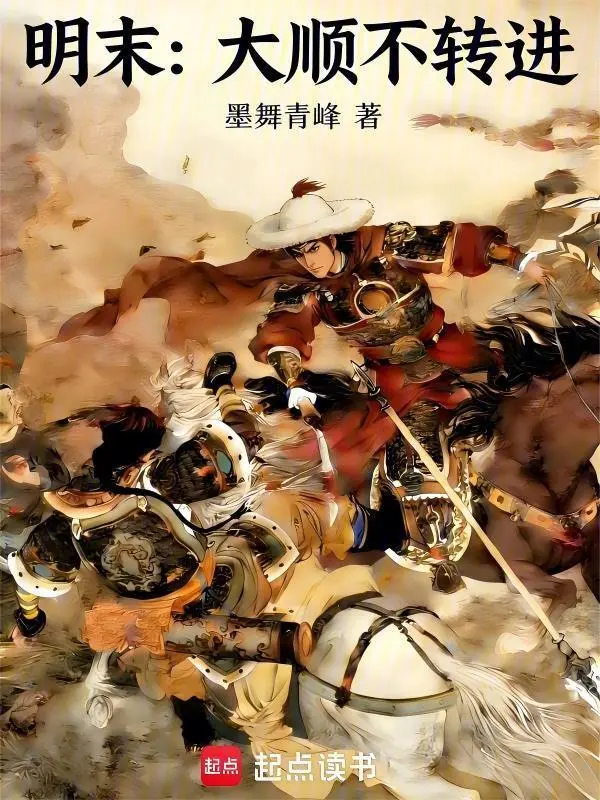
Late Ming Dynasty: Dashun Does Not Turn Forward
明末:大顺不转进
- Status
- Ongoing
- Length
- 1.2M Words
- Genre
- Historical
- Audience
- Male
- Subgenre
- Song-Yuan-Ming Dynasties
- Updated
- 1d ago
- Source
- Qidian
Stats
146Monthly votes
7.1kRecommends
14.7kFans
329Chapters
Tags
Synopsis
Reader comments
In booklists 1
Readers also read
 Fu Ming 1627
 After Lying in Bed for Three Years, He Was Forced to Help the Han Dynasty
 Red Mansion: Start Escaping and Farming from the Equipment Bar
 Northern Qi, Sage Khan
 Siheyuan: Start by Picking up Attributes
 Anti-Qing: Start with a Piece of Stone!
 Peace and Prosperity in Han Dynasty 1844
 Beastmaster: I Can See the Evolutionary Path
 Immortal Who Seizes the Body
 Late Jin Dynasty: from Two-Legged Sheep to Human Emperor
 Sun and Moon: Yongli 1656
 Taiping Heavenly Kingdom 1854
Well written, good luck to the author!
It's better to help Li Zicheng than to do it yourself. Li Zicheng's grass-roots team is worse than the Taiping Heavenly Kingdom.
Li Laiheng, the last general of the Han people who conquered captives, persisted in resisting the Qing Dynasty for more than 20 years. He resisted the Ming Dynasty with the first half of his body, and attacked the unruly Manchu Qing Dynasty with the second half. Speaking of the heroes of the late Ming Dynasty, everyone knows that Zheng Chenggong, Li Dingguo, and Li Laiheng are also well-deserved heroes of the late Ming Dynasty.
Novel related combat illustrations
Some readers said that it would be more convenient to have pictures. Since the author has not signed a contract yet, he can only post pictures in the comment area using a small account. Some illustrations will be updated here as the situation develops. The first is the situation on May 9, 1644 (the day the battle of Chengan Town started)
What mistakes are easy to make in historical novels❓
Before the Ming Dynasty, the emperor was not called "Emperor". In the Song Dynasty, he was mostly called "Guanjia", and in other dynasties, he was called "Your Majesty". In the Ming Dynasty, the emperor was occasionally called "Emperor", and in most cases he was called "Your Majesty". After Kangxi of the Qing Dynasty, people began to be generally called "Emperor". Princes and princes call themselves: Princes in the pre-Qin and Han Dynasties can be called "Gu", and a few can be called "Ignores". After the Wei, Jin, Southern and Northern Dynasties, the title of "Ignores" gradually became exclusive to the emperor, and princes, princes and princes can only be called "Gu" or "I". Song, Yuan and Ming called themselves "I" or "I". Before the Qing Dynasty, princes and princes rarely called themselves "this king". Starting from the Kangxi year of the Qing Dynasty, princes generally called themselves "this king". In ancient times, women called themselves: "nujia" was a modest name for women after the Song Dynasty. Women in the Han and Tang Dynasties more often called themselves "concubine", and noble women could call themselves "I" and "I". Before the mid-Ming Dynasty, most dynasties used copper coins for daily transactions, with very little gold and silver. It was only in the mid-to-late Ming Dynasty that silver became the mainstream currency. In the late Ming Dynasty, "meeting votes/deposit checks" appeared among the people. There were no unified rules. Most of them were deposits and withdrawals/exchange receipts from acquaintances or local circulation, and were not legal currency. In the early years of Daoguang in the Qing Dynasty (1823): Rishengchang Bank was established, and private banks began to issue standardized banknotes, focusing on cross-regional exchange. They were only circulated in Shanxi merchant trade circles and major commercial ports, and were not yet popular. In the third year of Xianfeng in the Qing Dynasty (1853): the official issued the Ministry of Revenue official banknotes (official banknotes), which were forced to circulate nationwide. At the same time, the network of private banknotes expanded to the whole country, and official and private banknotes ran parallel. The use of banknotes entered an explosive period and became the "starting point of popularization." High-leg tables and chairs only completely replaced the low tables for sitting on the floor in the Song Dynasty. During the Han and Tang dynasties, people knelt and sat on the tables to eat and discuss matters. The furniture was mainly low tables and couches. The memorial system was only established during the Kangxi period of the Qing Dynasty. Officials in the Tang and Song Dynasties used "memorials", "tables" and "statements" when submitting memorials, while in the Ming Dynasty they used "memorials" and "memorials". There is no such thing as "memo" or "zhezi". In ancient formal occasions, the hand-over gesture was performed with the left hand outside and the right hand inside. The right hand outside was a special "unlucky gift" for funerals. "Better greetings" is a unique etiquette of the Qing Dynasty. It was mostly used by subordinates to superiors and juniors to elders. During the Tang and Song dynasties, people often performed cross-hand salutes and bows to greet greetings when they met, and there was no such thing as "sending greetings". {"NickName":"Supervision and Restriction","UserId":406440657} Before the Yuan Dynasty, subordinate officials rarely called superior officials "adult". In some dynasties, subordinates called eunuchs "adult", and in some dynasties, they called their parents and elders "adult". Beginning in the Yuan Dynasty, lower-level officials would occasionally call officials of second-rank and above "sir". From the middle and late Ming Dynasty, only officials of third-rank and above would be called "sir" by their subordinates. Officials with lower ranks could not be called "sir". However, in the late Ming Dynasty, there began to appear a few cases where officials above the fourth rank were called "adult". Before the mid-Qing Dynasty, following the rules of the Ming Dynasty, only officials of third rank or above would be called "adult". Starting from the mid-Qing Dynasty, calling officials "adult" gradually became common for lower-level officials. Attention! ! ! What is mentioned above is that lower-level officials refer to higher-level officials. No matter which dynasty, it is absolutely impossible for higher-level officials to call lower-level officials "sir". Some novels even write about emperors or nobles calling other officials "sir". This is simply contrary to Tiangang! ! ! Finally, let's talk about the problem of civilians calling officials Before the middle and late Qing Dynasty, civilians in various dynasties and generations called officials differently, and most of them called them "officials" and "masters". From the middle to late Qing Dynasty, civilians also called officials "adult".
History of the Southern Ming Dynasty, what is it about?
Just edit Gu Cheng's "History of the Southern Ming Dynasty". People will immediately discover that in the late Ming Dynasty, the only ones who insisted on fighting against the Manchus and defending the people were the peasant army. Whether it was the remnants of King Chuang or the remnants of Zhang Xianzhong, they were the main force in the southern resistance to the Qing. The gentry, who had been favored by the people of the Ming Dynasty for more than two hundred years, besides fighting for each other's orthodoxy and stabbing the peasant army in the back, immediately surrendered when they encountered the Qing army. They were rarely able to deal a heavy blow to the Qing army. But under the propaganda of these Ming Dynasty remnants, the emperor and the peasant rebels were at fault for the fall of the Ming Dynasty. Wanli refused to govern the country, Apocalypse appointed eunuchs, Chongzhen was self-willed, farmers rebelled and destroyed the country, and only the gentry had no way to serve the country, so the Ming Dynasty would gradually die. It is precisely because of the whitewashing of these old and young people that they also verified the orthodoxy of destiny for the Manchus to enter the customs. "History of the Southern Ming Dynasty" actually makes one thing clear. The gentry of the Ming Dynasty betrayed their monarch and people to protect their own property. It's not their own way of putting money on their faces. It's about destroying their family to repay their country, or dying to repay their father. The fact is that in order to protect their land and property, the Ming gentry neither loyal to the emperor nor the people.
Don't apply the military discipline of the Red Army to the army of the 17th century. Don't impose the three-three system.
This novel is not much better than those novels. The war and internal affairs are very well written, and the emotional scenes are not obtrusive. It is really good. But I don't understand that the results are not as good as those of hydrology. Some novels that look like they are written by AI still have a monthly ticket of 400 or 500 yuan. I don't understand. Is it a matter of publicity?
One thing to say, if possible, I still don't want Xi'an to be lost. This means that it will be very difficult to recover after changing from hard mode to hell mode.
After reading the beginning, I feel that the author wants to revise the history of the Ming Dynasty. Of course, I even suspect that the author wants to revise the history of the Qing Dynasty. Very innovative. However, it is now the Post-Xinshun 1730 era. If it were still the king, the minister, the father, the son and the son, it would be difficult to write new ideas in the feudal style, and the ceiling would be here. There is no new learning system, military academy staff system, army code of conduct, no navy and sea trade going to Southeast Asia, using fleet bayonets to create markets and nurturing new production relations. Different themes. The data is as follows. Xinshun 1730 11w collection Da Ming Dynasty 1627 Currently 15w collection 1w6 are ordered. The Ming Dynasty Does Not Survive 2w Collection The theme determines the upper limit. If you want to be as famous as the Ming Dynasty 1627, there is still a lot of pressure, come on 🙂
Firstly, Li Zicheng did not have a stable base, and secondly, his discipline was too loose and he could not control his subordinates. Don't rush to Beijing, first establish a stable base outside, lay a solid foundation and train your own officials. You have to know that our party trained more than one million cadres and one million troops during the Anti-Japanese War. Only then can we defeat millions of Kuomintang troops and win the world.
Why didn't Shanxi become a mountain and river barrier to stop the Qing army?
Li Zicheng failed several times but was able to make a comeback because refugees were everywhere. As long as he set up an anti-Ming banner, there would be a steady stream of refugees coming to seek refuge. How were these refugees born? It was precisely because of the plundering of civilian property by the Ming Dynasty gentry and landlords that the Henan gentry was even able to set fire to the entire village in order to compete for the land of a village. Therefore, no matter how much the Ming gentry slandered Li Zicheng as a bandit who harmed the people, northern farmers continued to join the peasant army. Why did Li Zicheng fail? It was because he tried to compromise with the gentry and landlords after the founding of the People's Republic of China, and wanted those gentry and landlords to take the initiative to hand over their land to the refugees, instead of killing these gentry and landlords first and then distributing the land. This caused the gentry and landlords in the north to retain their property after losing their property. After the Qing army entered the pass, they began to unite with the Qing army to eliminate the peasant army. The most obvious thing was that the Shanxi gentry and landlords announced almost overnight that they were out of the control of the Shun army, allowing the Qing army to seize the mountain and river barrier leading to Shaanxi in vain. The conclusion drawn from the analysis based on these historical facts is that the Manchus did not receive any destiny at all, but only received the support of the Ming gentry and landlords, and Li Zicheng's failure was that the revolution was not thorough enough and he killed too few people. When a country's minority groups account for 70% of the country's wealth, then when the people cannot survive and launch a revolution, the main task is to redistribute the social wealth in the hands of these minority groups. In this process, killing is not a crime but a revolutionary method. Thinking that social wealth can be redistributed without killing people is just a fantasy of speculative revolutionaries who are not firm enough.
The paradox of the era of alternation of hot and cold weapons
Now that firearms are on the rise, firearms will be the main force in killing enemies in the future. The more firearms there are, the fewer spearmen and sword and shield men there are to cover them. This also means that the cavalry will be vigorously developed for a long time. And it must be the traditional charging cavalry. And it is not the mounted archer cavalry, nor the musketeer revolving cavalry that emerged in Europe at this time. Rather, it is a pure cavalry charge. Firearms are so efficient in killing people. This forces everyone to choose this way. The best way to deal with cavalry is cavalry. In this era of alternating hot and cold weapons, it is the most difficult era and the most challenging era for generals. The dawn of a new era has emerged. The era of firearms is bound to come. However, the darkness before dawn is the darkest. Polish charging cavalry, Ottoman hot and cold mixed troops, and even Persian armored cavalry can still blast those troops that use pure firearms at this time. Including the servants of the Ming Dynasty, the old camp of the Chuang Army, and the Bagara of the Donglu, most of the firearms troops who can still fight are not recognized by the mother. Before the problems of flint guns and bayonets, fire rate and cost are solved, there will be only matchlock guns in the era of alternation of hot and cold weapons, and the logic of raising troops will be different. The flint gun is equipped with a bayonet and can be used to pull cannon fodder. Disaster victims are perfect manpower. In this era of alternating hot and cold weapons, ordinary people without three to five years of off-the-job training cannot defeat those professional samurai servants. For ordinary generals and officer corps, the command ability, pure flintlock, bayonet, is actually lower than the requirements in the alternating era of hot and cold, and can be copied. Famous generals and geniuses are the same in every era. In the era of alternation between hot and cold, if the dawn never breaks, then, to a certain extent, the correct solution is to use the military household soldiers of Ming Taizu, or even the Eight Banners soldiers of Donglu, or to regress to the Tang Dynasty soldiers. It can even be said that at this time, the small aristocrats who have returned to cold weapons, the off-the-job soldiers who brought their own land and tenants, and the tens of thousands of armed aristocratic soldiers like Mulan will be more capable in field battles than the pure firearms soldiers who are just hobbling. But now that the light before dawn has been seen, the travelers have no choice but to go on. Now, a single pure infantry battalion must coordinate musketeers, spearmen, and heavy infantry. You need to train spearmen, you need to train musketeers, you need to train heavy armored infantry, none of them can be missing. There is only one marching shooting. In order to solve the problems of the size of the matchlock gap, the burning of gunpowder on the soldiers due to open flames, and misplaced shooting during the march, people who died due to gunpowder being ignited by the matchlock during training had to be in their fifties or sixties to figure out the best gap and alternate drum beats. These are just filler lines. What is more needed is an elite field force with cold weapons to protect these premature babies in the new era through the most difficult first years of life. Cavalry is needed. Heavy armored soldiers are needed. Requires martial arts melee combatants. Without these, any radical army reformed into a phalanx system with six rows of deep arquebusiers and a firearm ratio of 70% to 80%... The field battle will be defeated. In fact, if we talk about the unit that most resembles the Agricultural Corps at this time, it is actually the Eastern Tatars. Heavy artillery, heavy armored infantry, heavy armored cavalry... These are all things that only a powerful farming empire can afford, but instead they were created by a group of fishermen and hunters. But the uprising troops of the farming people turned into nomadic regiments. Very black and helpless. Donglu is now attacking cities like Jinan and Kaifeng, and has summarized a complete set of experience in infantry and artillery coordination. After completing preparations such as trenching and blockade, a city like Kaifeng has enough heavy artillery. After the siege, the siege officially begins, and it usually takes three or four days to capture it. The city wall is very thick and cannot be blown down. But why bombard the city wall? If Donglu comes to attack, they will finish digging trenches to blockade them. The first step is to forcibly requisition the people, coats, etc., Weave wicker baskets, fill them with earth, and build forts. The wicker basket is filled with soil and can well buffer the shelling from the opposite side. The second step is to set up artillery positions and select a point on the battlements of the city wall, assuming it to be point B. The city wall cannot be blown open, but the battlements are very thin, and soldiers need the protection of the battlements on the city wall. Donglu will choose to gather heavy artillery, bombard point B, destroy the battlements, forcing the defenders to lose their foothold and disperse to both sides. At this time, select point A fifty feet away to the left, and select point C fifty feet away to the right. Destroy all the battlements from A to C so that the defenders cannot have cover on the city wall. The third step is to assemble heavy artillery and bombard point B. Block A and C. It is not necessary to blast open the city wall, but to break the bricks of the city wall into pieces so that the rammed earth inside breaks up and slides down, forming a sloping earth slope on the city wall instead of a vertical city wall. The artillery provides cover, the musketeers approach and shoot to suppress it, and the heavy armored infantry rushes to capture point B and ascend the city. End. From Songshan to Yangzhou and then to Guangzhou, the routine is almost the same: the artillery bombards the infantry and rushes forward. But now, the invading army is like a nomadic army. It lacks heavy armor, heavy cavalry, and heavy artillery. There is little that can be done against a big city like Kaifeng. In the age of firearms, nomadism could not defeat farming. Take the Battle of Tongguan as an example, which truly determined the fate of surrender and the rise of Tartars. Before the heavy artillery arrived, the Chuang army and Donglu stared at each other's camp, neither of them able to chew it down. After the heavy artillery arrived, the barracks of the intruders could no longer hold up, and a gap was quickly opened. No. 11 Blasted the gap. Under such circumstances, the Shun army was still able to use heavy armor against heavy armor, cavalry against cavalry, and counterattack with 300 heavy cavalry to block the gap. So much so that Nikan, Geng Zhongming, Shang Shan and others had to counteract the attack of the three hundred cavalry. At the same time, the Shunjun infantry can still flank and attack behind to cover the retreat of the main force. In the confrontation with cold weapons and heavy armor, the Chuang army relied on counterattacks to stabilize the situation. The Donglu did not pass the Shun army's camp until the next day. At that time, the main force of the Shun Army had already retreated in an organized manner without any great losses. This also corroborates the performance of the previous battle at Shanhaiguan where Guan Ning's army was basically defeated in one day. But because of this, it left a psychological shadow on Li Zicheng: if he defended the city, he would not be able to defend it under the heavy Tatar artillery. He wanted to fight mobile warfare, but sadly found that even the mobile march, which he was best at, could not outrun the Tatars. The next day Ma Shiyao wanted to learn from Meng Da, and the reason was the same as the reason why he assumed Kaifeng: as soon as the heavy artillery arrived, Tongguan could not hold it at all, and as soon as the field camp outside retreated, Ma Shiyao had no choice but to surrender if he wanted to succeed. Not just the Chuang army, even the Western army, Zhang Xianzhong was shot by an arrow and bled. Before the blood dried up, he commanded the troops to counterattack and defend, but still did not let the Donglu take advantage of the chaos to break into the camp. He did not bleed out until the situation was stabilized and died. The quality of its subordinate troops is very good. The heavy infantry and cavalry of the Chuang army will not be bad. Moreover, there were many generals in the Chuang Army who could command heavy infantry, heavy cavalry and other cold weapons. Li Dingguo was capable of fighting in the Western Army, but he could not defeat He Zhen, the Chuang Army. He Zhen was not the most capable fighter in the Chuang Camp. That's why Zuo Liangyu would chase Zhang Xianzhong and try his best not to fight Li Zicheng. He would run and slip away when he could. The problem is that times have changed. At first glance, it sounds like a scene from a fairy tale. The Nascent Soul's powerful nails and hair fall off into the mortal world and become magical weapons for practitioners. It seems that a 33-fold Kofilin cannon found on a shipwreck in Western Europe has greatly changed the shape of warfare, offensive and defensive models, and city defense systems in East Asia. Actually not. The overall cultivation levels of both sides are similar, but their ideas are different. Actually, this is another [because advanced, therefore backward], which is contrary to the Tao. Because the handmade textile industry is too advanced, the mechanical textile industry lags behind. Because the steam engine is too advanced, the internal combustion engine is lagging behind. Because the internal combustion engine is too advanced, the electric era lags behind. Because the technology for building city walls was too advanced, the ultra-thick model of rammed earth walls was adopted hundreds of years before the bastion era. Therefore, heavy artillery must fall behind. Because it was useless in the early days, it was not the stone masonry wall in Western Europe. As for the Nanjing City Wall built by Emperor Hongwu to a high height, with bricks wrapped in rammed earth, and a layer of rammed earth tens of meters behind, it would be useless if you asked Urban to bomb it until it exploded. If the main threat is nomads, how about building four oxen to pull heavy artillery that can travel ten miles a day to build wool felt tents? Or build a 130-pound Weiyuan cannon that can be carried on horseback for marching? The stone fortress greatly stimulated the development of high-pressure heavy artillery technology. Rammed earth walls and the threat of unarmored nomads will lead the development of firearms in the direction of low-pressure spray guns. High-caliber heavy artillery in front of rammed earth walls and nomads is completely inferior to using small-caliber spray killing mode. It is impossible to focus on this aspect in terms of technology. There may even be another way, which is easier and faster to develop in the early stage. When these two routes intersect at a certain threshold, a gap inevitably appears. Just like at a certain moment, the rolling steam train finally surpassed the carriage that could only flatter before.
The writing is very good, I will fully support it as long as it is updated
This book is not about Li Laiheng alone, but about the growth of a team and an organization. After stealing Zhizhuang and gaining fame, King Chen rose up and waved the yellow ax. Come on, author.
The popularity is too low. I hope the author can continue to advertise himself on Zhihu.
I very much hope that the author can write this book to the end. Come on, I hope you can be signed.
General Li in armor
Reference Ming Army Armor
The core of the story is quite attractive, but unfortunately the writing technique is too heavy on AI, the language expression lacks personality and warmth, the narrative rhythm and character creation are slightly rigid, and it lacks a bit of the smart charm that the text should have. Personal opinion, don't comment if you don't like it~~
The situation in Shanxi has been stabilized for the most part. As long as this Qing army is annihilated or repulsed, the situation between Shun and Qing will change from a Shun-Qing attack to a Shun-Qing stalemate.
I think the name should be changed to Chuangshun Tianxia, and although Fan Zhiyi's jokes are quite interesting, the protagonists say that if history must be serious, then the history from the peasant uprising in the late Ming Dynasty to the Anti-Qing War must also be so.
By chapter 60, it's really getting ugly.
The argument from the battle of this Wubao to the article here is completely a hysterical disease based on modern moral concepts. If you are serious about researching the military of various countries in the 17th century, until the 18th and early 19th centuries, military plunder has been used as a military and political method again and again. Application is a measure to maintain the combat effectiveness and morale of soldiers. From Gustav's Swedish New Army and Wallenstein's mercenaries in the Thirty Years' War in the first half of the 17th century, to various armies in the late Ming Dynasty, to Napoleon's defeat and exile, there is no equal. Taking the historical environment in which this book is set, looking at it as a whole, this is the peasant uprising army's response to the counterattack of the landlord class. On an individual level, the soldiers only join you in order to improve their own lives. The class position of the ruler himself is still far away from the big landlords, but he actively responds to the feudal order of the big landlords.
Nowadays, many authors write novels in which the protagonist is an emperor, but they are too small-minded. As a time traveler, the protagonist becomes an emperor. He has more advanced weapons and his ambition to expand the territory is not as good as those emperors in history who had backward weapons! Both the Han Dynasty and the Tang Dynasty expanded their territory to Central Asia, and Genghis Khan went to Europe. If the Golden Family had not been involved in the succession issue, their original goal was to reach the seaside in all directions. As a time traveler, if you can popularize thermal weapons in your army. Then the territory of the Chinese Empire should be: the Arctic Ocean in the north, the Bering Strait in the northeast, the Ural Mountains in the northwest, the east coast of the Mediterranean in the west, Yemen in the southwest, Johor in the south, the Luzon Islands in the southeast, and Honolulu in the east. Southern Ocean islands such as Sumatra, Java, Kalimantan, Sulawesi, and New Guinea, as well as the Maldives, Sri Lanka, Madagascar, Australia and New Zealand, Africa, and North and South America were all entrusted to the princes.
Writing Liu Zongmin is too mentally retarded.
It's not fun to stretch your hips at the beginning. First of all, even if a modern person travels through time and does not engage in democracy and republic, he still has to consider the historical cycle rate. Where does the national sentiment of family and world come from! How to deal with the future if the people are not enlightened, accelerate the industrial revolution, implement universal education after 20 years in power, complete the industrial revolution in four five-year plans, reach the technological level of the 20th century in four five-year plans, enter the second industrial revolution, lead hundreds of years in productivity, achieve global deployment of technology, and dominate the world
The author's golden finger is a bit too big! Might as well come up with a system.
After reading the first few chapters, how could the protagonist, the Reborn, not understand anything!
We must kill all the pig monsters like Fengyang Pig Demon
The author is a eunuch. I still have a headache.
Nine Kings of the Qing Dynasty VS Emperor Dashun
The leader of the white flag, Mergen Daiqing, Prince Heshuorui, the emperor's father and regent... These are the status and prestige possessed by the nine kings of the Qing Dynasty in my destiny, one is stronger than the other, and each has higher status and public office... My name is - Duo Ergon The strongest man in the world at that time, since I took the emperor to order the Eight Banners, the territory and national power of the Qing Dynasty have continued to grow under my hands. The strength of martial arts is only comparable to that of Hong Tai a few years ago... Comparable? Huh, maybe now my talent has far surpassed that brother's! And in order to ensure that I have this invincible reputation, I will do whatever it takes - whatever is needed! In addition to dealing with all those who disobey me, they must also dedicate to me everything that can help me - If there is anyone who disobeys, even if it is my nephew or former colleague, I will not let it go Because this is my way... My way. Maybe some people don't identify with me, but when the vast majority of people in the world trust me and think that I am a noble hero and the greatest emperor, how can I be wrong? No, even if it is to distinguish between loyal and traitor, whether it is to shave off the hair and clothes of everyone in the world, or to slaughter all the rebellious cities, as long as the stupid people don't know, and others dare not resist, and are afraid of me - What else can I do wrong? Even if I make a mistake, in the end it will only be the fault of the Han people, the fault of the intruders, and the fault of the weak, because without my talent and ambition, they would still only live in the painful world of melee in the north! So, all people who do not want to die or suffer pain must love me, be loyal to me, respect me, and worship me! Appreciate me, the flag owner, I, Mergen Dai Qing, will swear to death to lay a white flag for me, I and Prince Shuorui, my royal father, the regent—I, I——— I, the Nine Kings of the Qing Dynasty—!
I recommend a good book with a niche setting "I Can Go to the Past and the Future". The first chapter is voiced by a female Loli author. It is a light novel with a male channel. The background is a passionate adventure in the fantasy future interspersed with daily love. It mainly uses the floating city in the interstellar era as the world view. There are nine ways to sublimate potions + three Ten sequential paths are the core timeline setting text, witty fighting + decisive killing, the plot is interlocking, there are many foreshadowings such as grass snakes and gray lines, the details are controlled, the setting party, there are no bloody routines and brainless plots, the overall is relaxed, interesting and semi-invincible. Brothers and sisters who are interested can come and take a look.
Installing a bayonet on the firegun is actually a very easy solution
In the late Ming Dynasty, there should be a direct-insert copper lock technology. This direct-insert copper lock can be transformed into a direct-insert bayonet by modification.