


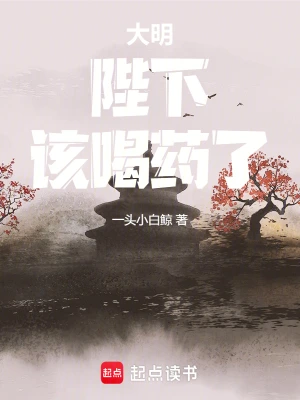
Great Ming: Your Majesty, It's Time to Take Your Medicine!
大明:陛下,该喝药了!
- Status
- Completed
- Length
- 2.7M Words
- Genre
- Historical
- Subgenre
- Song-Yuan-Ming Dynasties
- Updated
- 27d ago
- Source
- Qidian
Stats
680Chapters
40Votes
24kRecs
230.9kFans
Tags
Synopsis
More by this author
In booklists 4
On the Road to Godhood
A big thumbs-up to all you tentacle monsters on the road to godhood.
40Books600Follows1moUpdated
Book Recommendations from a 20-Year Veteran Bookworm
Mostly books currently being written, with a focus on the best
10Books1.2kFollows10moUpdated
My Banned Bookshelf: A Mixed Bag of What I'm Reading
Things have been rough. It took over three months for this list to finally get approved. I'll start updating the list in 2025. I read all kinds of books, but lean toward stories that cross worlds, comedy, and behind-the-scenes masterminds. I'll also check out other genres if they're well written.
27Books1.2kFollows10moUpdated
Time-Travel Novels Set in the Song, Yuan, Ming, and Qing Dynasties
Novels about transmigrating to different periods of the Song, Yuan, Ming, and Qing dynasties
21Books1.2kFollows1yUpdated
Readers also read
 Great Ming: His Father Is Useless, So He Must Summon the Founding Emperor
 Seizing the Direct Descendant in the Red Mansion
 Germany: 1914
 A Literary Master in Ancient Greece
 I Transmigrated to the Ming Dynasty and Trained Old Zhu to Become a Great Navigator
 I’m a Demon Daoist in the Northern Song Dynasty
 Ming Dynasty Veterinarian: From the Start, I Save Zhu Biao's Life
 Great Ming: The Dead Return
 The Sun Never Sets on Tang
 Great Ming: I Asked You to Die in Protest, So Why Did You Really Die?
 Great Ming: I, Yan Maoqing, Really Am Blessed
 Northern Song Dynasty: I Spoiled the Future, and Zhao Kuangyin Broke Down
 Game of Thrones: I Loaded the Witcher System
Reader comments 33
Google Translate
Many authors always have a problem. Once the protagonist is a supernatural being, there must be other supernatural beings from other places to challenge him. It seems that if the protagonist is alone in the world, someone must jump out to oppose and suppress him. Otherwise, the novel will not be written, and the contradictions cannot be written. But in ancient times, with the power shown in the novel, it must have suppressed all forces? Will he definitely be invincible? To say he is extraordinary is to praise him. To put it bluntly, he is just a strange person. As long as he makes up his mind, can't others kill the protagonist?
The theme is obviously a demon hunter potion, and the identity is an imperial physician, but after it was released, it ended up being a fight with the Tatars for twenty chapters? You might as well just rewrite the military commander essay.
It's nice to watch, but the main character forgets his roots a bit, and the master's family is completely gone 😰
What mistakes are easy to make in historical novels❓
Before the Ming Dynasty, the emperor was not called "Emperor". In the Song Dynasty, he was mostly called "Guanjia", and in other dynasties, he was often called "Your Majesty". In the Ming Dynasty, the emperor was occasionally called "Emperor", and in most cases he was called "Your Majesty". After Kangxi of the Qing Dynasty, people began to be generally called "Emperor". Princes and princes call themselves: Princes in the pre-Qin and Han Dynasties can be called "Gu", and a few can be called "Ignores". After the Wei, Jin, Southern and Northern Dynasties, the title of "Ignores" gradually became exclusive to the emperor, and princes, princes and princes can only be called "Gu" or "I". Song, Yuan and Ming called themselves "I" or "I". Before the Qing Dynasty, princes and princes rarely called themselves "this king". Starting from the Kangxi year of the Qing Dynasty, princes generally called themselves "this king". In ancient times, women called themselves: "nujia" was a modest name for women after the Song Dynasty. Women in the Han and Tang Dynasties more often called themselves "concubine", and noble women could call themselves "I" and "I". Before the mid-Ming Dynasty, most dynasties used copper coins for daily transactions, with very little gold and silver. It was only in the mid-to-late Ming Dynasty that silver became the mainstream currency. -In the late Ming Dynasty, "meeting votes/deposit checks" appeared among the people. There were no unified rules. Most of them were deposits and withdrawals/exchange receipts from acquaintances or local circulation, and were not legal currency. In the early years of Daoguang in the Qing Dynasty (1823): Rishengchang Bank was established, and private banks began to issue standardized banknotes, focusing on cross-regional exchange. They were only circulated in Shanxi merchant trade circles and major commercial ports, and were not yet popular. In the third year of Xianfeng in the Qing Dynasty (1853): the official issued the Ministry of Revenue official banknotes (official banknotes), which were forced to circulate nationwide. At the same time, the network of private banknotes expanded to the whole country, and official and private banknotes ran parallel. The use of banknotes entered an explosive period and became the "starting point of popularization." High-leg tables and chairs only completely replaced the low tables for sitting on the floor in the Song Dynasty. During the Han and Tang dynasties, people knelt and sat on the tables to eat and discuss matters. The furniture was mainly low tables and couches. The memorial system was only established during the Kangxi period of the Qing Dynasty. Officials in the Tang and Song Dynasties used "memorials", "tables" and "statements" when submitting memorials, while in the Ming Dynasty they used "memorials" and "memorials". There is no such thing as "memo" or "zhezi". In ancient formal occasions, the hand-over gesture was performed with the left hand outside and the right hand inside. The right hand outside was a special "unlucky gift" for funerals. "Better greetings" is a unique etiquette of the Qing Dynasty. It was mostly used by subordinates to superiors and juniors to elders. During the Tang and Song dynasties, people often performed cross-hand salutes and bows to greet greetings when they met, and there was no such thing as "sending greetings". Before the Yuan Dynasty, subordinate officials rarely called superior officials "adult". In some dynasties, subordinates called eunuchs "adult", and in some dynasties, they called their parents and elders "adult". Beginning in the Yuan Dynasty, lower-level officials would occasionally call officials of second-rank and above "sir". From the middle and late Ming Dynasty, only officials of third-rank and above would be called "sir" by their subordinates. Officials with lower ranks could not be called "sir". However, in the late Ming Dynasty, there began to appear a few cases where officials above the fourth rank were called "adult". Before the mid-Qing Dynasty, following the rules of the Ming Dynasty, only officials of third rank or above would be called "adult". Starting from the mid-Qing Dynasty, calling officials "adult" gradually became common for lower-level officials. Attention! ! ! What is mentioned above is that lower-level officials refer to higher-level officials. No matter which dynasty, it is absolutely impossible for higher-level officials to call lower-level officials "sir". Some novels even write about emperors or nobles calling other officials "sir". This is simply contrary to Tiangang! ! ! Finally, let's talk about the problem of civilians calling officials Before the middle and late Qing Dynasty, civilians in various dynasties and generations called officials differently, and most of them called them "officials" and "masters". From the middle to late Qing Dynasty, civilians also called officials "adult". {"NickName":"Restriction and Supervision","UserId":417773267}
I came to see you make medicine💊, not to see you show politics
Brother, you, an imperial doctor, come to the battlefield to play with this, right? Don't you know what everyone wants to see? It's like this on the shelves.
Ordinary people will die if they drink the medicine of the witcher The witcher himself can be poisoned if he has high physical fitness.
I don't understand why the protagonist enters the palace in the beginning. He dislikes himself for living a long time, but still thinks that he is a time traveler and won't die even if he is so promiscuous. Although from a God's perspective, we all know how promiscuous the protagonist is and how he will not die no matter how he plays, but the protagonist also knows?
There may be demons and vampires, so how can I have my own way? The protagonist's IQ is a bit low. He already knows the history, but he has no feeling for what Xia Yan and the civil servant group have done.
The source of the Ming Emperor's "easily soluble in water" was Zhu Yuanzhang suggesting that his subordinate Liao Yongzhong drowned the Xiao Ming King Han Lin'er in the lake. As the saying goes, if the upper beam is not straight and the lower beam is crooked, it is normal that the Ming Emperor is easily soluble in water. It is said that Zhao Guangyin, Taizu of the Song Dynasty, bullied the orphans and widowers of the Chai family of the Later Zhou Dynasty and gained the throne unfairly. But no one explained that Taizu Zhu Yuanzhang directly drowned Han Lin'er, the son of the founder of the Red Scarf Army, Han Shantong, Xiao Ming Wang. In terms of life, he was worse than Song Taizu.