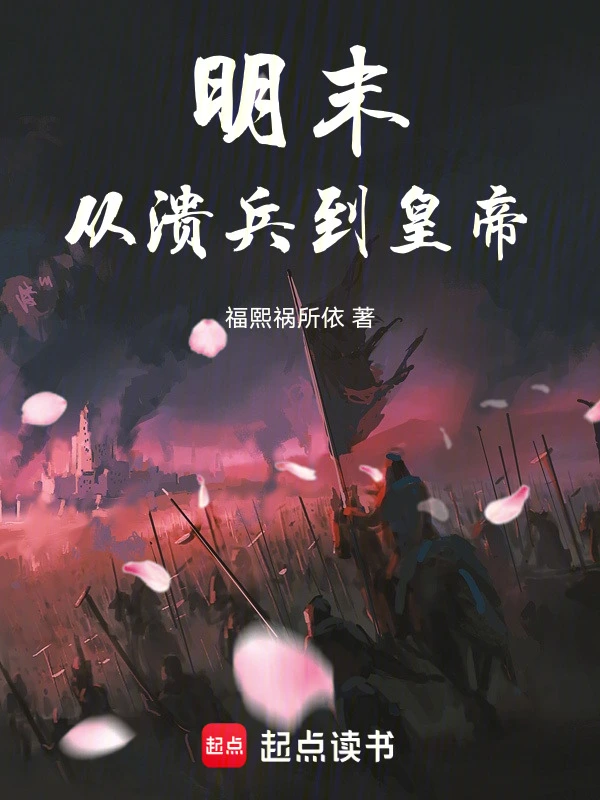
Late Ming Dynasty: from Defeat to Emperor
明末:从溃兵到皇帝
- Status
- Completed
- Length
- 1.1M Words
- Genre
- Historical
- Audience
- Male
- Subgenre
- Song-Yuan-Ming Dynasties
- Updated
- 7mo ago
- Source
- Qidian
Stats
0Monthly votes
1.8kRecommends
3.6kFans
397Chapters
Tags
Synopsis
Reader comments
Readers also read
 1914 Begins with the Rejection of the Schlieffen Plan
 Please Call Me Your Majesty the Tsar
 In the Red Mansion: Escort Daiyu to Beijing at the Beginning
 Talker in the Song Dynasty
 Never Walk Alone!
 Late Jin Dynasty: from Two-Legged Sheep to Human Emperor
 Anti-Qing: Start with a Piece of Stone!
 Daming: Have I Become Wanli's Portable Grandfather?
 I Am Drawing a Hot-Blooded Episode in the Zhiyu Episode!
 Reveal the Truth!
 You Promised to Fight Against the Qing Dynasty and Restore the Ming Dynasty, but You Are Going to Camp in Jintian?
 Overlord
Going to the countryside? Are you ready to be a rogue bandit? No mountains, no rivers, no dangers waiting to be wiped out? This was not yet the end of the Ming Dynasty. The officers and soldiers were quite capable and were wiped out in one fell swoop. Those who had divided their fields would not see any short-term benefits, and those who had not been forced to divide their fields had not yet been forced to form small groups. After the war was over, they fought twice in a few months before dividing their troops. This would have been impossible without something happening. The best result would be that the people and the army would be demoralized due to cholera, and the worst result would be that they would not be able to come back at all. Let's take a closer look at the peasant army. They are basically rogue bandits and cannot survive without running away. At most, they can only pretend to be in peace for a year and a half. The time is short, and there is no chance of accumulating grain widely. There is no chance of building a deep wall. It has not caused particularly big damage yet, and it has no value in being united. After the Long March, all those left behind were the elite backbones, who separated and became sparks, just like a virus. A few people promoted a village, and they had to have a very high level of ideological awareness. At first glance, the protagonist's group was also a mob, and it was impossible not to flee. If they stayed for a short time, they would have to be wiped out from behind, and they had to flee to find a new base. There were too few places to choose from in Shandong. Going north and west, they also acted as shells and had to defend themselves against enemies from all sides. I tried my best to climb the mountain, but there was no place.
Chen Bangyan
Chen Bangyan, a hero of the Anti-Qing Dynasty After the fall of the Ming Dynasty, the Manchu aristocratic army marched into the Pass, defeated the Dashun Army and the Daxi Army of Li Zicheng and Zhang Xianzhong, crossed the Yellow River, crossed the Yangtze River, and crossed the Five Ridges. The flames of national war ignited throughout the land of China. In the vigorous resistance struggle of the Han army and civilians, a striking national hero also emerged in Shunde County in southern Xinjiang. He is Chen Bangyan, one of the "Three Lingnan loyalists" who has been well-known in the Pearl River Delta for hundreds of years. Chen Bangyan, whose courtesy name was Huifen and whose name was Yanye, was from Xiaopu, West China, Longshan, Shunde. His father, Shaoyin, moved his family to Daliang, a county town, and started teaching as a church. Bang Yan was born in the 31st year of Wanli (1603). He studied with his father since he was a child. He had a courageous temperament, lofty ambitions and outstanding knowledge. At the age of eighteen, he entered the county school and ranked among the best in every exam. As an adult, he had a tall figure, a red face, a beautiful beard, and piercing eyes. He was "able to withstand the sun and could stare without being dazzled" (Ju Dajun's "Shunde Gongzhuan"). His moral character and knowledge were deeply respected by people at the time. Bangyan studied the "Book of Changes", "Mao Shi" and the study of practical application of the world. When he was more than 20 years old, he set up a tent to give lectures at the foot of Jinyan Mountain in the northern suburbs of the county, and was known as "Mr. Iwano" in the world. There are no fewer than hundreds of people from far and near who come to learn from him every year. The famous writer Qu Dajun is his disciple. In addition to teaching and studying, he paid close attention to current affairs and made sincere suggestions on major government and county affairs. Therefore, government officials often sought his advice when encountering problems. Although he was full of knowledge, he did not go well in the examination room. He failed to pass the examination many times. People were unfair to him, but he didn't care. In the seventeenth year of Chongzhen (1644), Qing troops entered the pass and the Ming Dynasty fell. King Fu Zhu Yousong established political power in Nanjing and changed the Yuan Dynasty to Hongguang. With the national crisis approaching, Kunihiko was worried and said impassionedly to his friends: "Anyone who does not want to serve the country at this time is not a man!" He immediately ended the lecture and carefully wrote the "ZTE Reform" with more than 17,000 words in response to the situation, detailing 32 strategies for resisting the enemy and saving the country. He rushed to Nanjing alone to present to Emperor Hongguang, but was not adopted because of his low words. Bang Yan had no way to serve his country, and lamented that "it's a shame to hide this body with a seven-foot tall body". He returned south in frustration, and continued to pay attention to the current situation and work hard. In May of the next year, Hongguang Dynasty overturned. The king of Tang Dynasty, Zhu Yujian, succeeded to the throne in Fuzhou and changed his reign to Longwu. He made a great effort to visit talented people and organize the war of resistance. Bangyan was recommended by Su Guansheng, a bachelor and native of Dongguan, and was admitted. Emperor Longwu read his "Zhongxing Politicians" and greatly appreciated it. He was granted the title of Supervisor and Discipline Officer. Soon, Bangyan took part in the Guangdong Provincial Examination and ranked seventh among the candidates. The next year, Bang Yan was promoted to the head of the Department of War, where he supervised the entry of Guangdong troops into Jiangxi and assisted Su Guansheng in defending the northern front. In September, the Qing troops pressed forward and stormed Ganzhou. Su Guansheng stationed his troops in Nan'an Prefecture and patrolled and watched. Bang Yan repeatedly tried to clear the country, but was not approved. Soon after, Ganzhou fell, Tingzhou and Shanghang in Fujian fell one after another, and Emperor Longwu died. Su Guansheng was eager to establish a new ruler in Guangzhou and ordered the entire army to withdraw. Bang Yan strongly opposed it. He pointed out that Su Guansheng's move was purely a matter of abandoning the basics for the sake of the weak. The top priority should be to rely on the natural dangers of Wuling and Hanjiang to resist the enemies coming from the north and east, so as to protect Guangdong and establish a solid base. It would not be too late to support the new emperor. He urged Su Guan to make fire and speed up the lord's force to pass through Huizhou and Chaozhou to rescue the frontline defenders of Quan (zhou) and Zhang (zhou) who were still struggling to support, and asked to lead an army to guard Nan'an and resist the Qing army on the northern route. But Su Guansheng refused to listen, and Bang Yan had no choice but to retreat south together. After returning to Guangzhou, Ding Kuichu, governor of Guangdong and Guangxi, Qu Shishu, governor of Guangxi, and He Tengjiao, governor of Huguang, elected Gui Wang Zhu Youlang as the regent of the country, stationed in Biwuzhou, and unified command of the southern and southwestern provinces to launch the war of resistance. Su Guansheng and Ding Kuichu had personal grudges and were very dissatisfied. Bang Yan believed that the enemy was facing a formidable enemy and they should abandon their old grudges and fight against the enemy together. Seeing that it had become a fact, Su simply followed the trend and sent Bang Yan to Wuzhou to persuade King Gui to ascend the throne and make Guangzhou the capital, so as to improve his status in the small court in the future. After Bang Yan set out, Zhu Yuyue, the younger brother of Emperor Longwu, fled from Fujian. Su Guansheng decided to support Zhu Yuyue as the emperor in Guangzhou instead of supporting him alone. He was still an emperor anyway. For the sake of being the first to support him, he had to be the "chief assistant". So he joined forces with former Mingge elders He Wuzuo, Huang Shijun and others to support Zhu Yuyue as emperor in Guangzhou and changed the Yuan Dynasty to Shaowu. After Bangyan went to Wuzhou, he was very angry when he heard the news. He felt that Su Guansheng was not only cowardly, but also too selfish. He would go back on his words and it would be difficult to achieve great things. So he decided to part ways with him and assist Zhu Youlang in the great cause of fighting against the Qing Dynasty. In November, Zhu Youlang rushed to Zhaoqing to ascend the throne, changed the Yuan Dynasty to Yongli, appointed Bangyan as the military officer, and sent him to Guangzhou to summon Su Guansheng to return and recruit troops in various counties. But at this time, Su Guansheng had already sent troops to attack Yongli Army. In December, the armies of Shaowu and Yongli were fighting to the death in Sanshui County. Qing general Li Chengdong took advantage of the situation and attacked Guangzhou in succession. Zhu Yuyue and Su Guansheng committed suicide. Yongli's monarchs and ministers also fled back to Guangxi in a hurry. In the chaos of war, Kunihiko lost contact with them. This was already the first month of the fourth year of Shunzhi (1647). Li Chengdong fell into Zhaoqing, captured Wuzhou, and went deep into the hinterland of Guangxi to pursue Yongli's monarchs and ministers. Bang Yan changed his name to Lin Jushi, and seized the opportunity to recruit rebels in the mountains of Gaoming County. He also ventured to Ganzhutan to persuade more than 2,000 people from the Yulong tribe of the green forest to surrender, and sent his disciple Ma Yingfang to join forces with them to restore Shunde. Then, Zhang Jiayu from Dongguan, Chen Zizhuang from Nanhai, Hu Jing and Liang Bin from Shunde, Huang Gongfu and He Shineng from Xinhui, Wang Xing from Enping, Mo Tinglan from Yangjiang, Liang Xinzhuo from Xinxing, and He Shizhang from Dong'an (now Yunfu County) joined forces to control the Qing army advancing westward. In April, Li Chengdong was forced to give up the pursuit of Yongli Jun and his ministers, and returned to the east to rescue them. Bang Yan got the intelligence and sent Ma Yingfang and Yu Long to lead the navy to block the river in the north of Huanglian Township, Shunde. After a long fierce battle, they were outnumbered and defeated by the enemy. Ma and Yu died heroically. Bang Yan took advantage of Chengdong's army turning to Xin'an to attack Zhangjia Yuhan, and together with Gao Mingfa Erxuan and Ou Huaihao captured Jiangmen in one fell swoop, gaining great prestige. Governor Tong Yangjia regarded Bangyan as a serious threat and discovered that his Chun family lived in his hometown of Longshan countryside. He secretly sent Tiqi to make a sneak attack and kidnapped Bangyan's concubine He and his youngest sons He Yin and Yu Yin back to the province in order to help him surrender. Bang Yan sternly replied in Tong Yangjia's surrender letter: "I humiliated my concubine, and my son will kill her. As a loyal minister, I have no regard for my wife!" So He and his two youngest sons were brutally killed. In July, Bang Yan and Chen Zizhuang joined forces to attack Guangzhou. In advance, guard commanders Yang Kuang and Yang Jingye were sent together with 3,000 rebels from Huashan (today's Huaxian County) to pretend to surrender and serve as internal agents. They agreed that Zizhuang would attack the southwest of the city and himself attack the northeast. On the seventh day of the lunar month, at the third watch of the lunar month, they forced the city below and launched an attack together. Unexpectedly, Chen Zizhuang took action two days early, captured the Xiguo Fort, and sent people to post inscriptions under the city. He was captured by the Qing army and forced to reveal secrets. All three thousand people who responded were killed. When Zizhuang saw that the attack on the city had failed, he was about to retreat when Bang Yan arrived with his troops and informed him: "Li Chengdong has just defeated Zhang Jiayu in Xin'an and is now returning to rescue the city. He is expected to arrive at Yu Zhuzhou in the eastern suburbs at midnight tonight. I have set up an ambush to attack with fire. Please join forces to attack. Please acknowledge me." "The symbol of our army is the green flag and red spikes." However, Chen Zizhuang did not pay attention to Bang Yan's intelligence. He made another mistake and did not tell his subordinates to prepare. At the third watch, the enemy troops came from the river. Bang Yan intercepted them with fire and burned dozens of enemy ships. Li Chengdong was caught off guard and retreated hastily. Bang Yan pursued fiercely down the river and approached Zizhuang's barracks at dawn. Zizhuang's men didn't know what was going on, thinking that the enemy was coming in large numbers, so they hurriedly sailed to retreat. Their positions were in chaos, but they were defeated by the Qing army. Bang Yan couldn't make a sound with his palm alone, so he had to retreat quickly. A great feat was ruined in one moment! After Bang Yan withdrew from Guangzhou, he turned to attack Sanshui County and killed Chen Yi, the magistrate of the Qing Dynasty. He then attacked Xinhui and Xiangshan, achieving successive victories. In August, Bai Changcan, the commander of the Nanming Guard, captured Qingyuan County. Li Chengdong counterattacked, but Chang Can invited Bang Yan to join forces and refuse to defend. They set up fences along the river. When Chengdong's warships approached, they were blocked and unable to move forward. Nanming general Huo Shilian took advantage of the situation and set fire to attack Chengdong. However, the wind soon blew in the opposite direction and burned down the fences. Chengdong took the opportunity to return troops and advance towards the city. Bang Yan, Bai Changcan and Zhu Xuexi, a member of the city's army, jointly commanded the soldiers to refuse to defend. They only ate one meal a day, and only sat down and dozed off for a while when they were tired at night. The soldiers were deeply loved and willing to die to serve. The Qing army attacked fiercely for ten days, but still could not succeed. Finally, they secretly dug tunnels directly to the city walls, used gunpowder to blast open the city walls, and swarmed in. The Nanming army could not resist and suffered heavy casualties. In the fierce street fighting, Bai Changcan and Bang Yan's second son Xinyin died. He himself was stabbed three times in the shoulder. He retreated to Zhu's garden and saw that Zhu Xuexi had hanged himself. In grief and anger, he wrote a poem on the wall of the pond pavilion: "No fists, no courage, no pay, no soldiers. Contact the mountains and seas, and the arrows will help Zhongxing. Destiny is not , Disaster is a baby, and it will come down for thousands of years. In view of this loneliness!" After writing, he plunged into the pool, determined to die to serve the country, but was immediately pulled up by the pursuers. He looked up to the sky and laughed: "I am Chen Bingke and Chen Bangyan! ! " After Bang Yan was taken to Guangzhou, he remained unyielding and unyielding despite Tong Yangjia's various attempts to induce him to surrender. He only needed paper and pen to write down his life story and three suicide poems as his answer. The historians loved his good calligraphy and rushed to the prison to ask for letters on paper. Bang Yan did not refuse anyone who came, and he wrote freely. Five days later, Tong Yangjia saw that there was no hope of persuading him to surrender, so he ordered him to be taken to Sipailou (his former address is now Jiefang South Road) and killed. Before his execution, Bang Yan's face remained unchanged and he sang generously: "It is so difficult for me to be born, and I am also in the Margin of the River. The scholar talked about the war, but Shi Zai is not with me. What will happen to me after that? I bow and suffer alone. There are many loyal souls on the cliff, and they will shine through the ages!" After singing, he calmly accepted the sword and ended his heroic life. It was September 28, the fourth year of Shunye's reign (1647). Not long after Bang Yan died for his country, Zhang Jiayu and Chen Zizhuang also died one after another. Although these three most stubborn anti-Qing armed forces in Guangdong at the time were suppressed, their heroic struggle tightly held back the Qing army and gave the Wanli regime that fled to Guangxi some time to breathe and develop. The next year, the Nanming army launched a counterattack and recovered the vast area in western Guangdong. The emperor and his ministers returned to Zhaoqing. Bangyan's eldest son Gongyin, who had escaped from the disaster, entered the martyrdom situation of Chen's father. Emperor Yongli issued an edict to posthumously make him the Minister of the Ministry of War and gave him the posthumous title of "Zhongmin". The students also built a shrine for Mr. Chen Yanye at the eastern foot of Jinyan where Mr. Chen used to give lectures, and burned incense and offered sacrifices at all times. Over the past 300 years, its majesty has never been extinguished, and the mountain has been passed down from person to person. This obscure scenic spot has been admired and respected by people from all over the world. Chen Bangyan is not only famous for his national integrity, but also famous for his poetry and prose. He is the author of "Xue Sheng Tang Ji". The poems are particularly grand, with strong writing skills and deep emotions. Both ideological and artistic qualities have reached a very high level. Together with the famous poets Li Suiqiu and Kuang Lu, they are also known as "the top three poets in Lingnan". "Ocean of Poems from Eastern Guangdong" praised him for "his time-sensitive works, with his breath gnawing at the rainbow, his bones leaning against the falcon, and directly touching the fortress of Shaoling to lift his flag." His great courage and deep emotion are unparalleled in his time. (Excerpted from "A Millennium Look Back at Longjiang")
The protagonist's surname is too niche. It would be better to just give him the surname Yuan Du. I can feel that many people will not watch it because of the protagonist's name.
About poison point collection posts
I've seen it through. Anyway, this book has poor results. As long as the book is not a personal attack on the author, the author will accept it. The author welcomes everyone to criticize the book, but don't criticize the author. After all, the author has now written his millionth word for free. Secondly, I will not ban anyone. You can mention specific poisonous points, and the author will take the time to modify them. Finally, a special statement is made that the protagonist will not surrender to Chongzhen and the Manchus. You can propose specific chapters + plots + protagonists or supporting characters to reduce their wits.
The protagonist is so miserable. Who will read this abusive article? They all read cool articles. Articles that are too depressing look suffocating. Wake up and hold the power of the world. Drunk and lying on the knees of a beautiful woman. That's what the protagonist should do
Well enough
Even if you lose, they don't clean up the battlefield. Why shouldn't they be looking for armor and weapons? Let's all grab money for the body, and then think of ways to gather some troops, and then think about how to live a better life. You are a time traveler. Are you very close to your relatives in this body?
1
Chongzhen's most fatal mistake
The core and most fatal mistake of Emperor Chongzhen was that during his tenure, the situation in Dongjiang Town was messed up and beyond control. At the same time, precious human, material and financial resources have been used to maintain the military presence north of Ningyuan for a long time, and even attempted to regain the Guangning area. This is the most terrible mistake Chongzhen made. In the last years of the Ming Dynasty, we should be on the defensive and awaiting attack, strengthen Dongjiang Town, monitor the bulk trade between North Korea and Houjin, and most importantly, cut off North Korea's ability to carry out shipping to Panjin. Secondly, there is no need to maintain any military presence north of Ningyuan. Manpower and material resources should be focused on strengthening the Yanshan Mountains defense area, especially Huailai, Zunhua, Miyun, Qianxi and other areas. The reason for guarding Ningyuan is that Ningyuan can be transported by sea, which can appropriately increase the depth of Shanhaiguan. More importantly, given Houjin's grain production capacity and supply level, it was impossible for the Eight Banners of Manchuria and Mongolia to siege Ningyuan for a long time. The Eight Banners of Manchuria and Mongolia can bring a monthly ration by themselves, but this kind of action cannot defeat Ningyuan. Especially if Dongjiang Town can be maintained, the Koreans will not be able to transport rations to the Panjin area by sea ships, and the Manchu and Mongolian Eight Banners' siege capabilities will be even weaker. Sticking to the rear of the Yanshan Mountains will greatly save the transportation losses of the Ming Dynasty's official army. The establishment of 30,000 garrison troops and 20,000 field troops in the western Liaoning region can be reduced, and the establishment can be expanded to 50,000 to 60,000 new garrison troops and 30,000 to 40,000 field troops behind the Yanshan Mountains, relying on Tianjin's role as the hub of the Grand Canal. Maintaining heavy military groups around Beijing instead of the Western Liaoning Corridor will significantly reduce the probability that the Eight Banners of Manchuria and Mongolia will break through and enter the East China Plain. This is also the fundamental intention of Zhu Di, the founder of the Ming Dynasty, to move the capital to Beijing. At a time when the empire was in decline and the situation outside the customs was in turmoil, placing the most financially powerful military group in the Liaoxi Corridor instead of around Beijing could be said to be the most serious mistake made by Zhu Youjian, Sizong of the Ming Dynasty! It extremely undermined the fundamental purpose of moving the capital to Beijing and the idea of defending the Yanshan Mountains.
Damn, I just watched it, but I remember that starting from April of the second year of Tianqi, Yuan Keli was the governor of Denglai. He was quite powerful. What should the protagonist do?
Collection of supporting roles
The rebel bandits, army officers, officials, merchants, and grassland generals gathered in the area. Please tell us your name, place of birth, and story, and the author will adopt it according to the needs of the plot. Thank you all book friends for supporting this book.
Is the protagonist going to attack Sichuan and then go north to completely separate the two provinces of Shaanxi and Gansu?
Can
It's interesting. It's rare to see the bottom proletarians written about in such vivid and vivid ways. Most of them are written briefly.
I wish the author a monthly monthly ticket sales exceeding 1,000
By the way, take a look at my novel, now I write about fighting against the way of heaven, fighting against the will of heaven, and moving forward fearlessly!
Food and grass, just the results are not good, I feel it is a pity, most of the good results are not good, and then they all write down to 600,000 to 700,000, it is a pity, it is a pity
Writing is getting better and better
I feel that the writing in the back is much better than the front. The writing in the front is indeed too miserable, which will make many people have no desire to read on. This will have a great impact on the performance of the book. It would be better if the plot in the front could be changed.
From the defeated army to the emperor, is this a rebellion? Do you want to smuggle Wei Yang to you to help you decide the court situation privately? I just read a novel in which the protagonist abducts Qin Guowei Yangling to the late Ming Dynasty. I find it quite interesting...
Often read
Good book, read it often and learn new things, support, support, support!