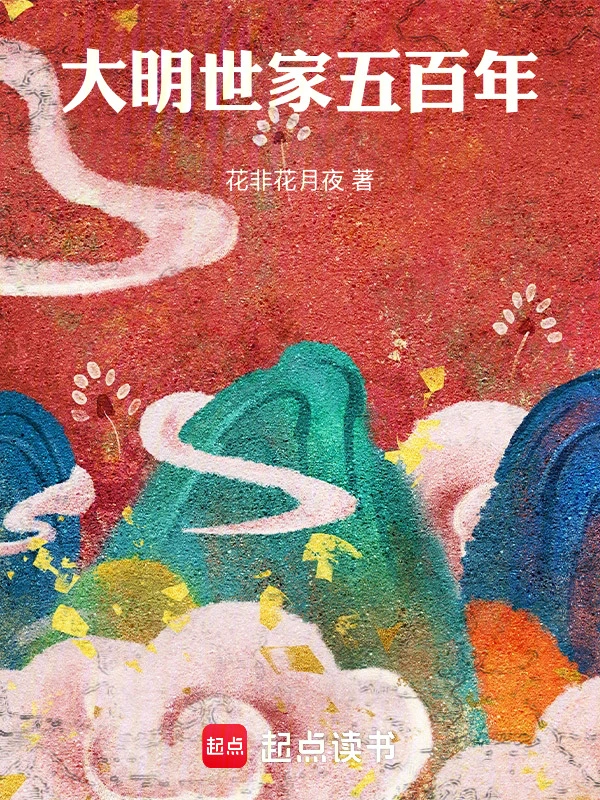
Five Hundred Years of the Ming Dynasty
大明世家五百年
- Status
- Completed
- Length
- 1.6M Words
- Genre
- Historical
- Audience
- Male
- Subgenre
- Song-Yuan-Ming Dynasties
- Updated
- 5mo ago
- Source
- Qidian
Stats
Tags
Synopsis
Reader comments
In booklists 10
🔥Highly Recommended New Books
Recommended level: [Heavenly King's Assets/Great God Level]>[Wanjun's Assets]>[Exquisite Assets]>[Books in the Wilderness to Read]>[Niche Articles] The owner of the new book list that has not yet been put on the shelves will predict whether Sanjiang will be available. They are all books that I am reading or that are good, high-quality online articles, and the quality is guaranteed. Mainly promote new books, no ads! Prediction of the list of twelve kings in 26 years: "Gou Becomes a Saint in th
Historical Time Travel Novels of the Tang, Song, Yuan, Ming and Qing Dynasties
Historical novels that travel through the Tang, Song, Yuan, Ming and Qing dynasties
Smiling at the World of Mortals ~ a Desert of Books
I've been a bookworm for ten years, I can't say how high my level is, but I have at least some appreciation ability. If this private book list is discovered and liked by you in the vast sea of books, it will be a blessing to me, and I hope it will be a blessing to you too!
Chronicles of Time
I will record the books that I have read and feel good about. Some are from the past, some are from the present, and some are moving towards the future. Welcome to communicate ~ and if there is an event, please send flowers for support^_^
Write About My Interest
Own preference
Personal Food Is Continuously Updated
All types are available
Recommended History
For personal use, these are all books that are currently being read or are about to be read. You are welcome to like/dislike, and thank you for your help in filtering.

Gather Books so That They Will Be Used When There Is a Shortage of Books in the Future (Good Books but Not Fattened up Yet)
The books here are all books that I personally think are good and worth reading after reading them. Some of them are just starting out and will be stored in advance until they are fattened up before reading, and some are just for the magical time when there is a book shortage.
Cai, Step on Me
Color
Food and Grass Go First Gogogo
I'm watching
Readers also read
 Red Mansion: Start Escaping and Farming from the Equipment Bar
 Northern Qi, Sage Khan
 Fu Ming 1627
 After Lying in Bed for Three Years, He Was Forced to Help the Han Dynasty
 If You Are Already an Adventurer, Who Should Work Hard on Your Own?
 My Portable Ming Court
 Datang: They Force Me to Be Emperor, Right?
 The Artist Begins in Prison
 Traveling at the Same Time: Great Love to the Heavens
 Golden Family, I Will Lead the Mongolian Cavalry Across Asia and Europe
 New Han Dynasty 1834
 Daming: I, Yan Maoqing, Really Smoked
 From King Wu's Defeat of Zhou, a Thousand-Year-Old Family Was Established
 The Establishment of the Divine Dynasty Began in the Spring and Autumn Period
1
Overall, it's okay. The only drawback is that I started reading the book less than half way through. It's very painful to follow.
Can it be faster?
Faster? ?
I would like to make a suggestion, don't let the family have people in high positions all the time. If a family has people who have been in high positions for generations and have outstanding abilities and high morals, then there is a question. Why can the emperor tolerate this family? People who are related to this family will wonder why you haven't usurped the throne. Now I see more of this kind I have understood the novel clearly. This kind of novel is about a family that has been established for many years in history. In order for the family to have peaks and troughs, glory and downfall, we cannot allow generations of people in this family to be in high positions and have outstanding abilities and high moral standards. This will make it impossible to write at the end.
Li Shanchang sought death himself.
Hu Weiyong has been dead for 10 years, and Lao Li is still alive, so he doesn't want to lose his dignity. . (Lao Zhu reminded Hu Weiyong for the second time 5 years after his death that he did not cherish the second chance... Lao Zhu knew that he knew what Lao Zhu meant, and he also knew that Lao Zhu knew that he knew what Lao Zhu meant. In the end, the relationship Getting worse and worse) Yang Guang said that Yang Su was not dead, but Yang Su immediately became ill and died. Li Shimin said that Li Jing was not dead, but Li Jing immediately became ill and died 8 days before Li Shimin died. . Only after seven days did Li Shimin dare to die. . Li Shanchang is 76 years old, 4 years older than Sima Yi. If he insists on not dying, then the whole family will have to die together. .
If the protagonist does not become the emperor, then the protagonist must carry out comprehensive changes that limit the emperor's rights. It is useless if the protagonist just copies the technology of later generations and adds a few reforms. If a country wants to produce a large number of original inventions and creations, it must carry out systematic changes in ideological foundation, political structure, legal system, social forces and other aspects. The reason why Britain was the first to enter the Industrial Revolution is that after experiencing the ideological changes of the European Renaissance, coupled with the British Glorious Revolution of 1688, the king's rights were further restricted. Britain established the framework of parliamentary sovereignty and the rule of law, and the bourgeoisie, the new aristocracy, and the king formed a check and balance, which allowed British civilians to gain unprecedented freedom. At this time, the degree of freedom of scholars, craftsmen, and farmers in Britain was higher than that of other European countries at the same time, and it was far more liberal than the civilians of China's Ming and Qing dynasties. The high degree of freedom of all British civilians fully inspired everyone's strength. The power of the Chinese emperor was not greatly restricted, and all officials, gentry and landlords were dependent on the imperial power. The freedom of civilians, who account for the vast majority of the country's population, is too low. This system inhibits innovation and hinders social development. China's Zhou Dynasty was a feudal system, and the central government could not control much of the local princes' affairs. The princes competed with each other. During this period, Chinese civilization truly allowed a hundred flowers to bloom. Most of the essence of Chinese civilization came from this period. During the Spring and Autumn Period and the Warring States Period, the "Mo Jing" recorded the principles of optics and mechanics, and the germination of geometry had emerged; the "Gan Shi Xing Jing" recorded astronomical observation data. But from the Qin Dynasty to the Qing Dynasty, there was almost no progress! The institutional innovation of the Spring and Autumn and Warring States periods stagnated after the Qin and Han Dynasties, lacking the ability to dynamically adjust. Since the Qin Dynasty, especially since the Han Dynasty deposed all schools of thought and only respected Confucianism, Chinese civilization has almost stood still and entered a dead end. The Zhou Dynasty and the Spring and Autumn Period and the Warring States Period were similar to the ancient systems of most European countries. They were all feudal systems. Even in successive years of war, less than 10% of the country's total population died directly or indirectly as a result of the war. But from the Qin Dynasty to the Qing Dynasty, every dynasty would kill half or more of the country's population due to war! What is even more tragic is that every time there is a change of dynasty, there is almost no progress in the system and culture! {"NickName":"Supervision and Restriction","UserId":406440657}
A bad ending is a bad ending. Every time I have to find various reasons to treat others as fools, I can't read this author's books 😁
I just spent a few hundred points and scrolled through Douyin to find out the ending. A female editor yelled loudly, saying that the book had crossed the line and had to be unfinished.
What mistakes are easy to make in historical novels❓
Before the Ming Dynasty, the emperor was not called "Emperor". In the Song Dynasty, he was mostly called "Guanjia", and in other dynasties, he was often called "Your Majesty". In the Ming Dynasty, the emperor was occasionally called "Emperor", and in most cases he was called "Your Majesty". After Kangxi of the Qing Dynasty, people began to be generally called "Emperor". Princes and princes call themselves: Princes in the pre-Qin and Han Dynasties can be called "Gu", and a few can be called "Ignores". After the Wei, Jin, Southern and Northern Dynasties, the title of "Ignores" gradually became exclusive to the emperor, and princes, princes and princes can only be called "Gu" or "I". Song, Yuan and Ming called themselves "I" or "I". Before the Qing Dynasty, princes and princes rarely called themselves "this king". Starting from the Kangxi year of the Qing Dynasty, princes generally called themselves "this king". In ancient times, women called themselves: "nujia" was a modest name for women after the Song Dynasty. Women in the Han and Tang Dynasties more often called themselves "concubine", and noble women could call themselves "I" and "I". Before the mid-Ming Dynasty, most dynasties used copper coins for daily transactions, with very little gold and silver. It was only in the mid-to-late Ming Dynasty that silver became the mainstream currency. -In the late Ming Dynasty, "meeting votes/deposit checks" appeared among the people. There were no unified rules. Most of them were deposits and withdrawals/exchange receipts from acquaintances or local circulation, and were not legal currency. In the early years of Daoguang in the Qing Dynasty (1823): Rishengchang Bank was established, and private banks began to issue standardized banknotes, focusing on cross-regional exchange. They were only circulated in Shanxi merchant trade circles and major commercial ports, and were not yet popular. In the third year of Xianfeng in the Qing Dynasty (1853): the official issued the Ministry of Revenue official banknotes (official banknotes), which were forced to circulate nationwide. At the same time, the network of private banknotes expanded to the whole country, and official and private banknotes ran parallel. The use of banknotes entered an explosive period and became the "starting point of popularization." High-leg tables and chairs only completely replaced the low tables for sitting on the floor in the Song Dynasty. During the Han and Tang dynasties, people knelt and sat on the tables to eat and discuss matters. The furniture was mainly low tables and couches. The memorial system was only established during the Kangxi period of the Qing Dynasty. Officials in the Tang and Song Dynasties used "memorials", "tables" and "statements" when submitting memorials, while in the Ming Dynasty they used "memorials" and "memorials". There is no such thing as "memo" or "zhezi". In ancient formal occasions, the hand-over gesture was performed with the left hand outside and the right hand inside. The right hand outside was a special "unlucky gift" for funerals. "Better greetings" is a unique etiquette of the Qing Dynasty. It was mostly used by subordinates to superiors and juniors to elders. During the Tang and Song dynasties, people often performed cross-hand salutes and bows to greet greetings when they met, and there was no such thing as "sending greetings". {"NickName":"Supervision and Restriction","UserId":406440657} Before the Yuan Dynasty, subordinate officials rarely called superior officials "adult". In some dynasties, subordinates called eunuchs "adult", and in some dynasties, they called their parents and elders "adult". Beginning in the Yuan Dynasty, lower-level officials would occasionally call officials of second-rank and above "sir". From the middle and late Ming Dynasty, only officials of third-rank and above would be called "sir" by their subordinates. Officials with lower ranks could not be called "sir". However, in the late Ming Dynasty, there began to appear a few cases where officials above the fourth rank were called "adult". Before the mid-Qing Dynasty, following the rules of the Ming Dynasty, only officials of third rank or above would be called "adult". Starting from the mid-Qing Dynasty, calling officials "adult" gradually became common for lower-level officials. Attention! ! ! What is mentioned above is that lower-level officials refer to higher-level officials. No matter which dynasty, it is absolutely impossible for higher-level officials to call lower-level officials "sir". Some novels even write about emperors or nobles calling other officials "sir". This is simply contrary to Tiangang! ! ! Finally, let's talk about the problem of civilians calling officials Before the middle and late Qing Dynasty, civilians in various dynasties and generations called officials differently, and most of them called them "officials" and "masters". From the middle to late Qing Dynasty, civilians also called officials "adult".
The details of this book are exquisite, but the general logic is rubbish. It is recommended not to read this rubbish book.
Let me tell you more about my thoughts
Although I haven't ordered many, I still want to share my thoughts. I think there are several reasons why the rhythm of this book is broken One is that I write something every day that I am not allowed to write. The more I write, the worse my condition becomes. I am not serious and amusing. One is that the existence of the system and ancestors is very weak. I saw some foreshadowing in the early stage, such as the development of industrial technology. But it's all mentioned in one stroke. This is one of the great things about historical writing. I don't know what I was thinking if I completely omitted it. Then there is the area of territorial expansion, which I call Rukai. Although some areas have been recovered and conquered, which is already good, the sense of existence is very weak. The book has become a silver tool producer, and Annan has been offline all year round. The west is not bad, but that's it. Others like Chao and Mongolia are also under economic control. It should be said that the details are inappropriate. This kind of thing that can bring pleasure is often left out and written less. Then there is a self-limitation. I have to write about a world without demons. I think I can write about some natural fantasy things, mainly focusing on spectacle environments, and I can also write about some monsters and ghosts at a level of super low martial arts. Then I can branch out into family branches and display system props to expand the character development.
The plot is repeated too many times
Let's change the protagonist. The group portrait has become a one-man show by Li Xianmu. Since he entered politics, hundreds of chapters have been written to highlight how awesome he is and how senior he is. Everyone respects him and then calls him awesome. If a chapter has 2,000 words, and 500 of them are about Li Xianmu's qualifications and status, you won't be tired of writing it, but the readers will be tired of reading it. I found it boring even if I skipped reading. Just by looking at the chapter titles, I knew that the protagonist's son held a court meeting to discuss reforms. Other officials were shocked and shouted "Awesome" again and again, and then the people said "Awesome" again and again. When something happens, all the other officials are the losers and ask the protagonist's son to make the decision. Then everyone is shocked, the first person in the Ming Dynasty.
I feel sick when I see Shi Jiawen
Kong family
It feels like the Kong family has been forgotten. Can the Kong family be sorted out? My heart twitches when I think that the Kong family can continue to enjoy hundreds of years of wealth.
The writing was quite good, but it was too concentrated on a few characters. There are no descriptions of ordinary people or other characters, it is just a meeting in the hall
Let me tell you what to do. As long as the nobles of the Ming Dynasty do not participate in politics, they can easily live for hundreds of years and wait for death.
Will there be a military commander-type protagonist among the descendants of the Li family? It would be boring if it was always the imperial court.
It's really not good. Every book falls apart at the end.
The current portrayal of the protagonist is considered good, but the choices are more based on modern knowledge and understanding of the historical process, which is considered good. It can be substituted, but if you have to write the protagonist to death and then write the next generation, the sense of substitution will naturally be lost. Unless you create a very good follow-up, you will regain the sense of substitution. The descendants of the protagonist have no modern knowledge or understanding of history, and they still have the limitations of the era. It is difficult to think out of the cage like the protagonist when thinking about problems? The audience for group portrait articles is inherently small. Once the connection is not very good and creates a big sense of fragmentation, it will disappear immediately and it will be easy to maintain. For new books, if you keep them, they will disappear.
Hang up a book friend to prove the full subscription, and then... I still ask for leave every day, four days a week, how many can you write, and then go to the construction site to move bricks, do you have some professionalism
Isn't it good that you charge money for the author's lecture? There is no content in the whole chapter, it's all about general principles. Do you want to pay money to come and watch your lecture? 😅
It's so good, it's just 28 chapters, and it's as high quality as watching a Netflix short series
Good authors are different. Usually novels are still in the water after 50 chapters, but in this case, in only 28 chapters, they have already broken through desperate situations one after another, returned to the court, planned to kill three thieves, suppressed the scholar, held the sword to Hongwu, built the cauldron and built the temple, and the temple was considered Yongle. It's too early to watch, I should watch it again in a few months 😭
Very boring, not as interesting as conventional historical articles
There is too much to write, but I cannot write in detail. I don't write about other things, such as technological development, territorial expansion, and family prosperity, all of which are very few. At the end of the book, few valuable characters were written. Except for Lao Er, a hundred-year-old Lao Deng, it can be said that all the other characters were not developed. Lao Er himself was also very boring. In short, this book was very uninteresting. I tend to write too much about the correctness, and not much about anything else. The result is a very boring novel.
All for you
Historical family is the leader. The author's skills are incredible. The more I read, the more fascinated I become.
Oh, that's it
This is the only way it can be, let it be this way. It's not as good-looking as the previous one. There are many protagonists in it, and they all have their own personalities. There is only one hexagonal warrior in this book. I read it well before but I don't know what the author thinks about the fact that he has been alive all this time. The writing is too exciting and there is not even a decent opponent or some twists and turns in the struggle. It feels like a million words have been omitted. The rest of the book is really boring.
Sure enough, the book is finished. The protagonist Li Xianmu is too strong and there is no way to find a replacement. When he dies, it will definitely collapse and the story will have to be finished.
When will the new book be released?
When will the author release a new book?
It ended suddenly, I'm still raising it 🥵
End without spoiling the flowers
As above, this book is finished, no need to congratulate it, but everyone who looks at it will know that it will become more and more boring in the future.
Go, go, go!
Didn't get first place😭
The real MVP of the Li family single-handedly eliminated other descendants' opportunities to play.
The real MVP of the Li family single-handedly eliminated other descendants' opportunities to play. The second generation is too strong.