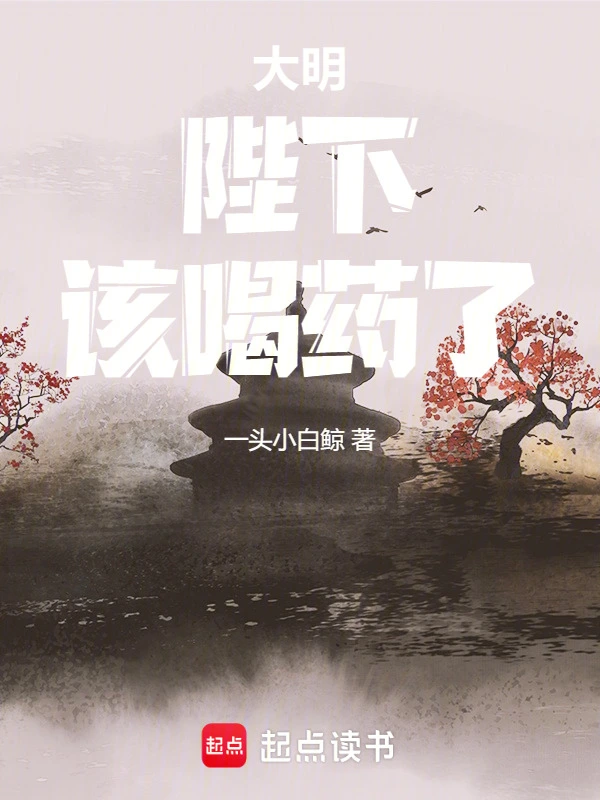
Daming: Your Majesty, It's Time to Drink Medicine!
大明:陛下,该喝药了!
- Status
- Ongoing
- Length
- 2.7M Words
- Genre
- Historical
- Audience
- Male
- Subgenre
- Song-Yuan-Ming Dynasties
- Updated
- 14h ago
- Source
- Qidian
Stats
210Monthly votes
77.4kRecommends
230.8kFans
671Chapters
Tags
Synopsis
Reader comments
In booklists 4
Historical Time Travel Novels of Song, Yuan, Ming and Qing Dynasties
Novels that travel through the Song, Yuan, Ming and Qing dynasties
21Books1.2kFollows12moUpdated
Blocked Book List, Mainly Recommending Books I Am Reading That Are More Complex
It's been so difficult for me. After more than three months, my book list has finally been released. I started to update the book list in 25 years. I read more books on astronomy, fun articles, and behind-the-scenes stories. I won't miss the wonderful books written in other genres.
27Books1.2kFollows9moUpdated
20-Year-Old Bookworm Recommends Books Online
I am mainly writing books, focusing on high-quality products.
10Books1.2kFollows9moUpdated
Conferred God, on the Way
To those tentacle monsters who are on the road to becoming gods, I give you a big thumbs up.
40Books594Follows16dUpdated
Readers also read
 Red Mansion: Start Escaping and Farming from the Equipment Bar
 Fu Ming 1627
 After Lying in Bed for Three Years, He Was Forced to Help the Han Dynasty
 Northern Qi, Sage Khan
 I Was a Demon in the Northern Song Dynasty
 Ming Dynasty Veterinary Medicine, Who Saved Zhu Biao's Life at the Beginning
 Daming: I Asked You to Die to Remonstrate, Why Are You Really Dead?
 Daming: I, Yan Maoqing, Really Smoked
 Northern Song Dynasty: Spoiler of the Future, Zhao Kuangyin Collapsed
 Travel Through the Ming Dynasty and Train Lao Zhu to Become a Sailing Emperor
 Ming Dynasty: Return of the Dead
 Traveling Through the Ming Dynasty: I Can Receive Modern Supplies
 Game of Thrones: I Loaded the Witcher System
Don't pay too much attention to book reviews
People who like to watch will naturally like to watch, and people who can't stand it will give up. Come on update. . . Before becoming a god, updating is very important. 🤓
Many authors always have a problem. Once the protagonist is a supernatural being, there must be other supernatural beings from other places to challenge him. It seems that if the protagonist is alone in the world, someone must jump out to oppose and suppress him. Otherwise, the novel will not be written, and the contradictions cannot be written. But in ancient times, with the power shown in the novel, it must have suppressed all forces? Will he definitely be invincible? To say he is extraordinary is to praise him. To put it bluntly, he is just a strange person. As long as he makes up his mind, can't others kill the protagonist?
The theme is obviously a demon hunter potion, and the identity is an imperial physician, but after it was released, it ended up being a fight with the Tatars for twenty chapters? You might as well just rewrite the military commander essay.
It's nice to watch, but the main character forgets his roots a bit, and the master's family is completely gone 😰
What mistakes are easy to make in historical novels❓
Before the Ming Dynasty, the emperor was not called "Emperor". In the Song Dynasty, he was mostly called "Guanjia", and in other dynasties, he was often called "Your Majesty". In the Ming Dynasty, the emperor was occasionally called "Emperor", and in most cases he was called "Your Majesty". After Kangxi of the Qing Dynasty, people began to be generally called "Emperor". Princes and princes call themselves: Princes in the pre-Qin and Han Dynasties can be called "Gu", and a few can be called "Ignores". After the Wei, Jin, Southern and Northern Dynasties, the title of "Ignores" gradually became exclusive to the emperor, and princes, princes and princes can only be called "Gu" or "I". Song, Yuan and Ming called themselves "I" or "I". Before the Qing Dynasty, princes and princes rarely called themselves "this king". Starting from the Kangxi year of the Qing Dynasty, princes generally called themselves "this king". In ancient times, women called themselves: "nujia" was a modest name for women after the Song Dynasty. Women in the Han and Tang Dynasties more often called themselves "concubine", and noble women could call themselves "I" and "I". Before the mid-Ming Dynasty, most dynasties used copper coins for daily transactions, with very little gold and silver. It was only in the mid-to-late Ming Dynasty that silver became the mainstream currency. -In the late Ming Dynasty, "meeting votes/deposit checks" appeared among the people. There were no unified rules. Most of them were deposits and withdrawals/exchange receipts from acquaintances or local circulation, and were not legal currency. In the early years of Daoguang in the Qing Dynasty (1823): Rishengchang Bank was established, and private banks began to issue standardized banknotes, focusing on cross-regional exchange. They were only circulated in Shanxi merchant trade circles and major commercial ports, and were not yet popular. In the third year of Xianfeng in the Qing Dynasty (1853): the official issued the Ministry of Revenue official banknotes (official banknotes), which were forced to circulate nationwide. At the same time, the network of private banknotes expanded to the whole country, and official and private banknotes ran parallel. The use of banknotes entered an explosive period and became the "starting point of popularization." High-leg tables and chairs only completely replaced the low tables for sitting on the floor in the Song Dynasty. During the Han and Tang dynasties, people knelt and sat on the tables to eat and discuss matters. The furniture was mainly low tables and couches. The memorial system was only established during the Kangxi period of the Qing Dynasty. Officials in the Tang and Song Dynasties used "memorials", "tables" and "statements" when submitting memorials, while in the Ming Dynasty they used "memorials" and "memorials". There is no such thing as "memo" or "zhezi". In ancient formal occasions, the hand-over gesture was performed with the left hand outside and the right hand inside. The right hand outside was a special "unlucky gift" for funerals. "Better greetings" is a unique etiquette of the Qing Dynasty. It was mostly used by subordinates to superiors and juniors to elders. During the Tang and Song dynasties, people often performed cross-hand salutes and bows to greet greetings when they met, and there was no such thing as "sending greetings". Before the Yuan Dynasty, subordinate officials rarely called superior officials "adult". In some dynasties, subordinates called eunuchs "adult", and in some dynasties, they called their parents and elders "adult". Beginning in the Yuan Dynasty, lower-level officials would occasionally call officials of second-rank and above "sir". From the middle and late Ming Dynasty, only officials of third-rank and above would be called "sir" by their subordinates. Officials with lower ranks could not be called "sir". However, in the late Ming Dynasty, there began to appear a few cases where officials above the fourth rank were called "adult". Before the mid-Qing Dynasty, following the rules of the Ming Dynasty, only officials of third rank or above would be called "adult". Starting from the mid-Qing Dynasty, calling officials "adult" gradually became common for lower-level officials. Attention! ! ! What is mentioned above is that lower-level officials refer to higher-level officials. No matter which dynasty, it is absolutely impossible for higher-level officials to call lower-level officials "sir". Some novels even write about emperors or nobles calling other officials "sir". This is simply contrary to Tiangang! ! ! Finally, let's talk about the problem of civilians calling officials Before the middle and late Qing Dynasty, civilians in various dynasties and generations called officials differently, and most of them called them "officials" and "masters". From the middle to late Qing Dynasty, civilians also called officials "adult". {"NickName":"Restriction and Supervision","UserId":417773267}
I came to see you make medicine💊, not to see you show politics
Brother, you, an imperial doctor, come to the battlefield to play with this, right? Don't you know what everyone wants to see? It's like this on the shelves.
Ordinary people will die if they drink the medicine of the witcher The witcher himself can be poisoned if he has high physical fitness.
I don't understand why the protagonist enters the palace in the beginning. He dislikes himself for living a long time, but still thinks that he is a time traveler and won't die even if he is so promiscuous. Although from a God's perspective, we all know how promiscuous the protagonist is and how he will not die no matter how he plays, but the protagonist also knows?
There may be demons and vampires, so how can I have my own way? The protagonist's IQ is a bit low. He already knows the history, but he has no feeling for what Xia Yan and the civil servant group have done.
The source of the Ming Emperor's "easily soluble in water" was Zhu Yuanzhang suggesting that his subordinate Liao Yongzhong drowned the Xiao Ming King Han Lin'er in the lake. As the saying goes, if the upper beam is not straight and the lower beam is crooked, it is normal that the Ming Emperor is easily soluble in water. It is said that Zhao Guangyin, Taizu of the Song Dynasty, bullied the orphans and widowers of the Chai family of the Later Zhou Dynasty and gained the throne unfairly. But no one explained that Taizu Zhu Yuanzhang directly drowned Han Lin'er, the son of the founder of the Red Scarf Army, Han Shantong, Xiao Ming Wang. In terms of life, he was worse than Song Taizu.
It is very different from the cool text written in the introduction. It is more like a historical text. The Witcher Potion is currently just a medicine.
Is there a vampire behind this book? ? ? ?
I have read more than 140 chapters in QQ Reading. I read a post saying there is a vampire behind this? ? ? ? Why did the vampire join in? ?
If the protagonist does not become the emperor, then the protagonist must carry out comprehensive changes that limit the emperor's rights. It is useless if the protagonist just copies the technology of later generations and adds a few reforms. If a country wants to produce a large number of original inventions and creations, it must carry out systematic changes in ideological foundation, political structure, legal system, social forces and other aspects. The absolute monarchy forms a fundamental restriction on the independent scientific and technological revolution. The monopoly of power stifles institutional innovation. The monarchy builds social order with imperial power as the core. The world is the absolute rule of the royal land. Under this system, policy formulation relies on the emperor's personal cognition, social innovation is constrained, and the intellectual class is reduced to a vassal of the imperial power. The reason why Britain was the first to enter the Industrial Revolution is that after experiencing the ideological changes of the European Renaissance, coupled with the British Glorious Revolution of 1688, the king's rights were further restricted. Britain established the framework of parliamentary sovereignty and the rule of law, and the bourgeoisie, the new aristocracy, and the king formed a check and balance, which allowed British civilians to gain unprecedented freedom. At this time, the degree of freedom of scholars, craftsmen, and farmers in Britain was higher than that of other European countries at the same time, and it was far more liberal than the civilians of China's Ming and Qing dynasties. The high degree of freedom of all British civilians fully inspired everyone's strength. The power of the Chinese emperor was not greatly restricted, and all officials, gentry and landlords were dependent on the imperial power. The freedom of civilians, who account for the vast majority of the country's population, is too low. This system inhibits innovation and hinders social development. China's Zhou Dynasty was a feudal system, and the central government could not control much of the local princes' affairs. The princes competed with each other. During this period, Chinese civilization truly allowed a hundred flowers to bloom. Most of the essence of Chinese civilization came from this period. During the Spring and Autumn Period and the Warring States Period, the "Mo Jing" recorded the principles of optics and mechanics, and the germination of geometry had emerged; the "Gan Shi Xing Jing" recorded astronomical observation data. The institutional innovation of the Spring and Autumn and Warring States periods stagnated after the Qin and Han Dynasties, lacking the ability to dynamically adjust. Since the Qin Dynasty, especially since the Han Dynasty deposed all schools of thought and only respected Confucianism, Chinese civilization has almost stood still and entered a dead end. The Zhou Dynasty and the Spring and Autumn Period and the Warring States Period were similar to the ancient systems of most European countries. They were all feudal systems. Even in successive years of war, less than 10% of the country's total population died directly or indirectly as a result of the war. But from the Qin Dynasty to the Qing Dynasty, every dynasty would kill half or more of the country's population due to war! What is even more tragic is that every time the dynasty changes, the system and civilization have almost no progress! {"NickName":"Restriction and Supervision","UserId":417773267}
Is Sister Jing completely smitten by the author?
Will Sister Jing appear again in the future? What a shame.
The first half is good, and even has a bit of a Cthulhu feel. But from the Japanese part, it's like the author has been replaced. Not only does it have nothing to do with the main storyline of The Witcher, but it's also completely unexciting and ridiculous.
I can only say that pig's feet have an unworldly beauty, ps: SB
The setting is top-notch, but the author is a bit overwhelmed, but it is understandable that people always have to grow up. I can only say that it is a pity for this top-notch setting. If this setting is replaced by a platinum author, there may be another explosive masterpiece. Don't be discouraged, the author. Poor writing can be slowly improved, but interesting ideas are talents. In my opinion, this novel is considered to be above average among historical novels. At least for now, I can read it all, (a fourteen-year-old bookworm)
The book is very good to read, but the change in style is too obvious, as if someone has changed.
Humanity is almost extinct! It should be done at all costs and with all possible means. Solve the main problem of monsters and consider other secondary problems! (It feels like the country is almost over, and Cixi is still celebrating her birthday)
🙋♂️Loyal readers, especially like the imaginative setting of the demon hunter potion combined with the Ming Dynasty background in the book. I have a little idea to talk to you: At present, monsters and vampires in the book are highly contagious. Monsters have appeared in the offshore and the west. Humanity has reached a critical moment of life and death. This should be the core contradiction at the moment. However, the plot is still entangled with issues such as the throne, the instability of the system, and the threat to imperial power if the scope of "hunters" is released. It feels a bit deviated from the overall background of life and death. Just like when facing a crisis of national annihilation, it will not first worry about the risk of nuclear bomb proliferation, but will give priority to building nuclear bombs to save lives. When monsters want to exterminate human beings, the court should "choose the lesser of two evils", focusing on fighting monsters first, and then considering internal power issues. Personally, I feel that this kind of plot logic will be more in line with the sense of doomsday crisis, and will also make the combination of demon hunting and Ming Dynasty more tense~
The comment section may not be true, but the data will not lie.
When should you listen to your readers and when should you stand up for yourself? It's very simple, look at the data. There are many factors that contribute to the rise and fall of subscriptions. If there is a sudden plummet, it is probably because your last plot fed readers💩. If it is a smooth decline, it is probably because the plot is boring and the readers disappear quietly. If the curve is close to straight, congratulations, you have accumulated a group of loyal readers. The sudden surge is mostly due to the help of a giant or great luck from heaven. After understanding the data, it only makes sense to read readers' comments.
As for Shangguan Jing, I can't forget when I go to the author. This character is from a sister series. LSPs like me really like it.
The witchers in the Trial of Green Grass are still too weak, and it is still too difficult to fight one against a thousand.
I think it takes a demon hunter who knows the dawn storm and hides murderous intent to save Ming Dynasty
One chapter is updated every day at 12 o'clock? One more chapter, please.
The idea is good and the writing is okay.
Just a supporting role. . . Too intellectual. The book is not bad, keep going.
Your Majesty (Dalang), it's time to take medicine
1. Ed [Book] Just call Dalang! Nani is obviously fine. Three thousand harems are in trouble, immortals. Help - the last minister who was such a good minister was Zhong Wuyan/I am the queen. Zhong Wuyan is in trouble and nothing is in trouble. Xia Yingchun! ! ! A man himself is the only one in a thousand years. To not respond to another man's every request is to break your heart! I don't want money or power—it's hard to guess what I want. By the way, what does Jiajing look like?
How could I live for so long without anyone commenting?
More updates, understand?
I still have 6 monthly passes on hand, so you understand?
I read it in one sitting for several days. Gotta catch up again. . Well
Come on author
Come, the author reads with me my solemn oath: starting from today, I will never update. I will not watch dramas, travel, or get sick. I will play no games, no hydrology. Strict self-discipline, cherish time like gold, worthy of readers, worthy of youth, worthy of the future. I firmly believe that I am a good author. I am the keyboard in the dark, the guard on the Great Wall of Internet literature. I voluntarily dedicate my life to coding day and night.