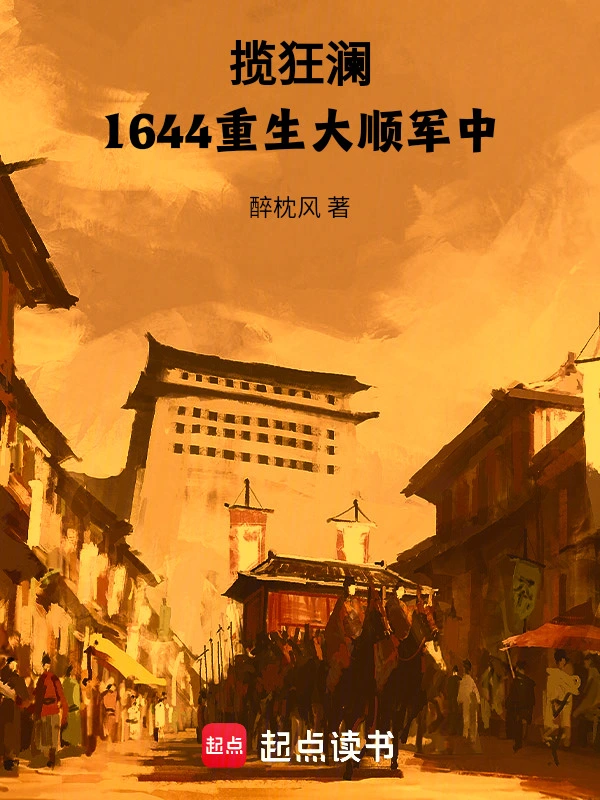
Riding the Waves, 1644 Was Reborn in the Dashun Army
揽狂澜,1644重生大顺军中
- Status
- Completed
- Length
- 623k Words
- Genre
- Historical
- Audience
- Male
- Subgenre
- Song-Yuan-Ming Dynasties
- Updated
- 1y ago
- Source
- Qidian
Stats
0Monthly votes
1.9kRecommends
4.7kFans
295Chapters
Tags
Synopsis
Reader comments
Readers also read
 Talker in the Song Dynasty
 Please Call Me Your Majesty the Tsar
 In the Red Mansion: Escort Daiyu to Beijing at the Beginning
 1914 Begins with the Rejection of the Schlieffen Plan
 Never Walk Alone!
 Anti-Qing: Start with a Piece of Stone!
 Taichang Daming
 Daming: Have I Become Wanli's Portable Grandfather?
 I Am Drawing a Hot-Blooded Episode in the Zhiyu Episode!
 The Resurgence of the Song Dynasty Began by Pretending to Be the Emperor
 Taiping Heavenly Kingdom 1854
 Becoming an Industrial Godfather from Beiyang
 Traveling Through Nanming: Who Dares to Say That I Am a False Prince?
The main reason for Li Zicheng's failure was his failure to effectively deal with the sudden collapse of the Ming Dynasty's state machinery. As a result, Dashun's ruling area quickly expanded from eight prefectures in two provinces (the four prefectures of Xiangyang, Jingzhou, Chengtian, and De'an in Hubei and Nanyang and Runing in Henan, in addition to the central Henan region centered on Yuzhou) to the entire North China; the army quickly expanded from more than 100,000 to more than 300,000. Furthermore, the Dashun Army had no state machinery or base when it left Henan in the 13th year of Chongzhen. It began to establish a government in the autumn of the 15th year of Chongzhen, and then invaded Beijing in the summer of the 17th year of Chongzhen. It only took four years for the Dashun Army to transform from an armed force of more than a thousand people to the master of the entire North China. The result must be a serious shortage of cadre reserves and a rather incomplete state machinery. In other words, most of the Dashun Army, from civilian and military generals to grassroots soldiers and officials, came to the Dashun Army for speculation in an environment of successive victories, and lacked organic connections with each other. It can be said that such a regime cannot withstand any failure and will "collapse" again at the slightest sign of trouble. This has essentially nothing to do with the political strategy adopted by the Dashun Army - except for a very small number of high-ranking officials and gentry above the third rank, the vast majority of the landlord class is not likely to be more disgusted with the Dashun Army's policy of recovering stolen goods [1] than they are with the Qing Dynasty's policy of enclosing land, let alone issues such as shaving one's hair to make it easier to serve. This is the basic starting point for our discussion of this issue. For detailed discussion, please see the old answers on my homepage. It can be seen that if Li Zicheng wants to improve his situation, he can start from two directions: 1. Avoid over-expansion in the short term. The easiest way is to stay in the northwest, capture Shanxi at most, and avoid capturing Beijing and the North China Plain. However, the disadvantages of doing so are also great. The Qing army could seize the above-mentioned areas as if they were ripe, and even advance southward quickly and enter the southern capital to control the rich Jianghuai River. Since the state machinery of the Qing Dynasty was far more mature than that of Dashun, and the talent echelon construction was far more advanced than that of Dashun, these areas that Dashun could not effectively utilize fell into the hands of the Qing Dynasty, and they could provide funds and troops for the Qing Dynasty. In turn, they could attack the Dashun army living in the northwest that had been destroyed by natural disasters and man-made disasters and had barren land and poor people. Therefore, although the Dashun Army can avoid chaos behind a stone, there is still a high possibility of failure in a long-term confrontation. Of course, if you don't capture Hebei, capture Shandong. Using Hebei as a bait and attacking from both sides is another matter. 2. Avoid major military defeats. Obviously, a more positive approach is to avoid military defeat. As long as the Dashun Army continues to win, internal collapse will not occur, and Dashun will naturally only improve its organizational construction in the process, becoming stronger as it fights. Considering that the Qing government had decided to mobilize the whole country to break through the Pass before Dashun captured Beijing, it was naturally difficult for the Dashun army to avoid a battle with the Qing army after entering Beijing. In this way, we must win this battle. As for how to win, we can naturally consider aspects such as gathering stronger troops, winning over Wu Sangui, and avoiding field battles. We will not go into details here. After the defeat of Yipishi, officials, gentry and generals in Xuanda, Jizhen, Zhili and Hebei launched large-scale rebellions. The Dashun army suffered heavy losses in the process. Nearly half of the 150,000 basic troops in the Eastern Expedition to North China were lost, and the total strength of the Dashun Army dropped to more than 200,000; while the upper limit of the Qing Army's strength increased from less than 150,000 to about 250,000. However, if the Dashun Army plans carefully at this time, it is still possible to win. The specific methods are: 3. Fight the Shanxi Campaign well. Historically, the Dashun Army deployed tens of thousands of troops in Shanxi. Even after Tang Tong, Nan Yikui and others rebelled one after another, they still had a basic strength of at least 50,000 people (20,000 people participated in the Huaiqing Battle, 10,000 Taiyuan defenders, thousands of Pingyang Prefecture defenders, etc.). However, Zehou Tian Jianxiu, who was in charge of the Shanxi campaign in Pingyang Prefecture, first sat back and watched the Dashun army fight in separate groups with thousands of people. As a result, they were defeated by the Qing army led by Ye Chen. Later, he launched the Huaiqing campaign, possibly with the intention of cutting off Ye Chen. (However, Ye Chen had already joined forces with Jiang Xiang and others who had gone south from Datong to Taiyuan, so this intention could not be realized at this time). As a result, Duduo's army was attracted, which seriously interfered with the plan for the northern Shaanxi battle. 4. Avoid antagonism with Zhang Xianzhong. Zhang Xianzhong became the Qin king of Dashun at the beginning of the first year of Yongchang. In the early days of his entry into Sichuan, he regarded Dashun as Zhengshuo. However, Li Zicheng did not temporarily entrust Zhang Xianzhong with full power in Sichuan. Instead, he assigned a large number of civil servants led by Jiedushi Li Yutian, and ordered Ma Ke to lead his troops to escort him into Sichuan. This action was understandable in Beijing, but after the failure of Yi Yi Shi, these civilian and military generals should have been recalled immediately to appease Zhang Xianzhong and stabilize the security of the rear. However, Li Zicheng had no idea, and he probably didn't expect that Zhang Xianzhong would take crazy actions that would make his relatives happy and his enemies happy. As a result, Zhang Xianzhong went north to attack Ma Ke after taking Chengdu in August of the first year of Yongchang. After the initial dispatch of Ai Nengqi was defeated, Zhang Xianzhong personally led Li Dingguo and other main forces to defeat Ma Ke in September. In October of the first year of Yongchang, Zhang Xianzhong, who had long been a superstitious believer in destiny, was proud of his victory and proclaimed himself emperor in Chengdu, officially establishing the Daxi regime. In November, Zhang Xianzhong began preparations to march into Hanzhong. In the first month of the second year of Yongchang, when the Dashun armies of Li Zicheng and Li Guo were fighting against the main forces of the Qing army, Duduo and Azige, in Tongguan and Yan'an, Zhang Xianzhong sent Li Dingguo to occupy Hanzhong, and Bao Xiedao threatened Chang'an, the capital of Dashun. After preparing a banquet and three tables of guests, Li Zicheng was already at a disadvantage in Tongguan and Yan'an. He was unable to deal with the threat of a third party and was forced to abandon his vast northwest base. In fact, looking back in hindsight, although Zhang Xianzhong's offensive was fierce, it was actually vulnerable. The Li Dingguo army that entered Baoxe Road was suddenly defeated by the Dashun Army He Zhen's troops who rushed from Baoji to help Hanzhong. After that, Zhang Xianzhong was no longer able to invade the north, and started a vicious cycle in which the entire Shu was rebelled, besieged on all sides, massacred the city and threatened the people, until he was ruined. However, the internal strife between Dashun and Daxi is really unnecessary and can be resolved through diplomacy. And without this fatal internal strife, Dashun might have had a chance to turn defeat into victory in Tongguan, and Daxi would not have become a target for the Sichuan warlords to gain experience from then on, and finally fell into a state of national madness when only Chengdu Prefecture was left. 5. First north and then east. In December of the first year of Yongchang, Li Zicheng had more than 100,000 Dashun troops on hand (minimum 110,000, maximum 150,000). His original plan was to march north and fight to the death with Azig's 80,000 North Qing army with an army of 100,000. However, Azige moved slowly in northern Shaanxi and was delayed in crossing the river. After crossing the river, he was delayed in going south. On the contrary, Duduo's 90,000 East Route Qing army moved quickly and was approaching Tongguan. Worried that Duduo would quickly break through Tongguan and advance into Guanzhong, Li Zicheng decided to attack Duduo eastward with his main force. However, the terrain along Hangu Pass and Tongguan is easy to defend and difficult to attack. After Li Zicheng's army arrived at Tongguan, it turned into the attacker, which meant that he chose unfavorable terrain. Duduo wisely chose the tactic of holding a stronghold, fighting in vain, and waiting for work, which frustrated the Dashun Army's attempt to attack in a roundabout way, and then turned to the offensive after consuming a large amount of Dashun Army's strength and obtaining red cannons. If Li Zicheng trusted Ma Shiyao's ability to defend Tongguan and went north to eliminate Azig first, then even if Guanzhong fell temporarily, the situation would still be better than reality. Of course, the risk of this move is quite high, and it is understandable that Li Zicheng does not want to do this. Compared with the surrendered generals in North China, the surrendered generals in Guanzhong and Li Zicheng had a relatively deep relationship of love and murder. Therefore, whether they are old enemies from the regular army of the Ming Dynasty such as Chen Yongfu, Zuo Guangxian, Niu Chenghu, etc., Or old friends such as Gao Ruli, Wu Dading, Wang Yongqiang, etc. Who were originally from the civilian army and then surrendered to the Ming army after the Battle of Ruzhou, they are all more loyal to Dashun than the generals in North China. Even after Dashun withdrew from the northwest, He Zhen called himself General Fengtian Advocating Righteousness (the honorary title used by Li Zicheng before he became emperor). He joined forces with Gao Ruli, Wu Dading, and Ming generals Sun Shoufa, Zhao Ronggui and others to besiege Xi'an. After failure, he joined forces with Dashun Guangshanbo Liu Tichun. Later, when Jiang Xiang raised his troops, Wang Yongqiang also raised his troops in northern Shaanxi, and appointed Dashun Prime Minister Hui Shiyang as the leader of northern Shaanxi's resistance to the Qing Dynasty. It can be said that Dashun had a ruling foundation in the northwest region. However, due to the above mistakes, Dashun was eventually forced to abandon the northwest. After abandoning the northwest, Dashun moved into the old base area of Hubei and Henan. At this time, Dashun's territory and military strength had declined back to the situation before defeating Sun Chuanting, that is, the territory was no more than five or six prefectures, and the military strength was no more than a hundred thousand people (and it was divided into two parts. The 40,000 to 50,000 people in the West Route Army led by Li Guo were fighting in Ningxia, Longxi, Hanzhong, Northern Sichuan, and the Three Gorges area, and the East Route Army led by Li Zicheng personally had no more than 100,000 combat troops). Since Tian Jianxiu did not burn Xi'an's savings (this itself also shows that Dashun does not have too many problems in governance, and the fiscal revenue is enough to meet expenses), the two armies of the Qing army were able to separate and pursue Dashun's army. In this very unfavorable situation, if Li Zicheng thinks calmly, it is still possible to reverse the situation. 6. Defend Jingxiang in the north and take Hunan and Guangdong and Guangxi in the south as a long-term plan. Historically, Li Zicheng believed that he could no longer maintain the Jingxiang base area, so he decided to go east to the south of the Yangtze River, seize Nanjing, and make another big move. Considering that Zuo Liangyu's forces of the Ming Dynasty often attacked Li Zicheng's base in Xiangyang, Hubei at that time, and the hostile attitude of the Southern Ming Dynasty towards itself, this idea is understandable. However, I have analyzed before that this move is very unwise. Dodo's actions will not be slower than his. Even if Li Zicheng could seize Nanjing before Duduo, he would still face the same situation as Beijing: there are officials and gentry inside who are ready to make a move, and there are hundreds of thousands of Qing troops outside who are watching covetously. The Dashun Army, which had suffered repeated defeats, could not perform better in Nanjing than in Beijing. However, given the lessons learned from Taiyuan, can Xiangyang City really be defended? Historically, Zhang Nai and other troops from the rear of the Dashun Army also defended the city in Yangwu Prefecture (today's Zhongxiang, Hubei Province), but they could not hold on for long. However, in fact, as long as the correct city defense tactics are adopted (although it is not clear whether the Dashun Army, which has long relied on field battles to annihilate enemies, is proficient in it), it is entirely possible to hold on for a long time in a larger city like Xiangyang. For details, you can refer to the battle of Jin Shenghuan and Wang Deren (also from the Dashun Army) to defend Nanchang a few years later. At this time, the Duoduo Division of the Qing Army had turned from Henan to the canal axis to attack the Nanming Hongguang regime in Nandu. Only a part of the Azige army (which was much smaller than the 80,000 troops in northern Shaanxi due to reasons such as leaving troops stationed along the way), Of course, he successively surrendered the Yunyang Army of the Ming Dynasty and the traitor Han Wen of the Dashun Army and continued to pursue the Dashun Army. As long as the Dashun Army has a determined general and an army of 30,000 to 40,000 people behind it, it can prevent Azig from continuing to move south. Moreover, after entering summer, Azig will inevitably have to return to the court. Of course, if you stick to Xiangyang, you will be breached one day. The main force of the Dashun Army should still try to join the West Route Army and march south to Hunan and even Guangdong and Guangxi. At that time, the Ming armies in Guangdong, Guangxi, and Hunan were in chaos, and it was not difficult to wipe them out in one go. The climate in these areas is relatively humid and hot, and Manchurian soldiers have avoided long-term stationing for many years thereafter (during the Ming and Qing Dynasties, Manchurian soldiers have always avoided long-term stationing in areas further south than Nanjing and Jingzhou). If Dashun's army can control the two lakes and pacify Guangdong and Guangxi, there is still a considerable chance of revival. Li Zicheng failed to plan this and blindly followed Chongzhen's old routine of mobile warfare fifteen years ago, forgetting that he was no longer the leader of the rebel army. As a result, he was defeated at Fuchikou and Jiujiangdong. Not only did he lose his territory, but the entire army also lost its organization. In the end, Li Zicheng himself was killed by a militia group at Jiugong Mountain in Tongshan County. Despite this, the remnants of Dashun are still there, and they have considerable cohesion. A few months later, all the ministries gathered in Jingzhou, accepted the unified leadership of Li Guo, and formed the Loyalty Camp. At this time, whether Li Guo was independent or united with the Ming Dynasty to resist the Qing Dynasty, the Dashun Army still had a chance to revive. Although it may not be within the scope of the question, I will mention it here by the way. 7. Winning the Battle of Jingzhou Don't overly believe in the combat effectiveness and reliability of He Tengjiao, Ma Jinzhong and other troops. Adjust the focus to reinforcements, defeat the troops that rushed thousands of miles away from Luck Deh, and then capture Jingzhou and eliminate Zheng Siwei. The prestige of Li Chixin (i. E. Li Guo, Li Jin) can rise just like Sun Kewang killed Zeng Ying in Chongqing, and the cohesion of the Dashun Army can continue to be maintained without falling into a state of disintegration. After the Dashun army was defeated in Jingzhou, the leaders went their separate ways. Liu Tichun and Yuan Zongdi went north to Xing'an to join He Zhen, and moved to Kuidong earlier. They mechanically imitated Li Zicheng's strategy of retreating into the mountains from the 11th to 13th years of Chongzhen's reign, but they accidentally opened up an anti-Qing base for the thirteen families that followed. Hao Yongzhong, Wang Jincai, Niu Wancai, Zhang Guangcui and other figures who were originally relatively alienated from the direct line of Dashun (probably from Cao Ying and Gezuo Fifth Battalion) were incorporated into Zhongwu Camp by Nan Ming, and followed He Tengjiao into the internal party disputes and warlord melee in Nan Ming. The main force of the Zhongzhen Battalion was controlled by Du Yinxi, and continued to be squeezed out by the Nanming government; after retreating to Guangxi and Du Yinxi's death, Gao Bizheng and Dang Shousu tried to turn the Zhongzhen Battalion into the Central Army of Emperor Yongli, in order to reorganize the authority of the Ming court and solve their own food and salary problems. As a result, this plan offended all the warlords, and the Zhongzhen Battalion was attacked by a group. When the Yongli court played the situation between Guangdong and Guangxi to death and was forced to accept the leadership of Sun Kewang, the leader of the Western Qin Kingdom, the remnants of the Zhongzhen Battalion only had 20,000 or 30,000 soldiers and horses. They were in an embarrassing situation because of their previous refusal to entrust Qin's civil service and had to return north to Kuidong. After that, the remnants of the Dashun Army achieved a long-lost rendezvous in Kuidong, with more than 50,000 troops, but they were no longer an independent force politically and fell under the control of Wen Anzhi and others. At this point, the Dashun Army's final outcome can only be sacrificed to prove that they are worthy of being outstanding descendants of the Chinese people of all ethnic groups.
Dashun was terrible. The Ming Dynasty at least had a great cause. The Qing Dynasty at least knew how to unite the local gentry and bureaucrats. Only Dashun, a peasant uprising, offended the bureaucrats, offended the local gentry, and finally offended the basic farmers. This is also the flaw of the peasant uprising. The protagonist should gather troops, grain, and workers as soon as possible to find his own basic base and create a new world. The Ming and Qing dynasties are all unreliable, which makes them conquer the world.
Some of the author's concepts are difficult to understand. He licks Chongzhen, praises Confucian loyalty implicitly and subtly, and marries a servile and servile maid of the Zhu family, a brain-dead fan. In the original history, this brain-dead girl even killed the protagonist. . . .
Li Zicheng was doomed to fail First, many people joined his team midway and were not convinced by him. A regime with many voices is not enough. Not to mention Zhu Yuanzhang, even Chen Youliang and Zhang Shicheng's team had to listen to their boss. Secondly, there is no real counselor like Li Shanchang who can make suggestions. He is surrounded by ghosts, ghosts and ghosts, and opportunists. Thirdly, Li Zicheng did not have the strategic thinking of Zhu Yuanzhang. Cao Cao had the genius-like strategic thinking. He did not have a long-term vision and was short-sighted. He hurriedly overthrew the Ming Dynasty and released the demons of the Manchu and Qing Tatars. To sum up, the Ming Dynasty at least still had status, national justice, and a group of truly patriotic generals in the court. However, Li Zicheng was a bunch of troublemakers who bloodletted him crazily behind the Ming Dynasty's back. As a result, the Ming Dynasty fell, and he still couldn't handle the Manchu Tatars.
"No food will be paid when King Chuang comes" is not just a slogan. It is also true that the people eat pots of pulp to welcome the king's master. It's going to be rotten tomorrow morning, and the smell of decay is permeating from the beginning to the end. The Dashun Army also enforced military discipline when they entered Beijing. These are recorded in historical facts. As for comparing the greed of the landlord class, King Chuang is indeed on the side of the people. Have you really understood the Dashun Army? Its story is very interesting, much more interesting than Nanming. In the end, most of the people who resolutely resisted the Qing were the Dashun Army. On the contrary, the Ming army was still used to suppress the Qing Dynasty (in the Qing army's guise). However, it is true that the composition of the Dashun Army is complex, but King Chuang is a good boss. In order to stabilize military discipline in troubled times, he said, "Killing my parents and raping their wives and daughters is equivalent to killing my parents and raping my wives and daughters."
It's really too poisonous. There is no sense of immersion at all. He is from the rebel side. Later he entered the Chongzhen Palace. Capture Emperor Chongzhen alive. It was nice to talk to him nicely. He also calls him "Your Majesty" and calls himself "little person". His tone was very respectful. I used your title, Your Majesty. This is the least immersive novel I have ever read. Maybe the first three chapters put me off. Xiaobai, a nine-year-old reader, has read a lot of everything. It's rare to see the first three photos look like this.
Some historical information about Chuangying
I can give the author some popular science
It is a bit whimsical. It is foolish to fight the Qing army in the north. What should be done is to immediately go south to rely on the water network of the Dongting Lake Plain and Jianghan Plain to resist the Qing army's attack, and then go south to capture Guangdong and Guangxi, and be prepared for a long-term confrontation with the Manchu and Qing Dynasties using Guangdong, Guangdong and Huguang as bases. Then they formed an alliance with Zhang Xianzhong in the west to guard the middle and upper reaches of the Yangtze River, and then plotted against Jiangxi. Don't have any expectations for Nanming, it's just a bunch of crap.
Author, if you are so biased towards Chongzhen, then you will not be able to write good works. People are selfish. Do you think the Donglin Party is dead? In fact, the ministers are still the same ministers, and the people are still the same people. If you replace the emperor with an awesome emperor, these ministers will be like dragons and phoenixes among the people, and they will be loyal ministers. If you replace the emperor with a rubbish emperor such as Chongzhen, Zhuge Liang will be forced to death by him. To put it bluntly, just like you When our boss was alive, we were united as one, with high benefits, goals, and a virtuous cycle of development. Everyone had their own skills and no one had to work hard. As a result, the boss was gone and his son was replaced as the boss. The first thing he did when he came up was Cut wages, and then hit here and there with a hammer. You want to do this today, and you want to do that tomorrow, and then you blame others for the loss, saying someone is corrupt, but you can't find out if you go and check it yourself. In the end, you bring an empire to bankruptcy, and then you jump off a building. Before he died, he complained about his employees. He couldn't remember the people who were tricked by him and wanted the company to be good. The employees were forced to death when they saw such a boss. Anyone else who dared to help him, who didn't form a party to protect themselves, or who didn't join the new boss would be killed by Chongzhen.
How much does the author know about the history of the Peasant Army and Dashun Army?
Alas, worse times than ever. Chuang Jun is destined to be a helpless man. I hope the author can stand on his own as soon as possible, otherwise this book will be unbearable to read.
The core of Li Chuang's failure was the warlord Li Chuang, who went straight to the capital to conquer the world as a vassal; but Li Chuang's correct method was to lay the foundation for the rebel army to conquer the world as a means of fighting for hegemony in troubled times.
Don't write about historical figures in a particularly positive light. What you write is similar to those heroic dramas of the 1960s and 1970s, Pleasant Goat Wei Guangzheng.
As soon as you walk in, you are off the mark. Are you a primary school student traveling through time and space?
Good guy, I first sent people to protect Wu Sangui's family, but ended up protecting a lonely person, and then personally went into battle to massacre Wu Sangui's family camp of Guan Ning Army. I really don't understand this operation.
This time travel is too frustrating. I am not a powerful minister or a wise master, but at most a middle-class person with some foresight in ancient times. The class is a mess. It is logically unreasonable to want to clean up the country to this extent...
Come on, the writing is really good. I have been following this book before, and now that I have a new account, I will read this book as soon as possible! Come on! I always support you, please update more often! 😏
I can't stand the three golden chapters. The first three pictures are all poisonous. He is a rebel. Then he went in and caught Chongzhen. She also wanted to speak kind words to him and call him your majesty. He also calls himself a villain. The tone was very respectful. Really convinced. He led his soldiers and horses into Chongzhen Palace. He caught him and still talked to him in a low voice. Just watch it if you can.
Good guy, whose general is this?
The writing is so concise that it makes me cry to death. There are very few good writings on historical classification nowadays.
The plot of the heroine and the supporting character is poisonous
This author writes very well (personal feeling), and this is the only historical novel that I can read... I hope the author will continue to work hard... 😁😁😁