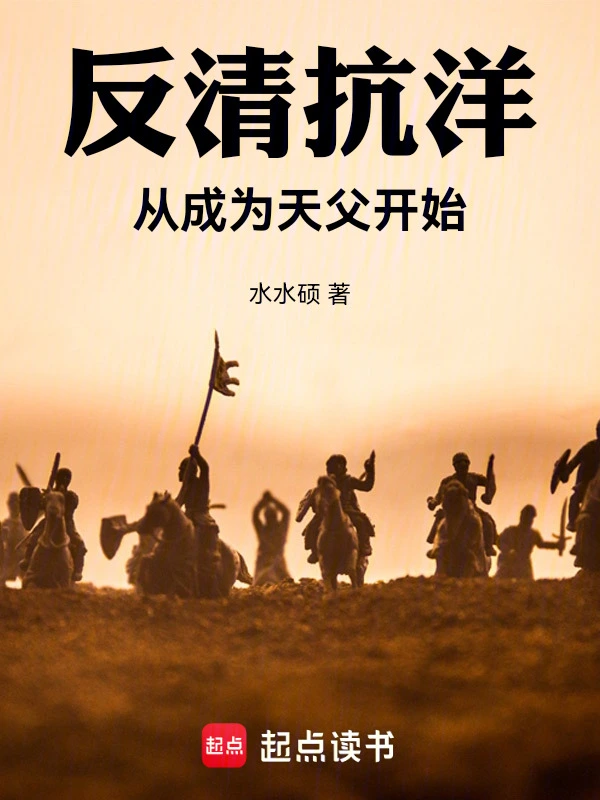
Fight Against the Qing Dynasty and the Foreign Countries: Beginning with Becoming Heavenly Father
反清抗洋:从成为天父开始
- Status
- Completed
- Length
- 652k Words
- Genre
- Historical
- Audience
- Male
- Subgenre
- Qing & Republican Era
- Updated
- 1y ago
- Source
- Qidian
Stats
0Monthly votes
2.4kRecommends
5.2kFans
195Chapters
Tags
Synopsis
Reader comments
Readers also read
 1914 Begins with the Rejection of the Schlieffen Plan
 In the Red Mansion: Escort Daiyu to Beijing at the Beginning
 Talker in the Song Dynasty
 Please Call Me Your Majesty the Tsar
 Never Walk Alone!
 Taichang Daming
 Anti-Qing: Start with a Piece of Stone!
 Daming: Have I Become Wanli's Portable Grandfather?
 I Am Drawing a Hot-Blooded Episode in the Zhiyu Episode!
 Anti-Qing: Start by Kidnapping Shi Dakai!
 You Promised to Fight Against the Qing Dynasty and Restore the Ming Dynasty, but You Are Going to Camp in Jintian?
 Gou Qin
 My Brother Should Be Yao and Shun
I personally think that traveling through Yang Xiuqing is not a good choice. First, Yang Xiuqing is too old and is also a core figure of the Taiping Heavenly Kingdom. There are many variables in being passed through, so the book is easy to be biased. Second, the Taiping Heavenly Kingdom was founded on religion. If it succeeded, it would do great harm to China. The best option is to travel to a landowner in Guangdong and Guangxi, go north after the Taiping Heavenly Kingdom and plot Lingnan, then spend ten years carrying out reforms, industrialize the northern expedition as much as possible, and start overseas colonization after demarcating the Huaihe River
As a Guangxi person, and it was actually the most important battle of the Taiping Heavenly Kingdom, the place where King Nan died, I have read the history books of the Taiping Heavenly Kingdom. The Taiping Heavenly Kingdom was able to become a thing. It was the first place in Guangxi where the feud between natives and guests was the most intense. In the late Qing Dynasty, the natives fought in groups. Millions of people died. This was deliberately instigated by the Qing Dynasty, so the Qing Dynasty deliberately did not write about it, so they raised Gu and raised a group of people like the Taiping Heavenly Kingdom. They actually escaped from the Guangxi war. Then they went to Hunan and acted like cheaters, fighting fiercely and rushing directly to Beijing. The failure of the Taiping Heavenly Kingdom can be attributed to many aspects. The most important thing is the failure of strategic thinking. They have no foundation at all. Their legal principles are the Christ of Tamar. The Manchus still worship Confucius and occasionally advocate the unity of Manchu and Han. However, the Taiping Heavenly Kingdom is fundamentally opposed to most intellectuals. Therefore, the Taiping Heavenly Kingdom is isolated. It has no allies at all. It does not resist the banner of the Han people. It fails at the strategic level. The second one is the internal struggle. Hong Xiuquan actually went crazy in the middle and later stages and completely ignored the affairs. Yang Xiuqing's failure was that he was not the only one who talked about the issue. There were four equals to him. .
The authentic cult inside and outside the Taiping Heavenly Kingdom
The progress feels too slow. It's almost thirty chapters. I don't talk about rebellion. I just lead a few people to run around. Although it's not a waste of effort, it's not fun enough. I originally came here to watch the rebellion, which is understandable in order to accumulate strength. However, the progress is still too slow. This kind of rebellion article mentioned in the introduction and title of the book has no rebellion in ten chapters. I don't have the patience to read it.
The religion you created will not turn into a monster later, right?
If you don't have a few golden fingers, you can't write anything! Although Yang Xiuqing was defeated, he was indeed a military wizard. It would be great if the time traveler could carry his shoes with him. The Qing court's biggest trump card is that it can pay any price to invite foreigners to fight, so what the author wrote does not make any sense to me! It's just a waste of everyone's time.
The first few chapters were okay, but in the later chapters, they were running around trying to recruit people to rebel. They didn't even have a serious army, and they didn't have their own uprising program, so they left everyone alone to recruit people to rebel.
The heavenly father kills the heavenly brother, and the world is blocked. Changmao is not the rightful owner, so he still gives way to Xianfeng.
It's not like a rebellion novel, it's a bit like Hong Kong's gangster novels, with a little family spirit everywhere.
Heavenly Father kills Heavenly Brother, and the country cannot be connected 🙂
Why choose a historical figure as the protagonist? It's still such a big deal
How can I fight against the Qing Dynasty without a golden finger?
A rebel bandit was actually kidnapped by the Qing army and civilians were used. The protagonist should commit suicide. What kind of ** was written?
Of the time-travel novels I have read so far, only "50 Years After Yashan" is the closest to the real possibility. There is no other one. It is not pleasant, it is sad, and it is a group time travel. But they are all ordinary people, with neither golden fingers nor technology trees. How many years of hard work, how many years of life and death, how many years of being consistent, can do something 😢
He doesn't even engage in military training and acts like a warlord from the beginning. How can this be accomplished?
Everyone seems to like it. They regard the Kingdom of Heaven as Liu Futong and themselves become Zhu Yuanzhang.
There are more than a hundred chapters, but there is no rebellion yet, and there is still an uprising. What we want to look at is the occupation of Nanjing, the occupation of Jiangnan, and the Northern Expedition to the Central Plains. More than a hundred chapters have not entered the theme, and it is MB.
The protagonist must do a good job in theoretical construction
The original God-worshipping religion is at best a mutated version of Arianism. The authentic Arianism has been refuted for thousands of years. Just look at how Athanasius crazily tortured the Arianism in the fourth century. Two thousand years of scholasticism is really not in vain. It is scientific developments such as the theory of evolution rather than Hong Xiuquan and others that have impacted the Christian faith from a doctrinal perspective. The basic conclusion of these clergy is: "The Christianity of the King of Heaven is not a good thing, it is just the greatest blasphemy of the sacred by a madman. And the religion of his subordinates is simply a big joke and a farce."
There are so many dramas. When you see the chapter where Zhang Gouer died fighting for Zhang Gouer's life, protagonist, don't worry about whether it will hurt the hearts of those who come after you. You have to understand that it was your subordinate who agreed in the name of the Taiping Army first, and you who voted for Zhang because he saw the situation was not good, and the protagonist doesn't seem to understand what his basic base is at all. Are these so-called heroes? They are ordinary people whose names don't even appear! He even offered 50,000 taels to settle the grudges. Protagonist, how about you tell me how much I would pay after killing you to settle the grudges? 2 Pussy
Objectively speaking, historical hegemony literature has always been a small field. Its audience is either teenagers who love history or young and middle-aged people with certain experience and culture. Personally speaking, these people do not accept mindless plots with confusing logic and will not read them. Therefore, it is difficult for historical literature to achieve results. Authors must be mentally prepared if they want to be successful in historical literature.
The author should be a trumpet, right? It's not like a newcomer could write this. The flow and details of this writing are very experienced.
The Taiping Rebellion caused 46.93 Million to 95.11 Million abnormal deaths
The impact of war on population growth needs no elaboration. It has always been the focus of research by scholars from all walks of life. The social unrest caused by the largest and most influential wars in human history not only changes the population distribution areas of the world today, but also profoundly affects the differences in economic and social development between regions. In the mid-19th century, the Taiping Rebellion that broke out in China's late Qing Dynasty fell into this type of war. The Taiping Heavenly Kingdom War lasted for 14 years from the first year of Xianfeng to the third year of Tongzhi (1851-1864) in the Qing Dynasty. The scope of activities involved 18 provinces and had an important impact on the population and economy of modern China. In the mid-19th century, China experienced uprisings and riots at home, invasions from foreign powers, and natural and man-made disasters that followed one after another, putting the entire country at a critical juncture of life and death. Among them, the most influential one was undoubtedly the Taiping Rebellion that began in late 1850 and ended in early 1851. Under the leadership of Hong Xiuquan, Yang Xiuqing and others, the Taiping Army occupied Yong'an Prefecture (now Mengshan County) in Guangxi in the autumn of 1851; they broke out of Yong'an in April 1852, went north to attack Guilin, and then entered Hunan from Guangxi; they captured Nanjing the following year, and then moved their armed forces through the Northern Expedition to the West. It developed into Guangxi, Hunan, Hubei, Jiangxi, Anhui, Jiangsu, Henan, Shanxi, Zhili, Shandong, Fujian, Guangdong, Zhejiang, Guizhou, Sichuan, Yunnan, and Gansu provinces, and conquered more than 600 cities. Finally, in 1864, the fall of the capital Tianjing marked the end of the regime. Whether it was direct killings or indirect effects, the population losses caused by the Taiping Rebellion were appalling. On the one hand, war killings directly resulted in the loss of a large number of people; on the other hand, war also indirectly hindered population growth to a large extent by destroying the means of production and living. However, scholars have different opinions on the population losses caused by such a large-scale, long-lasting and widespread war. The early American missionary Harper estimated that the war caused at least 50 million losses; Ge Jianxiong and others believed that the loss number was at least 100 million; Cao Shuji, after conducting a more systematic analysis, came up with an estimate of 73.3 Million final losses. Although Cao Shuji's estimate is recognized by many historians or demographic historians, it still fails to identify the net impact of war and population loss. Statistical results show that the Taiping War had a significant negative impact on modern population changes. Compared with war-affected areas, the former's average annual population growth decreased by about 35‰. In this result, after using the duration of the war and the intensity of the war as proxy variables for whether it is a war-occurring area, the average annual population growth rate in war areas is 18% and 14% lower than that in non-war areas. Based on the average annual growth rate calculated above, the author calculated the population losses in the main areas where the Taiping Rebellion was active. The results found that nationwide, the net population loss caused by the Taiping Rebellion ranged from 46.93 Million to 95.11 Million. This number is not sensational and is still within the estimation range of traditional historians and population historians. However, comparison shows that there are obvious estimation biases in existing research on the impact of the Taiping Rebellion on population. Through the analysis of this article, it not only reveals the huge population losses caused by the Taiping Heavenly Kingdom War, but also provides indirect evidence for understanding the rapid economic development of Jiangnan in modern times and why there was a generally low fertility rate in modern Jiangnan
Awesome, the return on investment is up to 59 coins
The plot is less family-friendly
The most important thing about online articles is entertainment, and everything else is embellishment. The plot of this book is not very satisfying. What readers want to know is that the Taiping Army broke from 2,000 to 20,000 in history! Travel from Changsha to Nanjing in 28 days! Twenty thousand Northern Expeditionary troops hit Tianjin!
Is a country established during a religious uprising a secular country?