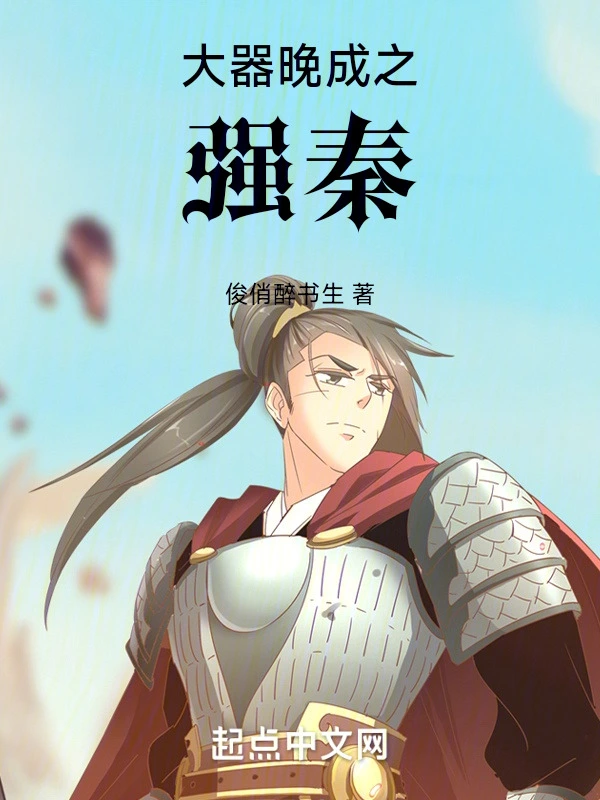
The Late Bloomer Qin Dynasty
大器晚成之强秦
- Status
- Completed
- Length
- 140k Words
- Genre
- Historical
- Audience
- Male
- Subgenre
- Qin-Han & Three Kingdoms
- Updated
- 2y ago
- Source
- Qidian
Stats
0Monthly votes
633Recommends
11Fans
56Chapters
Tags
Synopsis
Reader comments
Readers also read
 1914 Begins with the Rejection of the Schlieffen Plan
 Please Call Me Your Majesty the Tsar
 Talker in the Song Dynasty
 In the Red Mansion: Escort Daiyu to Beijing at the Beginning
 Never Walk Alone!
 Seizing the Direct Descendant in the Prosperous Tang Dynasty
 Daming: Have I Become Wanli's Portable Grandfather?
 I Am Drawing a Hot-Blooded Episode in the Zhiyu Episode!
 I Am Lord Xinling
 I Am Li Chengqian, the Emperor of the Tang Dynasty
 When I Was in Hongwu, I Started by Rebelling Against the Party.
 Game of Thrones Alexander the Great's Iron Throne
 Douluo Begins to Dominate the World from Common People
 At the End of the Yuan Dynasty, the World Was Dominated by Deer
Let's talk about it briefly: people in a strange environment will only prioritize survival, rather than worrying about the country and the people, so the first few chapters look very strange.
A brief discussion on the reasons for the demise of the Qin Dynasty
During this period of time, I watched the documentary "From the First Emperor of Qin to Emperor Wu of the Han" and some excellent answers on Zhihu (such as Yu Chaoyang's "Qin and Han Emperors 05: The First Emperor's Chapter - The Standing of the Eldest Son" and "Why did the Qin Dynasty die after two generations? What are the issues worth exploring behind it?", Etc.), And after careful consideration, I added some more opinions. I personally believe that the Qin Empire has eight major problems that need to be solved urgently. First, the military merit system is unsustainable. The Qin State was a wartime state, and the military merit system was definitely advanced at the time. However, after the unification of the Qin Dynasty, the military merit system could no longer operate. The First Emperor also noticed this problem, and launched the subsequent southern expedition to Baiyue in order to divert internal conflicts. However, the failure of the military merit system has caused an extremely serious problem, trust. The Qin government did not completely resolve the land issue caused by the military merit system and broke trust with the Qin people. This was quite serious. However, the military merit title system has been operating in the Qin State for hundreds of years, and solid military merit interest groups have long been formed, such as the Meng family, the Wang family, the Qiang family, the Yang family, the Sima family, etc. If you want to change it, you must first offend them. This is not an easy task. It requires enough time to indiscriminately distribute titles and reduce the enthusiasm of the Guizhou leaders for the title, thereby disintegrating the military merit title system and establishing another applicable system. The second is the shortcomings of Qin officials, especially after the overall system of counties and counties, the shortcomings are more obvious, and local control is obviously insufficient. Xiang Liang and Xiang Bo could find someone to protect them when they killed people. Zhang Liang could escape pursuit after assassinating someone. Qin Shihuang would even encounter assassins in the capital Xianyang. These are undoubtedly manifestations of insufficient control. At that time, enfeoffing and enfeoffing counties in parallel was the optimal solution. It could not only strengthen the control of remote areas, but also reduce the dissatisfaction of local Guizhou leaders towards the central government, divert attention and vent their goals. The first emperor of the Qin Dynasty fully transformed counties into counties, abolished hereditary inheritance, and gave no time for transition. This not only caused the Qin Dynasty's hero group to lose profits, but also cut off the hereditary rights of the nobles of the six countries. Are those nobles from the Six Kingdoms really trying to restore their country? Fart, it's just for profit. Who is Zhang Liang? He has been Prime Minister of Korea for five generations. The throne of prime minister is beckoning to him. Qin State slapped him back to reality. Do you really think he is so noble and patriotic for the restoration of the country? Shit, anyone who ruins my future is like killing my parents, it's just for profit. Just imagine, if partial enfeoffment is really carried out, it will definitely reduce the trouble. Third, the ideas were not unified enough. Qin Ting never found a suitable idea for ruling the empire from beginning to end. The First Emperor initially invited hundreds of scholars to come to the Qin Dynasty to become Ph. D. S and receive the treatment of a gentleman, which showed that he did not only respect Legalism, he was just using Legalism, and he hoped to find an idea to rule the empire through this method. However, each of the hundreds of schools had their own interests, and they were not integrated, or even mutually exclusive. Confucian scholars fundamentally looked down on the "Rong Di" of Qin, and even openly laughed at Qin Shihuang when he was raining on Mount Tai. (The Confucian Kong Yu did not bother to serve in the Qin court and only sent his disciple Shusun Tong. However, after the uprising of Chen Sheng and Wu Guang, he quickly went to Zhang Chu to serve as an official.) Until seven years after the unification of the world, there was still a situation where the Confucian Chun Yuyue tried to restore the feudal government and boycott counties. The health of the first emperor was not as good as before. The policies of the Qin court began to change, and the first emperor adopted Narlis burned books, burned "Poems", "Books" and history books of various countries, and later killed Confucian scholars who slandered the government in the case of trapping sorcerers. How can I put it, the fundamental purpose of burning books and trapping Confucians was to strengthen the central government. From the perspective of the time, you can't say it was completely wrong, but it must have done more harm than good to the Qin court. After this incident, the First Emperor's ruling ideology completely changed from the initial inclusive and harmonious approach to the exclusive legalism. His high-pressure rule made people almost breathless. The result of this was that the scholars of the world and Qin were separated from each other several times. In addition, there are old nobles from the six countries in the local area who are spreading rumors and causing trouble, and it is difficult to unify the thoughts of the head of Guizhou. It was not until his later years that Qin Shihuang paid tribute to Emperor Shun and Emperor Yu from afar during his last tour. His ruling ideology changed obviously, but his death was sudden. The Six Kingdoms were destroyed by Qin, and they must hate Qin. Moreover, those old Qin people also discriminated against the people of the Six Kingdoms and thought highly of themselves. It is obviously unrealistic for everyone to identify themselves as Qin people. We can first create a Chinese nation with the common ancestors of Yan and Huang, eliminate barriers, set up temples, worship celebrities from the six countries, win over people's hearts, and wait until the world is stable for decades, and then let the idea of being a Qin person deeply rooted in the hearts of the people. The fourth is issues such as land annexation and various corvee services. The Qin Empire mainly faced internal problems, but the external problems were not big. After unifying the world, the First Emperor actually implemented a light tax policy, "suspended penalties, thin taxes and reduced taxes." During the reign of Qin Shihuang, the Qin Dynasty field tax was 7%, 8.5%, 8.82%, And the average tax was The agricultural tax was not heavy, but the miscellaneous things added up to it and it was a burden. Moreover, it was impossible to recuperate, and corvees were collected one after another to build the Great Wall, the Straight Road, and even the Epang Palace and other large-scale projects. Work that originally required generations of people was completed in less than ten years by the First Emperor. The problems can be imagined. Later, the policy of "making the capital of Guizhou own its own land" was promulgated, recognizing the private ownership of land, and the nobles seized a large number of land in the capital of Guizhou, which aroused public resentment. It has always been mainly said that the Qin Law is harsh. In fact, the Qin Law is just too detailed and controls too much. It almost controls people from birth to death. Every aspect of your life is clearly stipulated. It is suffocating to think about it. Another point is that it does not spare the people's power, various corporal punishments, the labor force is greatly reduced, and there is also the criticized neighborhood system. Moreover, the Qin Law was only accepted by the people of Qin after hundreds of years of digestion. How could the people of the Six Kingdoms be required to accept it completely when the world was just unified. (After Liu Bang captured Xianyang, he abolished the Qin Law and made a three-chapter agreement, which won the support of the old Qin people in Guanzhong. It can be seen that the old Qin people have been dissatisfied with the Qin Law for a long time.) In short, it is too hasty. Fifth, the clan relatives are weak. The clan system of the Qin State was very strict after Shang Yang's reform. "A clan cannot be a vassal without military merit." If the clan of the Qin State did not achieve military merit, in a few generations, it would be expelled and reduced to a side branch. , As a result, there were not many famous figures in the Qin clan. Except for Ying Qian, Ying Ji, Ying Hua, Ying Xi, etc., There were almost no outstanding figures who left their names for future generations. The Qin clan did not have much real power and only retained the right to enjoy wealth and wealth. Considering that when Qin Shihuang came to power, the Qin clan pressured him to expel guest ministers from the six countries after spying on Zheng Guo, I think the First Emperor himself also had a suppressive attitude towards the clan. After abolishing the enfeoffment, the First Emperor weakened the power of the clan to a great extent. In the eyes of later generations, this was obviously a wrong move. After all, the clan was an affiliated force of the imperial power. Although it might threaten the status of the imperial power, it was also an important factor in the consolidation of the imperial power. But from the perspective of the First Emperor, you certainly cannot say that he was wrong. All in all, the Qin clan was so weak that it was not only unable to save Qin's decline, but also unable to ensure its own safety. It could only perish under the haze of Qin Xianyang being massacred by Xiang Yu. Before the First Emperor of Qin came to the throne, the relatives of the Chu family were powerful. The Queen Mother Mi, the mother of King Zhaoxiang of Qin, his uncles Wei Ran and Mi Rong, the Queen Mother Huayang, the aunt of King Zhuangxiang of Qin (the wife of King Xiaowen of Qin and the nominal grandmother of the First Emperor), and Mi Qi, Jun of Changping, were famous representatives among them, and they greatly influenced the Qin court. After the First Emperor of Qin came to the throne, there were two major categories of relatives in the Qin court. One was the relatives of the Chu family, headed by the Queen Mother of Huayang. The Queen Mother of Xia (the biological mother of King Zhuangxiang of Qin and the first emperor's grandmother) also belonged to the Chu family (doubtful) and accounted for the majority. The Queen Mother of Huayang and the Queen Mother of Xia had a very good relationship with the First Emperor. After their death, the Queen Mother of Xia was buried with the emperor's ceremony. Qin Shihuang did not have a queen, but under the arrangements of his two grandmothers and Lu Buwei, he should have a queen. The queen was also a member of the Chu family, and it is speculated that she should be Fusu's biological mother. As for why this queen is unknown, she may have been implicated by Lord Changping. After the death of Queen Mother Huayang, the Chu clan's relatives were leaderless and their power gradually shrank. Lord Changping rebelled against Qin, and the Chu clan's forces were bound to be implicated and lost their influence. One type is the relatives of the Zhao family, headed by the First Emperor's mother, the Queen Mother Zhao. This type of relatives had little influence and disappeared after the fall of the Queen Mother Zhao. From here you can see that the clan and relatives, as the two major auxiliary forces of the imperial power, did not play much role during the period of the First Emperor. It is true that the First Emperor's family was dominant, and it was also true that he felt powerless. It is obviously beyond the power of one person to counter the anti-Qin anti-Qin forces of the Six Kingdoms. Sixth is the problem of the old aristocrats of the Six Kingdoms. The problem of this group of people is definitely not small, or in other words, it is much more serious than everyone imagined. After the demise of the Six Kingdoms, Qin Ting did not kill all these people, and it was mainly unable to kill them all. Before the demise of the Six Kingdoms, they were in the light, and after the demise of the Six Kingdoms, they were in the dark. Their local influence was too great, and they colluded with local officials. Qin Ting was unable to take the initiative in this matter. When the Six Kingdoms were destroyed, this group of nobles from the Six Kingdoms did not lose much at all. When Chen Sheng, Wu Guang and others made a fuss, these people turned around and rebelled against Qin. The First Emperor certainly did not say anything and did nothing. He moved the old noble merchants of the Six Kingdoms to Xianyang (I really don't know if Xiang Yu's gang of reckless men in the name of punishing the Qin Dynasty thought that there were not only Qin people but also people from the Six Kingdoms in the city when they massacred Xianyang). As soon as Qin unified China, rebellions broke out in Korea, and rebellions occurred from time to time. The First Emperor abolished feudal divisions and established counties and counties, and unified writing, currency, weights and measures. Which of these things did not damage the interests of the nobles of the six countries? When the First Emperor visited the east, he discovered the powerful force of the old nobles of the Six Kingdoms. He sent the heads of the old nobles of the Six Kingdoms to Guizhou for corvee work several times. He also had the intention of robbing the old nobles of the Six Kingdoms for people. He promulgated the policy of "letting the heads of Guizhou return to their fields" in order to bring the people of the Six Kingdoms back to their hometowns. However, the result was that the price of food rose sharply the following year (you would not believe it if you said there were no old nobles from the Six Kingdoms in it). In the later years of the First Emperor, the meteorite incident and the sinking of the wall were engraved with the words "The First Emperor died and the earth was divided." Who is responsible for the meteorite incident and the wall sinking incident? Seriously speaking, the First Emperor's control in his later years was actually somewhat out of control. Wasn't the Epang Palace he built just to satisfy the world in his fantasy? I think at that time, the First Emperor was already regretting that his decision-making was not foolproof. After experiencing countless blows, he felt obviously lonely in his later years. But the nobles of the Six Kingdoms were not happy for long. After several years of the Chu-Han War, they were basically wiped out by one vote, and they could no longer make waves. Seventh is the issue of the county system. You read that right, I am talking about the county system. As a necessary local system to maintain centralization, the county system must be better than the feudal system. But there is a major premise for all this, that is, the central government must be stronger than the local governments. However, the Qin Dynasty faced an embarrassing problem after the establishment of a comprehensive system of prefectures and counties. There were not enough officials in Qin. This point can be combined with the second point. In order to solve the problem of insufficient officials in Qin, the First Emperor had to use scholars from the Six Nations, but he could not guarantee their loyalty. This is indeed the case. Once the Qin Dynasty was in chaos, they rebelled. In this case, the Qin court's control over remote areas such as Qi, Yan, and Chu was obviously insufficient. What is the difference between this and the feudal system? It's better to divide the disciples into enfeoffments, so that they can still be managed by their own people. In a sense, when the Qin Dynasty fully implemented the county system, it only considered whether to strengthen centralized rule, but ignored very important environmental issues, which reflected the "urgent" issues of the First Emperor as always. There is a saying that the development of things is a process of spiral upwards and zigzag advancement, which Qin Ting completely ignored. There were two important problems in the general environment at that time. First, transportation was inconvenient, making it difficult for the central government to quickly disseminate policies to local governments. In the event of rebellion, it was difficult for local governments to report to the central government immediately. The second is the problem of people's hearts. The impact of the 800-year enfeoffment of the Zhou Dynasty has been too great and has long been deeply rooted in the hearts of the people. People all over the world are puzzled and suspicious of this new centralized system. When Lu Sheng and Hou Sheng escaped, they scolded Qin Shihuang for "being ruthless and self-indulgent" and "Everything in the world is determined by the superiors. The superiors use weighing stones to measure books. They submit their submissions day and night. If they fail to succeed, they will not rest. They are so greedy for power. , Cannot be used as a magic medicine." Their views actually represent the dissatisfaction of the people of the world with this concentration of imperial power. The old forces that represent the feudal system are not without compromise. From the feudal clan heroes to the feudal disciples, there have actually been great concessions, but the First Emperor has never accepted it. He thinks he can control it, but ignores who can continue to control this situation after his death. The parallel system of prefectures and states that Liu Bang later implemented was not only for the purpose of appeasing the princes in the late Qin Dynasty and strengthening the power of the clan to consolidate rule, but also the best choice based on the overall environment In the final analysis, it was a contradiction caused by the old forces headed by the nobles of the six countries who represented the feudal feudal system. They did not understand and distrust the centralized monarchy. And this contradiction gradually disappeared after experiencing the huge trauma of the war in the late Qin Dynasty and the conflict between Chu and Han, which caused the world's population to be halved. Centralization has completely entered the world's choice. Sometimes, you have to admit how important it is to have a good heir. Hu Hai and Zhao Gao's tricks are really unjustifiable. Look at what he did after he took the throne. He killed his brothers and sisters (the clan was in shock), lost control of the army (killed Meng Tian, a powerful general, and sent troops to Xianyang but refused to provide him with food). He destroyed the center of the imperial court (killed Li Si and Meng Yi, forced Feng Quji, Feng Jie and his son to death, etc.), Killed local officials at will, and lost power ( He handed over all power to Zhao Gao), carried out large-scale construction (continued to build Afang Palace), was cruel and unkind (buried the concubines without children in the harem of the First Emperor and the craftsmen who repaired the mausoleum, killed wantonly, and adopted the tyranny of supervision). He really killed all the capable people. It was not until Zhang Han surrendered that he realized that this was really the seed of the First Emperor? I personally think that Prince Fusu must be the first heir to the First Emperor. The young master Fusu, who was called "resolute and brave, a trustworthy and a warrior" by history books, was by no means a weak and incompetent person. He must have studied Legalism. He could not and would never violate the Qin Empire's ruling ideology and foundation. However, he discovered the Qin Empire's situation of the head of Guizhou not returning to his original intention and lack of local control, so And he has a certain tendency towards benevolent government, but he will never abandon Legalism because of this. Li Si is purely utilitarian and is afraid that Meng Tian will take his position. He deserves this end. Don't forget, he was also the one who used the art of supervision in order to regain Hu Hai's trust in the later period. It was pure tyranny and a self-serving villain. As the successor of the Qin Empire, he must put the interests of the Qin Empire first. It is impossible for Fusu not to know that the saying "the father gave the son death, Shang'an asked again" is not a compromise made for the stability of the Qin State? Who could have imagined that there would be such consequences? Nowadays, there are always people who say that Fusu was fooled by Confucianism and advocated enfeoffment. This is nonsense. There is no such thing as historical data. The First Emperor might not be angry because Fusu didn't understand him, but he was angry when he discovered that his eldest son had compromised with the old forces as "all living beings recite the Dharma of Confucius". He was worried that his political legacy would be overturned after his death. Maybe Fusu's compromise would have been an effective measure at the time. Who knows? The emperor has always been afraid that the prince will destroy his hard work after he comes to power. To a certain extent, didn't Emperor Wu of the Han Dynasty and the prince Liu Zhi also have such conflicts? If Fu Su comes to power, not only will it change the fate of the Qin Empire's demise, but it will at least solve the hidden dangers of the Qin Empire step by step, prolong the reign of the country, and even if it doesn't work, it won't end up being a joke. This is just a personal opinion. In my opinion, the fundamental reason for the demise of the Qin Dynasty was the failure to shift from the Qin State to the Qin Dynasty's governance ideology in time. The direct cause was the sudden death of Qin Shihuang and the usurpation of the throne by Hu Hai. The main reason was the large-scale construction projects at the expense of people's efforts and the eagerness for success.
I guess Meng's mother was a daughter of the Meng family, who eloped with a heartless man and gave birth to Meng Zhang.
😒 I don't understand why so many people like the tyranny of the Qin Dynasty. Is it because they don't have enough education or because they live a good life? The Qin Dynasty had the shortest lifespan among the unified dynasties, was the most difficult to be promoted, had the heaviest corvee, and had the heaviest taxes. One of the most cruel eras of severe punishment and law, and also the most uneconomical court. On the upper side, the Zhou Dynasty enfeoffed the land, and on the lower side, Liu Bang enfeoffed 145 candidates. The Qin Dynasty and the Qin State have been together for more than two hundred years, and Shang Yang's reform has been more than a hundred years ago. There are only seven Chehou in total, two of which are father and son of the Wang family. A good fighter is like Bai Qi, and he has no title. The so-called Wu Anjun is just a blank check, which he never cashed until his death. An ordinary soldier has to fight without farming and has no chance to study. Those who can study are either nobles or people who jumped over from the Six Kingdoms. Therefore, the more famous people in Qin are all from the Six Kingdoms, and the generals are also from aristocratic families. If you don't study, how can you understand command? Moreover, the reward is small, but the punishment is big. It is very difficult for a soldier to kill a soldier first. Even if you are promoted to a captain or a hundred generals, if there is no head in the battle, you will still die. You must kill at least 33 more people before you can be promoted. If you have a noble title, you will be reduced to a noble title, and if you don't have a noble title, you will be put to death. So throughout the Qin Dynasty and even Shang Yang's reform, there was no real civilian who could rise to the top in one step. This was due to realistic factors. Unless you want to rebel, as long as you want to help in all dynasties, dogs will not choose the Qin Dynasty. From the Xia to the Qing Dynasty, the only dynasty with the worst treatment was Qin and Ming. The Qin Dynasty punished heavily but rewarded lightly. It was difficult for you to get ahead in the Qin Dynasty simply relying on merit. As long as the Wang family and his son were your immediate superiors, you would never be a Chehou, and after becoming a Chehou, you must retire. The Chehous of the Qin State include Shang Yang, Wei Ran, Fan Ju, Lao Ai, Lu Buwei, Wang Jian and Wang Ben. Except for the Wang family and his son, who are from a military family, their merit is military merit. The rest are either politically accomplished or have special skills that can serve the Queen Mother well. Who do you think you can outplay? On the contrary, let's not talk about the Zhou Dynasty before Qin. In the Han Dynasty after Qin, five of the eight kings died, and 145 princes died, and two died. The only military leaders in the Chu-Han War were Han Xin and Liu Bang, who were equivalent to the Wang family and his son in the Qin Dynasty. But under their command, Zhou Bo, Fan Kuai, Xiahou Cao Shen can all be granted the title of marquis. Like Zhang Liang and others who did not directly participate in the war or make suggestions, Xiao He, who is in charge of logistics, can be granted the title of marquis of ten thousand households. Even the person who divided Xiang Yu's body can be granted the title of marquis. Although this Hou Shiyi only has more than a thousand households, it is enough to honor the ancestors. As for why Ming's treatment is poor, it's because in addition to the danger, the rewards are also very low. The government's treatment ranges from 3,000 to 5,000 Dan
Take a day off
I need to take a day off. An emergency situation requires injection for a few hours. I will update tomorrow.
"A time-traveling old man picks up rags and makes a living by making bad movies"
"An old man who traveled back in time picked up rags and made a living by making bad movies" [Nod to see directly] A director graduate from his previous life accidentally traveled back in time and became an old man who picked up rags. He worked hard in variety shows, worked professionally, begged on live broadcasts, ate takeaways from Overlord's meals, and made bad movies to earn disgust points to continue his life. Kill decisively and without any scruples to survive After that, he traveled through infinite scary and strange planes to collect film materials. You can invest with confidence, thank you for your support
Too little, not enough to see, please give me more
Reminder
The new book has been collected and supported. It's not enough to read. I need more updates. I also remember the author of the book at the end of the Yuan Dynasty to update more.
In the past, Zhao Tuo, the general of Qin, was finished, and now Meng Zhang is writing about strengthening Qin.
Notice to readers
This book will be updated slowly, and will be accelerated after it is put on the shelves. Before it is put on the shelves, everyone can read it in the early stages.
Qin's problem is almost unsolvable! With two completed world wonders and one under construction, the country has become a powder keg! If there is a spark, war will be everywhere!
According to Qin Shihuang's method, as long as he dies a few years later and still has uprisings everywhere, he will be dead for the rest of his life.
Sorry, I will update it tomorrow
The lumbar disc herniation has recurred. It's really painful. I'll update it tomorrow.