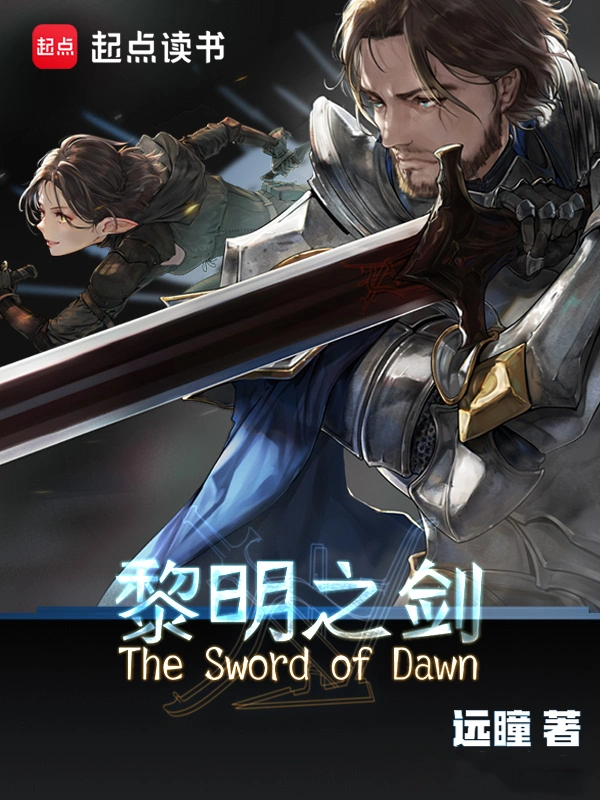
Sword of Dawn
黎明之剑
- Status
- Completed
- Length
- 6.3M Words
- Genre
- Sci-Fi
- Audience
- Male
- Subgenre
- Time Travel
- Updated
- 1y ago
- Source
- Qidian
Stats
Tags
Honours
Synopsis
Reader comments
In booklists 2k
Explore more →
The Spiritual Reserve of a Fat Chicken with a Round Face
A good book is enough to make people forget about sleepiness, hunger, playing games, and falling in love. And with countless good books piled together, you don't have to sleep at night. When day and night are reversed, we are no longer bookworms, we are all fat chickens with round faces who open our eyes at night~ Gu! In addition to reading, I highly recommend "Those Things About That Rabbit That Year". When you are depressed, reading it once is enough to revive you. This prosperous age will be
Looking Back, I Lay on the Railing and Listened to the Wind, Listening to the Whispers of the Wind, and the Sunset Disappeared by Itself.
Post-apocalyptic science fiction, in-depth and good writing, half of it is a complete masterpiece, half of it is a new book. Self-recommendations are welcome. Useless and poisonous articles will never be included in the book list. Everyone has their own favorites. I hope everyone can find the genre they like.
A Long Review List Focusing on Seedlings
Self-recommendations will be deleted, but those who are interested will basically try the poison. In addition, I will not help with reviews, so don't force it, thank you.
Book List No. 4—Science Fiction Category Book List
Note, this is the starting point of science fiction classification, not science fiction novels. Do not enter it if you are a good person.
Inventory of the Strongest Books in 2018
There are many years in a person's life, and each year leaves traces, deep or shallow. Every year, there are always some books that are like a dazzling galaxy that cannot be avoided. Every year, there are always some people who are there and cannot be ignored. In 2018, this book list will take you to meet these books and these people! (There is a kind of book list that he has to read backwards to see the highlights. Why? Because I write it forward! By the way, I will add another sentence, only t
Divine Book Seedling🔥complete a Classic🔥unpopular Good Book🔥imaginary Anecdotes
Changed name! Thanks for the review! [Note] On a whim, I want to start a likes war to see how many books can reach 9999 likes through the likes war. There are now 11 books. [Special Note] Comrades, be sure to collect the book list, click on the five-pointed star🌟 at the bottom of the screen, and turn it into a red star to collect the book list, instead of paying attention to me! Click the little heart below 👇! 2. I felt that the number of places in the book list was seriously insufficient, so
The [Most] Book List to Read Even If You Stay up Late
[Special Note] Click on Lao Chai's avatar to see Lao Chai's main book list. With 30,000 followers, the main book list is even more exciting. Haha, I wanted to take stock of some of the most interesting works in 2018. I would like to thank Qidian for giving me this opportunity. [Special Note] Comrades, be sure to collect the book list, click on the small five-pointed star🌟 at the bottom of the screen, and turn it into a red star to collect the book list, instead of paying attention to me! ! Let'

Reading Journey·starting Universe
A Zen master once said in ancient times: "Blow out the reading lamp and your whole body will be filled with moonlight." Master Shan keeps more than a dozen books on his bookshelf all year round and "reads them" at night. There is a fiery and vivid soul lying in the book. In the hustle and bustle of the city, we read more books not for the empty and unrealistic fantasy that we can really change our destiny, but just to view and think about the whole world from the perspective of the characters
What You Thought Were the Pinnacles
The peak is not the end, but the starting point of a legend. A true god-level author is always breaking the limits of his own creation. Let's take a look at those masterpieces that have reached their peak again today~
Red Ji's Shuhuang Relief Center
Personal reading standards: The writing is good, reasonable, and self-consistent. It can be imaginative, but the deduction must be reasonable, it is best to have practical information, and the plot should be as detailed as possible. This book is a list of personal tastes. It collects works that Chiji has personally read and feels are worth recommending. We do not seek to satisfy everyone! I have a clear preference for good writing and imaginative settings, and Taneda-style works! Don't like to e
[September Hot and Cloud List] 25 Game Sports Science Fiction Light Novels
25 Copies
Reading When You Are Young Is Like Walking Towards the Rising Sun
Reading when you are young is like walking towards the rising sun.
Wolf Tu's Science Fiction Book List (Mostly Completed)
Welcome everyone to pay attention to the main book list of Wolf Picture. You can click on my avatar twice. 💎(If you like it, remember to bookmark it⭐) 💎Science fiction novels, so I only recommend this type of novel. I have read most of them (even if I haven't read them before, I will read them on the book list). ^O^ 💎I think the recommended book list is best to have several categories in one big category, so that brothers who like this kind of books will know if there is a book that suits thei

Recommend Some Good Science Fiction Novels
The combination of technology and fantasy. I have read a lot and selected excellent materials. Book lovers, this is a list of books on science fiction topics. Do not recommend other genres. To collect the old version, you need to follow it. The starting point for collecting the new version is to click on the five-pointed star below. If it is red, you have collected the book list.
Excellent Books for Future Readers
I have a lot of reading experience. I have read many types of novels over the years, and I have been recommending books for nine years. Most of my book list has been read and understood by myself, and I feel that each book has its own characteristics and is different from ordinary literature. Everyone has their own type of novels that they like to read. If the books I recommend can suit your liking, that would be the best. The content of the books I recommend is very good and interesting. You ar

A Collection of Novels Commemorating Old Books
Select classic novels from the past that are worth reading, and each author can only choose one. If you think what I recommend is good, come and add it to your collection!
Good Sci-Fi Articles & Powerful Coming #*Classified Book List!
In 1904, the birth of the first science fiction film "Journey to the Moon" made humankind's imagination of the extraterrestrial world a classic theme on the screen; the advanced concepts and forward-looking technology in "2001: A Space Odyssey" are still unsurpassed today; "Interstellar" explores the torture of human nature in the grand space and time of the universe... Over the past 115 years, science fiction movies have carried too many human missions and emotional sustenance. With the release
Trust Me, Click on Me, I Won't Be Wrong.
There are risks in testing poison, so be careful when chasing books. Update frequently, keep reading, There are always good books, if you like them you can follow them. Giving flowers means choosing flowers
Group Portrait, War, Civilization, History, Exploration
Group portrait war genre, science fiction, historical civilization world exploration, if you like it, please save it and read it.
Different Taneda-Style Works
Cultivation and cultivation of immortality, survival of tribal farming, revitalization of rural farming, historical farming struggle... Bookmark and read what you like.
[Exquisite Science Fiction Articles]
🤓😎🥸🥸🤩 Both soft and hard are available. Personally, I don't pay much attention to soft and hard. As long as it looks good 🤓😎🥸🤩🥳
[Twenty Years of Internet Writing, Complete Science Fiction Masterpiece]
A specially recommended book list for novices. Lao Bai should have read it before, so you don't need to read it. A good start with more than one million words, a complete book
[Real Long Reviews, Detailed Reviews of Popular Books]
🍂🌾⭐🌙🌞👑 [Objective evaluation of popular books on various lists, and auxiliary recommendation of some buried good books] There are too few savvy authors If you write a book without understanding, you are doomed to be unable to make a difference. Only accept books written by enlightened authors Books don't necessarily lead to understanding But the author who writes the book must be a wise person PS. You are welcome to recommend various niche and unpopular books, with a minimum reading of 200,000 w


Those Classics and Masterpieces That Are Not "Well Known" by People
The place where the protagonist is located is called a 'boundary', and each book has a 'boundary', so they do not interfere with each other. Even the protagonist can never cross the limit of 'boundary' And we are observers who can transcend the limit of 'boundary' [Grain and Grass]: You can watch it [Recommendation]: Interesting and beautiful [Highly recommended]: Don't regret it (ಡωಡ)
Readers also read
 I Am Picking up Corpses in the Last Days
 Xueba: I Picked up a Wasteland World
 Unlimited Employment Starting from Sheriff
 I Have Become a Zombie, and the System to Punish Rape and Eradicate Evil Is Here
 Qingdu Shanshuilang
 Trafford Buyers Club
 Players Are Super Righteous
 Disciples of Fangcun Mountain, Traveling Westward
 I Have a Dark Secret Martial World
 Tao and Carbon-Based Monkey Breeding Rules
 Doomsday Jigsaw Puzzle
 Gourmet Food Supplier
 Alien Hotel
 Deep Sea Embers
 Anecdotes About Unusual Creatures
 Xiling Empire
 A Brilliant Plan: Sea of Storms
 Sword of the Dawn: Extra
Why in 2023, I still love you "Sword of Dawn"?
Because in this novel, you can enjoy a reading experience that is extremely difficult to experience elsewhere. It may not be the best online novel in history, but it is undoubtedly a type of work that is more "literary" in terms of literary tendencies - it is not a random graffiti, but an artistic work that has the theme and soul running through it from beginning to end. After reading the first few chapters of "Sword of the Dawn", readers will mistakenly think it is a fantasy adventure story in the world of swords and magic, but please do not be fooled by it. This article is essentially a science fiction novel, even a bit hardcore. —————————— What is the theme of "Sword of the Dawn"? In other words, what is so wonderful about it and what is there to see? I would like to summarize the following points using my own reading experience. The first point is the complete world system constructed by the author, which presents readers with extremely real feelings from various perspectives such as country, class, magic, religion, and profession. What is particularly surprising is that the author even boldly raised some deep questions while achieving logical self-consistency under the original world system. For example, the setting of "magic" may be replaced by words such as "spells", "spells", and "spells" in other books - what a convenient setting! Animals turn into humans, this is magic; plants speak, this is magic; magic cannons destroy the world, this is magic... But in Sword of the Dawn, you will see the author using a lot of pen and ink to research and explore such an issue. What is the essence of "magic"? For most people, what magic is is not a question at all. They think that magic is magic, a force that exists everywhere in the world, the wealth of the gods, and a treasure that divides people into three, six, and nine grades. Is magic a wave? Is magic the result of the resonance of the specific magnetic field that envelopes the planet with people? Or is it some "thing" that uses matter as a carrier? If magic is an energy field, can the operation result of magic be regarded as a special kind of fluctuation? It sounds a bit convoluted and confusing, but this is the interesting part of this book. The author uses a rational writing style to explore those neglected "laws" in a world of swords and magic. What is surprising is that he can finally make a convincing explanation and develop science on this basis. In other words, he has completed the most difficult to achieve and the most essential logical self-consistency among all fantasy novels. The second point is the description of the people at the bottom of society in the book. This is another reading experience that is difficult to get elsewhere. In ordinary fantasy stories, the wheel of history always seems to be driven by the protagonist, and most authors do not use a lot of writing power to write about the fate of ordinary people who pass by the protagonist. But what surprises me again is that the width of Yuantong's pen seems to be able to accommodate those people caught in the cracks of history. Where will those blacksmiths go under the magical machinery brought by the Magical Industrial Revolution? Will farmers' new-age planters lead to more harvests, or more exploitation? What impact will the emergence of railways have on businessmen? What impact will the circulation of newspapers and periodicals have on the literacy rate of ordinary people? Even the first mechanical ship sailed to the sea to bring about golden trade routes, and the first aircraft soared into the sky to subvert the war system. How did the declining knights of the old era transform and contend under the torrent of tanks? When the new religious system and the new doctrinal flag of the Holy Light are held high over Cecil City, what kind of shock will it have to the remnants of the old era? Yes, this is another highlight that shocked me - the changes of the times. The violent collision between the old era and the new era, and the contradictions caused by the confrontation of ideological trends can almost firmly attract your attention! Yuantong uses a huge amount of space to tell you that the real driving force for the advancement of the times is not the protagonist Gawain, but the people around him. The people, only the people. The third point is the relationship between people and gods, and people and religion. In order to better tell this point, please allow me to tell you a short story from the book in brief language (please skip this point if you don't want to be spoiled). There is a priest who truly believes in the God of Holy Light. He has traveled a long way from the Central Plains and sincerely preaches to everyone. He is so pious, but his own magical talent is not outstanding and he can only use very simple spells. On the other hand, the Holy Light Church in the Central Plains is greedy and selfish, and constantly exploits the money of civilians in the name of the Holy Light, euphemistically calling it "atonement." Ironically, the God of Holy Light responds extremely strongly to them. Their magical talents have not been reduced at all because of their sins, which is completely inconsistent with the description of faith in the doctrine. This priest has come a long way. He had never had the slightest doubt or wavering in the Holy Light before, but the Holy Light abandoned him - just because he attacked other priests in order to save a child who was abused by the church. He was forced to wander, and was forced to become enemies with other colleagues in the war. He watched helplessly as the Holy See Knight killed an innocent, poor girl like a beast, and the holy light of justice flowed around the murderer. As a result, his trust in the Holy Light was shaken. He tried to think about why God gave those thugs the powerful power of Holy Light. The Holy Light was supposed to be used to save the world, but was used by those people as a barbaric weapon. So - who is the God of Holy Light? What is the Holy Light? What does human faith mean to gods? So, there is the following classic scene. " Wright opened his eyes, and the holy light surged in his eyes, surging in the shocking wound on his face. He raised his light-cast arms and grabbed the neck of the Holy See Knight... Under the fear of death, the Holy See Knight widened his eyes and stared into Wright's eyes: "The Lord... The Lord curses you! " "I-curse-it! " Pure brilliance burst out from the Holy See Knight. In this unprecedented clear light, the blood, flesh and bones of the Holy See Knight instantly vaporized, and a pair of tattered armor and robes were scattered on the ground. ………… The righteous people are abandoned by the Holy Light, but the ferocious villains who loot and kill have the power of the Holy Light. What is the reason behind this? "Sword of the Dawn" certainly gives a very shocking answer, and it is also an enlightening truth. I can't write it down directly. That would lose a lot of fun. What I can guarantee is that when the true relationship between people and gods is truly revealed, the truth will definitely be an unexpected answer for you. I admit that I was too excited to write, but I read Sword of the Dawn twice. I was almost as shocked as the first time. This strong emotional impact made me have to write something down. I love this book so much. If you have any novels similar to the style of this book, please let me know. Finally, I want to say, Yuan Tong is awesome!
Secret Blood Soldier City Cup When we read the farming article, what are we looking forward to?
What are we looking forward to when we read farming articles? Farming is a theme that has been popular for many years. It involves time travel and rebirth, ancient and modern times, China and foreign countries, and alien continents. The backgrounds are rich, and the plots also present different interests due to different background structures. Generally speaking, Zhongtian Wen has also summarized certain routine templates. The term "routine" here is not a derogatory term, but a summary of some experiences in the industry that will inevitably be brought about by the gradual maturity of the online literature industry, such as the classic Industrial Revolution routines. But after reading so many farming novels, besides watching the growth of the protagonist, the harvest of family love and career, and the progress of society, what else are we looking forward to? "Sword of Dawn" is such an answer. Strictly speaking, Sword of the Dawn is not a farming novel in the traditional sense. It is more like a symphony orchestra playing under a famous conductor. The conductor is the soul, but it is each musician in the orchestra who contributes an auditory feast to the audience. Gawain is a shining sword in the darkness. He rises from the coffin and illuminates the Cecil family that is shrouded in declining destiny. He cuts through the haze shrouding the ruins of the world and lets the dawn sun shine on the earth. But to clear the dark clouds in the sky, we need more than just a sharp sword. It requires cannonballs hitting the torn hole, and it requires the efforts and waiting of people on the ground. What Gawain brought was scientific concepts and ideologies that were more advanced than the social structure at that time. He himself was the conductor of the symphony orchestra, allowing each musician to maximize his or her own value without conflicting with each other and taking the lead. But Lai Ming's biggest surprise is not here, but the direct criticism of backward ideologies and the lack of shyness about social shortcomings. Under the dark clouds in the city of Luan, what persuaded Amber to be used as a poison-quenching dagger was Gawain's display of more powerful social productivity. Although the citizens of Luan City may have lived better than most people in Cecil at that time, the future brought about by stronger productivity has shown itself to be more progressive. Bertila mocked his "bullshit great cause", and Gawain also reminded himself that "the people don't need you to teach them." That's right, the people's view of history, the revolutionary view of history. Big Eyeball uses a skillful writing style to skillfully depict the relationship between heroes and the people. Gawain is a hero, but the creators of history are the people. We have all read in political books that "the progressive ideas and propositions put forward by the political representatives of the advanced class can become the forerunners of social change, and they can become the initiators of the realization of certain historical tasks." "The people are the subjects and creators of history, and are the decisive force in promoting historical development." These words, Gao Wen and the people who support him jointly interpreted such a materialist view of history, and the imaginary background also reflects that this is a universal law of the development of human society. The revolutionary view of history is explained by Gawain using the violent Southern Territory Unification War and the Crystal Cluster War. It is also explained by Amber's continuous internal chipping and scraping to remove the degenerate power in these systems. It is also explained by building a community of destiny and uniting all forces that can be united. Revolution is not only violent resistance to the old system, but also self-revolution with a gun pointed at the enemy and a gun pointed at oneself. The big-eyed man did not shy away from how progressive forces can maintain progress. Constant revolution, always young, facing the future, and preparing for a rainy day. This is the description he gave us, and what history and reality tell us. This is a deep or shallow view of revolutionary history that is rooted in the hearts of our generation. When we read farming articles, perhaps what we are looking forward to is something more profound and essential. We are eager to see our magnificent history repeated in another place, and we are also eager to see a preview of our yet-to-be-achieved future in another dimension. We hope that our ideas will be carried forward in the world, and we hope that mankind as a whole can leave the cradle and go further into the distance. We don't expect a perfect ending, we expect a bumpy but unswerving process. This is a good book that only modern China can produce. It is a condensation and portrayal of our history and practice. The so-called Chinese stories and cultural output do not lie in those forms, but in the core of Chinese people's empathy. At this point, Sword of the Dawn can already occupy its own place in the history of modern Chinese literature. I look forward to the day when it goes abroad and goes to the world. Sincerely thank you Big Eyeball.
Sword of the Dawn is really a very mature work. In my opinion, it mainly includes: 1. The maturity of narrative expression ability. After reading hope Ling's previous writing style, you can deeply appreciate Yuantong's progress. When comparing the works of other authors horizontally, you can also find Yuantong's excellent ability to control large-length medium and long paragraphs. 2. A group drama with many but distinct characters. Many supporting characters and supporting characters showed impressive wisdom and rationality. The author's attention to the logic of thinking prevented many plot directions from being abrupt. I have to say that there are quite a few smart people in this book. 3. A warm atmosphere that is both laughter and touching. Make people happy but not funny, give people serious but not heavy. 4. Exquisite plot and compact development. What Yuantong did here is very clever. I don't know if anyone else has written like this. After all, I don't read much online articles. What this story has to fight against is not a concrete enemy, but a natural rule, which allows the whole story to pass smoothly through the later stages. In most online articles I have read, the later stages inevitably become mediocre and boring, and a single long-term battle becomes the main tone. But in this book, the development of the story advances as the protagonist and others understand the rules of the gods step by step, and Yuantong reveals the puzzle bit by bit. When all the answers are revealed, the ending can be said to be a matter of course. This book still attracts me 98+% of the time, which is rare. Of course, I have also seen some people say that the lack of a big twist in the ending is a shortcoming. However, only short stories can be enhanced by big twists. It is difficult not to use big twists in a long novel of more than 6 million words without being funny. This is equivalent to overturning the author's painstaking foreshadowing. 5. Pattern. The core of this book is actually: anti-superstition and anti-feudalism; people's view of history; community of destiny; and romantic longing for the starry sky. It abandons the traditional personal heroic plot of a brave man fighting the devil, and highlights the power of the people. It is a very unique work in all aspects.
I don't quite understand the male protagonist
People usually have motives for doing things. For example, the double-eyed Roland collects witches because of heroism to protect women and save the weak. Brando with the Amber Sword does it to make up for his regrets and take the harem. However, I can't see any proper motives in Gawain. There is an ideal behind any plan that is large and sophisticated and even implemented in life, but where does Gawain's ideal come from? He is an earthling who was forced to wear something unknown for hundreds of thousands of years, unable to move or communicate with people. Suddenly having a body, shouldn't he have this kind of thought, "Emma is finally a human again, I want to have fun" and then eat, drink, have fun, collect the beauties around him, and stage the legend of the ancestor and the eighty princesses? If a person with a high moral standard borrows the body of someone's ancestor, he may also protect other people's descendants. Gawain does not have this awareness. He is not aiming at the Cecil Territory but the entire kingdom and even the world. However, traveling to another world and promoting the development of civilization and people's progress are usually the ambitions of people who have just traveled through time. For someone like Gawain who has witnessed countless times of civilization construction and destruction, and the history of worthless creatures coming and going, his mentality should be "tired, destroy it", which is more reasonable. Of course, the author has changed Gawain's physical structure. Whether he can still be classified as a "human" is still a question. He is incredibly calm as a satellite spirit, not crazy or stupid. But in this way, his motivation to promote civilization is even more incredible. Where does this kind of spiritual core come from? According to the description in the article, Gawain has the joys and sorrows of ordinary people, but his inner spirit is complicated and confusing. This setting is contrary to the situation. This kind of Gawain gives me the feeling that he is a character based on the mold of "legend", "perfect protagonist" and "author's representative", lacking a sense of substitution. There is not even a male weakness, such as seeing a beautiful woman unable to walk, or at least being greedy. Although ten or eight of the male protagonists in the starting point are studs, this is relatively normal. If Gawain has the mentality of an uncle who has gone through vicissitudes of life, and looks down on little girls, but his mentality is that of a young man only when it comes to reform, this is too contradictory. All in all, it's so inhuman. Speaking of which, Hetty's method of detecting evil spirits is not effective. If someone else wears it, of course they can give the name of the body. Doesn't anyone doubt that Gao Wenxi is occupying the magpie's nest? He had known people like Solderin before, and he had never noticed that there was much difference between his friends before and after, and the original legendary hero was too pitiful.
Final words
I walked through three books with Big Eyeball, watching his world grow from big to small, and watching him describe his thoughts more and more perfectly. Hope Ling's story has never been about an extraordinary individual, but rather a fairy tale about powerful, primitive, advanced, or ignorant civilizations struggling to survive in their own way in a harsh environment. The reason why fairy tales are fairy tales is because they have hope. Big Eyeball's stories do not like to use strong sacrifice and dedication to highlight difficult situations and arouse emotions. In his stories, good people will be rewarded, and those who save themselves will wait for rescue. However, the 17-kilogram civilization and the superimposed parameters of the demon tide will repeatedly remind readers that trying your best is only a necessary condition for survival, and a world not favored by luck is the normal state of the universe. There is only one kind of heroism in the world, and that is to still love it after recognizing the truth of life. The background of Xiling is a hymn of courage and a vast heroic spirit. In Dawn, this heroic spirit is reflected even more vividly. Big Eyeball decisively abandons the connection that continues Xiling's world view, and instead uses fairy tales of starting from scratch, building homes, and resisting fate to praise how ordinary people overcome crises step by step and move towards adulthood and the starry sky. Gawain is a hero, he brought new ideas and systems, leading the world with his wisdom; Belsetia is a hero, she led the entire empire through the crisis in the wasteland, and buried the Druid faith; Ravencase is a hero, he used his own life to practice his beliefs... There are many ordinary people, they work diligently, use the most simple actions to face the uncertainty of fate, and seek a better future for themselves and their families. They are all unsung heroes. I think this is what impressed me the most. Go do things and face the future. The past is the past, the present is yours, and the future is still yours. Use your hands to create your own heroic stories. As long as you can work hard for a better life, you are a heroic person. All of your stories together are the heroic epic. All of your efforts together are the Sword of the Dawn.
A little emotion (there are spoilers, be careful)
I'm exhausted. When I realized this, I had already played Dawn for the second time and stared at the chapter that had just been updated. I hate it so much, I should watch it slower. Stop all the nice words, let me start by posting what I said when selling Amway to people Too awesome, big eyes (sincerely In fact, I saw them slowly enough, the big eyes are unique The long paragraphs slowed me down, and I was forced to read this story full of humanistic care and philosophy from the beginning again. Where should I start? Let's start with Amber. I don't know what other people think. But as far as I am concerned, Amber is so appropriate as the heroine, so just right - so natural Appropriate refers to Amber's positioning, and just right refers to Amber's behavior... And naturally, it is given to Big Eyeball, to him. The subtle and silent writing power, and the jaw-dropping gray lines behind it, foreshadow thousands of miles. If others read this word by word like me, then they should know that the character Amber - as a representative of the characters written with big eyes - has been growing. . How difficult is it to write about growth? There is actually only a thin line between growth and character collapse. Growth requires foreshadowing, hints, and a huge amount of thinking to determine where to place these foreshadowings. (Is the character really a weakness of Big Eyes? In my personal opinion, Cong hope. From the spirit to the abnormal and then to the dawn, the writing power of characterization should have improved, "naturally, no one notices" is the best proof) From the little thief at the beginning, to accompanying the old Zongzi reluctantly when opening up wasteland, but still observing the differences between the "old aristocrats" and the "old commoners" and the wasteland. Amber. In this early part, Amber is shown to be "arrogant" and "mocking" - according to the following, we can know that in Amber's own eyes, he was born as a street gangster, a representative of the vast number of "poor people", and one of the contradictions in the conflict between "nobles" and "poor people". Cecil at this time, Satellite Spirit at this time, gave her a different "common sense" from Cecil. So she began to see. At this point, Amber gradually "faced" the old Zongzi. Later, when Cecil was brought to the Cecil Empire, Amber went from "noble bodyguard" to "director of military intelligence". This content is wonderful. This "smart" (the original text actually didn't mention Amber being smart, just like the original text always called Rebecca a stupid roe deer. But we readers just think they are smart, why? This is of course also the result of the amazing writing skills of Big Eyes). From "face to face" to "take seriously", from "mockery" to "admiration", Amber, this character who represents millions of "lower people" in the book, represents the "beloved" in the book. The day when he followed Gawain step by step to the empire was the day when he found his "meaning of existence, the meaning of life". ——Insert a sentence here, Dragon Omega's question "what is the meaning of life", I personally think that it can actually be figured out The whole book has a hidden theme. The book "Sword of Dawn" seems to be just a story about time-travelers farming infrastructure, but I personally think that apart from that, one of the main themes of this book is the story of people of all classes, factions, and races finding the meaning of their lives. The greatest affirmation that human beings have for themselves is that they are "necessary to exist" and "meaningful". Okay, at this point, Amber began to gradually admire and understand Gawain - from being ignorant at the beginning, to envying the students of the Imperial Academy, to. When she started to learn by herself, the biggest change was actually quite noticeable: In the past, Amber "didn't care" that Gawain and others talked about things that she didn't understand. Later, she asked Rebecca and Tyr, "Do you understand?" She is still "proud", but she is humble enough. Her attitude towards Gawain ranges from fear to admiration to worry. Even now, Amber can be said to know Gawain best. Their interaction is proof. (To say that big eyes can't write characters is simply an insult to Amber's character in this series.) I'll write it here first, and then continue writing it. Thank you Yuantong for eight votes.
Farming explodes! Farming explodes! Farming explodes! At this time, I am here to give a thumbs up, and it is all subjective: Compared with the book about a certain witch, this book is simply gauze. I also read it because of it at that time, and it was really out of the ordinary. What is written follows what, do you want logic? Do you want details? Is it reasonable to do so? Don't want any of them. The losers are still promoting it under the banner of farming, bah. Isn't it just a collection of harem Pokémon? I declare unilaterally that Sword of Dawn is a fantasy farming article, blow it up, blow it up, blow it up.
Secret Blood Soldier City Cup Civilization Epic
. Dawn comes to an end, and I am once again asked to compare Two Eyes Witch, both of which are top-notch works by Western Fantasy Farm. Of course, the western fantasy farming genre has never lacked quality products (The two-purpose fantasy farming formula of heaven, I personally feel that it is not good, maybe fantasy farming has not reached its peak yet?) Let's look at the core of the farming genre first, farming The Sword of 8:05 and the Witch both follow the imperial route and are both magic industries. However, the difference is that Witches play an elite style, and the national industry is played by a special group of [Witches] as the core productive force. Moreover, on the basis of farming, Witches do not have much creative ideas. Basically, they have all the industrial resources they should have, and there is also an extraordinary group of [Witches] as basic support. The Sword of Eight Points and Five is set in the wasteland, and the early stage was laid out through the excavation of data from the previous era and Mr. Dan and Silly Roe Deer. In the industrial revolution, because the elements were not universal, Eyeball's imagination created a brand new industrial system, which was like "ascension". The industrial development and magic of the Sword of Eight Points and Five are more completely integrated, rather than being highly differentiated like the Witches. At the same time, in terms of subsequent development, witches continue to expand around the core group of [Witches]. The development of ordinary people means equipping them with industrial products, and the upper limit is relatively low. After entering the main line, there is less farming, and it basically becomes a battle of extraordinary powers, and the people As a mortal object, it is not easy for a weapon to cause damage to magical creatures 😁 The magic industry created by the Sword of Eight Points and Five based on [magic] has not only popularized magic products to civilians, but also popularized magical power in large quantities. It can be said to be a "collective ascension". In terms of description, The Witch of Two Eyes grasps the group of [witches], and writes the main female characters with the protagonist Roland as the center. From this point of view, The Witch is a relatively traditional and refreshing novel. The advantage is that the description is very concentrated, it actually advances the direction of the main plot in the later period relatively steadily, the look and feel is also good, and the threshold is low. The Sword of Eight Point Five, the protagonist of "Gawain" is more like a [civilized narrator] perspective, describing a magnificent epic of human civilization, and is a group portrait work. Whether it is the common people of Cecil's empire, Augustus and his ministers, or the gods, they are all extremely well-formed characters. ■■■ From the perspective of farming literature, Sword of the Dawn is undoubtedly more in-depth than The Witch, and because of this, the reading threshold of Sword of the Dawn has a higher threshold, and the concentration of exciting points may make some chapters boring. This is why I prefer to call Sword of the Dawn an epic of civilization. This is a group struggle. This is the flourishing of a civilization. This is the rise of a group of heroes.
Talk about impressions Cecil was an ideal combination of the United States in the golden age and New China on the one hand. Typhon, an enhanced version of Britain. Silver Empire, plug-in version of old China. Dragon clan, plus version of cyber civilization. The United Nations of Tribes, the best match for Africa. For the various countries in this book, due to the Gawain plug-in, as well as their own energy resources being more abundant than the earth's, and their foreign enemies being too strong, the bloody plundering stage that occurred in the history of the earth does not appear in this article. In addition, in order to make the plot popular and smooth, this novel deliberately reduces the suspicion and aggression between people, deliberately improves the ideological consciousness of everyone from leaders to employees, and deliberately increases the number of use of plug-ins. This makes the book somewhat uncomfortable logically. Although this book repeatedly emphasizes that the development of the world in the book is not due to Gawain's participation, it is obvious that the history without Gawain's participation may just be the Typhon country plundering Old Ansu and the United Nations of tribes, only superficial communication with the elves, little contact with the dragons and sea monsters, and the two major cults It is possible to win but it hurts one's vitality, and the path of controlling thoughts is tortuous. Moreover, due to the small map of ordinary kingdoms in this world, Typhon without Cecil has no room to communicate with the outside world. In the end, it will only become a British Empire with little room for development. It is impossible to reach adulthood and defeat the demonic tide. However, this book reflects the author's mature control both in terms of writing style and the overall situation. Compared with some authors who are too hard or too suppressed in terms of text or ideological output or emotional expression and character creation, the author's writing level is high, smooth and natural is the best. The author's profound understanding of scientific thought is also worthy of respect. The author must have a comprehensive understanding of the history of human scientific development. Above, I, a rookie, used such a disrespectful tone to criticize Mr. Yuantong. I dare not express my opinion. You can just watch and enjoy it.
As one of the people who once pursued reading, I finally made up my mind to finish it recently.
I still remember the transition between winter and spring before the epidemic, and I happily read The Sword of Eight and Five with everyone, watching Cecil sweep away the decadent aristocratic forces and church factions in the south... Until the advent of the Age of Empire "..." Thought I was going to say that I was disappointed when I saw the word [Age of Empire], and then gave up the book and stopped reading? (That's weird!) Actually, we just wanted to save more and read it again. Like a silly little squirrel in autumn, I watched Uncle Tong update from a distance, making the book fatter... As a result, it turns out that a year has passed since the book was finished. . . "Annie, hold on, daddy will save you." The Wild Mage and his daughter Annie "If he comes back alive, E is equal to 1.29, If he doesn't come back, E is equal to 1.66." Ravencrest and E=1.66 "I don't know if your father can come back like me. But all of us will meet somewhere one day... " (Immortal, right |•ω•`)) Little Patty and her Uncle Gawain "I curse it!" Holy Light, Child, White Knight "Children, this is a war." The knights of the old times, the times push them forward "Because it has become like this... You can live by eating stones." Have you taken a serious look at those humble people? "Here, the story ends..." The upper-level narrator who wants to go see the stars "Goodbye, son." Let the beacon become the final ending of the past "All members - light up the blades!" "For our country!" What's the point of fearing when you hit an egg against a stone? "From now on... You will go on your own." Talrond's Coming of Age Ceremony, the former gods broke free "The Battle to Recover the Wasteland of Gondor." Forged with iron and fire, blood and tears, the Alliance of Lorren The same body "Conversation across light years." Contact between two civilizations on a light year scale "Did he detonate the Deep Blue Well?" The God of Holy Light's self-sacrifice gave him hundreds of years of breathing space Look back to Wright at this time... Ugh, I feel so sorry for this "god" who didn't make it to the end "Reject the throne of the God of the Starry Sky." It's better to just lift up the coffin and say, "Whoops, whoever smashed my hand" "And the greatest adventurer in history!" Crossing the Quadrant, Mordor Wilder, this trip is great There are many, many impressive places, aside from the "people's view of history" that is praised every day. After reading this story of "the whole race unites to defeat natural disasters and survive", we just want to say - "It's really good." Thank you, Uncle Tong, for bringing us such a work after Xiling and Anomaly. She may have been criticized as "boring" at the beginning of the serialization, and may have been labeled as "lethargic" in the middle of the serialization... In our opinion, it is a bit too much, but what does it matter. The fairy tale world for adults is probably like this. The Hollywood style of turning the tide and self-sacrifice to save the world basically does not exist. Relying on that way to survive the crisis is not considered a true "adult" compared to the ignorant people. When encountering the next round of crisis, they will still have to rush into the street. Many farming novels of the same type are guided by the protagonist all the way, as if he is an omniscient and omniscient prophet. This kind of reading can be read, but it always makes people have a kind of worry - "If the protagonist suddenly dies suddenly in the future, will the people under his rule become [technological barbarians] quickly? Are life full of black boxes?" Recalling more than five years ago, when I knew that Uncle Tong was going to write a farming novel, someone took out "The Witch" as a comparison. In this process, it has become inevitable to step on and support others. I remember one time, some people criticized the setting issues in the article such as "cannot boil water" and "struggle to explain what magic does". Regarding this issue, some people choose to complain about it, and naturally some people choose to understand it. We belong to the latter, because it is obvious that the appearance of these settings will conflict with the readers' sense of "immersion". If you are familiar with the radio wave, you will think it is great, but if you are not familiar with it, you will think "What the hell is this? Isn't this just a persuasion to quit." It has been almost ten years since I started reading it, and I still feel so moved in my memory. Especially after watching Dawn last night, I really couldn't calm down the excitement in my heart for a long time. Working together Mortals united with swords to split the darkness before dawn A good story will resonate with people and will never be forgotten. I hope that Uncle Tong will be healthy and healthy, and that cute Tong will occasionally show up in the morning and bring you more stories in the future, which may make you cry or roll on the bed with laughter, so that we can recommend it to our children again in the future - "Look! This is your family's favorite fairy tale." (Put your chest up and look up so proudly)
On what kind of book can I mention the title only after writing chapter 1546 in the nth year?
Is Wales about to show his true colors? (Funny life-saving)
Before the Zen position: Oh yes, throw away the crown and run towards a free and happy life. After I am so salty, I don't care about the monstrous black tide. My fishy lips, Doudou, what are you planning to do? If you want it, tell me and my father. It's not easy to discuss if you are a family. It's all yours, this crown is yours, this Silver Castle is yours too. I can also take down the heads of these more fishy nobles for you. Do you think you can take a picture? After the Zen position: Wait, this is different from what was promised. I have shed blood for mankind, and I have taken the blame for Gawain. You can't do this to me. I want salted fish, I don't want to work overtime. I want to see Gawain!
As a street writer who also writes a lot on a daily basis, the new book Big Eyeballs had a huge impact on me. I am used to narrating stories from the fixed perspective of the protagonist, so I was a little uncomfortable when I saw this style of multi-perspective switching. If not done properly, it is likely to cause confusion in the reader's sense of substitution, and the serious consequences of the overall structure being shattered into a pot of gruel (personal experience). But Big Eyeball's skill is indeed not limited. Even though the characters involved are extremely complex, the reader's perspective can still be fixed on the team led by Gawain. The portrayal of other characters not only does not impact the main character, but also achieves the result of mutual deepening in the interaction between the characters. As the story develops, the character's personality also develops more naturally. It is difficult to achieve this without turning into an unchanging face and having a high ability to control the character. Back to the content of the story, to be honest, what I want to do most right now is to go to Big Eyeball's house to steal his outline and take a look at it. I'm really curious about what kind of detailed preparations it took for him to completely construct such a worldview. Putting aside the background of the gods and the old empire, which has been the consistent line of thinking since "Lingxi Empire", just talking about the intricate relationships between the major empires on the planet is enough to be amazing. Down to the "Cecil Empire" that is mainly inked, a few seemingly idle descriptions fully express the new things that promote the advancement of this empire. It is not until the end of a big plot that you will find that several scenes that seemed unrelated before actually played an important role in the plot. On the other hand, the positioning of the time traveler itself is also very real. He can be a pioneer or a guide, but he can never be a savior or god. It is true that Gawain's positioning is still on the high side, and his knowledge reserve cannot be explained by the "keyboard warrior of the previous generation". But at least in terms of the balance of IQ between the enemy and ourselves, "Sword of the Dawn" is already a very well-written book that I have read. There are no stupid people, but they are not as inexplicably stupid as some routines (for example, an old monster who has been practicing for tens of thousands of years is as straight-minded as a middle-schooler). Stupid people all have their own reasons and backgrounds for being stupid. Although they are not necessarily completely reasonable, they are basically acceptable. On the other hand, the collisions between the wise men were very enjoyable. Especially the battle of Changfeng Fortress made me hold my breath while reading the article for a long time. The secrets behind the three major sects also surprised me. After weakening the protagonist's golden finger as much as possible (after all, Gawain's ability is not too unreasonable), the weight of the battle of wits will be greatly increased, but at least so far, I personally think that Big Eyeball has handled this aspect very well. All in all, this is a book worth reading. Of course, everyone has their own ambitions, and it cannot be ruled out that some friends just don't like it. But personally, I feel a lot worth studying from "Sword of the Dawn". At the very least, I should think about how to make my characters look less like they are sleepwalking in the middle part of the plot connection... Above
It's dawn eight, and I finally have the confidence to write something to praise this favorite novel of mine. The Sword of Dawn is the best novel I have read so far. It is also the Oracle of Lord Maya. Neither Xiling nor Abnormality gave me this kind of heart-pounding joy and satisfaction in it. I like it for many reasons, but the most important thing is that it is a thorough human epic and a victory of historical materialism. In fact, there are many works about mortal epics, but whether from the perspective of writing skills or content, it is difficult to make the protagonists of group dramas ordinary but not mediocre. Because when you use people as the main line, exaggerating his merits and shaping his greatness will weaken the sense of epicness and the subjectivity of the people; and when you excessively suppress his particularity and coincidence of fate, the main line will appear ambiguous. From hope Ling to Dawn, Big Eyeball is also constantly improving his brushwork and skills, and this is even more prominent in Dawn and the Unfinished Deep Sea🐟. From the perspective of writing and structure, the protagonist of Dawn is probably Gawain. As a time traveler, satellite spirit, and Zentraedi heritage, he is destined to have unparalleled abilities and irreplaceable identity from the moment he appears in this world. But under the threat of the demon tide, the collapse of the world is just a matter of an instant. No matter how brilliant he is, it means nothing if there is only one left after destroying everything. At this point, personal specialness is tied to the common fate of mortals. Unlike tradition, Gawain or Yuantong smashed the protagonist's "god statue" to pieces at the beginning. He said, "The people don't need you to teach." Structurally, I think there are at least three main lines running in parallel. One is the protagonist Gawain, the second is the demonic tide, and the third is the fate of mortals (or history). These three lines are intertwined with each other and respectively meet the spiritual needs of the personal hero, the fantasy world, and the people's history, presenting a dazzling but not dazzling protagonist image. This style of writing must use strong historical and social scene shaping to offset the protagonist's personal halo, and at the same time use the protagonist's personality charm and plot to set off the torrent of history. This can prevent the group drama from turning into a relationship between flowers and green leaves. The second, third and fourth points are all from the perspective of content. The second point is the people's view of history or the trend of historical materialism. From the very beginning, the Father of the Magic Web, to the Ravencrest Constant, to Rebecca's many creations, and the contributions and sacrifices of the rebels for thousands of years, magic is not used here as a display of power, but as a carrier of history. As Gawain said, he only provides a vision and direction. The world never lacks wisdom and hope. Many authors regard the power of the people in "The People Make History" as only a quantitative situation. For example, in The Witch, Teacher Ermu uses weapons to arm the army and expand production. The special productive force is still the Witch itself. But this is not the case in Dawn. The return of transcendence to people is not to use guns and cannons to smooth the gap in force, but to completely return rights to people through the universalization of magic. This is people's creative exploration and genuine productivity. (Of course, there are differences between the worldviews of Witches and Dawn, and they have their own limitations in the world. These are just examples, not derogations.) We must not only believe that the people occupy the subjectivity of labor production in terms of quantity, but also believe that the people also occupy the subjectivity of discovery and creation in terms of wisdom. This is Liming's best expression of the people's view of history. The third is the sense of epicness. I think most novels inevitably have a supreme ending at the end. Regardless of the protagonist or the protagonist's camp, there must always be a summit as an ending, which makes people feel satisfied. But Dawn is not the case. The main text gives people a feeling of unfinished business at the end, and many people say it is unfinished. But for the vast starry sky, and for babies who have just emerged from the cradle, any predetermined ending is a shackle around their necks. When you assume the future, the starry sky is no longer a starry sky, but just a curtain like the starry sky. And what this blank space gives us is to always be alert to the spirit of curiosity and exploration. When we are immersed in the plot of the perfect ending, are we as limited in our field of vision as the children who dare not look up at the stars? Are you immersed in the cradle of illusion just like the poems of The Sailor? Epic is not only the thrilling history that happened in the past, but also the present that is in full swing of construction, full of hope and expectation, but also the face of the unknown, the exploration of the unknown, and the embrace of the unknown future. Similarly, the community of mortal destiny is an eternal and ideal concept from before and after the wasteland crisis to the establishment of the Lorennoi community. Yuan Tong starts from the social nature of human beings and believes that a united collective is far more capable of determining destiny than a special individual. Just like Gawain's insights on how humans respond to disasters in the end, there are certainly many individuals with outstanding abilities among humans, and there will also be many key historical nodes. However, the real creation of history is to seize these fragmented opportunities on the basis of uniting all forces that can be united, and to remain unchanged in response to changes, which is often said to be the overall view. At a time when neoliberalism is dismembering collectivism, I think the shaping of this collective-individual relationship is also very successful and ideal. It is not too much to call it an epic. The fourth point is the creation of the character. As a group drama, it must create many characters to fill in the gaps in history. Rebecca, Hetty, Philip, Byron, My Little Pony, etc., The creation of these characters is also a unity of stability and change. They have maintained their own personalities and characteristics from beginning to end, and have grown in line with their own characteristics in the ever-evolving world changes. The most powerful one among them, I think, is the character Amber. From an unidentified little thief at the beginning, to the right-hand man of His Majesty the Emperor in the end (according to the rumors, it is not even just the right-hand man), from the little thief who works for money to the military intelligence chief who is loyal to the empire, and then to the pioneer of immortals who see through the essence in the 40th millennium. Her changes are the most obvious and interesting, and more people have their own growth and experiences like her. This is the cornerstone of the group drama. (From an individual point of view, the ones that impressed me the most were Wales' Self-Destruction and Belk's Beacon) These four points should be what I think are the most successful aspects of Dawn. I won't waste time and space on the other bits and pieces of advantages and strengths. Everyone will definitely have their own feelings after reading it. I think if I have children in the future or the younger children grow up, I will also recommend Sword of the Dawn to them. I have seen something in it that transcends personal limitations and transcends the limitations of the times. There may be some shortcomings and flaws in it, but just like reading all books, it is enough for them to see the glittering gold sand at the bottom of the river.
Secret Blood Soldier City Cup Cecil and the development history of the flower grower
I am a loyal fan of Big Eyeballs. I have always read Liming as a farming article. Today I wanted to write a post about participating in an event. After thinking about it carefully, I found that it really matched the sentence, "Socialism, always dripping with God, yyds" Let me analyze it for everyone. Starting from the unveiling of the old rice dumpling's coffin, Cecil's founding of the country began with nothing. Among the major forces (the feudal forces of Anzu, the warlords of the Dukes, and the beautiful country of Typhon), the roles played by the major forces changed over time. This is also in line with the development of productive forces, and the objects of contradiction will also develop accordingly. To be precise, it was me in the past You like to ignore me, you can't reach me now) You need to rely on your words to move around and use clever tricks to win Cecil's territory, but the premise here is that there is a big killer. The old rice dumpling is a legend, which corresponds to the birth of our second kicker. After the second kicker was born, everyone in my flower-growing family said that this is a sure thing, brothers don't have to rely on flesh and blood to rush! As I write this, I am reminded of the episode "The Ice Sculpture Company" in the "Anti-M Aid C" that year about Natu, and my eyes are a little sore. Later, Cecil began to develop at full strength, the magic network developed, and ordinary people used magic lamps (electric lights). What followed was the explosion of various technologies, communications, networks, and transportation were upgraded from generation to generation, just like the manufacturing industry of my flower gardener went from being rough to being at the top of the world. When I was chatting online with a college student from China, I mentioned the beautiful country's technological blockade against Chinese families. She exclaimed that she didn't even know about such a thing. I immediately seized this opportunity to pretend to be 13, and told her with a light tone and a contemptuous expression that the rabbits in our flower garden were used to being blocked. We built our own two kickers, satellites, 5G, high-speed rail, and space stations. I also wanted to talk about the Kirin operating system, but I thought she didn't understand the meaning of this system, so I didn't mention it. To go a long way, back to Cecil Ha, when Lao Zongzi developed the technology tree, he actually followed the principle of checking the core technology and keeping it in his own hands. The same is true for Typhon. After introducing the Magic Network, the first thing he did was to study the principle thoroughly. As the saying goes, how can the most important weapon of the country be controlled by others! As for Cecil's ultimate goal, it has never been Typhon. Typhon is just a small player on the road to development. It is like the country that once had an overwhelming military advantage, and its economic and social system is a little more advanced than the Chinese. It always wants to invade the flower growers. We have suppressed him in various aspects, and it is not a big problem now. The ultimate goal is the Kingdom of the Gods. Before Cecil developed, ordinary people were like this: "The Kingdom of the Gods, how beautiful and rich it is! I wish I could be born in a beautiful country, the moon is bigger than ours!" Waiting for Cecil to discover When it comes to development, the younger generation is like this: "What, the country of the gods? Do they have so many fun and delicious food? Is there a high-speed rail to other cities? Do you dare to walk on the street at two o'clock in the middle of the night? When the plague comes, there are reliable epidemic prevention methods and life-saving white people. Are you a knight? Can you be admitted to the hospital if your condition breaks out? Unlike our Cecil, even if the goblin becomes ill, the white knight will treat him for free instead of putting him in the observation room to wait for death. Our Cecil can mobilize the power of the entire territory at any time. Can they rescue all kinds of disasters? They can't save even one person for ten days! " Of course our goal is not to destroy the gods and their country. As long as they are willing to retire well, we can coexist peacefully!
As a glorious Cecilian, we must achieve the four modernizations, that is, the behavior is amber, the thought is auspicious, the pronunciation is refined, and the style of painting is eye-catching.
From the story of the Xiling Empire's majestic conquest of the universe, the battle against the abyss, and the battle against the fallen apostles, to the story about traveling back and forth between a small universe and the "dream plane" stuck to it in Anomaly, to the story about a group of abnormal creatures in a small suburban house enjoying their daily life, to the third book Sword of the Dawn, the narrative of the story The scope of the story has been narrowed to a small planet, full of fantasy and magic, and the technology tree is stagnant in the Middle Ages. The highlighted pattern is no smaller than cosmic wars and plane travel, from stories between gods and gods, to interesting stories about the titular pope and the bottom-level gods of the company, to trivial matters between humans and natural phenomenon gods, thank the God of Maya! Let's hope that the next two books will not go downhill. The world may not need such good books, but I do.
It seems that Dawn has come to an end. As a reader who has read the latest chapters of Dawn from Xiling to Anomaly to now, I have to admire you, big eyes, you are really good at writing novels. In fact, Big Eyeball's three novels all have one feature, at least in my opinion, the withdrawal period in the first 50 or 100 chapters. The initial parts of the three novels have all discouraged me at least once (meaning to skip these chapters and read the following first), because Big Eyeball wants to write a grand story, an epic, so there must be a foreshadowing at the beginning of the story to allow readers to enter the macro he constructed. The big world view, at the same time, also allows readers to have a preliminary impression of the protagonist group (this is also a major feature of the three novels, they are all group dramas). These must be completed within the first 100 or even 50 chapters. Take Sword of the Dawn as an example: What is in Chapter 100? Satellite high technology? →World of Sword and Sorcery? →Mutant Monsters (Chaos Corruption?) →Lost Empire? →High-tech dragon? →Rune Technology (Alien Industrial Revolution)? Or is he an earthling who was reincarnated as a satellite spirit and then as an ancestor in another world? Two comedians, grandson and grandson? A thief? A familiar alien egg? This is the amount of information in 100 chapters. To be honest, if you read it at the beginning, you will have a feeling of confusion and dizziness. To put it in more realistic words, "Oh my god? What is this?" But after this preparation period, everything started to go on the right track, from the normal farming in the magical world, the country's internal and external troubles, to the two countries' struggle for hegemony, to the secret of the gods, and then to the global crisis. Then to the familiar but unknown starry sky, our sight expanded step by step with the old rice dumpling. Does anything sound familiar to you? In Xiling, from worlds and universes to the eternal void, In Anomaly, from planetary civilizations to the universe, In Dawn, from countries to planets, Has the pattern become smaller? At first I also had such a wrong idea, but this is not the case. This instead proves the progress of Big Eyeball, both in terms of writing style and ideas. In the final analysis, these three stories can be said to be: Epic stories of technology and magic, mortals and gods Simply, the story of civilization and life More briefly, the story of "mortals" Because civilization is the civilization of mortals, and gods are not developed by mortals, they are formed by mortals, and they can certainly be communicated with or defeated by mortals. Therefore, the pattern of the story has not changed at all, but the stage or development stage of the mortals is different. Some mortals have just flown out of the planet, some are exploring the universe, and some are heading into the void. What remains unchanged is the will of mortals, the instinct of life and civilization: continuation and development. Therefore, no matter where it is or what period it is, there are countless epics that can touch us and heroic figures that we can identify with. This is the novel of Yuan Tong that I admire very much.
Good book, but let's talk about the shortcomings
Let's talk about the conclusion first: It's fully booked, a good book, definitely worth more than 80 points. The concept and the early and middle rhythm beat most similar works in an instant. The ending is also considered to be contained, but the shortcomings are also obvious and affect a large part of the reading experience Without vomiting or displeasure, let's talk about a few major problems (Spoiler Warning) First of all, the later period is a bit watery. From around Chapter 900 onward (that is, after the entire territory of Ansu was recovered), apart from the two minor battles between gods, it was almost all about long stretches of chatting, meetings, and dialogues. Sometimes a whole chapter was spent chatting. A large amount of the plot was driven by chatting, and the suspenseful world view was also directly thrown out mechanically through conversations with the gods. It's not that there aren't any in the early stages of chatting, but there are too many in the later stages. The setting is very stiff and boring, not to mention that some of the known information is mentioned repeatedly. Since the theme of Sword of Dawn is to solve the mystery of the world, the later deus ex machina basically abandoned this theme. Fortunately, the world view is large enough, even in the end The decryption speed is as fast as that of a rocket. Of course, the development of part of the story is probably at the cost Then there is Typhon. Typhon can be said to be the biggest structural failure of the entire novel. It fails to form any interaction with Cecil with plot tension. It can be seen that the story has been changed. Many of the foreshadowings about Typhon are in a state of being held up high and then gently put down (or simply disappeared), such as the mines buried by the 25th boss, the described conflicts between classes/north and south/old and new aristocrats, and even Augustus. Due to the curse of the Du family (in the end, it is said that it will disappear once it is released, and at most one will be replaced), Typhon has also changed from competition at the beginning to antagonistic coexistence. However, considering that Typhon is an unpopular country, it is difficult to say that such a sharp turn is not abrupt. In the early days, Typhon was basically the stereotype of a country that is the protagonist of a farming industry novel. Typhon had reforms, but they were ordered to be implemented by Rosetta the Great with a wave of his hand. Typhon had domestic conflicts, but Rosetta the Great solved/temporarily suppressed them with a wave of his hand. In this way, a country was reduced to the incarnation of the glorious but empty Rosetta the Great. , It can be said that it is exactly the opposite of what Big Eyeball wants to write about Cecil. In order to force Typhon and Cecil into a 50-50 split in the later period, Cecil suffered numerous defeats through reverse cheating. Especially later, Typhon tried his best to seize a few small islands, and also used righteousness as an excuse for Cecil to restrain himself. It has a kind of absurd humor that is like a barbarian in me. While his status changed, Typhon's image did not change at all. Aldernan was still a "fog city", and the parliament of the conservative nobles was cleaned up. Unfortunately, it was still a wave of the emperor's hand, and the competition between Typhon and Cecil did not bring any positive results to Cecil. Typhon did not promote the development of Cecil's technology and system (except for currency, although in fact, he did not "cross the river by feeling for the stones"). Cecil's unilateral technological charity, on the contrary, Typhon has become the spokesperson for backward productivity/production methods, but Cecil no longer carries the banner of liberating productivity like he did with the Anzu nobles - this can be patched countless times in the future, but in the end it goes against his original intention Finally, many people say that the character creation is flat. In fact, I think this evaluation is not accurate. There are many supporting characters with depth in the work, but the protagonist and the protagonist group are much inferior in comparison, and there is generally a lack of character arcs. Gawain becomes more and more flat as the plot progresses, but this is actually a common problem in many novels. The image of the protagonist tends to be sanctified during the adventure, while the saint should have a vague face. This isn't really that big of a flaw, because when it comes to grandiose things, it's not Gawain Cecil that really drives the story, but the moral compass within us. Amber, Rebecca, Betty, etc. Are used as gags and jokes. They have a lot of scenes, but their simple characters are not interesting enough, while Hetty and others are just tool characters who lack description. It can be said that Big Eyeball may not be very good at writing a long-term character with a sense of existence, but when giving a noble curtain call, the personalities of characters such as Belk Laurent, Naratir, Norris, and Dragon God Enya can be understood through just a few sentences, and shine with a bright flash of humanity, so that the subsequent dumpling-making plot seems a bit Redundant (yes kids 😎Some people won the Easter match, but some didn't, I saw a bit of red warmth anyway, but I won't say who it is 😡💢), but having said that, making dumplings is absolutely good, everyone likes it That's all, I hope you will keep up the good work, there are too few good science fiction online books, the book wasteland will really catch you and give you a hard time
Suddenly fell ill and wrote a book review
I rarely write long comments on the starting point, but I was discussing with others today so I just wrote a little. My definition of "Sword of the Dawn" is that it is a science fiction novel full of idealism. I would call it sci-fi, and it's worth it. Its view of people's history is excellent, and its worldview structure is relatively self-consistent and complete, allowing me to truly fall in love with every character. In my mind, it is a particularly good example on the topic of telling Chinese stories well. Even though it is ideal and green, it is an article on this website. Some people may think its content is too idealistic, but this is exactly what I like. When I recommend this book to others, the most common thing I say is "it's a fairy tale for adults." Because it is so good, all stories are developing in a good direction, all efforts will not be forgotten, all good intentions will not be let down, all truths can be heard throughout the world, and every step taken is solid and powerful. I think if people are always immersed in negative thoughts such as "reality is very cruel", it will be difficult for them to be energetic, and they will instinctively resist solving problems and fall into the dilemma of "this is the way it is". People still need to be exposed to the sun to realize that those black things are not what they should be, so I think everyone still needs fairy tales. When I was in middle school, I read "For You in the Future" by Yu Guangzhong, and I particularly liked one passage. Here it is for you: "Child, I hope you will always be an idealist from beginning to end You can be a farmer, you can be an engineer, you can You are an actor, you can be a tramp, but You must be an idealist In childhood, we told you heroic stories It is not that you must be a hero, but we hope you have a pure character Young man, we let you get in touch with poetry, painting, and music br>It is to fill your heart with noble tastes These noble tastes will support you throughout your life, so that you will never forget the fragrance of roses in the harshest winter Ideals will make people outstanding Children, don't worry about your appearance Ideals are pure Cleanse your temperament The most beautiful woman can also be annoying because of vulgarity The path to the ideal is often unsatisfactory, and you will suffer for it But, child, just go for it The ending of an idealist is tragic but not pitiful."
Humanistic care under the technological giant
I have read a lot of online articles, and also watched a lot of science fiction films and television works and classic science fiction literature, such as the 1960 science fiction drama Star Trek and the subsequent Star Wars, "The Three-Body Problem" written by the famous modern Chinese science fiction writer Liu Cixin, and his previous works "Ball Lightning" and "The Wandering Earth", etc. I have been thinking about a question, what is a good science fiction work, or what should an excellent science fiction work contain? Is it the author's strong scientific background? Is it a rigorous academic setting? We have seen works like Interstellar, Three-Body Problem, and The Wandering Earth being labeled as hard science fiction. The reason may be because they have settings and evidence that are relatively in line with the laws of physics, but does a good science fiction work have to have such evidence? Or to put it another way, can't it be called a good science fiction work without these testimonials? I think the answer should be no. Looking at these outstanding and excellent works, you will find that the core that makes them outstanding is not the icing on the cake of "hard science fiction", but that they all grasp a key point. The name of that key point is called human beings. This is my personal opinion. The criterion for judging a good science fiction work should not be how "hard-core" it is, but whether its narrative can reflect a kind of humanistic care, an in-depth discussion and depiction of the future of civilization, individuals or groups. I like to watch works like "Star Trek" and "The Wandering Earth" very much, precisely because their stories have a kind of temperature, human temperature. An excellent science fiction work should also contain this kind of temperature, humanistic care for humanity, this kind of humanistic care will inspire us to think about the real society and have good hopes for the future. This is also a very rare thing in this increasingly impetuous society. This work is well-deserved to receive five stars of glory.
A brief discussion on far-eyed writing and Sword of the Dawn
After reading the comment section, I found that many book friends felt that using gags to describe a dark and cruel world would feel very disconnected and uncomfortable. But I like it very much. I think the most valuable thing about the big-eyed book is that it can write a warm world while writing a cruel background. It does not write a long talk about the darkness of the world. Instead, the text is mostly used to describe the dedication of heroes and the struggle of the people. The whole book reveals a feeling of "even if the world is difficult and dangerous, we and everyone will be able to win with one heart." And we won't insert some knives in the book to promote the plot, or even just to sensationalize. In the big-eyed book, each character's ending has countless foreshadowings. When it ends, it will make us feel reasonable and even surprised. For example, the big spider, I didn't expect it to survive. Even if the character dies, we will feel that this is the best, and even feel happy for their relief. He really has few roles. Even if the process goes through hardships, everyone will have a bright future. Compared to the darkness itself, aren't those lights that are still stubborn and shining in desperate situations more worthy of description? The core of his works is not the dark and cruel background, but the upward power within it. I like to see these, hope is a very precious thing, and so is a smile. The adult world also needs fairy tales occasionally. Some people say that the early development of Dawn is too bland and boring, but I really think it is quite interesting. Don't you think it's cool that the refugees from another world can live a better life because of our ideas? My own thoughts not only saved us, but also took root in another world and saved another group of people. The salvation in this way of thinking is far more meaningful than feeding them directly. Technological development is also very interesting. The logical chain that operates perfectly like a machine makes me want to stop. Watching the people of Cecil Territory use their wisdom and hard-working hands to move from refugees to well-off step by step, this kind of thing is really super fulfilling. Furthermore, Yuantong rarely lays down particularly long foreshadowings, and most of the time he fills in any pitfalls on the spot. This is very interesting for a novel whose main plot is to decipher the world view. It feels very satisfying to know the answer on the spot without having to wait for a long time. Anyway, I just feel very happy, happy in every sense of the word, so happy that my soul trembles. I read this adult fairy tale with a smile most of the time. It can inject vitality into my boring life, and put a smile on my face that is so calm that I can barely notice it. This positive and upward mood swing makes me feel like I am still alive. I am really happy to see such works. So I don't quite understand where the boringness you mentioned comes from.
I had some thoughts after reading it again in the middle of the night.
I recently finished the 14 main chapters of Arknights, and some of the worldviews in it reminded me of "Dawn" again. I remember reading a review before that said that Yuan Tong is gentle, the villain will put down his butcher knife and become a Buddha immediately, and everyone will unite to overcome the difficulties. I have always felt that "Dawn" is actually the cruelest work I have ever seen. Yuantong is very good at combining the creation of small characters with the outline of the big era. The earliest large-scale disasters were the final destruction of the gods and the destruction of Ansu. The little girl who can survive by eating rocks, the aloof feudal nobles, the royal family in political struggle, the opportunistic Eastern Duke, the stable Northern Duke, the peaceful Gawain, the Death Society who has gone astray, the witty siren, the eyeing Typhon, the traitors in the wasteland, the countries with different situations, and the undisclosed crises lurking in the shadows. These things are interspersed to shape the main political background and social conditions of this crisis, but what is submerged under these things are the incalculable civilians who have been crystallized, the ordinary people who suffer from the dual oppression of feudalism and spellcasters, and the equal indifference of suffering to the creatures struggling to survive. We can't see death, they are just a series of numbers, but we can see the little girl who eats rocks to survive, we can see the villagers in ragged clothes, we can see the church deceiving the people, we can see the politicians sacrificing the people for their own interests, we can see the people who are suffering, but we can't see the people who are suffering even more deeply. This is only a small part of the civil war in Ansu. It does not involve the restrictions on knowledge by spellcasters, magic tides, gods, churches and many other factors that threaten people's survival. Under all these weighty things, the working people are at the bottom. There is never any gentleness or instant enlightenment, it is just pain covered by despair that makes people feel numb. There are restrictions on magical productivity in the feudal system. On top of that is international conflict, and above that is the wasteland demonic tide. Above that is the gods and spiritual seals. Above that is the ancient threat. Above that is the legacy of the aliens. Beyond that, there is the sigh of the universe. The good and evil of human beings are almost equal to 0 in the face of this life-and-death and helpless problem. It is not that the bad people have become good, but that even good and evil themselves are meaningless. This is actually far more painful and desperate than evil. If we talk about gentleness, then it is probably only Yuantong who set the probability clock, allowing all breakthrough factors to have the opportunity to sprout with the arrival of Gawain. But behind this accident is the inevitable accumulation that has been unrecorded by generations of people and civilizations. Gawain is not a hero, but an accidental carrier through which the necessity of history is expressed. This is also the beauty of Yuantong. What you see is a heroic epic, but after reading it carefully, you will find that what he wants to say is that everyone is a hero, and the real promoters of history are everyone in history. Now that Norris is gone, he will have successors, and generations of farmers will stick to this land. Whistleblowers have become monuments, and countless whistleblowers will cry out and light beacons for people. These things are stacked together to show the grandest and most romantic dialectic in the entire "Sword of the Dawn". I think if you want to take anything from Dawn, it will definitely be unsatisfactory. But if you have the patience to read the entire book first, you will find yourself already in the sea of stars in history and philosophy when you look back. Dawn couldn't study how many pits were filled, what settings were perfected, what writing methods were used, etc. He could only recall that only when Omega sent back the last sample of the deceased, the e=1.66 Bullet would really hit you between the eyebrows; when the two civilizations restarted contact, the pioneers of Old Ansu really opened up a land of hope for mankind. From this moment on, Noren does not need to stand in the starry sky at the expense of the people and civilization as a whole. A person who walks a hundred miles is half a mile, and there is no need for dramatic scenes and sword-fighting. The plot of Thousand Chapters just tells the process of a person learning to walk from crawling to crawling, but it is this growth that makes people feel really moved and shocked until the end. Of course, fortunately, I have read this book at least seven or eight times. I can harvest this shock and will not abandon it like the shadow of the moon in the water. I'm very lucky in this regard.
Adult fairy tale
After reading that section in the newspaper, I couldn't help but come over and leave a comment. This book is really a fairy tale, with all kinds of beautiful fantasies written in it. It is a fairy tale that conforms to the logic of adults and the trend of social development. There are gags and a powerful and heavy sword 😭. In general, the main line of the story has the epic feel of a brave man defeating the dragon in a fairy tale, which is very romantic.
Book review
The content is bland with traces of irritation, the climax interval is long, the character description is not profound, and the quality of the article fluctuates. The world structure is good, and the laughs are deliberate, but it is also easy to read because of this. The underlying logic does not directly copy modern times but makes a clever reflection There is still a protagonist aura, and which novel does not exist?
Cecil Empire national map
As shown
This is the best infrastructure article I have ever seen written! ! !
First number supplementary ticket
The book is very good. I was so shocked after reading it that I made a special trip to create an account to replenish my ticket.
Most of the other books are about opening high and moving low. This book is about opening high and moving low. It's a good book.
At every turning point in history, there is one or a few brilliant people standing there, as if guiding the tide of the times, shouting morality and shouting hope, as if the entire era appears for him/them We often call such people heroes, they have unparalleled achievements and extraordinary abilities. This distinguishes them from ordinary people Those who worship heroes praise the glory of the hero's blood and praise the legendary destiny of great achievements. Those who spurn heroes shout that they would rather have their own kind and vow to break the hero's flawlessness There is actually no difference between heroes and ordinary people. The birth of a hero is often backed by the support of countless ordinary people. , Everyone gives their ideals to the hero to trample on, so as to realize the hero's ideal Let us compare them to three things The sun, the moon, and the stars The sun, so easy to understand, they are often pure idealists But idealists are always arrogant. Their ideals are always higher than others, and they accomplish their great deeds by trampling on the ideals of others. This is not a criticism, but this is how idealists should be. They impose their kindness and support on people or things they think should be in need of a helping hand So they are the sun, selflessly dedicating their warmth to the earth, even if the earth is already cracked When the sun sets, the moon slowly rises Another kind of hero is born. They have lost the ability to shine, but they shine the clear light on the earth through reflection. Compared with the violent sun, they are more rational and know how to examine their own position with history and then choose a suitable beam of light to project on the earth The stars are more silent and insignificant. They seem not worth mentioning in front of the sun and the moon In the long river of history, they are a reed, an inconspicuous seed. They are not perfect, will be cowardly, confused, and have many bad behaviors But just like the starting point of everything, the reed It will drift stubbornly in the river, and the seeds will eventually grow into giant trees The gods asked Sisyphus to lift the boulder to the top of the mountain. He understood that it was an endless journey. Icarus used wings made of wax and feathers to fly to the sky, but fell into the water because of the burning of the sun. He understood that it was a journey with no return Their victory was greeted by a fall, and their ideal was to use their own ideals to fulfill the ideals of others The sun ignited the ideal, the moon clarified the way forward, and the stars became wings