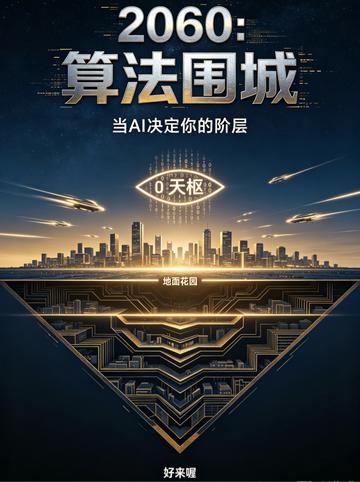
2060: Algorithm Siege
2060:算法围城
- Status
- Completed
- Length
- 467k Words
- Genre
- Urban
- Subgenre
- Urban Everyday
- Updated
- 4mo ago
- Source
- Fanqie
Stats
Tags
Synopsis
More by this author
 Others Just Farm, but You’ve Got Cheats
 The Anti-Fraud Auditor: Exposing Every Money Scam
 Dawn over Pengcheng: The 2026 Comeback Frenzy of Young Drifters
 Reborn in 1982: A Hong Kong University Whiz Rules Hong Kong Island
 The Tale of the Waking Stone
 Reborn in the 1970S: I Kick My Scumbag Ex to the Curb and Become an Educated Youth
 A Northeastern Girl Shakes Up Beijing's Elite Circle
 That Cotton Candy
 A Lone City Guarding the Realm
 The Princess Who Reads Fortunes
In booklists 20


Looking for a Good, Unpretentious Copycat Author Story!
Looking for books similar to "Fans Report Me! I Can No Longer Hide My Identity as a Composer."

I've Read 4,000 Books, and Every One Was Complete! Who Can Top That?

Urban Slice-of-Life, Realistic and Immersive, with Vivid, Believable Writing
No transmigration, cultivation, fantasy, or whatever else. I want something real: grounded in everyday life, with sincere emotions that resonate.



Books Just for Older Readers
Looking for books similar to *Nine-Tenths Foolish*.
Hard Sci-Fi with Rigorous Scientific Logic! Harder Than The Three-Body Problem!
Looking for books like Quantum Fossils. Sci-fi, not fantasy! Make it realistic!
Looking for Science and Technology Novels: The Protagonist’s Brain Is Enhanced, They Do Their Own Research, and There’s No Harem




High-quality Novels with Real Depth
The kind of book that makes you want to read it a second time as soon as you finish it.





There's Not a Single Good Tycoon Novel. Disagree? Prove Me Wrong

A Powerful, Low-Key Protagonist with a High IQ
A brilliant, incredibly capable protagonist who keeps a low profile and knows how to lie low, so even their subordinates don’t know how powerful they are.


Any Slice-of-Life Urban Stories With Daily Sign-Ins That Feel Grounded and Aren't Brain-Dead?
I want the protagonist to build up gradually, not start out with billions or tens or hundreds of billions.
Looking for a Logic-Driven Novel with a Highly Intelligent Protagonist. Nothing with Clunky Plotting, and Preferably Some Romance.
No rebirth, no transmigration into a book, no Mary Sue, no entertainment-industry stories, and no quick transmigration. Fantasy or modern settings are fine. I’d like something imaginative with a touch of horror. (Please forgive my picky taste.)

Looking for Tech Fiction About Real-World Industries, Machinery, and Electronics
No mindless stories. The author should know at least a little and do some research, instead of just making things up. Please don’t recommend stupid stories that start with things like photolithography machines and artificial intelligence 😥.
A Sci-Fi Masterpiece with Original Theories That Make You Think
Looking for books similar to The Three-Body Problem Trilogy (Complete Edition).


Urban: High-IQ Protagonist
A high-IQ protagonist who seems to have everything under control. Hint: high IQ.
Sci-Fi with Hackers, Supercomputers, and AI, but No Protagonist Starting a Company
Looking for Sci-Fi Novels About Artificial Intelligence
Ideally, the protagonist creates their own artificial intelligence.

Technology Novels Rated 9 or Higher
Novels About Computer and Hacking Techniques
I'm looking for a novel that can introduce beginners to the core principles of computer technology. Something like Reborn: I'm the Stock God, with a fictional storyline but plenty of solid, useful information too.

Any Apocalypse Novels You Can Read Without Turning Off Your Brain?
Please, no more ridiculous scenes like a Tianqi beating up an 99A, a V3 firing 18 rounds per second, a mattress stopping a heavy machine gun, or a Kevlar superhero tanking a 30 mm cannon shell.


Any Completely Imaginary Otherworlds That Don’t Follow the Rules of the Real World?
Looking for books like *Hey, What a Wonderful World!* I like lighthearted, funny stories that are pure fantasy. I don't want ones that borrow from real life, since we already know all that stuff. It just feels boring.
Reader comments 1
Google Translate
When an algorithm determines your class, how can an ordinary person move an entire city? After reading the first two volumes of "2060: Algorithm Siege", the deepest feeling is not "I dare to think about science fiction", but "This seems to happen tomorrow". The most powerful thing about this book is that it turns the technical-sounding topic of "algorithmic discrimination" into a pain that everyone can feel. The cleaner's application for referral was rejected, always citing "insufficient priority"; a poor student ranked third in the class, but was turned away from a key high school because of insufficient computing power. This is not the distant future, this is what we are worried about every day - education involution, difficulty in medical treatment, and class consolidation. The author just pushed these anxieties forward thirty-four years, into a world governed by AI. The protagonist Lu Ze is not a superhero, has no golden finger, and does not even have the halo of the protagonist. He is just an ordinary operation and maintenance engineer. Because he discovered a line of code in the system that should not exist, he went from "acting according to the rules" to "questioning the rules." The most impressive thing about him is that he never feels that he is doing something great. He just sees people in the data who should not be ignored, and then chooses not to remain silent. In terms of rhythm, the first volume is high-energy from the discovery of anomalies to the acquisition of evidence, from being threatened to being forced to hide. The second volume is even more exciting, with reports, interceptions, re-collection of evidence, witnesses defecting, public opinion erupting, and official intervention - every step is based on the readers' expectations. In particular, the process of the three witnesses Fang Yuan, Ding Yi, and Gu Min from being concerned to agreeing to come forward is written delicately and powerfully. The most touching thing is that the underlying theme of this book is not despair, but hope. It is not a dystopia, but a "restoration of utopia." The nature of the Tianshu system is good, but it has been tampered with by a few people; the nature of society is fair, but there are bugs that need to be fixed. What Lu Ze does is not to overthrow the system, but to help the system regain its original intention. If you care about real-life issues such as educational equity, medical resource allocation, and class mobility, this book will resonate strongly with you. If you want to see how an ordinary person can leverage an entire city, this book will not disappoint you. 2060 Is not far away, but I hope it can really be like what is written in the book.