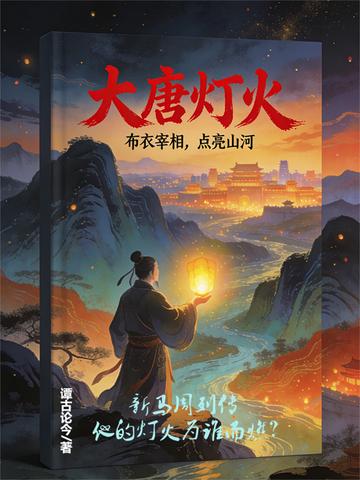
The Lights of the Tang Dynasty
大唐灯火
- Status
- Completed
- Length
- 568k Words
- Genre
- Historical
- Subgenre
- Historical & Ancient
- Updated
- 7mo ago
- Source
- Fanqie
Stats
260Chapters
1Reads
7.7Score
1.8kReads · all time
Tags
Synopsis
More by this author
 The First Street Lamp in the Republic of China Electrocuted One of Our Own People
 Electromagnetic Penetration of Kingship
 Good Night Emoticon for Grandpa
 "Guestbook" in a Used Bookstore
 The "Revenge" of Corgi Briquettes
 Virtual Lovers Feed Me: My Reality Is Cheating
 Transmigrated as a Stray Cat, I Was Adopted by a Movie Emperor and Became an Overnight Sensation
 The Year Beast Isn’t Fierce. My Name Is Nian: A Five-Thousand-Year History of Spring Festival
In booklists 7

Looking for New Books to Swap Reviews On
I want to read books like *Six Paths Martial Saint*. Let’s review each other’s new books, fellow readers! One person gives you five stars, but what about a thousand? Come on over!
1.3kBooks888.9kViews1dUpdated

Spy and Counterspy Novels
That kind.
298Books26.5MViews1dUpdated
Top-Tier Reads for the Deeply Picky: No Masterpieces, No Entry
1.8kBooks298.4MViews1dUpdated

Any Books by New Authors? Let's Review Each Other's Books, Give Five Stars, and Add Them to Our Shelves
Looking for books like *The Cannon Fodder Characters' Beloved Little Princess*. Something like *The Fool's Reversal* or with a cover like Yuan Dazhuang's. They're so cute.
1.3kBooks1.9MViews2dUpdated


Looking for Tutor-Type Stories, Preferably with No Romance
Looking for content like *[Bungou Stray Dogs, Katekyo Hitman Reborn] Return*. It's about Katekyo Hitman Reborn.
745Books17.6MViews3dUpdated

Changsun Wugou as the Female Lead
Stories like those about Empress Zhangsun Wugou.
194Books27.4MViews10dUpdated

What Are Some Good Reads on the New Releases Chart?
Looking for something like *At the Divorce Banquet, One Phone Call of Mine Shook Three Provinces*. First, here’s a political drama that ranks at the top of the career-in-politics genre.
27Books5.9kViews8moUpdated
Reader comments 59
Google Translate
When the modern soul collides with the elegance of Zhenguan, "Lights of the Tang Dynasty" uses the double time-travel setting of Zhang Jianye and Ma Zhou to light up a passionate and tender counterattack in the prosperous Tang Dynasty! Unlike the lonely brave people who traveled through time alone, the encounter between the two was like sparks igniting each other, causing amazing flowers to bloom in the dust of history. One is transparent and courageous with a modern perspective, and the other carries the ideals and sharp thoughts of managing the world and benefiting the people. They step on the drumbeat of Zhenguan, from the fireworks in the market to the storm in the court, use advanced cognition to dismantle the dilemma of the times, and use tacit cooperation to write the legend of counterattack. There is no brainless cheating with golden fingers, only the complementary wisdom and side-by-side trust of the two people. In the turbulent situation of the Tang Dynasty, they not only protect the morality in the heart, but also add the unique "stranger" color to the prosperous age. The book has both the rich texture of historical details and the interesting interactions of double-crossed partners. Every plan and every game is enjoyable to watch. When Zhang Jianye's pragmatism collides with Ma Zhou's strategy, and when modern thinking blends with the style of the prosperous Tang Dynasty, this "light of the Tang Dynasty" that spans time and space not only illuminates the magnificence of history, but also warms the original intention of small people to support each other and pursue the light in troubled times. It's so exciting to read it! Still reading, keep paying attention
The historical warmth illuminated by a solitary lamp is not only a time-travel novel, but also an affectionate inquiry into why Ma Zhou became Ma Zhou. With rare patience, the author allows a modern soul to huddle, tremble, and ignite in the cold night of the early Tang Dynasty. There is no golden finger eager to change the world, only the repeated tracing of water conservancy drawings under a solitary lamp. This awe of the historical process and empathy for individual struggles make the process of Zhang Jiye becoming Ma Zhou more shocking than any magnificent court drama. What it illuminates is the true body temperature of an idealist in the folds of history
The Other Side of the Tang Dynasty: How "Lamp" Polished a Forgotten Bronze Mirror in the Flood of Internet Articles Among the vast library of Tomato literature, the title "Lights of the Tang Dynasty" is not surprising at first glance, and is even a bit unusual. It does not have the straightforward power of "god of war" or "supreme", nor does it have the temptation of "sweet pet" or "counterattack". It is like a glimmer of light that will easily be drowned in the bright fireworks of the torrent of data. However, when you follow this glimmer of light and step into it, you will find that what the author lit is not a reproduction of a magnificent era, but a warm and true light that can illuminate the folds of the prosperous age and the dark corners of human nature. Of course, this work is not flawless. Some of the textual research may still have room for discussion, and the conclusion of some subplots is a little hasty. However, these minor flaws cannot conceal its unique luster as an excellent historical online text. It does not provide a "daydream" to escape reality, but invites us to have a deep "historical empathy"; it does not sell cheap historical vanity, but triggers our continuous thinking about the destiny of civilization, society and individuals. All in all, "The Lights of the Tang Dynasty" is a breath of fresh air on the Tomato literature platform, and it is also a polished bronze mirror. The Tang Dynasty it reflects has lost the excessively magnificent oil paint applied by later generations, revealing its complex texture of intertwined warmth and coldness, coexistence of glory and suffering. For readers who are tired of reading "Invincible Starts" and "Sweet Pets with Sugar" and are eager to touch the real body temperature and weight of history in the text, this "Light of the Tang Dynasty" swaying in the torrent of data is worth your time to stop and watch, and let its light also illuminate a neglected corner of your heart. It may not make your blood pump all the time, but the long aftertaste of warmth and desolation will definitely linger for a long time. Today, with the explosion of historical online articles, "Lights of the Tang Dynasty" is like a strange color, blooming quietly on the Tomato Literature platform. Tan Gu Lunjin's description of the prosperous Tang Dynasty did not choose the usual path of grand narrative, but took a different path. The most touching thing about this work is precisely that it elevates the image of "lights" from the background to the foreground, allowing history to move from the heights of temples to the depths of the marketplace. Seeing the prosperous times through glimmers of light: the civilian turn in writing history The title of "Lights of the Tang Dynasty" is a declaration. Different from the imperial perspective of "The Long Song of Zhenguan" or the Jianghu legend of "The Legend of Two Dragons of the Tang Dynasty", Tan Gu Lun Jin chose a more plain entry point: lights. "The Lights of the Tang Dynasty" is an anti-routine historical life novel. It does not rely on the time-travel setting to bring information disparity and excitement, but relies on its profound historical foundation, delicate literary touches and unique civilian perspective to light up a warm and real lamp for readers that can shine into the texture of daily life in the Tang Dynasty. If you are tired of the same cookie-cutter time-travel narratives and are eager to see a world of the Tang Dynasty that is simpler, more lively, and needs to be savored slowly, then this work will be a very rare and surprising choice.
It takes root in historical facts and blooms in fiction. The author's research on martial ethics and the political situation during the Zhenguan period is commendable. What is commendable is that the research is not to show off skills, but to fully serve the character creation. The historical label of Ma Zhou's aloofness in his youth is reasonably interpreted as a modern soul, a projection of depression under a rigid system, and his legendary history of prosperity is also endowed with local sentiments. This novel with a warm core completes the most reasonable ideal and enrichment of the spiritual world of a famous prime minister in the Tang Dynasty within a rigorous historical framework.
I am following this novel. The author is eloquent and has profound artistic skills. It is not an ordinary Internet novel, but it allows me to see history, understand people's hearts, and enrich my knowledge. What I most recognize is the logic of this book, which is especially suitable for quiet reading. When the power company swept away the poor households in the Tang Dynasty, what was it like to experience late-stage occupational diseases? ——When I saw an old water tanker, I wanted to write a "Notice on Rectification of Potential Safety Hazards." When facing the dirt road, I started to brainstorm the "Implementation Plan for Hardened Roads in Every Village." I even had to study the "Compendium of Materia Medica" QC quality team to eat wild vegetables. Others relied on poems to cheat during time travel, but this old man just turned Zhenguan Village into the "Datang Infrastructure Headquarters" and used KPI thinking to defeat the ancient subordinate officials. Suggested book titles with subtitles: "About my years as chief engineer in the Tang Dynasty", "Leader, this project really lacks an excavator" 👍 Warm reminder: After reading this, you will be in awe when you look at the distribution box in your own community.
When the modern soul knocks on the door of the prosperous Tang Dynasty "This is not a time travel, but a pilgrimage to return to your hometown." "The Lights of the Tang Dynasty" tells the story of Zhang Jiye, the leader of the power grid, who accidentally traveled through time and became Ma Zhou, a famous official in Zhenguan, but started from the humblest place and finally changed the times by blending modern wisdom with ancient wisdom. The most touching thing about it is not the refreshing feeling of "dimensionality reduction attack", but the profound narrative of how a modern man finds his place in the grand history. The highlight of this story is that "local sentiment" illuminates the cold power of politics: among many historical articles focusing on the power of temples, the core of this book is extremely warm. The protagonist's nostalgia for "Chiping" that transcends time and space is the starting point and destination of all his struggles. Building water conservancy and developing education, these seemingly ordinary measures have become as important as the deep feeling of "this place where I feel at ease is my hometown". This made his "contribution" out of the utilitarian level and sublimated it into a concrete love for a land and its people. The overall feeling is that this is more than just a historical time travel novel. It is a profound discussion about "hometown" and "destination", and a wonderful demonstration of the dialectical integration of modern technology and ancient wisdom. The author uses calm and delicate writing to make us believe that it is really possible for a modern soul to go through the Zhenguan years in this way, and leave his own warm breath in the words of history books. If you are tired of the exaggerated time-travel farce and long to see how a soul with weight, warmth, and wisdom walked out a legend down-to-earth in the glorious Tang Dynasty, then this book will be your best choice. It is dedicated to all readers who believe that wisdom and affection are enough to travel through time and space. A lamp illuminates the prosperous Tang Dynasty, and half of the book travels back and forth to write about the human world - Thoughts after reading "Lights of the Tang Dynasty" When the wave of time travel sweeps across the field of historical literature, "Lights of the Tang Dynasty" breaks out of the cliché of "gold fingers clear the way and cheats all the way" and uses a warm and tenacious light to illuminate the fireworks world and the stormy world of the prosperous Tang Dynasty. The protagonist falls into the Zhenguan era with a modern soul. He does not have the superpower to control the wind and rain, but only has a delicate and down-to-earth sobriety that can see people's hearts. From making a living in the market to playing games in the court, every step he takes is solid and hot. The most moving thing about the novel is the balanced description of the character of the prosperous Tang Dynasty and the fireworks of the world. The protagonist's calculations when struggling to make a living, the warmth of getting along with neighbors, and the struggle when facing difficulties make the time traveler no longer a suspended "spectator", but a "participant" that is truly rooted in the times. This exquisite study of historical details and depiction of the quality of life make the Tang Dynasty no longer a cold background, but a living world with warmth and breathing. What's even more rare is the protagonist's growth line and the transmission of values. He did not rush to subvert the times, but used modern thinking as his edge, and on the premise of respecting historical logic, he promoted changes in subtle ways: improving agricultural tools to benefit his neighbors, optimizing skills to improve people's livelihood, and using reason and empathy to resolve conflicts. This kind of change of "no slowness, no slowness, no noise" is far more convincing than "one-time change". It also makes "feelings for family and country" no longer an empty slogan, but is implemented in every little thing that "makes people live a better life." The supporting characters in the book also have their own brilliance. They all break away from the flat tool-person setting and have their own persistence and choices, which makes the group portraits of the story particularly exciting. The rhythm of the plot is relaxed and moderate. It contains the fun of life in the market, the shocking plot of the court, and the passion for the righteousness of the family and the country. The author's writing is simple and powerful. He does not deliberately pile up rhetoric, but he can see the truth in the plain and hide the deep meaning in the details. Reading "Lights of the Tang Dynasty", it feels like you have really followed the protagonist into the inclusive and prosperous Tang Dynasty, watching the lights rising in the alleys and eventually becoming a prairie fire, illuminating the hope and warmth of an era. For readers who like historical time travel novels, this is not only a masterpiece that brings both excitement and tears, but also an immersive journey into the prosperous Tang Dynasty - it allows us to see that the most moving time travel is never about changing history, but about living your own wonderful life in a strange era with modern goodwill and wisdom, and also warming others.
The author not only restores the customs and humanities of the Tang Dynasty, but also does not have the sense of suspension caused by the "golden finger" of the time traveler. From improving people's livelihood to offering advice to the court, the two used modern thinking to collide with the order of the feudal dynasty, and every confrontation was full of tension. The book contains both the surging feelings of family and country, as well as the warmth of urban life, making the thousand-year-old Tang Dynasty vivid and tangible under the light of lights. You can't stop reading it!
A project delivery that spans thousands of years. This novel can be called a costume version of The Craftsman of a Great Country. The protagonist seamlessly transfers the system thinking, risk assessment and project management experience of power grid management to the water conservancy and water transportation projects of the Tang Dynasty. It reads with both familiar professional intimacy and flashes of wisdom that transcend time and space. It vividly explains that the real core technology is the thinking mode of solving problems. Watching infrastructure projects being pushed forward with difficulty amidst debates over resource constraints in court is like witnessing a rigorous millennium delivery, which gives me a full sense of accomplishment.
The pen is the light, the ink is the galaxy: On the alchemy of writing in "The Lights of the Tang Dynasty" At a time when online writing pursues "fast pace" and literature pursues "deep thought", reading a work like this is a long-lost luxury. It makes people believe that in the realm of historical novels, true "good writing" is far from a pile of words, but an alchemy that melts thoughts, emotions and historical dust into sensible light and shadow. With his exquisite writing power, the author illuminates for us a picture scroll of the Tang Dynasty that is not static, but allows readers to step into it, feel the wind, touch the frost, and witness how a lamp burns into a galaxy. The writing style of this work is a comprehensive and highly conscious literary one. It has the skeleton of history, the flesh and blood of poetics, the nerves of philosophy and the context of engineering. It is not satisfied with telling a story of "success in ancient times", but insists on asking: how a modern, lonely individual with technical rationality and humanistic care can find meaning, place himself in a strange and grand era, and leave an eternal light. The author uses his pen as a lamp, which not only illuminates the world of the Tang Dynasty that he constructed, but also illuminates a possible path for the creation of historical novels with a calm and confident light - where literary, intellectual and storytelling can achieve such an elegant and powerful balance. This is not only good writing style, but also a manifestation of the realm of writing.
In terms of narrative structure, "Lights of the Tang Dynasty" shows exquisite ingenuity. The novel does not adopt the grand epic mode of linear advancement, but uses scattered perspective to weave a dense network of human relationships through a series of seemingly independent but interrelated stories. Each chapter is like an independent lantern, illuminating a forgotten corner; and when these lights converge, they outline the spiritual topography of the entire era. In particular, the image of "light" throughout the book is not only a concrete lighting tool, but also a metaphor for the transmission of knowledge, the retention of memory, and the immortality of hope. It is true that "Lights of the Tang Dynasty" is not a flawless white jade. The conclusion of some branch plots is a little hasty, and the balance between academic details and story rhythm of some historical scenes can be further polished. But the flaws do not hide the flaws. These minor shortcomings are insignificant in the face of the literary ambition and humanistic care displayed in the work as a whole. "Lights of the Tang Dynasty" provides readers with much more than just a recreational time. It is like a warm candle that has traveled through thousands of years. It not only illuminates the dusty faces in the historical corridor, but also reflects the confusion and longing of our own era. In this era of pursuit of speed and representation, it reminds us to slow down, listen to the whispers drowned by the noise, and cherish the light of individual life that still shines stubbornly outside the grand narrative. This work is not only a love letter to the Tang Dynasty, but also an invitation to all hearts looking for meaning and connection in the long river of time. The lights are on, waiting for you all.