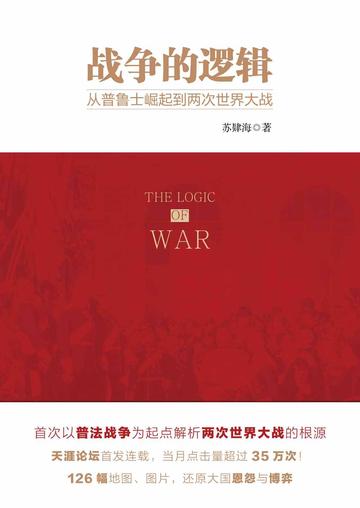
The Logic of War: From Prussia's Rise to the Two World Wars
战争的逻辑:从普鲁士崛起到两次世界大战
- Status
- Completed
- Length
- 375k Words
- Genre
- Historical
- Subgenre
- Unknown
- Updated
- 3y ago
- Source
- Fanqie
Stats
Tags
Synopsis
In booklists 40
Explore more →
Can You Write About the War of Resistance Without Making It Another Bright Sword?
Any War Stories? Looking for Something Detailed
The battles shouldn't be glossed over. The author should analyze them in detail, whether they're offensive or defensive, and describe how different troop types work together. Those things are secondary, though. Most importantly, the story should showcase the protagonist's or enemy's command skills, rather than having them win through brute force.



A Collection of Chinese and Foreign Classics
Just as the title says.
Looking for Pure War Stories Focused on Military Strategy and Tactics


My Five Favorite Historical Novels



The Kind of Hard Science Nobody Can Understand
I want hard science, I want hard science. The main thing is for the protagonist to lead the whole world toward technological prosperity.

Any Books About World War I or II? Europe, Germany, France, Britain, Italy, America, Austria, Russia, Hungary, Greece, Romania, and the Balkans
Looking for books similar to *Serbia's Counterattack*.


Historical Novels Set in Europe
Stories set in ancient or modern-era Europe, but not contemporary times. No characters getting dumber for the plot, and a solid grasp of history. European history, not Chinese historical fiction.



Any High-Quality Historical War Novels Like Shao Song?
Any Stories About European Politics and Wars? No Magic or Fantasy, Preferably Historical
Looking for books similar to *Welcome to 19th-Century Europe, Where Strength Reigns Supreme*.
Looking for New Novels About Germany: Prussia, the Second or Third Reich, or the Holy Roman Empire
I want new books! I've already read the older ones. I'm looking for something that won't go on hiatus and updates regularly.



Intrigue, Schemes, Political Maneuvering, High Intelligence, Master Plans, and Suspense





Looking for Books About Skills and Abilities
Looking for books similar to Microsoft Word, Excel, and PowerPoint: From Beginner to Expert. I want to learn some skills to make money. My wallet's a little thin, so I'd love recommendations for free books on learning practical skills. Anything goes, including crafts and handiwork, or...




Essential Reading for Chinese Language and Literature Majors
Any books that can genuinely help improve writing and communication skills?

Any Novels with Massive Armies Clashing in War?
Looking for High-Quality Historical War Novels
Historical Fiction Recommendations
I’m the history class representative. Are there any good books about history, historical literature, or real history?

Books Every Student Should Read: Essential for Surviving the Rat Race
Math, Chinese, English, chemistry, physics, biology, geography, history, classical poetry...



Books About Politics




Any Stories About the West, Ancient Greek Mythology, or France?
I've really been enjoying this kind of story lately: quick transmigration, transmigration, or even one where the protagonist was already part of that world. Help, help, help, help, help, help, help, help, help, help, help, help!

Books About Germany in World War II
Germany in World War I would be fine too. Let me see the glory of the German Empire.


Books for Late-Night Study Sessions

Straightforward Historical Military Fiction


Looking for History Books. Real History!!! No Unofficial Tales or Fiction!!
Looking for books similar to *From the Qin Dynasty to the End of the Qing Dynasty (Four-Volume Set)*. No novels, like stories about someone transmigrating into the past. I want real history!!! Please (●'◡'●)
Reader comments 52
Google Translate
It must be said that the author's insights and analysis are very unique. The writing also has dark humor. I hope that more people will read this book to systematically understand Europe since Prussia and increase their knowledge; at the same time, they can also see the cruelty of war and treat it rationally.
In this book I read: On the surface, the Ruhr crisis broke out because of Germany's reparations issue, but in essence it was the result of France's efforts to weaken Germany and maintain high pressure on Germany to contain its rise. As Britain became increasingly pro-German, the Treaty of Versailles did not fundamentally weaken Germany. "As long as the victors still have strength, the Germans must be forced to taste the bitter consequences of defeat. Poincaré is convinced that France's advantage is limited to a few years, so it must do its best to make use of these few years."
This book really opened my eyes. Is there logic in war? ? But after reading this book, I was deeply shocked. It turned out that there were many, many reasons behind these wars, which made the war inevitable. The author is really bold. Through a large amount of historical data, he discovered an extremely secret logical chain of war. All countries acted in their own national interests and promoted the outbreak of World War II. In fact, both the first and second wars originated from the contradiction between France and Germany.
The part from Prussia to World War I is very good, but the part involving the Soviet Union and World War II is terrible. First of all, there is a lot of material that has been completely accepted by the West to smear it, and many of the evaluations and analyzes are very doubtful. Secondly, it only talks about the Soviet Union's black material and does not talk about what the West, Britain and the United States did. I don't quite agree with the final conclusion of the book. But I completely agree with the conclusion that war is a struggle for interests. Although it does not rise to the level of class, he tells the first half of the historical game very well in this regard. Overall worth a look.
This book really opened my eyes. Is there logic in war? ? But after reading this book, I was deeply shocked. It turned out that there were many, many reasons behind these wars, which made the war inevitable. The author is really bold. Through a large amount of historical data, he discovered an extremely secret logical chain of war. All countries acted in their own national interests and promoted the outbreak of World War II. In fact, both the first and second wars originated from the contradiction between France and Germany.
I am very happy to see this kind of book on the Tomato list, and I hope there will be more such valuable books. By the way, I highly agree with the author's idea, because I had a similar idea a long time ago, but I couldn't write it out😂
The author writes well and is very knowledgeable, but I don't quite agree with the final war of technological annihilation. No matter how powerful the technology is, it still needs resources and materials. I don't think the earth's resources are unlimited. Whether a war can break out depends on people's needs.
This book is different from other history books I have read. Anyway, the most intuitive feeling is that I will not find it boring. This may be because the language of this book is relatively popular and humorous, and at the same time it can explain things clearly. Anyway, I like it very much.
The author's profound insights allowed me to understand the causes and processes of the world war at a deeper level. The author discusses each country separately, which is a bit like a biographical history book. It is clearly organized and coherent, making it easy to understand. This is a good book. The author is a sensible person. It is a blessing to read a book written by a sensible person.
The author's awareness of the problem is to trace the fundamental reasons for the outbreak of the two world wars in the 20th century. To this end, he drew on common practices in historical research, extended the timeline, and looked for how the factors that prompted the outbreak of the war sprouted and developed from earlier times. In this book, his core point is that the contradiction between France and Germany was the core contradiction of the two world wars. The resulting alignments and alliances between countries completed the division of power among military groups. The contest of comprehensive national power played a fundamental role in the success or failure of the war. This analytical framework is also more in line with the emphasis by some political scholars on the shaping of nation-states by military and war mobilization.